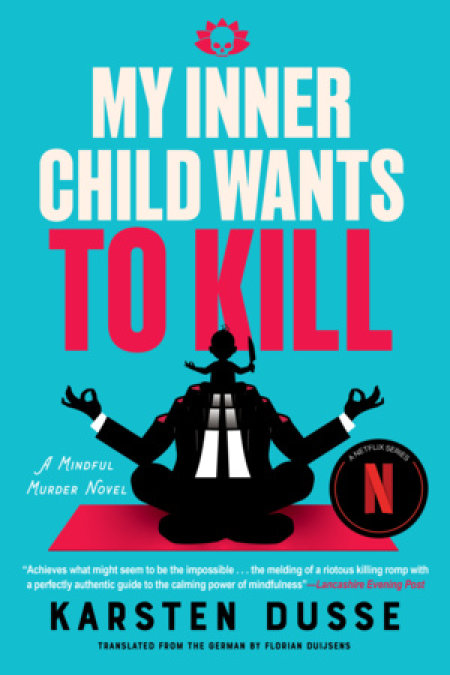
A shady lawyer puts the “meditate” in “premeditated” as he searches for inner peace with blood on his hands the darkly funny and shocking follow-up to Murder Mindfully, now an original series streaming on Netflix.
Björn Diemel, once an overworked defense lawyer for very nasty organized criminals, has mastered the principles of mindfulness, and he only had to kill a couple of people to pull it off. Now, running his own practice, spending more time with his daughter, and arguing less with his wife, he should be sitting pretty, but he keeps losing his cool—with deadly results.
Why can’t Björn just enjoy his new mindful life? Does it have something to do with the mafia boss he has locked up in the basement of his daughter’s preschool? Or is his wounded inner child to blame?
Over the course of one outrageous week, Björn and his inner child confront overzealous helicopter moms, hypocritical startup bros, and mysterious blackmailers as they race to solve all their problems at once before the criminal empire Björn has built for himself comes crumbling down.
Release date:
August 4, 2026
Publisher:
Soho Crime
Print pages:
448
* BingeBooks earns revenue from qualifying purchases as an Amazon Associate as well as from other retail partners.
Our soul is structured like a Russian doll. When something is rattling in the doll that is our adult soul, it is really the sound of the other, smaller doll inside it: our inner child’s wounded soul. —Joschka Breitner, Parenting Your Inner Child
There were two things wrong with my childhood: my mom and my dad. But I only realized this forty years later, when, pressured to do so by my wife, I first considered my inner child.
If I hadn’t already been sensitized to psychological issues through my very positive experiences with mindfulness, I probably would’ve thought the very notion of an inner child utter nonsense. Anything a gastroenterologist cannot discover during a thorough check-up simply isn’t inside us. Or so I used to think.
A year ago, I would’ve thought a book about the inner child was targeted at people who were expecting. One of those books that might provide a man with a great deal of information about what was going on inside his partner biologically but was useless when it came to elucidating his own inner life.
By now, I know that the psychological concept of the inner child has nothing whatsoever to do with preparing for childbirth. It only becomes relevant after you’ve exited the birth canal. And that holds true for any sex. According to the notion of the inner child as my mindfulness coach, Joschka Breitner, explains it, we are emotionally constructed like a Russian doll. When something’s rattling in the doll that is our adult soul, it’s really the sound of the other, smaller doll inside it: our inner child’s wounded soul.
It’s not us who stand in the way of our own happiness, but our inner child. It’s a part of us, along with all our childhood injuries. If we want the rattling to stop, we need to heal our inner child.
Taking my inner child into consideration turned out to be the ideal way for me to eliminate the causes of the problems whose consequences I had started to mitigate by practicing mindfulness.
In my childhood, there was no Siri or Alexa. The people who turned lights on and off, operated the stereo, and answered the stupidest questions incorrectly were called Mommy and Daddy. So, if anything got screwed up in my childhood, these two must be the culprits.
This explanation was reassuring in that it enabled me to comfortably blame my parents for my own marital problems, fear of the future, and general irritability, as well as several murders.
The fact that I only conceived my inner child at the age of forty-three was partly down to an unprotected argument with my estranged wife. Katharina always had a very effective approach to problems: The person responsible for solving her problems was always the one without whom she wouldn’t have them. This made me the one responsible for providing the protection when it came to conflicts in our dissolving marriage.
And that’s exactly what I’d unfortunately messed up on our last summer vacation together. Against her express wishes, I had gotten into an altercation with a waiter at an alpine hut. That alone was reason enough for her to demand that I seek therapeutic assistance for my constant mood swings. And this without her even knowing that, after a little retaliatory stunt on my part, the waiter had unfortunately died.
While still in the Alps, I made an appointment with my mindfulness coach for the week after we got back, like the good husband and father that I was. The fact that if I hadn’t, Katharina would’ve taken Emily and left was also fairly significant.
Completely independent of my wife’s sensitivities, however, I had long since realized that I needed to work on myself. Something inside of me kept stopping me from enjoying life. If worries were a liquid, I felt like my mindfulness practice might’ve helped calm the waves inside the barrel of my soul, yet it was still filled to the brim with anxiety. And sometimes, when a new worry came along, something still splashed over the edge, making me freak out about things other people would consider minor.
So far, my freak-outs had been mere trifles:
One night, I threw ice cubes at drunks shouting in the park across the street.
I gave clients who annoyed me bad legal advice.
I brought the prisoner in my basement his meal two hours late, just because.
Things basically anyone in the same situation would do if they were annoyed. And as long they didn’t get caught.
The fact that I let a waiter plunge into a ravine, however, is of a slightly different order.
I didn’t like this escalation.
And so, one rainy evening in early September, I found myself on Joschka Breitner’s doorstep again. A week after my vacation. Almost half a year after my last mindfulness coaching session.
Before I pressed the doorbell, I stood outside his door and took stock of how I felt. Over the last six months, a great deal had changed.
Back then, it had been spring. Summer was around the corner. Now it was autumn. Winter was on its way.
Back then, I had left Breitner’s practice in the daylight, newly energized. With my new insights, I was positively surfing the flow of a mindful lifestyle into the world blossoming outside.
Now, I’d been washed back by the tides of life. It was already dark, and the first yellowed leaves rustled under my feet.
By now, my life should’ve been completely happy. In the last six months, with a lot of love and mindfulness, I had transformed my professional and personal environment the way I’d always dreamed of:
I’d exchanged a crippling permanent position at a large law firm for a financially sound freelance position as a solo practitioner.
Katharina and I had re-routed the dead end of our tired and stressed-out marriage into the parallel life paths of co-parenting individuals.
Our daughter, Emily, enjoyed her hard-won spot at preschool and was a cheerful, confident member of Little Fish’s Nemo group.
I had not only my law office in the same beautiful old building as Little Fish, but my own apartment too. I managed the whole building for my main client—Dragan, the absent boss of a criminal syndicate.
All these changes had a lot to do with the fact that, half a year earlier, I’d killed Dragan. That no one knew about this was not entirely insignificant to my happiness. And to ensure no one would ever find out about it, I had no choice but to let his criminal consortium continue to operate under Dragan’s name. And pretend to his gang that their boss was still alive.
As a lawyer, this shouldn’t have been difficult. After all, I had hand-knitted the legal coverlets for Dragan’s drug, sex, and weapons trading, and, as a consultant, been the de facto CEO. This was the exact role I continued to play for everyone. Nothing more.
But a single screw-up, one more ill-considered freak-out, a set of critical outside eyes trained too closely on my life—and this whole web of lies I’d woven would collapse.
I had to make sure anything I did stayed under the radar of both the police and any gangsters. This made my accidentally killing a waiter rather counterproductive. Not just for my spiritual life, but for my life full stop.
What was wrong with my life was that I couldn’t put a foot wrong.
My present existence might have been nicer than my past, but I was tremendously afraid of the future.
This was stressful. Mindfulness helped keep things under control. But it couldn’t get rid of what was causing the stress. Mindfulness might’ve slowed my hamster wheel, but somehow I still couldn’t get off. That’s why I was here again, waiting outside Breitner’s door. Organizing my thoughts had brought a little clarity to the troubled particles of my soul. Still, I hesitated to ring the bell. For one, because I wasn’t quite sure how much I could even tell Breitner about my problems.
I’d certainly be able to tell him about how Katharina’s snippy remarks kept making it clear to me how fragile and unresolved our relationship actually was.
I could also tell him about my feelings of guilt toward Emily because Katharina and I had failed to save our marriage.
I wanted to talk about needing time for myself, outside of my family and my clients.
I could tell him about my little freak-outs, even if they were embarrassing.
I’d bring all those things up—and Breitner would be able to help me deal with all of it.
But I wouldn’t be able to talk about what weighed on me most.
I wouldn’t say a word about the murders I’d committed the previous spring.
I’d remain silent about the double life I’d led since.
And I certainly wouldn’t talk about Boris.
Boris, the Russian gangster I was holding captive in the preschool’s basement. Boris, the only person who wanted (and already knew enough) to burst the bubble of my perfect world.
Boris, whom I’d kidnapped six months earlier to save my life, and that of my daughter.
Boris, whom I didn’t want to kill because I was tired of killing. Who was my living proof that I could say no to murder. Yet whom I could also neither hold captive forever, nor ever release. Boris, for whose future I hadn’t yet been able to find a solution.
My prisoner would burden me as much dead as he now did alive.
I wouldn’t be able to talk about him.
So I wouldn’t tell Breitner everything. I’d pretend I was there for an entirely normal follow-up. As if, now that some time had passed, I just wanted us to take a look at what had transpired in my life since. Tighten a few screws. We’d have enough to talk about if I told him how my mind was turning mundane mini-mosquitoes into enormous emotional elephants. Which were now charging through the china shop of my otherwise untroubled soul. I’d openly admit that mindfulness exercises helped me to condense each and every one of these problems back to their core issue relatively quickly. But, after a brief spell of peace and satisfaction, the old familiar chill of anxiety and self-doubt would always set in.
I’d openly admit that, while I understood how mindfulness could help me come to grips with most of my problems, I had no idea why the same problems reared up again and again.
That was the part of the truth I needed to discuss. That’s why I was standing outside Breitner’s door. I rang the bell.
Inside, I could hear hinges squeak and wood slide over tiles. The hallway light went on, warmly illuminating the colorful frosted panes in the solid wooden door. Calm, unhurried footsteps came closer. Moments later, the door opened. In front of me stood Joschka Breitner, who greeted me as though I’d only walked out of this door two minutes ago.
“Mr. Diemel! Nice to have you back. Do come in.”
“Thank you for making the time.”
We shook hands. He stepped aside and let me go on ahead. I walked down the long hallway into his practice. Nothing had changed at this end. Two armchairs, one table, a bookshelf, and a side table with a glass teapot. Breitner was wearing the same casual clothes as always. Stonewashed jeans, plain cotton shirt, chunky wool cardigan. Felt slippers on his bare feet.
Yet he didn’t give the impression that time had passed him by; it was more like he was time, that it was the world that’d passed him by.
While I took off my jacket, Breitner studied me with interest.
“You look like a changed man,” he remarked, without judgment.
I looked down at myself. Six months ago, I’d been wearing bespoke suits and expensive accessories. Now I was wearing jeans, a T-shirt, a sweater, and sneakers.
“Yes . . .” I shrugged with a smile. It was reassuring to be able to start with positive changes. “I have less of a dress code now.”
But that wasn’t the change Breitner had noticed.
“I mean your eyes. The last time we saw each other, they were beaming. Now you have circles under your eyes,” he noted, with a caring kind of candor.
Caring candor can be brutal. I hadn’t even been in his office twenty seconds, but I already realized this wouldn’t be some fluffy follow-up. Instead, it’d be an arduous confrontation with myself. Breitner had obviously already known this when I set up the appointment. After all, that was his job. He pointed to one of the comfortable tubular chrome chairs covered in corduroy. I hung my jacket over the backrest and sat down while Breitner poured me some green tea. My silence after his observation was confirmation enough.
“We have not seen each other in a long time,” he said. “What has been going on?”
As I took a sip of the lukewarm tea, I considered my response. I had murdered four people, blackmailed my former employers, forced the former operators of the preschool to sell their shares so that my daughter could get a spot, and I’d kidnapped a Russian gangster. None of these were appropriate topics. And I could hardly share the fact that, while I was on vacation, a waiter had broken his neck because of me.
“I’ve taken a new career path. I quit the firm and am now a freelancer. My daughter is in preschool, and we went on vacation,” I stalled instead.
“First of all, I would like to congratulate you on your career decision.” Breitner knew how much the daily grind of a large law firm had gotten me down. “That explains your new outfit. But why the sadness around your eyes?”
I said nothing. I wanted to but couldn’t. Instead, I felt the sadness around my eyes liquify. The question alone overwhelmed me. When was the last time someone noticed I was sad? Without also being the reason for my sadness? It took me two breaths to steady myself.
We hope you are enjoying the book so far. To continue reading...

 Please log in to recommend or discuss...
