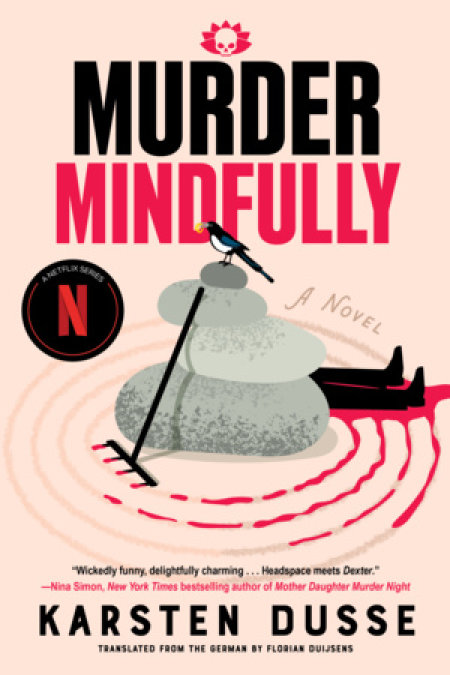
In this zen and zany crime debut, a shady lawyer transforms his life through mindfulness—and uses his newfound techniques to kill his way to the top. Original series now streaming on Netflix.
Criminal defense lawyer Björn Diemel has been given an ultimatum: repair his work-life balance, or his wife will leave him—and take their daughter.
He reluctantly starts a mindfulness course, and to his surprise, it’s a revelation. He becomes calmer, happier, and more focused as he starts to understand what’s really important in life. When his worst client, brutal crime boss Dragan Sergowicz, tries to interfere with his precious family time, Björn discovers that even murder can be a mindfulness exercise to protect his peace.
Release date:
April 14, 2026
Publisher:
Soho Crime
Print pages:
416
* BingeBooks earns revenue from qualifying purchases as an Amazon Associate as well as from other retail partners.
First off, I’m not a violent man. Quite the opposite. For example, I’ve never once in my life gotten into a fight. And I didn’t even kill anyone until I was forty-two. Which, looking around my current professional environment, seems rather late—though, true, the week after that I did bump off almost half a dozen.
That doesn’t sound great, I know, but anything I did, I did with the best of intentions. A logical result of my commitment to becoming more mindful. To harmonize my work and my family life.
My first encounter with mindfulness was actually very stressful. My wife, Katharina, tried to force me to relax. To improve my resilience, my unreliability, my twisted values. To give our marriage one more chance.
She said she wanted that well-balanced man back she’d fallen in love with ten years earlier, that young man full of ideals and aspirations. Had I responded I would also like her to have the body back that I fell for ten years earlier, our marriage would’ve been over and done with. And rightly so. Obviously, time should be allowed to leave its marks on a woman’s body, but apparently not on a man’s soul. And that’s why my wife’s body was spared a plastic surgeon whereas my soul was sent off to mindfulness training.
Back then, I thought mindfulness was just a different cup of the same esoteric tea that’s warmed over and repackaged under a new buzzword every decade or so. Mindfulness was just autogenic training without lying down. Yoga without contorting yourself. Meditation without sitting cross-legged. Or, as the article in Manager magazine my wife once demonstratively placed on the breakfast table put it: “Mindfulness means taking in each moment with love and without judgment.” A definition that made as little sense to me then as those pebbles on the beach pointlessly stacked by people so de-stressed they’ve become entirely detached from reality.
Would I have even participated in this mindfulness racket if it’d only been about the two of us, my wife and I? Not sure. But we have a little girl, Emily, and for her I would hitchhike from Sodom to Gomorrah if it meant our family would have a future.
She’s the real reason why, one Thursday night in January, I had my first appointment with a mindfulness coach. I was already twenty-five minutes late when I rang the bell outside the heavy wooden door of his “mindfulness studio” to discuss, among other matters, my time-management issues.
The coach rented the ground floor of a lavishly renovated old building in a fancier part of town. I’d spotted his flyer in the wellness area of a five-star hotel and seen his fees online. Someone who charges an arm and a leg to teach people to be more relaxed could probably meditate away any annoyance at a paying client’s lack of punctuality—at least, that’s what I thought. But when I rang the bell, nothing happened.
Until this relaxation guru refused to open the door, I’d actually been quite relaxed, because my delay was entirely excusable. I was a lawyer—criminal law—and had managed to squeeze in a remand hearing just before. An employee of my main client, Dragan Sergowicz, had found himself in a jewelry shop that afternoon wishing to pick out an engagement ring. Instead of money, however, he only had a loaded pistol on him. And when he didn’t like the rings that were presented to him, he smacked the jeweler in the temple with his gun. Since the jeweler had already triggered the silent alarm by then, the police arrived to find the jeweler on the ground, and the armed man offered no resistance when faced with the police’s two submachine guns. After they took him to the police station, they informed both me and the district judge.
If I’d retained the ideals I had as a law student, I’d have found it completely justified for such an utter lowlife to remain in pre-trial detention until the court hearing and then be tossed in the slammer for a few years.
With my years of experience as a criminal defense lawyer who specialized in utter lowlifes, however, I managed to free the idiot in under two hours.
So it wasn’t like I was running late to my coaching appointment; I’d basically been running a victory lap. And if this relaxation flake didn’t waste the remainder of our time being petulant, I could tell him why I’d been so victorious.
The man with a penchant for shopping while carrying was twenty-five and still lived with his parents. His criminal record didn’t have any violent offences, only drug-related ones. There was no danger of flight, repeat offence, or suppressing evidence. Plus, I’d argued, he shared the common social values of marriage and family—after all, that’s why he’d been in the jewelry shop: By purloining an engagement ring, he was expressing his readiness to form a strong marital bond.
All right, for the jeweler in hospital and the cops on patrol, it must certainly have been difficult to understand that someone who was undoubtedly a violent offender was released to preen and mock the authorities to his friends that same night. When it came to things like this, even my wife occasionally found my work rather questionable. But explaining our legal system to other people wasn’t my job. My job was to exploit that system using every trick in the book. I made my money doing good for bad people. That’s it. And I’d mastered it perfectly. I was an excellent criminal defense lawyer, employed by one of the most prestigious corporate law firms in the city, ready and available around the clock.
It was stressful, of course it was. And not always compatible with my family responsibilities. That’s why I found myself at the door of this mindfulness guy, who wouldn’t let me in . . . My neck started to tense up.
But I got a lot in exchange for all that stress: a company car, bespoke suits, expensive watches. I’d never cared much about status symbols before, but once you’re a lawyer representing organized crime, status symbols start to matter. If only because, as a lawyer, you become a status symbol for your client.
So I got a large office, a designer desk, and five figures a month to bring home to my family: my delightful daughter, my wonderful wife, and me.
Sure—a high four-digit slice of that salary went to paying off our house. A home for my delightful daughter, whom I never saw because I was always working, and for her loving mother, with whom, when I did see her, I only ever seemed to argue. Me because I was irritated by my work, which I couldn’t tell my wife about because she hated it; and her because she had to take care of our little girl alone all day—and had given up her own serious job as department head at an insurance company to do so. If our love was a delicate plant, we’d obviously been careless when we moved it up into a family-sized pot. In short, we were like so many successful young couples—going to shit.
In order to reconcile work and family, and because I was the only one of us who had both, my wife had decided I was the one of us who needed to work on themselves. She’d sent me to this mindfulness coach, a moron who wouldn’t open the door. My neck was really tensing up now, quietly crackling with every shake of my head.
I rang the doorbell next to the heavy wooden door for the second time. The lacquer seemed to be fresh, or at least that’s what it smelled like.
It finally opened, revealing a man standing there as though he’d been lurking the whole time, just waiting for that second ring. He was a few years older than me, in his early fifties.
“Our appointment was for eight o’clock,” he stated, then turned and walked down the bare hallway without another word.
I followed him into an indirectly lit, sparsely furnished office.
The man looked ascetic, not an ounce of fat on his sinewy body. The type of guy who essentially wouldn’t gain a pound even if you subcutaneously injected him with an entire cream cake. He looked well groomed, wearing stonewashed jeans, a chunky wool cardigan over a plain white cotton shirt, and slippers on his otherwise bare feet. No watch. No bling.
The contrast couldn’t have been greater. I was wearing my dark-blue bespoke suit, white shirt with cufflinks, a silvery-blue tie with diamond-studded tie pin, Breitling watch, wedding ring, black socks, Budapest brogues. Even just my accessories outnumbered the furniture in his practice. Two armchairs, one table. A bookshelf and a side table for drinks.
“Yes, sorry. Got stuck in traffic.” After his non-greeting, I already had half a mind to turn around and leave. My wife could complain about me being late free of charge. But if Katharina found out that not only had I been late to my mindfulness course, but I’d also left in a tizzy, the resulting argument would cause enough stress to require two additional relaxation coaches. “I had a sudden remand hearing come up. Aggravated robbery, so I couldn’t just . . .” Why did I have to be the one talking? He was the host, shouldn’t he at least offer me a seat, or say something else? But the guy was just looking at me—almost like my daughter studying a beetle in the forest. Whereas beetles instinctively freeze when they find themselves observed by an unfamiliar species, I reflexively started to chatter.
“Maybe we can just speed things up . . . for the same fee,” I offered, trying to start afresh after our botched beginning.
“A road doesn’t get any shorter when you run,” was his response.
I’d read more meaningful slogans on my secretaries’ coffee mugs. And this one wasn’t even offset by a good cup of coffee. This did not bode well.
“Have a seat, won’t you? Can I offer you some tea?”
Finally. I sat down in one of the armchairs. It looked like it had once won a design award back in the antediluvian 1970s and essentially consisted of a single chrome tube, over which was suspended a coarse brown corduroy cushion—astoundingly comfortable, it turned out.
“Do you have espresso as well?”
“Green tea okay?” Ignoring my question, the coach was already pouring me a cup from a glass teapot. Its milky glass showed it had been in daily use for years. “There you go, room temp.”
I started, “Well, to be honest, I don’t know if this is the right place for me . . .” I clung tightly to my teacup, hoping he would interrupt me, but he didn’t. My words stammered to a sudden stop, met with the coach’s open expression.
After it became clear I wouldn’t finish my sentence, he took a first sip of his tea. “I’ve only known you for thirty minutes, but I think you could learn a lot about yourself here.”
“You haven’t known me for thirty minutes, though,” I remarked astutely. “I’ve only been here for three.”
Annoyingly placid, the coach replied: “You could have been here for thirty minutes. Obviously, you spent the first twenty-five or so minutes doing something completely different. Then you stood outside the door for three minutes wondering whether to ring the doorbell a second time. Correct?”
“Uh . . .”
“After you finally decided to ring again, the three minutes you’ve spent here so far have shown me that you do not consider the rare appointment focusing solely on you to be very important, that you exclusively let your priorities be set by external circumstances, that you think you have to justify yourself to a complete stranger, that you cannot stand silence, that you cannot intuitively grasp any situation that deviates from the usual and that you are completely trapped by your habits. How does that make you feel?”
Wow, the dude was right.
I blurted out, “If those are also the exact same reasons you don’t want to have sex with me, then I’d feel right at home!”
Choking on his green tea, the coach started to cough and then burst into hearty laughter. Once he’d finished, he held out his hand. “Joschka Breitner, nice to have you here.”
“Björn Diemel, good to meet you.”
The ice was broken.
“So why are you here?” Breitner asked.
I thought about it. I could think of a thousand reasons, and then not a single one. I felt I should probably display a certain degree of openness towards a mindfulness coach. After his burst of laughter, I also found him quite congenial. But I was far from ready to start sharing intimate details from my private life.
Breitner noticed my hesitation. “Just tell me five things that are related to you being here.”
I took a deep breath, then launched right in. “There aren’t enough hours in a day, I can’t switch off, I’m high strung, stressed out, my wife annoys me, I never see my daughter and I miss her. When I can spend time with her, my mind is always elsewhere. My wife does not appreciate my job, my job does not appreciate me—”
“You’ve lost count.”
“Excuse me?”
“Nine of these five things are classic symptoms of work-related stress. Can you describe a few situations when you feel this way?”
I didn’t need long to remember when I had last felt overwhelmed, so I simply described my fraught experience just outside his door, taking him on my entire mental roller coaster ride.
He nodded. “As I said earlier, I think learning mindfulness techniques will prove helpful for you.”
“Great, let’s go!”
We hope you are enjoying the book so far. To continue reading...

 Please log in to recommend or discuss...
