*A royally twisted murder mystery written in collaboration with Historic Royal Palaces*
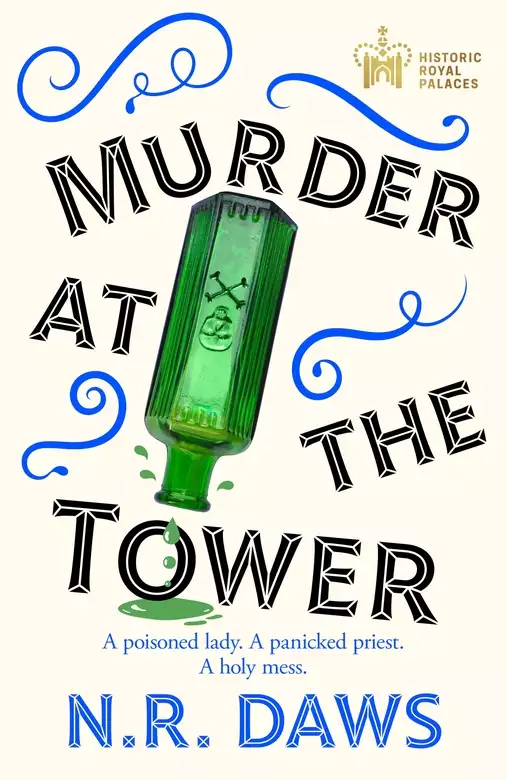
An excitable and clumsy Reverend Weaver is leading a church service at the Tower of London. It's meant to be a special honour, but when one of the ladies in the congregation drops dead from poison, the Reverend finds himself under arrest as the number one suspect. After all, the murdered lady in question was trying to have him fired . . .
When Palace Housekeeper, Mrs Bramble, hears about the Reverend's conundrum, she journeys from the safety of Hampton Court Palace to investigate. How could she not, when the Reverend is a dear friend, and she has a knack for solving the murders of distinguished ladies?
Arriving at the Tower, Mrs Bramble finds evidence of bitter feuds between families and secret trysts that lengthen the list of suspects. Will she be able to find the killer before they strike again and free her friend? Or will the holy man have to pay for this unholy crime?
In this witty, mind-boggling murder mystery, join Mrs Bramble as she races against the clock to get to the bottom of a royally twisted murder!
*** Readers love N.R. Daws:
'Love, Love, Love! I absolutely devoured this book... The ultimate locked room mystery' READER REVIEW ⭐⭐⭐⭐⭐
'A refreshingly fun, different and exciting read!... I could do nothing else but laugh at the final line! I really hope this gets a sequel of sorts so we can see what happens next; I was highly entertained reading this.' ⭐⭐⭐⭐⭐
'Great historical mystery. I didn't figure it out . . . doesn't get dull. Great writing. I will definitely look for more by this new to me author. Would recommend.' ⭐⭐⭐⭐⭐
'This was a really well done mystery novel . . .Had that element that I was looking for... Can't wait to read more from N. R. Daws.' ⭐⭐⭐⭐⭐
'I am on a cozy kick, and this is as good as a cozy afficionado can hope for. I didn't guess the ending but the clues were pertinent and the mystery was well fleshed out. Will definitely read more by this author!' ⭐⭐⭐⭐⭐
Release date:
March 12, 2026
Publisher:
Orion
Print pages:
400
* BingeBooks earns revenue from qualifying purchases as an Amazon Associate as well as from other retail partners.
The vestry door eased open a crack and one eye peeked through. As it spied on the seated congregation its gaze alighted on Mrs Fry and her husband. She stared back, fancying she saw it widen in alarm, and smiled to herself as it blinked rapidly and disappeared.
‘Did you see that?’ She nudged her husband until he glanced at her. ‘That Reverend Weaver may be from Hampton Court Palace, but we have a perfectly good chaplain of our own.’
The Chapel Royal of St Peter ad Vincula within the Tower of London was full to bursting and Reverend Augustus Dench would normally have officiated, but this was no ordinary service. Two Yeoman Warders were to be honoured for their twenty-five years’ service at the Tower, and to Mrs Fry’s mind, Reverend Weaver was no more than an interloper who should not have been invited to lead the prestigious Holy Communion.
‘Hmm?’ said her husband, dressed in his uniform of a captain in the Royal Fusiliers, and he grunted as she elbowed him for attention.
‘Remember me saying he helped unmask a murderer there?’ she said. ‘Barely a week ago, apparently, but why that gives them the right to afford him this honour is beyond me.’
‘I – um …’ Captain Fry looked distracted as the Governor of the Tower of London and his wife took their seats between two of the highest-ranking members of Tower staff, including Stuart Treadle, who held the coveted position of Chief Yeoman Warder.
Many other Yeoman Warders and officers from the Royal Fusiliers who guarded the Tower were also in attendance, some accompanied by their spouses, so Mrs Fry gave the governor’s wife her best sugary smile. After all, there could be no harm in being pleasant and remaining in the good books of those with influence.
Mrs Fry did a double take when she caught sight of a middle-aged man lurking furtively by the wall near the front, wearing a dark-grey Ulster coat and carrying a black bowler hat. She supposed this was Detective Inspector Cole of Scotland Yard, the officer who had led the recent hunt for the Hampton Court murderer.
‘Good grief,’ she chuckled. ‘They’re letting them all in.’
A sudden unexpected bout of dizziness preceded a wave of nausea, leaving her with a headache and dry mouth, and she silently chided herself for having drunk two glasses of wine with her canapés before the service. She waved a hand at her face to cause a breeze. ‘Do you think it’s warm in here?’
‘Hmm?’ said Captain Fry.
Mrs Fry felt the increasing tug of a twitch at the corner of her mouth, becoming irritated when a new tic pulled at the corner of her eye on the opposite side. She glanced around to see if anyone had noticed, annoyed when she saw Dr Burford look away hurriedly.
A hush descended as Reverend Dench opened the vestry door and began the procession to the altar.
The first half of the service did not go smoothly for Reverend Weaver. Mrs Fry smiled as he caught his shoe in the hem of his cassock on the way to the high altar, and could not avoid grinning as he stuttered and stumbled over his words during the sermon and the celebration of the Yeoman Warders’ achievements. His failure to remember all the correct words to the chosen hymns threatened to tip her over the edge into full laughter, but it was his loss of poise and grace as he slid down the tricky steps from the pulpit that had her stifling an outburst by coughing into her handkerchief.
By the time the most important religious ritual of the service arrived, for which Reverend Weaver again took the lead, the flush of his face and sheen of perspiration on his brow had alerted Mrs Fry to his soaring level of anxiety. Reverend Dench would not have bumbled through in such a fashion, she was about to whisper, but she refrained beneath her husband’s steely glance.
Row by row, the congregation knelt at the chancel rail to receive Holy Communion, and Mrs Fry could not help tutting when she noted Inspector Cole kneeling with his head bowed and arms at his side, indicating he required nothing more than a blessing. Reverend Weaver obliged by laying a gentle hand on the top of the inspector’s head and softly uttering a prayer.
As Inspector Cole left the chancel rail, Mrs Fry almost lost her composure once again as Reverend Weaver grimaced and used his cassock to wipe a sheen of hair cream from his fingers. Glancing at Cole as he retook his seat, her laughter threatened to bubble up as the policeman combed his hair back into place with a look of disgust.
Returning from her own turn at the rail, she gave Reverend Dench a stern glance and nudged her husband again. ‘What’s the point of me donating a chalice cloth if he doesn’t use it?’ she hissed through gritted teeth as her stomach cramped and her head pounded.
The whole inside of the chapel tilted and the face of her husband seemed to recede into the distance.
‘I shall be glad when this is …’ She took a breath and closed her eyes.
After his calamities thus far, Reverend Weaver allowed himself to relax a little as the remaining congregants took the bread and wine, signifying the service was entering its closing stages. He then signalled for the organist to come forward as one of the final communicants, but before he could approach the chancel rail, one of the older ladies uttered a groan and gripped her stomach. Another staggered as she returned to her seat, supported by her neighbours as she reeled as though on the sloping deck of a listing ship. One of the Yeoman Warders clamped a hand over his mouth as he retched and rushed from the chapel, and the Fusilier major mopped trickling sweat from his brow, clearly in barely contained distress. Soon, almost everyone had been affected in some way, even Reverend Dench, whose wide-eyed, red-faced expression spoke volumes about his own condition.
A cry rose from the middle of a pew.
Gasps of horror echoed around the chapel as Mrs Fry slumped sideways in an apparent faint. Captain Fry held his wife as the nearby major shouted, ‘Is the doctor present?’
‘I am,’ said Doctor William Burford, resident physician at the Tower of London, as he stood up unsteadily and pushed his way towards the commotion, clearly suffering himself.
Some of the wives seemed overcome by what they were witnessing, especially in a house of God, and grown men were pouting and jutting chins as though a stiff upper lip and bravado would stave off whatever ungodliness had taken hold. Reverend Weaver saw the governor and his wife being ushered from the chapel, while lesser mortals remained transfixed by the events unfolding around them.
Weaver realised Reverend Dench was leaning against him for support and helped him to a chair in the vestry. Returning to retrieve the blessed and precious items of the Eucharist, Weaver had a sinking feeling in his stomach that had nothing to do with whatever had afflicted everyone else, and wished he was back in his cosy lodgings at Hampton Court Palace where he always felt safe and in control.
Dr Burford stood to address the ailing congregation from the epicentre of former activity, bringing sudden silence and stillness to the chapel.
‘I’m afraid she’s dead.’
Reverend Weaver took a deep breath to stave off the dizziness threatening to overcome him. That someone should die during his Holy Communion service was horrific almost beyond his comprehension. Any dismay he might ordinarily have felt at anything untoward occurring at a time when he should be enjoying the limelight and the fruits of his endeavours paled into insignificance.
Captain Jeremiah Fry, still resplendent in his dress uniform but with his face crumpled in deep distress, stood helplessly nearby while others tended to his wife. Detective Inspector Cole seemed unaffected by whatever had struck down the congregation and introduced himself to Chief Yeoman Warder Treadle.
‘I suggest you marshal your men into helping all those affected to leave the chapel and take in some fresh air, but do not let anyone leave the Tower just yet,’ said Cole. He nodded to Captain Fry. ‘Better take him with you, for his benefit and ours.’
Despite Captain Fry’s ingrained military training and experience, at one moment he looked ready to lean forward in some misguided attempt to help and at another he shied away to stand stiff and formal as though he had no idea how one should react in such a situation.
The chief appeared about to contest Cole’s orders, clearly not used to a policeman taking charge while in his own domain, but he looked somewhat queasy himself.
Reverend Weaver’s senses started to clear and he saw only three others, besides himself and Cole, remained in the chapel near the body of Mrs Fry.
Jasper Chant, the chapel’s long-standing organist and a friend of Reverend Dench, appeared to have escaped the effects of whatever had taken hold of the congregation. Looking unruffled in his dark suit, white shirt and bow tie, he had taken charge of tidying the high altar and resetting cushions knocked over or aside during the hurried exodus. Weaver suspected Chant was much like his friend Dench and himself; someone who liked tradition, continuity and order.
Reverend Dench reappeared in the doorway of the vestry, still unsteady on his feet but seemingly recovered enough to take an interest in what was still unfolding in his chapel. His vestments were creased and askew, and his face had a sheen of perspiration.
Dr Burford busied himself examining Mrs Fry by loosening her high collar and checking her neck, looking into her lifeless eyes, and studying her wrists, hands, fingers, and finally her lips and mouth. He muttered, ‘Curious,’ from time to time but failed to explain. He flinched when something dangled close to his face and looked up to find Dench proffering the white chalice cloth. Burford looked at the wine stains but took it with a nod of thanks and laid it with respect over the face of Mrs Fry.
‘The number of people who became ill at the same time is remarkable, wouldn’t you say?’ said Inspector Cole as he watched Dr Burford stand up with some effort, as though carrying a huge weight. ‘Given the timing of the reception that preceded the service, I am inclined to point a finger at the canapés served in the officers’ mess of the Royal Fusiliers building. What say you?’
‘Now look here, army cooks, jolly damn good, loyal soldiers to boot,’ said a voice with less conviction than the words suggested.
Heads turned towards the objector and Reverend Weaver realised Chief Yeoman Warder Treadle had re-entered the chapel unnoticed.
‘I am merely speculating aloud,’ said Cole. ‘The simplest explanation is usually the right one, and that points to what just occurred being a case of food poisoning. No one’s fault. Simple bad luck.’
‘Death of Captain Fry’s wife. Hardly “bad luck”,’ bristled the chief.
Reverend Weaver preferred full sentences for the sake of clarity and thought the staccato delivery of clipped phrases rather strange.
From the glance he gave the chief, Cole appeared to think so too. He looked back to the physician. ‘Are you able to come to any initial conclusions, Doctor?’
Dr Burford mopped his forehead with a handkerchief and took a moment to catch his own laboured breath. ‘I am concerned it may be more than common food poisoning because that usually takes a few hours to manifest and we’ve had, what, an hour and a half since the reception?’
‘If it was particularly virulent, might it …?’ Inspector Cole’s voice trailed off at the look from the doctor.
‘I have seen similar symptoms before, during my time working at Guy’s Hospital across the river, and I noticed Mrs Fry had some facial twitching as she entered the chapel. It remains to be established whether this was a tragic accident but, in all honesty, I cannot be certain.’
‘Let me get this straight,’ said Reverend Weaver, his face having paled again. ‘Are you suggesting the possibility this could have been deliberate?’
Dr Burford returned a single nod.
‘Murder?’ said Cole, frowning at the suggestion.
‘Murder?’ echoed the chief. ‘Who—?’
‘I didn’t say that,’ Burford interrupted. ‘If it was a deliberate poisoning of the many that inadvertently led to the death of the one, I couldn’t begin to understand why.’
‘It’s my job to find out,’ said Cole. ‘What do you think could have caused it?’
‘We have to establish what it is first. Any uneaten canapés should be collected for analysis before they are thrown away,’ said Burford.
‘Can arrange,’ said the chief.
‘I still have old friends at Guy’s Hospital from my time there. I’m confident any one of them will agree to arrange a fast toxicology test on Mrs Fry and the canapés. You’ll need to call for a litter.’
‘A litter? Trundled through the streets? Wife of a Royal Fusilier? Not on one of those three-wheeled contraptions,’ said the chief, jutting his chin in indignation. ‘A carriage. With my men.’
‘As you wish,’ said Inspector Cole, giving the chief a curious glance. ‘I’ll need to take some preliminary statements from Captain Fry and those who were in closest proximity to him and Mrs Fry. I’ll also need to speak to all of you, and those who prepared and served the canapés.’
Reverend Weaver’s heart sank at the thought of Detective Inspector Cole taking charge. Their paths had crossed on his most recent case and Weaver had suffered the ignominy of being accused of obstructing the murder investigation as he escorted him around Hampton Court Palace. His experience of the detective having been less than optimal, Weaver suddenly longed to be far away, back in the safe haven of the palace.
‘Forgetting where you are,’ said the chief suddenly, drawing himself up to his full height. ‘Military establishment. Heart of old London town. A City of London Police investigation. Or mine.’
Inspector Cole inclined his head to the side as a signal to the chief and the two men stepped away for privacy. Weaver wasn’t about to let secrecy play a part and staggered towards a pew as near to the two men as he dared without raising suspicion. He put his head in his hands as though still suffering and listened intently to the conversation.
‘It will take too much time for the City of London Police to dispatch a suitable officer, even if they have one to spare,’ said Cole.
‘My investigation then,’ said the chief.
‘But you are not a policeman.’
‘Police and army. Civilian and military.’ The chief smiled and produced a police whistle from a secret pocket near his left shoulder and a warrant card from his trouser pocket. Tower and its inhabitants. My domain. My forte.’
Inspector Cole held out his arms for emphasis. ‘Which makes me impartial.’
‘But not au fait. Military fortress. Certain sensitivities.’
Reverend Weaver thought he’d lost his hearing during the following silence and peeped through his fingers with one eye. He saw Cole gritting his teeth while the chief stared at him, unmoving. The detective relaxed slightly and glanced over his shoulder towards Dr Burford as though a decision had been made.
‘How about a compromise?’ said Cole. ‘A joint investigation drawing on your knowledge and experience of the Tower and its inhabitants and utilising my expertise and experience of investigating crimes and criminals.’
By the chief’s narrowed eyes and slight frown lines on his forehead, Reverend Weaver could see him wrestling with his desire to retain overall authority and the need to clear up the incident that had occurred on his patch.
‘Agreed,’ said the chief, thrusting his hand forward.
Inspector Cole looked at it as though offered a piece of mouldy mutton left outside in the rain for three days, before accepting the gesture and shaking. ‘Agreed. Quick arrest?’ he whispered, with raised eyebrows and a knowing look. ‘For appearances?’
‘Arrest who?’ said the chief, perplexed.
‘Obvious, is it not?’
The chief’s frown deepened. ‘Not to me. Know something?’
Cole shrugged. ‘No other choice.’
Reverend Weaver’s heart thumped in his chest and he got unsteadily to his feet. Reverend Dench, still looking queasy, leant against a pillar and closed his eyes as he rested his forehead on the cold white stone. Weaver moved slowly across to him and touched his elbow.
‘Augustus,’ he whispered, waiting for Dench to open his eyes in acknowledgement. ‘I require your assistance.’ Dench glanced at Weaver’s earnest face. ‘I need you to send an urgent telegram on my behalf.’
‘Of course, my friend,’ said Dench. ‘But why? Whatever is the matter?’
Weaver explained and had barely finished when a hand touched him lightly on the shoulder. He turned to see Inspector Cole with the chief at his shoulder, both of them with solemn expressions. His stomach turned to jelly and his bowels to water as Cole spoke.
‘Reverend Thomas—’
‘Weaver—’ the chief interrupted.
‘I know,’ said Cole, irritably. ‘Reverend Thomas Weaver, I am arresting you on suspicion of the murder of Mrs Catherine Fry.’
Mrs Bramble, Lady Housekeeper of the grace and favour apartments at Hampton Court Palace, sat at her breakfast table. Today, the occasional alternative of a soft-boiled egg with toast soldiers graced her plate instead of the usual two slices of toast with thick butter and a smear of marmalade. Fancy breakfasts came with fancy prices and she saw no need for either, unless for a special occasion.
Her jet-black cat, Dodger, emitted a questioning meow, his big green eyes seeming to luminesce like emeralds on black velvet.
Mrs Bramble chuckled. ‘I know. I haven’t forgotten your usual.’ She took the thickly buttered remains of a toast soldier and placed it on the floor next to her chair. ‘There you go.’
She watched his pink tongue licking the butter and gave thanks for his willing company, especially every evening. Named after a slippery character in Oliver Twist, her favourite novel by Mr Dickens, Dodger always waited patiently for the daily treat he earned through his mousing duties.
Turning her face to the window to gaze at the Outer Green Court, she sipped her cup of Earl Grey tea, subconsciously noting the usual to-ing and fro-ing across the bridge over the moat. This had formed a part of Mrs Bramble’s early-morning routine since her first day in post five years ago, and she considered it an integral part of keeping the grace and favour residents safe and secure. She found it fortunate that her ground-floor apartment, on the south side of the turret forming the main entrance of the Great Gatehouse, was perfectly placed for such observations, and considered its suite of spacious and comfortable rooms, decorated with an understated elegance, a much-appreciated bonus.
Kitty, in her uniform of long-sleeved black dress, white apron and crocheted white cap, entered and propped a telegram against the marmalade pot. The young housemaid, employed by Mrs Bramble for the last three years and with whom a relationship of mutual trust and respect had grown, stood to one side. Mrs Bramble saw the concerned expression on Kitty’s face and smiled wryly at the thought of what new gripe lay inside.
Some of the ladies resident in the grace and favour apartments were constantly dissatisfied with their allocations and wrote frequently to the Lord Chamberlain to complain about Mrs Bramble’s unfairness and lack of consideration for their real and imagined plights. Invariably, the Lord Chamberlain’s office wrote direct to Mrs Bramble and she could sense his waning patience at the current volume of correspondence. This was something over which she had no control, but she had great sympathy for his rising frustration.
Although many years a widow, she had been happily married to an infantryman in the British Army who had lost his life to cholera during a posting to Bengal. Serving herself as a military nurse, she left the profession a year after his death and used her experience dealing with the confused, wounded, self-important and irate to gain a foothold in the world of domestic service. Despite securing prestigious posts as housekeeper, she found the hierarchy in many hotels and private houses no less rigid than in the army, a situation she was eminently suited to cope with. Bombastic owners, colleagues and guests found themselves dealing with her on her terms, for she suffered no fools, gladly or otherwise.
Having had the good fortune to secure employment at Hampton Court Palace, such skills often came in useful in her current position.
Her attention returned to the telegram and she cleaned her butter knife before slitting open the envelope. She saw instantly it had come from her friend, Reverend Weaver, and recalled his delight at being rewarded for his part in catching a murderer by being asked to officiate at a special Holy Communion service at the Tower of London. Anxious on his behalf, she had hoped to discover how he had fared last night in the Chapel Royal of St Peter ad Vincula and was pleased he had sent a telegram.
Her face fell.
‘Here we go again,’ she said, as she read the telegram, drawing a surprised glance from Kitty. ‘I’m afraid we’ll be needing our travelling coats. It seems, inexplicably, that our good friend Reverend Weaver has been arrested for murder.’
‘We are here to see Reverend Weaver,’ said Mrs Bramble in the most pleasant manner she could muster.
The small one-storey building to which they had been directed stood near the main entrance for visitors to the Tower of London. The bespectacled official behind the counter of a tiny office within looked her up and down before checking a list attached to a clipboard.
‘No Weaver here,’ came the blunt reply.
‘Detective Inspector Cole will do,’ she said, her voice adopting a more authoritative tone, but his name didn’t register either. ‘Let us try either Reverend Augustus Dench’ – the official looked up from his clipboard at the mention of the Tower’s resident chaplain – ‘or Chief Yeoman Warder Stuart Treadle.’
The invoking of the name of the Chief Yeoman Warder made the official’s eyes narrow and he nodded to a lad standing nervously in the corner. The youngster hurried from the office and could be seen through the window, running towards the Tower itself.
‘I’m afraid this office is a little cramped so please wait outside until the boy returns.’
‘Gladly,’ said Mrs Bramble with a glare, her hackles up because of the official’s terse responses. ‘But we shall leave our bags in your care until Chief Yeoman Warder Treadle sends to collect them.’
Mrs Bramble took a visitor’s map from the counter and left the official to his silent seething. Outside, she studied the map with Kitty to familiarise herself. As far as she could see, the Tower of London fortifications differed from the rabbit warren of Hampton Court Palace by its relative simplicity of consisting of four main areas: the moat, the Outer Ward, Inner Ward and Innermost Ward.
The inner wall dotted with defensive towers enclosed the Inner Ward. This contained the largest and most important buildings, such as the Queen’s House with its pristine lawn, guardhouse, Waterloo Barracks with its parade ground, the Royal Fusiliers officers’ quarters next to the married men’s quarters, the resident chaplain’s house, and the Chapel Royal of St Peter ad Vincula. At its centre stood the familiar landmark of William the Conqueror’s imposing White Tower with the area known as the Innermost Ward to its front.
The outer wall, also sporting a number of towers and strengthened with defensive casemates, formed the boundary of the low-lying Outer Ward. Many of the casemate chambers had long been converted to accommodation for the Yeoman Warder guard force and other occupants of the Tower.
The impressively wide moat, outside of which Mrs Bramble and Kitty currently stood, encircled the entire fortifications. A dry ditch since the Duke of Wellington ordered the fetid, disease-ridden waters to be drained, it still presented a formidable obstacle to anyone wishing to gain entry.
Mrs Bramble folded the map and looked up as a Yeoman Warder marched into view with the young lad trailing several paces behind. The Warder sported the red and dark blue ‘undress’ uniform used for daily duties, rather than the red-and-gold Tudor state dress uniform used on special occasions. Mrs Bramble could tell he was someone of importance by the gold crown sewn above four gold chevrons on his arm, and the gold edging to his uniform.
‘Mrs Bramble?’ he asked, as he approached.
‘Yes, and this is my housemaid, Kitty,’ said Mrs Bramble. ‘And you are …?’
‘Stuart Treadle,’ he said. ‘Chief Yeoman Warder. Just Chief. Understand you had a telegram from Reverend Weaver?’
Mrs Bramble shook his proffered hand. ‘Yes, I did. Is he well?’
‘Accused. Arrested. Locked in the Tower.’ The chief shrugged.
‘Not the Bloody Tower, I hope.’ She was only half-joking.
‘The delicate reverend?’ The chief chuckled and shook his head. ‘Night under guard in the officers’ quarters. Royal Fusiliers. Very cosy. Walk and talk?’
Mrs Bramble fell into step beside the chief, with the attentive Kitty two paces behind, and they passed through the gated archway beneath the entrance tower and crossed the moat over a stone bridge.
Mrs Bramble had been a little disconcerted at first by the chief’s way of conversing and imparting information through the barest essential number of words. However, having seen and heard clipped orders barked by army officers during her time abroad as an army nurse, her ear soon tuned in to allow instant translation into standard English in her head.
‘I’m afraid, doesn’t look good for the reverend,’ said the chief.
‘On what evidence?’ said Mrs Bramble.
He gave her a sideways glance. ‘Detective now?’
‘He is my friend, so you can’t blame me for wanting to gauge the seriousness of his predicament. All I know is, he was arrested for murder and I should come quickly.’
The chief acknowledged a Yeoman Warder guarding the passage beneath the entrance tower and led them through to the Outer Ward.
He gave Mrs Bramble another glance and sighed. ‘Very well. Congregation ill. Three unaffected. None a Tower resident. Mr Chant, the chapel organist? Known personally by the chaplain. Inspector Cole? A policeman, so beyond reproach. Witnesses from canapé reception and inside the chapel came forward. Only Reverend Weaver, also no illness, had direct contact with deceased. Briefly.’
‘I’m not convinced anybody is ever fully above reproach, except maybe Reverend Weaver, but I take your point,’ said Mrs Bramble. ‘Have you recovered a murder weapon?’
The chief looked sheepish. ‘Not yet. Congr. . .
We hope you are enjoying the book so far. To continue reading...

 Please log in to recommend or discuss...
