
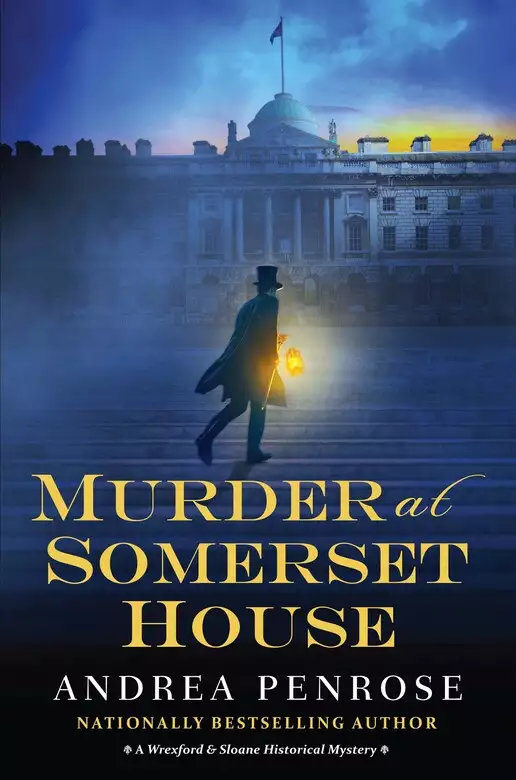
Murder at Somerset House
- eBook
- Paperback
- Audiobook
- Hardcover
- Book info
- Sample
- Media
- Author updates
- Lists
Synopsis
Beyond the gilded ballrooms and salons of Regency London lurks a sinister web of intrigue and deception, and when a murder occurs within the scientific community, Lord Wrexford and Charlotte are the perfect pair to unravel it . . .
A welcome interlude of calm has descended on Wrexford and Charlotte, though with three lively young boys in their care and an unconventional circle of friends and allies, quiet rarely lasts long. And sure enough, in the dead of night, an old acquaintance appears and asks for help. His
brother-in-law has been accused of murdering a fellow member of the prestigious Royal Society at their London headquarters, Somerset House.
Wrexford agrees to investigate, and with a little unexpected help from their young charges, discovers that what seemed a simple case may be part of a darker, more dangerous plot, where science, money, and politics collide. A mysterious new technical innovation threatens to ignite a crisis throughout Europe, with frightening consequences for London’s financial world.
There is also personal upheaval for Wrexford and Charlotte, when a shocking secret from the past brings a profound change to their family, testing the bonds of loyalty and trust as never before . . .
Release date: September 30, 2025
Publisher: Kensington Books
Print pages: 368
* BingeBooks earns revenue from qualifying purchases as an Amazon Associate as well as from other retail partners.
Reader buzz
 Please log in to recommend or discuss...
Author updates
Murder at Somerset House
Andrea Penrose
As London’s most popular—some might say infamous—satirical artist, she felt it was her solemn duty to keep the public informed about the important social and political issues of the day that affected their lives. Corruption, misuse of power, the personal peccadilloes of the high and mighty, laws that placed unfair burdens on the poor—her sharp-tongued commentaries spoke out for the masses who had no real voice of their own.
Of late, however, things had been awfully quiet in Town.
“No wars, no political crises, no scandals.” Her lips twitched. “Which, of course, is a good thing.” The only bit of current news was the daring escape of an exotic monkey—a gift to the king from an Indian sultan—from the Tower Menagerie. Having taken Hawk, a budding artist and one of the three orphan boys for whom she and her husband served as official guardians, on a recent expedition there to sketch the famous lions, Charlotte had actually seen the creature.
Long, feathery silver-grey fur framed an ebony-black face, whose darkness was accentuated by a pair of luminous yellow eyes … After quickly dipping her pen into the inkwell, she began to doodle. Elongated arms and legs, curious fingers that seemed to be constantly exploring his surroundings … Apparently a keeper had left a key in the cage’s lock, and the clever monkey had let himself out—
“Are you perchance going to comment on the Marauding Monkey?” asked McClellan as she nudged open the workroom door and placed a tray replete with tea and pastries on the side table. Officially, her title was lady’s maid to the Countess of Wrexford, but that did not begin to encompass the full range of her duties. Taskmaster of the three Weasels, sometimes sleuth, baker of ambrosial ginger biscuits—she was, in a word, the cog who kept all the various gears of the admittedly eccentric household running smoothly.
“Apparently, the animal broke into the kitchens of Carlton House last night and ate all the special fruit and custard pastries that had been prepared for the Prince Regent’s supper,” added McClellan. “Which, of course, has captured the public’s fancy. They are all cheering for the monkey to remain on the loose and can’t wait to hear what havoc the rascal will wreak next.”
Charlotte pursed her lips in thought and then let out a chuckle. “Ah, I have it—the Pirate Primate!” she announced, already envisioning a composition featuring a gleeful monkey eluding a crack regiment of the Coldstream Guards led by the apoplectic royal regent. “Prinny must be furious. Not simply because of the ridicule that is about to explode, but because he is a glutton for sweets.”
“Among other pleasures,” said the maid dryly. She poured two cups of tea and carried one over to Charlotte’s worktable. “Adding to the drama of the story, the palace has just announced that a very handsome reward of five gold guineas will be paid to the person who returns the fugitive to the Tower.”
“This gets better and better by the moment,” said Charlotte with an evil smile, mentally picturing the monkey in a fancy embroidered waistcoat and tossing gold coins to the pursuing soldiers. “But this is a perfect solution. I’ve been dawdling, but now I had better get to work, so Raven can deliver the drawing by midnight.”
“Be careful what you wish for,” warned McClellan after taking a sip of her tea. “The Weasels had a decidedly worrisome gleam in their eyes after I told them the news of the reward.”
Charlotte was suddenly not feeling so amused. “Drat.”
“I heard them rummaging in the attics when I stopped to leave a plate of ginger biscuits in the schoolroom just now.” A cough. “The words fishing nets and coils of rope were repeated several times.”
Expelling a sigh, Charlotte closed her eyes for a moment, trying not to picture the diabolically creative plans that three exceedingly clever boys could concoct for snaring the fugitive monkey …
“M’lady, m’lady!”
Hawk, the younger of the two brothers whom Charlotte had taken under her wing when she was a struggling widow, raced into her workroom.
Has it only been three years? It felt like a different lifetime. Her smile quivered ever so slightly, recalling both the sorrows and the joys of that fraught time when she had been an outcast from Society, trying to eke out a living with her satirical art after assuming the persona of A. J. Quill, her late husband’s nom de plume … until Fate in the form of a gruesome murder had thrown her and the notoriously short-tempered Earl of Wrexford together.
It had not been a match made in heaven. But strangely enough, our mutual antipathy turned to grudging respect … and then friendship.
And then—
Her musing was wrenched back to the present moment by a loud chortling from Hawk’s older brother Raven and Peregrine, the recent addition to the band of fledglings, as they appeared in the doorway.
An orphan—although because of the death of his aristocratic father, he was now Lord Lampson—Peregrine had come to be involved with their family during the murder investigation of his uncle, a brilliant inventor who had been working on a secret project for the government. Due to a number of complexities within his own family—his aunt bitterly resented the fact that the family’s title had gone to a boy whose mother was of African descent—Charlotte and Wrexford had offered him a loving home, and his kindly cousin had agreed to transfer legal guardianship to her husband.
“Ha! I’m willing to wager we’ll have the monkey in our sack by dawn!” crowed Raven as he held up several coils of rope and a bag of overripe fruit from the kitchen.
Peregrine raised the two long-handle fishing nets cradled in his arms and nodded enthusiastically.
Charlotte noted that Raven was, like his fellow Weasels, also wearing a bulging rucksack strapped to his shoulders. She decided not to inquire what was inside it.
“The three of you must realize that the money—” she began.
“Oh, we are well aware that seeking the reward money would threaten our family secrets,” assured Raven. “If we catch the monkey, we’re going to give it to Scratch, the street sweep who took over Skinny’s corner, so he and his friends can claim the reward.”
“We are looking at the hunt as an educational experience, m’lady,” piped up Peregrine. “We’ll need to use geometry to figure out the angle of approach if the creature is hiding among the buildings, and I’m sure our tutor will applaud the reading we have been doing on monkeys.” A pause. “Did you know that the word simian, which is used to describe the broad family of monkeylike animals, derives from the Latin word for ape?”
She smiled. “Actually I did. But I give you high marks for creativity in trying to convince me that this expedition has any relation to your schoolwork.”
The boys all grinned.
“Don’t look too smug yet, Weasels,” warned McClellan. “I have a feeling that m’lady is about to lay down some rules before you hare off.”
“Correct,” replied Charlotte. She deliberately took her time in eyeing their urchin garb and the sooty filth streaked on their faces. Raven and Hawk had spent their early years fending for themselves in the slums of London, so their rags were like a second skin. And Peregrine had quickly learned how to blend in.
“If you spot any official authorities while you are on the hunt, you are to immediately give up your chase and melt away into the shadows.”
“Oiy,” agreed Raven.
“If you corner the monkey, you must be extremely careful about being bitten or scratched. No attempting to approach it unless you are wearing a pair of thick leather gloves.”
“Oiy!” answered Hawk. “I put three pairs in my rucksack.”
“One last thing,” she added. “You will have to put off your departure for an hour. I need to finish my drawing and have you drop it off for Mr. Fores before you set out on your great hunt.”
“Oiy!” The three of them looked a little disappointed at the delay, but they answered in unison without hesitation.
“There are ginger biscuits in the schoolroom, which should help sweeten the wait,” said McClellan, which had them jostling with each other to lead the way to the stairs.
“Well, then, I had better get to work,” replied Charlotte, though her voice betrayed a flutter of uncertainty. “Though I do wonder whether this particular night is a wise time for them to be out in the city. Given the reward, I daresay a great many people who aren’t the usual denizens of the night will be on the prowl for the fugitive monkey.”
“Don’t fret.” The maid gathered up the tea things to take back to the kitchen. “The boys are experienced in navigating all the ins and outs of the stews and know how to stay out of trouble. I don’t think there’s any danger of them getting into any serious mischief.”
Charlotte drew in a deep breath as she dipped her pen into the inkwell. “From your lips to the Almighty’s ears.”
Steam rose from the liquid gurgling at a soft boil in the iron cauldron. Wrexford consulted his pocket watch and then made a notation in his log book. Two more minutes. He watched the second hand move through the increments, finding scientific satisfaction in the unwavering precision.
He couldn’t remember the last time he had been able to devote several uninterrupted days to chemical experiments, and the orderly sequence of thinking demanded by testing his theories was calming as well as demanding.
“Reason rules in science,” he murmured, extinguishing the flame at exactly the right second. “While in Life, chaos is king.”
Grasping the cauldron with the two ends of a towel, he moved it to a trivet on the counter and covered it with a sheet of glass. Once it had cooled overnight, he would be ready for the next step in his experiment. But for now …
Wrexford straightened and took a moment to massage a kink in his neck. A glass of Scottish malt and a bit of reading by the banked fire would be a pleasant way to spend the rest of the evening. Indeed, the pleasures of a quiet evening at home feel even sweeter in this new year, reflected the earl, as he moved from his laboratory and poured himself a measure of spirits.
“Sláinte,” he said to the cosmos in general before settling into the soft leather of the armchair angled by the hearth in his workroom. The previous summer and autumn had brought a number of unexpected upheavals—
“You look thoughtful,” said Charlotte as she appeared from the shadows of the corridor and joined him in the mellow glow of the glass-globed oil lamps and red-gold coals.
“Grateful,” he replied with a wry smile. “To think that we’ve had blessed peace and quiet for over—”
“Ha! Cast that thought to the wind.” She took a seat in the facing chair. “Ensconced as you were in the cerebral solitude of scientific inquiry, you’ve not yet heard of the Great Escape!”
Wrexford tightened his grip on his glass. “Bloody hell, don’t tell me that Napoleon has—”
“What a macabre imagination you have! But grâce à Dieu, no, it’s not quite that dire.” Charlotte allowed an amused smile. “The monkey—a grey langur—recently gifted to the king by the Sultan of Golcanda escaped from the Tower Menagerie yesterday …”
She proceeded to explain about the animal’s pilfering of the Prince Regent’s special sweets from Carlton House and the subsequent reward being offered for its recapture.
Wrexford chuckled.
“You might want to stifle your mirth until I finish,” she warned.
“Ah.” He took a prolonged swallow of whisky and stared down at the dregs in his glass after hearing what the Weasels had in mind. “I should have known better than to spit in the eye of Fate by raising a toast to the fact that we’ve eluded murder and mayhem for several months.”
Charlotte rose in a rush and grabbed a bottle from the sideboard. Pulling out the cork, she splashed a measure of the amber liquid into the coals.
Smoke and steam billowed up with a serpentine hiss.
“May Eris, the goddess of Chaos, accept this libation as an apology for a mere mortal’s hubris,” she intoned.
“Amen to that,” responded Wrexford. He blew out his breath. “A lone monkey on the loose in a very large city filled with all manner of buildings and hidey-holes …” He pursed his lips. “The odds of the boys finding it are not good.”
“Indeed not,” announced their close friend Kit Sheffield as he entered the room. An unofficial member of the family, he—along with his now-wife Cordelia—came and went as he pleased at the Berkeley Square townhouse.
“If you wish, I could do the mathematical calculations.” Sheffield pinched at the bridge of his nose. “But I’d rather not. I’ve spent the last five hours wrestling with mind-boggling numbers and equations.”
“A budget meeting for the Bristol Road Commission?” asked Wrexford.
Sheffield and Cordelia were the owners of a highly profitable shipping business, though as members of the beau monde they had to keep their involvement in trade a secret. He had become a vocal critic of Britain’s antiquated system of roads and transportation infrastructure for moving goods and people around the country, and when the opportunity had arisen to have a voice in shaping the future, he had seized it with great enthusiasm.
However, observed the earl, their friend was presently looking a little deflated.
“Yes,” replied Sheffield, frustration sharpening his voice. “And I decided to stop here and whinge before heading home. Cordelia has listened to my recent rants about our lack of progress with grace and good humor.” He made a face. “However, patience has its limits.”
“But Love does not,” observed Charlotte. “Cordelia admires and applauds your dedication to making the country a better place for all who live here. Nonetheless, you are always welcome to unburden yourself here. Heaven knows, we’ve drawn you into enough of our troubles.”
“So what’s the current issue?” queried Wrexford.
“We’ve a number of important projects planned and have spent months hammering out the final costs. But the funds promised by Parliament have slowed,” replied Sheffield. “I’ve been told that there has been some unexpected fluctuation with the sovereign debt, and thus government spending has been cut back for the moment.”
The earl frowned. “My understanding is that financial markets are always fluctuating.”
“Don’t ask me to explain how they work.” Sheffield blew out a mournful sigh. “I liked it better when I was a feckless fribble and everyone assumed that I wasn’t capable of intelligent thought.”
Their friend had a reputation in Society of being a charming but ne’er-do-well rascal. However, over the past few years he had proved himself to be an astute entrepreneur and had recently taken an interest in the world of finance.
Charlotte smiled. “No, you didn’t.”
That drew a wry chuckle. “I suppose not. Cordelia wouldn’t have given me a second look if I was a complete lackwit.” He fluttered his lashes. “Despite my beaux yeux.”
“You’re an idiot,” commented Wrexford as he rose to refill his glass. “Would you like a drink?”
“True. However, I do appear to have some people fooled,” drawled their friend after giving a grateful nod. “A fellow member of the Bristol Road Commission just asked me to be chairman of the Finance Committee and take charge of trying to convince the government that funds for the project are an important investment in the future of our country.”
Sheffield paused to accepted a glass of spirits from Wrexford. “But getting back to Cordelia, I’ve received an even more important invitation because of her. Several weeks ago, she met a very interesting fellow at a symposium held by the London Society of Mathematics, and they spent a great deal of time discussing economics and the use of mathematics for modeling risk and reward.”
“A subject that Cordelia no doubt found fascinating, both for its abstract intellectual challenges and its practical applications for your shipping business,” mused Charlotte.
“Yes. They’ve met several more times at the society’s frequent lectures, and when she mentioned that I was a member of the Bristol Road Commission and unhappy with the cutbacks in government funding for the project, the fellow—by the by, his name is David Ricardo—invited me to become a member of the Society for International Banking and Commerce, whose members include prominent leaders in the finance community.”
“David Ricardo,” mused the earl. “I’ve heard that he’s a brilliant financier and is involved in helping to finance the government’s debts.”
“Yes, he’s apparently quite brilliant. Word is he started out in 1793 with only £800 in capital, and he’s now one of England’s richest men,” replied Sheffield. “He’s also published articles on economic theory, which are highly regarded by leading thinkers in the field.”
“I’ve also heard that he has a reputation for integrity,” added Wrexford.
“Now that you mention it, I included David Ricardo in a series of drawings I did several years ago on how our government financed the astronomical amount of money needed to wage war against Napoleon,” said Charlotte.
“As I recall, he also has an unusual personal background,” interjected the earl.
Sheffield nodded. “His family are Sephardic Jews of Portuguese descent, who relocated to Britain during the last century from the Dutch Republic. His father was a successful financier who traded on the stock market. However, Ricardo fell in love with a Quaker Englishwoman, and after eloping with her, he renounced his faith, which caused an irreparable break with his family.”
Charlotte’s expression turned pensive, mingling sadness and regret. “How unfortunate. Families are precious.”
Wrexford knew she was thinking of her own estrangement from her straitlaced father and mother, and how she had never had the chance to reconcile with them before they passed away.
“Families are complicated,” he replied.
That made her smile.
“Amen to that,” said Sheffield. “But sometimes they can surprise you in ways that you never, ever imagined.”
He spun his glass of whisky between his palm and took a meditative sip before abruptly turning the talk back to a less fraught subject. “Ricardo has become very wealthy through his profession as a stockjobber—”
“I confess, I’m confused by that term,” interrupted Charlotte. “Is it simply another name for stock trader?”
“No, Ricardo has explained to me that there is an important distinction. A stock trader picks and chooses whatever securities he wishes to buy or sell and only trades at times of his own choosing. A stockjobber plays a far more complex role in keeping the Stock Exchange functioning smoothly. He acts as a middleman of sorts, or a market maker—”
“What does market maker mean?” interrupted Charlotte.
Sheffield hesitated. “I’m still learning, so I can’t yet explain all the nuances. But a stockjobber is, in a sense, the oil that keeps the gears of the London Stock Exchange turning smoothly. He stands ready at all times to buy and sell whatever securities someone wants to trade, setting a stated price for each specific security at which he will buy it and a slightly higher price for which he will sell it.”
A pause. “As I understand it from Ricardo, a stock trader usually buys from or sells to a stockjobber,” he continued. “As does a broker, a bank, or an individual. It’s much easier for them to trade with a stockjobber, who is always there quoting a price, than to find an individual party and have to negotiate the terms. By serving as an intermediary, the stockjobbers allow the market to function efficiently.”
Charlotte thought for a moment. “But as Wrex pointed out earlier, aren’t the markets always fluctuating? How can a stock-jobber possibly know how to price a security?”
“A stockjobber is constantly adjusting his prices for buying and selling,” answered Sheffield. “Yes, he takes a significant risk that he may misjudge the direction of the market and incur losses. On the other hand, he can make considerable profits if he correctly anticipates where market prices are likely to go in the future. A major stockjobber like Ricardo will also use his central position on the floor of the London Stock Exchange to buy and sell securities for his own investment when he believes their prices warrant.”
Sheffield made a face. “And before you ask, I can’t explain all the various forces that affect the rise and fall of stock prices, but I hope to learn more about it from Ricardo. He is said to have an uncanny ability to read the trends of the market through mathematics—so much so that many other investors tend to be guided by whatever Ricardo is doing if they can learn of his trades, which in itself makes it all the more likely that his investing will lead to favorable market developments.”
“That certainly sounds like a demanding business, even if it can be highly profitable for those with the necessary talent and temerity,” mused Charlotte. “But as I said before, I seem to remember from those previous drawings I did that Ricardo played a key role managing the large borrowings the government has had to make each year to pay for all the wars against Napoleon and his allies.”
“Yes,” Sheffield said, “that’s a somewhat separate but intriguing part of Ricardo‘s business. Those annual loans raised by the government are enormous. For example, two years ago, the government borrowed £49 million.”
The earl raised his brows at the mention of such a staggering amount.
“To facilitate the government’s borrowing of such immense sums,” Sheffield continued, “rival consortiums of a dozen or so bankers, stockjobbers, brokers, and other professional investors form each year to bid on making the loan to the government—but that process and how the public participates is a complicated story that I will leave for another day.”
A pause. “And besides, with Napoleon now locked safely away on the isle of Elba, such large-scale loans are happily a thing of the past.”
“That’s all very fascinating.” Charlotte massaged at her temples. “Though the thought of parsing all those numbers makes my head hurt.”
“Mine, too,” agreed Sheffield with a self-deprecating grin. “But enough jabbering on my various concerns. Let us return to the boys and their current escapade.”
A laugh rumbled in his throat. “Weasel versus simian? Hmmm, this could prove exceedingly interesting.”
Raven darted a look over the stone parapet of the outer walkway ringing the warehouse roof and then ducked back down into the shadows. “We’ll need to rig Peregrine’s new ratcheting winch and a length of rope,” he whispered. “But we need to be quiet about it so we don’t wake the rascal.”
Their strategy had paid off. Though finding a runaway monkey in a city the size of London was perhaps even more daunting than searching for a needle in a haystack, Raven had come up with a plan. Based on the location of the Tower Menagerie and the Prince Regent’s residence, and the fact that the monkey had arrived at the East India docks, he had come up with an educated guess that the animal would stay near the river and then made clever use of their network of urchin friends. While Peregrine had waited for Charlotte to finish her drawing, he and Hawk had set up a surveillance system to funnel any information on sightings of the monkey to several key checkpoints.
One tip-off had led them east, another tip-off had turned them south … and lo and behold, a third had sent them climbing to the top of a riverside trading company, where they had spotted the monkey sleeping atop the entrance portico of the loading bay in a secluded courtyard space.
“Who has the fruit?” added Raven, as he began unfolding the large square of fish net that he had found in the attic.
“Oiy.” Hawk held up a burlap bag with several overripe apples that McClellan had unearthed in the back of the pantry.
Peregrine sniffed the air and grinned. “Sweet!”
“I daresay the monkey will be hungry when it awakes.” Raven threaded a rope through the center of the netting and tied a fist-sized knot at the end of it.
“Explain to me again what you have in mind,” said Peregrine.
Raven gestured for his brother to hand him the bag. He withdrew one of the squishy fruits and cut it into quarters with the knife he carried in his boot, then tucked the pieces in his coat pocket before carefully tying the bag’s drawstrings to the rope just above the knot. “Once you two lower me close to the monkey, I’m going to toss some pieces of the apple to wake it. Then I’ll let down the rope holding the bag—”
“What about the netting?” demanded Hawk.
His brother responded with an evil grin. “I’ll be holding the netting, which as you see has the rope threaded through its center, and once the monkey begins fiddling with the bag, I’ll let it drop.” He gave it a jiggle. “Mac sewed lead fishing weights around the perimeter for me, so it will drop like a stone and entangle the monkey before it can flee.”
“Ingenious,” said Peregrine with an admiring nod.
“Assuming it all works as planned,” replied Raven dryly. He buckled a heavy belt around his middle and centered the large iron ring that the thick length of leather was holding in place. “Is the winch ready?”
“Oiy.” Peregrine, who had learned a great deal about engineering from his late uncle, double-checked the apparatus that he had built to lower Raven down from the roof and then fastened the brass clip that was tied to one end of the pulley rope to the ring. “Ready?”
With catlike stealth, Raven climbed over a parapet and noiselessly dropped down several feet until the gears of the rachet clicked softly into place. After a downward glance, he signaled for Peregrine and Hawk to begin slowly lowering him toward the sleeping monkey. The breeze gusted as it squeezed through the gaps between the buildings, but Raven adjusted his weight to keep his descent steady. He passed by a darkened window of the top story, and then one on the story below it.
On catching a glimmer of light reflecting off his boots, Raven realized that the room he was about to pass was illuminated from within.
Mouthing a word he was strictly forbidden to say aloud in front of Wrexford and Charlotte, he looked up and gave a quick wave for them to hurry in lowering him through the glow.
His descent quickened—
And then snapped to a halt.
Giving thanks for his dark clothing and soot-streaked face, Raven held himself very still. He was hanging uncomfortably close to the glass, but clouds had scudded over the moonlight, deepening the midnight gloom. With luck, he would go unnoticed.
He silently counted to ten … And then did it again.
The wick of the oil lamp on the table facing the window suddenly sparked, and its flame flared up for moment, illuminating a number of papers spread over the dark-grained mahogany.
Piles of banknotes, letters of credit issued by several of London’s leading banks, stacks of stock certificates, along with what looked to be pages of mathematical calculations …
Raven recognized the bank documents, as Sheffield had once explained to him how they were used extensively by international merchants because they were as good as money in many places around the world. One simply presented them to the local agent representing the London bank in order to convert them into the local currency. Sheffield had also explained stock certificates—
A movement deep in the shadows caught his eye. A gentleman—no, two gentlemen—entered the room. They were both well-dressed, though oddly enough, there seemed to be a length of crumpled silk tangled with some sort of silvery fur lying on the edge of the table.
They appeare. . .
We hope you are enjoying the book so far. To continue reading...
