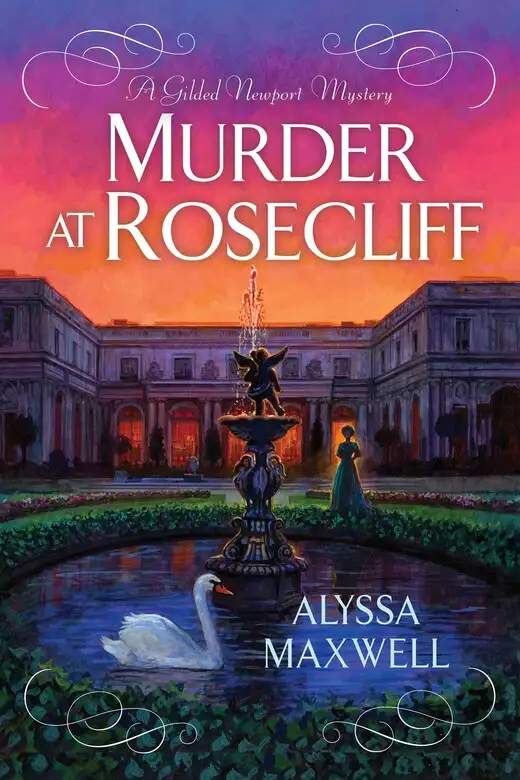
When a troublemaking party crasher is found dead in a fountain during an elegant soiree in Newport, Rhode Island, newspaper editor Emma Cross Andrews must clear her own society reporter from suspicion of murder…
August 1903. Emma and her husband Derrick are among the men in white tie and tails and the women wearing white gowns from the House of Worth at Tessie Oelrichs’s Bal Blanc, or White Ball, at Rosecliff, her grand cottage on Bellevue Avenue. There to cover the event of the season is young Ethan Merriman, society reporter for the Newport Messenger, the newspaper owned by Emma and Derrick.
It’s an utterly charming affair until a stranger intrudes flaunting a green-striped necktie and matching vest in defiance of their hostess’s theme. But his fashion crime is a mere misdemeanor compared to his intention to blackmail Mrs. Oelrichs by producing a compromising document supposedly signed by Tessie over a decade ago.
Insisting it’s a forgery but terrified of scandal, she agrees to his terms, but the blackmailer will not live to see payday. His body is found face down in a fountain before the party’s end. Beside him stands a very wet Ethan, who was seen being confronted by the man earlier in the evening. Coming to the aid of their luckless cub reporter, Emma and Derrick must sort through the white lies and blackened reputations to discover the identity of the true killer.
Release date:
August 25, 2026
Publisher:
Kensington Books
Print pages:
288
* BingeBooks earns revenue from qualifying purchases as an Amazon Associate as well as from other retail partners.
If I were to remember only one thing about Theresa Fair Oelrichs’s White Ball, it would be the scent of flowers. The overwhelming, cloying scent of roses, orchids, hydrangeas, and lilies, arrayed around every doorway, tucked into every carved niche, draping every cool marble statue, and held in place by artful arrangements of white satin and reams of silver ribbon. The French doors running the length of the east and west sides of the ballroom stood open to the night air, mingling the breezes off the churning Atlantic with the serenity of Tessie’s newly planted Italian garden in Rosecliff’s front courtyard. The open doors seamlessly melded the ballroom with the out-of-doors, and a glance upward at the clouded sky painted on the ceiling, framed by elaborate plasterwork, reenforced the illusion.
“Tessie certainly has outdone herself tonight,” I commented to my dance partner, who was in the process of sweeping me in circles past the fireplace at the north end of the room. The unlit hearth was filled with startlingly white American Beauty roses, developed in France but introduced to this country by Rosecliff’s former owner, George Bancroft. That Rosecliff, or Rose Cliff, had been a much smaller house. As Marble House had been Alva Vanderbilt’s social victory, Rosecliff was Tessie Oelrichs’s. “The flowers alone are a triumph. I wonder who provided them.”
“What’s that, Mrs. Andrews?” Daniel Ahearn, nearly twice my age, negotiated us past the other couples waltzing in our path. Mirroring the night’s snowy decorations, every woman wore sumptuous white silks and satins from the houses of Worth, Doucet, Lucile, Paquin. …
I, however, had broken with tradition and opted for a gown designed right here in Newport, emulating the flowing, high-waisted designs of German designer Anna Muthesius. According to her newly published book, Women’s Own Dress, women should reject the dictates of fashion and wear what suited our bodies and lifestyles; each gown should be an individualized, free-flowing work of art, much like the current art nouveau aesthetic in interior design. I couldn’t have agreed more. I had garnered several puzzled looks so far this evening, including from our hostess, but what did I care when this style required neither a tightly laced corset nor the stiff petticoats that rendered sitting a tricky endeavor.
The men had also been meant to clad themselves completely in white, as well as shave off their facial hair, if they had any. Most had rebelled against such edicts. Their mustaches, if anything, had seemed to grow longer in the days leading up to the ball, and most men wore formal black, their only tribute to the night’s color scheme reflected in their vests, shirts, and bow ties. I believed their mutiny had more to do with Harry Lehr, who had devised the all-white theme, than any true objection to the color.
Together with the myriad florals, the overall effect struck me as that of a mass wedding, with dozens of brides and grooms trading partners each time the small orchestra struck up a new number.
Mr. Ahearn cleared his throat to recapture my attention. He held my gaze with his deep-set eyes and waggled his eyebrows in a manner I found mildly inappropriate. “You like flowers, do you, Mrs. Andrews? Are you a gardener? Do you enjoy the sensation of moist soil clinging to your hands?” His fingertips played a sensual rhythm at the side of my waist.
Good heavens. Somehow I managed not to exhale a sharp breath of perplexity. Daniel Ahearn, though well into his fifties, was classically handsome and boasted an athletic figure, rather like a marble statue himself. Another of the Four Hundred’s avid sportsmen, he held on to youth with both hands firmly clenched. I didn’t doubt he could have enticed half the women at Tessie’s Bal Blanc—the White Ball. Actually, I didn’t doubt he had already done so at one time or another despite being married. When did that ever stop New York’s upper crust from dashing into bedchambers that weren’t their own?
“Not particularly,” I replied to his question, assuming a bored air and injecting into my voice a coolness meant to quell any untoward ideas he might entertain. He held me too tightly and bent his head too closely over mine, as if to blot out the rest of the room from my view. A pity for him that, no matter where he maneuvered me in Newport’s newest and undisputedly largest ballroom, I never lost sight of my husband, Derrick. Nor he of me. Even now, I glimpsed him smiling at me through the crush that milled in and out of the way.
As often happened, I felt a tug of desire. Talk about handsome. Talk about athletic. Talk about a man who could entice me any night of the week with a flash of his lopsided grin. My heart warmed at the thought, and my annoyance with Mr. Ahearn transformed into amusement.
With a shrug, he danced us toward the center of the room, beneath the cloud-strewn mural above us. “Say, isn’t it time we dropped the formalities? Your husband’s family and mine go back a number of years, and he and I are certainly on a first name basis.”
“As you wish, Mr. Ahearn. You may call me Emma if you like.” I had no intention of returning his familiarity. It would only give him further notions. And I couldn’t help wondering what my in-laws—my mother-in-law especially—might have said about me that planted these improper notions in his head.
“You and Derrick are coming to the Casino next Saturday night, aren’t you?” He made it sound like an assignation between him and me.
“We wouldn’t miss your daughter’s engagement party for the world,” I assured him, then concluded with, “Isn’t that your wife over there? I believe she’s beckoning.” With that I slipped my hand from his and coiled away from his hold on my waist, though I had not, in fact, glimpsed Carmella Ahearn signaling for her husband’s attention.
By the time I had crossed to my husband, I’d dismissed Mr. Ahearn’s tasteless flirting. Yet, Derrick’s dark eyes held mine as he took my hands in his. “What is it? You seem unsettled.”
How well he knew me after only two years of marriage. Then again, even in the years before we spoke our vows, we had shared more than most couples did in a lifetime: intrigue, murder investigations, attempts on our lives. …
With no desire to cause a rift in his parents’—or Derrick’s— association with Daniel Ahearn over something so trifling, I smiled back at him. “It’s nothing.”
“It’s never nothing, not with you.” He moved closer, bringing the essence of his shaving soap and hair tonic and the starch in his collar—and something else, something warm and mysterious that made all three uniquely his—to tantalize my senses. His hand moved beneath my chin; he raised my face and studied me closely. “Did Ahearn say something? So help me, if he—”
“You know how he is.” I flicked a dismissive hand in the air, then let my palm come to rest on the front of his tailcoat, just below his shoulder. His larger hand rose to cover mine. Like the other men, he wore black but for his silk vest and tie, with a white rosebud boutonniere adding another nod to the evening’s theme. “He’s no different than most of the others here tonight,” I reminded him. We both knew these balls were typically rife with little conspiracies, with secret communications and the making of plans to be acted upon later, on the sly. “Nothing I can’t handle.”
He nodded in reluctant agreement. “No, if anyone can take care of herself, it’s you, my darling.” Then he changed the subject. “I understand there are quite a number of Tessie’s acquaintances from San Francisco here. No wonder there are so many people I don’t recognize.”
I followed his gaze as it scanned the room, spotting at least two dozen unfamiliar faces among Newport’s regular summer crush. After making fortunes in the mining industry, many families from California and Nevada had come east, eager to stake their claims among society. Tessie herself had been one of them, arriving with her mother and sister in 1889 and stunning New York society with her beauty and her considerable dowry. “Ethan has his work cut out for him, trying to identify so many newcomers,” I said, referring to the society columnist reporting on tonight’s ball. Ethan Merriman worked for the Newport Messenger, the local newspaper Derrick and I owned and operated.
“He can handle it. But your relatives would be scandalized by such a motley assortment.” He gave a mock shake of his head, a dramatic shudder. “As would Mrs. Astor, if she were here.”
“If she had been invited, Caroline Astor would have refused to come. After all, Tessie’s background is hardly up to snuff, what with her father having been a poor Irish immigrant and his fortune reeking of newness, even now.”
“He did become a U.S. senator, after all.”
I laughed. “One term. Hardly enough to impress Lina Astor. And if Aunt Alice were here, she would positively turn up her nose as if she smelled something sour. Never mind that the Vanderbilts were once considered as crassly new money as these mining moguls.”
Across the warm gloss of the parquet dance floor, another Vanderbilt relative, albeit a divorced and remarried one, caught my eye. She waved a plump hand and winked. “Aunt Alva is the exception, of course. Far be it for her to stand on Mrs. Astor’s stuffy standards when it comes to who may enter her inner circle.”
Neither Alice Vanderbilt nor Alva Vanderbilt Belmont were my aunts in the truest sense, being instead cousins by marriage several times removed. Even so, each had taken me under her wing years ago and shown me far more affection than I’d had any reason to expect, especially with my “odd” predilection for working and earning an income of my own. In their world, I constituted quite the anomaly, something neither would have tolerated in their own daughters. It had often left me wondering whether they felt sorry for me or were secretly … well … envious of my lifestyle.
“I’d say the guest list was designed to impress Tessie’s oldest acquaintances as well as her newer ones with her aptitude for spending money.” Derrick recaptured my attention with his next observation. “It would seem the only member of her exceedingly wide circle who isn’t here tonight is Hermann.”
“No, I suspect he’s in New York or traveling with their son. Poor Tessie. She puts on a brave face, but I wonder if she ever misses her husband.”
“She looks happy enough.” He gestured with a black-clad arm through a wide doorway. Clad in cascading layers of white satin and lace, ropes of pearls and diamonds, and a crown of roses circling her high-piled coif, Tessie held court in Rosecliff’s salon as guests continued to arrive.
“Still …” I let out a sigh and curled my fingers around his. “I don’t believe she’s spent time with him privately in nearly a decade. Not even when they trade custody of young Hermann.”
He pressed a kiss to my lips—quickly, because it was considered poor taste for husbands and wives to be caught in displays of affection at such occasions. Even dancing together for more than a waltz or two would raise eyebrows. Thus far this evening, I had partnered with two of my cousins, Neily and Alfred, Jay Gould, JJ Astor, and Orme Wilson, while Derrick had partnered their wives, one of them being my dear friend Grace, married to Neily.
Derrick leaned and whispered something in my ear— something that pertained to what might occur between us much later that night, once we had arrived home. For the time being, we parted ways with secretive smiles on our faces.
I wandered into the dining room and spotted Grace with several other wives helping themselves to refreshments laid out on the long table. A red-haired beauty, she held a glass of champagne punch and laughed at whatever someone had just said. She looked carefree, beautiful, and young—and no longer affected by the family schism her marriage to Neily had caused. Even today, seven years later, Aunt Alice refused to receive them. Yet that hadn’t stopped Grace making her mark on society. I watched as the other women appeared to hang on her every word. She might not be the Mrs. Vanderbilt, but she was certainly a Mrs. Vanderbilt to be reckoned with.
“Emma,” she cried out upon seeing me, though we had greeted each other earlier, if only briefly. I credited the champagne for her exuberance and unreservedly returned her embrace.
Arm in arm, we drifted from the group of ladies and took a turn about the perimeter of the dance floor, so highly polished we could see our reflections. Grace’s tiered diamond earrings, choker, and wrist cuff glistened like liquid stars in the light of the chandeliers. “Did I tell you about Neily’s latest project? Or did he?”
“Which one?” My eldest Vanderbilt cousin loved mechanics of all kinds and could typically be found tinkering in the workshop he’d assembled in the basement of Beaulieu, the house they leased here each summer. He held multiple patents, some of which his brother, Alfred, who now ran the New York Central Railroad, had utilized to make improvements to train cars and engines. As the elder brother, it should have been Neily running the New York Central, but this had been another sacrifice when he married Grace.
“He’s partnering with Ollie Belmont’s brother, August, to construct New York’s first ever subway, like they have in London and Paris,” she informed me. “America is entering the modern world—finally. Can you imagine, Emma? Train travel below the ground. It boggles the mind.”
“Goodness, it does indeed.” I enjoyed hearing the pride in Grace’s voice. All too often, Neily’s and her interests lay worlds apart. Only last month she begged me to drop everything at the Messenger and come to tea because Neily refused to look up from his books and papers and she had grown bored.
A sudden change in topic exemplified her capricious nature. “You must come by and see the children. Corneal is almost all grown up. Goodness, he’ll be off to St. Paul’s in a few short years.” She referred to the boarding school in New Hampshire all the Vanderbilt men attended—although Reggie, Neily’s youngest brother, never made it to graduation before being shown the door. “And Gracie … she’s quite the young lady now.”
“She’s four, Grace,” I said, laughing. Just as when she’d brought up Neily’s latest project, it was good to hear her boast about her children. As much as I loved her, there were times I wondered if she remembered she even had children. It wasn’t coldness of heart. Unlike her husband, who was happy being home among his family and his books, Grace yearned for excitement, for extravagances like tonight’s ball. Like the socialite she had been before her marriage, she still had the power to turn heads, as she was doing presently. The twinkle in her wandering eyes told me she was well aware of it.
I didn’t begrudge her glamour. I only wished she and Neily had proved to be better suited.
“Let’s step out into the garden.” She steered me toward the closest of four west-facing doors that opened onto the Italian flower garden at the front of the house. Torches and moonlight gilded the statuary, while two fountains gurgled pleasantly, one at the center of the garden and the other, much larger, one out on the lawn beyond the driveway. Farther off, the lights from the smaller house that blocked Rosecliff’s view of Bellevue Avenue, owned by the Parkman family, sent the shadows of well-trimmed trees and hedges stretching across the grass.
As we stepped into the doorway, I came to an abrupt halt. Despite Grace’s gentle tug, I stayed put and gestured discreetly. “Who do you suppose that is? That man there.”
The person in question appeared to have come up the driveway on foot and now picked his way along one of the garden pathways toward the French doors. That alone would have made me notice him. No one invited here tonight would have the audacity to enter the ball any other way but through the front door, past the butler in the marble-clad vestibule, from where he would be escorted into the salon and announced to Tessie.
Grace followed my gaze; instantly her brows converged to a frown of distaste. “Dear heavens, look how he’s dressed. Granted, he’s not a bad-looking bounder, but a bounder all the same. I have no idea who he is, and I don’t doubt Tessie will send him packing for his brazen disregard of tonight’s dress code. A green striped vest and matching cravat? Not even a bow tie?” She wrinkled her nose. “I don’t believe I’ve ever set eyes on him before. He’s quite young, isn’t he? About our age, perhaps? A whelp who hasn’t learned his way in society yet.”
I didn’t think he was quite that young. Moonlight and the glow of torches always smoothed complexions and gentled features. Late thirties, I judged him to be. He entered the ballroom through the open doors to our right. As he did, he removed his top hat, turned his head toward us with an appraising look, and nodded in what appeared to be appreciation.
I bristled at his insolence.
Grace did, too, judging by her huff. “Ignore him. As I said, he won’t be long for Tessie’s Bal Blanc.” Once again, she started over the threshold and into the garden, but I didn’t follow. Some instinct turned me full around as I watched him cross the ballroom without once adjusting his stride or attempting to sidestep the whirling couples. He made them veer out of his path or be struck by his shoulders.
Excusing myself to Grace, I followed him. He turned into the grand stair hall and for a moment stood looking about him as if to gain his bearings. He peered up the broad, rose-carpeted staircase to its landing, where it divided into curving flights on either side of an astonishing heart-shaped opening. Then he looked to the left, into the salon. He set his feet in motion.
Rather than follow in his wake, I dashed the width of the ballroom to a second doorway, which led directly into the salon. As I neared the threshold, I saw him standing behind two couples who had also arrived late and were greeting Tessie. He slipped a gold pocket watch from his vest pocket, consulted the time, and slid it back in with an impatient huff, as if he had somewhere else to be.
I recognized the exact moment of Tessie’s horror when she spotted him. Freezing utterly, several seconds passed before she roused herself and, with the deft skills of a seasoned hostess, urged the two couples to proceed to the ballroom and enjoy themselves. Without yet acknowledging the man waiting for her attention, she spoke to someone out of my line of vision. Her butler moved to her side yet made no move to escort the obviously uninvited guest from the house. Tessie apparently hadn’t demanded he do so.
“What on earth is going on?” Grace, having abandoned her plan of strolling in the garden, came up beside me.
Tessie not only looked aghast, but she did something that drove home to me the seriousness of the matter. In what might have appeared a trivial gesture, she turned her head slightly to the right. Only those who knew her well would understand. During the building of Rosecliff, she had been here nearly every day, issuing orders to the workmen, demanding the architect, Stanford White, make constant changes, and inspecting each phase of the construction. One morning, a carpenter’s tack went flying and hit Tessie directly in her right eye. She had been half blind ever since, and in times of distress would unconsciously tilt her head to favor her left side.
She did so now, as if not quite believing what she was seeing; that it might possibly be a figment of her imagination.
No one else occupied the salon now, only Tessie, her butler, and the stranger. Looking over my shoulder into the ballroom, I caught Aunt Alva’s eye and waved my fingers emphatically. She spoke a quick word to her dance partner and joined Grace and me. I wondered where the third member of their Triumvirate was, but at present it appeared Mamie Fish wasn’t in the ballroom. Tessie’s younger sister Virginia, or Birdie as everyone called her, was also nowhere to be seen. Even so, I felt as though we formed a small army ready to come to Tessie’s defense. The only question was, from what? Or from whom?
“Won’t you welcome a dear old friend to your home, Tessie?” The man’s voice carried over the music and conversation, reaching us as our little force stepped into the salon.
I couldn’t make out Tessie’s reply; she kept her voice much lower than his. But I recognized the expression she wore: entreaty. She very much wanted him to leave.
Then why not have him ousted?
“Tessie, is anything wrong?” Aunt Alva marched her way past both the stranger and the onlooking butler to take up a defensive position shoulder to shoulder beside her friend. She turned to face the man with her classic bulldog expression, which stated unequivocally that whatever he wanted, he wouldn’t find it here. “Who might this be?”
Grace and I went to stand slightly behind and beside the two other women. The man tipped his head as his gaze lighted on each of us. “Name’s Solomon Wheeler, ladies. Tessie and I go back a long way. Surely she’s mentioned me?”
“I don’t believe she has,” Aunt Alva deadpanned.
Up close, I could see this Mr. Wheeler was about Tessie’s own age, which made him only a few years older than me. Grace had called him a handsome bounder, and so he was, if one disregarded the insolent slant of his mouth. His eyes were a sharp blue, like a clear winter sky, his nose prominent but balanced by carved cheekbones and a strong chin; his hair was a thick, golden brown. He wore his clothes well, and they were of quality, if not in keeping with the night’s occasion.
A movement in the doorway into the stair hall drew my attention to a footman who had taken up position there; another blocked the doorway into the ballroom, effectively preventing any guests from wandering into the salon. It had been accomplished without a word from Tessie, not even a visual signal from her butler, who continued to hover close by.
“Solomon, I don’t know what you want, and I assure you, I don’t care.” Tessie spoke barely above a murmur. “All I want is for you to leave.” A corner of her lip nearly bled from being bitten. “You are not welcome here.”
“Is that so?” Before any of us could react, he leaned and whispered something in Tessie’s ear, a message cut short when Aunt Alva stepped forward and swatted him. He lurched back in surprise, but not without a satisfied grin.
“Tessie,” Alva said, “have him tossed out.”
Solomon Wheeler stood his ground, his gaze leveled on Tessie. “She won’t. She and I understand one another. Don’t we, my dear?”
“Only if you understand that at the first hint of trouble, the police will be called.” Tessie clasped her hands and turned away, focusing all her attention on the intricate carvings of the room’s enormous Gothic fireplace.
Holding his top hat aloft, he tipped a mocking bow and sauntered back into the ballroom, his shoulder knocking into that of the footman guarding the door. Mr. Wheeler glanced over his shoulder at us, that infuriating grin still stretching his lips. The moment he disappeared into the crush, the other women and I surrounded Tessie.
“Who is that cad?” Aunt Alva demanded. Her gaze shifted to the butler and other servants. With a. . .
We hope you are enjoying the book so far. To continue reading...

 Please log in to recommend or discuss...
