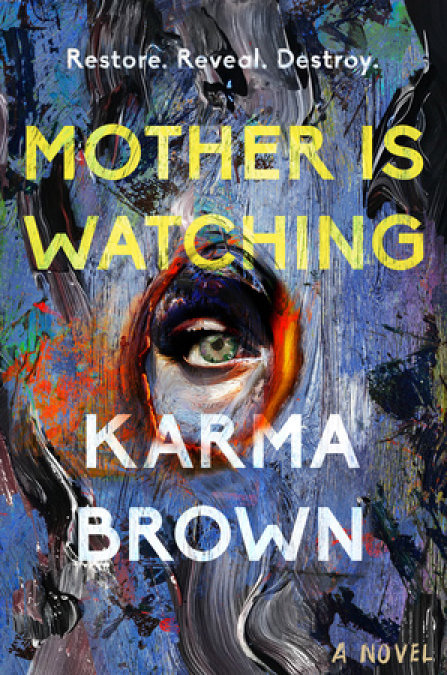
The chilling horror debut from a #1 international bestselling author—an art conservator’s obsession with a mysterious painting spirals into a nightmarish descent, where the line between reality and the supernatural shatters, threatening both her sanity and her life
Mathilde "Tilly" Crewson, a thirty-nine-year-old mother and art conservator, is tasked with restoring The Mother. The painting, believed to be the work of a female surgeon-turned-artist after a personal tragedy, is the rumored fourth piece in a collection of only three known works. But this newly discovered painting, scarred by fire, holds more than meets the eye.
Soon after receiving the painting, Tilly discovers she’s unexpectedly pregnant, and strange, inexplicable occurrences begin: terrifying insect swarms, eerie visits from her long-deceased mother, and sinister whispers that invade her mind. As these malevolent forces intensify, Tilly comes to a harrowing realization: the only way to sever the perilous bond she shares with the painting is to destroy it. But The Mother has plans of her own—and they’re darker than Tilly could ever imagine. . . .
Release date:
March 17, 2026
Publisher:
Dutton
Print pages:
320
* BingeBooks earns revenue from qualifying purchases as an Amazon Associate as well as from other retail partners.
Hers are wider set and blue. These golden-chartreuse-color eyes are more realistic than she has ever painted before.
These are the first thoughts she has when she comes back to herself, soon followed by What have I done?
Music plays on a record player in the corner of the room. Chicago 17. Newly released, and her current favorite album-easy listening, ideal for painting. She sits on a metal stool in front of the canvas, the gauzy fabric of her paint-splattered bohemian skirt-her artist's uniform-gathered between her legs. She holds her brush in midair, and the tension in her fingers creates a quiver through the wooden handle to the paint-drenched hog bristles. A drop of deep red hovers, falls to the floor, and lands on her bare foot. There are angry scratches on her right forearm, not yet scabbed over. The nails on her left hand are sharp, short but ragged; a few show bloodied crescent moons.
A tickling sensation scurries across her cheek, and she presses a gentle finger against it. Something comes away with her touch-an insect's wing. Her gaze snaps to the painting, where she finds more wings-so beautifully patterned, nature the first artist-placed carefully, adding texture to the arched eyebrows of the subject's face.
A loud metal screech pierces the silence as she shoves her stool back and stands, trying to get some distance from the painting. Wingless cockroach skeletons fall from her lap as she takes in a deep, urgent breath. Fear thrums through her and her heart races, as though she's run a fast mile.
The goddamn eyes.
She lets out a low moan, shakes her head back and forth until she's dizzy.
But there's no time to be self-indulgent. With a purposeful step forward, she bends and dips her brush into the plastic yogurt container below the easel. She presses her lips into a thin line so the bile breaching her throat doesn't spill out.
Dipping the brush five, six, ten times, soon oversaturates the bristles. She stops, the color streaming thinly back into the container as she pauses, holding still. Then, with a guttural scream, the painter launches herself toward the canvas. Her paint-laden brush connects with enough force to shove the easel back half a foot.
She splashes thick blackish paint across the eyes and cockroach-wing brows with frenzied slashes, covering the subject's entire face. Her mouth hangs open as she sucks in quick, shallow breaths. A moment later she stops and her body stills, except for her heaving chest. The painter watches carefully, wondering if she's done enough.
The answer comes quickly, the newly applied paint shifting. It's subtle at first. Small bubbles, like what form on a barely simmering pot of heated milk. The paint slides away from the subject's face in wide swaths, like someone else is undoing the painter's work. The sudden smell of marigold flowers (acrid, antiseptic) fills the air around her, as though she has stepped into a field of the sunrise-orange blooms.
She thinks of her daughter then, and wonders how to explain what she's done. The painter never meant for it to go this far. However, now she needs to finish what she started.
With shaking hands she sets the brush back into the pot, removing a small cardboard box from her skirt's pocket. The wooden matchstick she pulls from the box feels rough in her fingers as she twirls it. Crouching, she slides the match head slowly but firmly along the sandpaper-like strip on the box.
For a moment she stays as she is, holding the now-lit match, inches from the painting.
She drops the match into the linseed-oil-soaked rags, gathered purposefully in a pile under the easel. They catch easily, and she scrabbles backward from the flames, even as she knows she won't leave the room.
The wooden easel catches fire next. As she watches, refusing to blink despite the tears streaming from her eyes, the subject's face comes to life. The mouth opens in surprise, then morphs into a grimace of pain. The eyes lock on her own as the canvas starts to burn. Then the wing-brows rise a half inch and the subject's eyes . . . blink. Once, twice.
A piercing shriek that comes from elsewhere fills the room, and the painter presses her hands against her ears. She trips over a tin juice can holding paint when she tries to get farther away. A dark red puddle forms near the tipped-over tin.
As the liquid inches toward her, she knows it will soon reach her bare feet. The quiver starts in her stomach, then spreads all over her body, and she recognizes the sensation as terror. She didn't used to be afraid of blood.
The black-red liquid lazily but thickly fills the crevasses between her toes, the space around the painting now a burning inferno. Suddenly, a voice echoes through the fire's roar, and it's childlike. Heartbreakingly familiar.
"Come out, come out, wherever you are . . ."
Tall flames lick the floorboards under her, the fabric of her skirt catching quickly. The thick smoke engulfs her, and she coughs involuntarily and squeezes her eyes shut. But she manages to smile, whispering, "Here I come. . . . Found you, my darling!" before the fire takes her.
Now
The Conservator
The call comes as I'm halfway between the lab and Clementine's school, walking quickly down the sidewalk. My watch vibrates, flashing orange to let me know it's work, and I slide in my earbud to answer the call. It's hot, and even the inside of my ear is sweating.
"Hi, it's Tilly," I say, not breaking stride. I can't believe I'm late again. It will be the third time this week.
"Hey, Tilly, it's Dale." Dale's my colleague, though he specializes in sculpture conservation while I'm on the painting side of things. "Sorry to call, but a shipment arrived for you and it needs a signature. Request incoming."
I touch my finger to the signature box that pops up on my watch face. "What's the item?"
I hear Dale tell the delivery team to place the package by my station.
"Not sure, though it's climate-crate packed, ten by twelve. Are you expecting a piece?"
Ten by twelve feet? Crate packed? I try to recall what's upcoming on my docket, though I wouldn't forget this sort of shipment. It's rare to receive original artwork at the lab, most of it housed in climate-controlled warehouses and underground bunkers.
"Nothing I can think of," I reply.
"That's odd. Well, it came with an audio card. I put it on your desk," Dale says.
An audio card? My curiosity is piqued further.
Dale and I work at the Savannah location of the Georgia Institute for Art-nicknamed GIA. I love my job. I'm an art conservator by training, but since most museums went virtual after the fires and then the Great Flood damaged many precious works of art, I've worked as a virtual conservator. We create art experiences: in-person, augmented-reality tours at museums like the Telfair on York Street, and virtual visits from at-home devices, all for a low annual cost. GIA's installations are also free of charge at community hubs and schools, set up to make art accessible to everyone.
My watch vibrates on my wrist again, and I glance down. It's Clementine's school-I'm five minutes late. Shoot.
"I better go. Clem's school is buzzing me." My focus immediately shifts from the mysterious delivery to my daughter, who will be displeased with my tardiness. She hates being the last one picked up.
After the end-call pleasantries (Have a great night! Hope Wyatt spoils you . . .), we hang up and I remove the earbud, tucking it into my purse.
Speeding up, I navigate a path around two women with a swinging child sandwiched between them, and an elderly man walking a marmalade cat on a crystal-studded harness. He says "Howdy" as I pass, and I offer a quick "hey there," slowing enough to not appear rude. I'll have to tell Clem about the cat. She'll get a kick out of that.
My hair is sweat limp and my thighs stick together under my cotton dress. It's a typical midsummer's day in Savannah-sweltering heat and mugginess, making you dream of ice pops and cool swimming pools. Despite having lived here for years, I've not yet acclimatized to Savannah's weather. In summertime the air is as thick as warmed honey, the humidity record high. Residents stroll sidewalks under the canopy of oaks that drip with moss, no one ever seeming to be in a rush. Racewalking is best saved for less genteel destinations, like New York City, or even my hometown of Toronto.
"The tea is cold and sweet, the people warm and friendly, and the pace of life is best described as 'civilized'" is typically what I'll say when friends back home ask what it's like to live here.
My watch vibrates again. Seven minutes late. I walk faster.
The crash and the smell hit my senses at the same time in one startling burst. I gasp, a hand going to my chest (thump, thump, thump, thump), the other snapping outward to find Clementine’s hand, which is sticky and warm. A whiff of tangy sweetness clings in my nose, and my mouth fills with saliva. My watch releases a series of three short vibrations against my wrist, meant to remind me to breathe, to lower my heart rate. Now I wish I’d opted for drone delivery versus coming to the grocery store myself.
"I'm sorry, Momma," Clementine says, sucking in her bottom lip the way she does when tears are near. At our feet is a smashed jar of preserved sweet cherries, the red syrup a messy puddle dotted with the now-inedible fruit. The syrup is thick, the color of blood. My watch sets off another series of buzzes against my wrist, which I ignore.
Before I can answer my daughter, reassure her that it's fine, an older woman to our right says, "Don't fret, honey." She smiles-pale blue eyes, weathered skin from the too-strong sun-and presses a yellow button on the buggy's handle. "That's what this is for!"
A moment later a cleaner arrives. The hovering white disc chirps out, "Caution, caution, caution," as it approaches the puddle of syrup, a clear tube with silicone feelers releasing from under its belly to suck up the mess. The sounds of suction, interrupted each time a cherry makes its way up the tube, make my stomach turn.
"Thank you, ma'am," Clementine says to the woman. Ever polite, ever observant of a stranger's kindness, the way kids here are raised. We only came to the store to pick up a couple of things, so we have canvas bags and no buggy, which means no cleanup button. Clementine prefers the self-serve kiosks to the buggy, so she can hand-scan the items. I'm partial to the delivery service, but it isn't worth the extra drone cost when you only need a few things.
"Thank you," I say, echoing Clementine. "You didn't have to do that, but thank you."
I know the jar of cherries will be automatically added to this woman's bill, because she hit her buggy's cleanup button. I'm uncomfortable with her generosity, even though it's what I would have done if the situation were reversed.
"Happy to," the woman says, waving my discomfort away. Then to Clementine: "You and your momma have beautiful eyes. I don't think I've ever seen such pretty eyes!"
"Thank you, ma'am." Clementine smiles shyly, pleased by the compliment. "Mine are just green, but my mom's eyes are extra special. They have a funny name . . . What is it, Momma?"
She looks at me, head tilted, her little brow furrowed.
"It's called central heterochromia," I reply. "Two different-colored eyes, or in my case, two colors in the iris." Green, with a thick gold ring around the pupil.
"Central he-te-ro-chro-mia," Clementine repeats, taking her time to get it right. Her efforts are rewarded by the woman's generous smile.
"How interesting!" she says, before looking at me, eyebrows raised. "Any others at home?"
I swallow hard. Regret and shame stick in my throat, like a too-big pill I can't get down. I could lie, but I don't. "No."
The woman frowns, giving me a look that could be either pitying or judgmental. "How unfortunate."
She reaches up and tugs on her necklace, which she then presses flat against the knit of her sweater. I see them then, the six silver rings threaded on the thin chain. We lock eyes, and mine drop before hers do.
I think of my own necklace, hiding under the halter neck of my dress. Of the one gold ring it holds, another ring hidden in a small jewelry box at the back of my sock drawer.
"Well, we better get back to it." I grip Clementine's hand firmly and she protests. The woman's frown deepens. "Thanks again for your help."
She smiles tepidly this time and carries on down the aisle. My guilt about her paying for our cherries lessens.
"Well, bless your heart," I say, but she's far enough away that I know she won't hear it.
"Nana says that isn't always as friendly as it sounds," Clementine tells me as I step around the cleaner. It's polishing the floor with soft muslin-cloth fingers to avoid anyone slipping, the robot still chirping out caution warnings at five-second intervals.
"Nana's right, but I meant it appreciatively, Clem. Because she paid for our cherries, which was very kind."
I did not mean it appreciatively, and Clementine's dubious look tells me I'm fooling no one.
"Can we get another jar, Momma? You promised." There's a hint of whine in her tone, but her face is wide open and, ah, the power a seven-year-old has over you. Especially when you harbor guilt, as I do.
"You're right, Clem. I did." I release her hand and reach for the cherries from the shelf.
We head to a checkout kiosk, and my watch gives me another set of buzzes. Again, I ignore it.
Clementine presses the "Family Car" button at the train station. I hope it arrives quickly. My stomach is off and I want to get home. I use the hand not holding our groceries to wipe at the back of my neck. It comes away slick with sweat. The air is blow-dryer hot, but at least there's shelter from the oaks that line the train's outdoor platform. A tiny relief.
We hope you are enjoying the book so far. To continue reading...

 Please log in to recommend or discuss...
