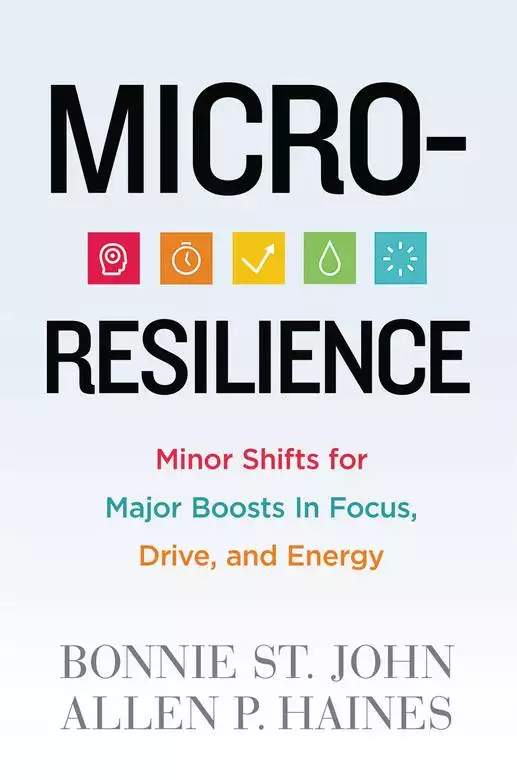
Learn powerful, science-based techniques to boost focus, drive and energy hour-by-hour throughout the day -- every day. As leadership consultants and executive trainers, Bonnie St. John and Allen P. Haines have heard the same complaints from clients for years; periodic burnout, lack of focus and low energy. So they dug into the latest research on neuroscience, psychology and physiology looking for big answers. Instead they found small answers; proof that small adjustments in daily routines, including thought patterns, food and drink, rest and movement can fight the forces that sap our energy and store focus and drive. They call these amazing efficient restorative techniques "micro-resilience." Thousands of men and women from all walks of life have already found effortless ways to incorporate these little changes into the busiest of schedules. Dozens of entertaining anecdotes from real people using micro-resilience demonstrate that when our brains fire faster, our energy increases and we can cope with almost any surprise, pressure or crisis.
Release date:
February 7, 2017
Publisher:
Center Street
Print pages:
352
* BingeBooks earns revenue from qualifying purchases as an Amazon Associate as well as from other retail partners.
If you met Elaine at a dinner party, you’d think she’s one of those people who somehow figured out a way to have it all. You’d hear her talk about what a supportive partner she has in her husband, Kevin. She’d have a dozen stories to tell you about her kids, four-year-old Jane and two-year-old Henry. And she’d be proud to announce that she’s running the final lap in the race to make partner in her full-service corporate law firm. Confronted with such high achievement, some men might want to believe that Elaine doesn’t really deliver the goods. They might think she was able to rise so high in her firm only because the partners wanted to show a lack of gender bias. Similarly, some women might try to convince themselves that Elaine hasn’t really told the whole story; she must have some deep-seated unhappiness or some hidden character flaw that she’s reluctant to reveal. But still, to all outward appearances, Elaine is a superwoman. She apparently embodies the cliché that all you have to do is “lean in.”
Dig deeper into her story, though, and you find the truth: Elaine is a hair-on-fire workaholic.
During our busy times it’s not unusual to get into work at eight o’clock in the morning and not leave until two a.m., six or seven days a week, for two or three months on end. In my line of business, it’s in your face all the time: get it done, get it done, get it done! And then I still have to find time to be a good wife and mother!
I’m used to going all out until I crash and I’m dead, over and over. I put forth 110 percent and want everything to be A-plus quality when I do it. I’m an all-or-nothing person. If I say, “I’m in,” I don’t just ante up and see the other players’ bets. I push all my chips across the table.
Elaine subscribed to a common fallacy among type A personalities: more work equals better work. The only way to succeed is to drive yourself until you hit a brick wall—and then do it again. Rest is for losers. A large international law firm (along with many other types of high-stakes businesses) traditionally demands this kind of work ethic. It is common practice for firms like this to engage their workforce in a kind of survival-of-the-fittest competition so they can weed out the “slackers.” Anything less than complete dedication implies a lack of strength and commitment that translates into less value to the organization. Thus people like Elaine come to believe that the only way to prosper is to put in more hours than the next person and make sure everybody knows it.
Elaine wasn’t just heading for burnout: she was on course for thermonuclear conflagration. And by the time she came to us for help, the fuse was lit.
Unlike most lawyers at big firms, I spend 100 percent of my time focused on one large government organization. This client represents more than forty-five thousand billable hours per annum and is the firm’s largest single client. The contract is coming up for renewal, and we have to compete with other firms who are dying to take the business away from us. Our team—including forty partners and more than three hundred associates, clerks, paralegals, and others—only has forty-five days to create a detailed, five-hundred-page response to the RFP [request for proposal], which is worth more than $100 million.
Did I say there is a lot riding on this? Basically, if we win this proposal I have a clear path to promotion into partnership. And if we don’t win this proposal… I have to find a new client. I don’t want to be dramatic about it, but my whole career is pretty much riding on the next forty-five days.
Elaine is a perfectionist as well as competitive by nature, so it was almost impossible for her to see a course of action other than the one she was used to—drive until you drop. And she’s not alone. It doesn’t matter if you work in a high-pressure corporate environment, sell real estate, tend bar, heal the sick, or toil as a full-time parent, the pace of our information-driven, globally connected twenty-first-century society forces us to accelerate down the tracks of modern life—and most of us feel dangerously close to flying off the rails. Rampant corporate “rightsizing” often demands twice as much from half the number of people. Our children boomerang back home after college while at the same time our parents need our support as they hit their golden years. We multitask ourselves into oblivion just to keep up. We push, we strive, we conquer!
And then we collapse.
Can we keep this up? Not if we continue to live exactly as we have up to this point. Like Elaine, we often drive ourselves past the point of exhaustion and then hope to catch up in the evenings, on weekends, or with a vacation. But often the bits of rest we do manage to achieve are co-opted by an array of technology that blips and bleeps with e-mail, text messages, Facebook updates, Instagrams, Snapchats, and whatever else keeps us plugged in 24-7.
So what do we do? Since the outward forces that exert stress on us are unlikely to disappear, our only choice is to look inward at ways we can better harness our natural human resources and adapt to the environment. We need to find a work-around that allows us to achieve the resilience we need to more quickly and efficiently bounce back when we inevitably get knocked off course. If the speed of life won’t slow down, we need to speed up our recoveries to stay ahead.
In a Harvard Business Review article entitled “Surprises Are the New Normal; Resilience Is the New Skill,” world-renowned sociologist and Harvard Business School professor Rosabeth Moss Kanter defines resilience as “the new skill” for the contemporary workforce. The ability to be resilient is not just “nice to have,” it has now become a “must have.”1
That’s what this book is all about: resilience.
But our definition of “resilience” is different from the word’s traditional meaning. According to Dictionary.com, resilience is “the power or ability to return to the original form… after being bent, compressed, or stretched.” Think of a sponge. When you squeeze a sponge, it will always spring back to its normal shape. But we believe that normal is not good enough; we focus instead on ways to bounce back better than normal.
Our approach differs from traditional notions of resilience in another important respect. When we tell people that our work is about helping our clients stay resilient, they often say, “I know someone who is very resilient; she bounced back from ___________.” You can fill in the blank: cancer, hurricane, divorce, or any other major ordeal that qualifies as something difficult to recover from. These extreme scenarios can be devastating, and a lot of support is available to help you manage these catastrophic events. But instead of taking the macro view of resilience—the long view, encompassing a process that often takes many years—we chose to exclusively study the day-by-day, hour-by-hour challenges of resilience. Our focus is on the ordinary interactions with friends, family, and coworkers that throw us into conscious or unconscious turmoil. For most of us, the hundreds of miniature bruises we experience each day determine the overall quality of our lives far more dramatically than the giant traumas that punctuate the decades.
Research conducted by Dr. James Loehr—a respected sports psychologist, author of The Power of Full Engagement, and the founder of the Johnson & Johnson Human Performance Institute in Orlando, Florida—intrigued us.2 Jim decided to find out what he could learn by studying athletes who dominated the world-class tennis circuit. He wanted to understand why there were hundreds of players on international tours but only a handful of champions who consistently took home the trophies. What made the difference for the athletes in this top tier? What are the habits that enable breakthrough performance under intense competitive pressure? Jim performed all sorts of analyses, but to his frustration, he couldn’t find any consistent differences among the best players.
Until he looked at what they did between the points.
A pattern jumped out immediately. As he sifted through several hours of video, Jim noticed that the top athletes exhibited very similar habits when they returned to the baseline after scoring and when they retired courtside between games and sets. These distinct, identifiable between-the-points behaviors were common to the winners and centered on energy recovery and positive focus. Jim put heart-rate monitors on these top players and found that they were able to bring their heart rates back to an ideal zone more quickly and efficiently than less successful competitors. The further he went down the list of seeded players, the more dramatic the differences were. Those at the bottom of the list employed almost none of these rejuvenating behaviors. They stayed keyed up, tense, and even distracted in the sixteen to twenty seconds that normally elapse between a point scored and the following serve.3
Jim used his discoveries to revolutionize sports training. He developed a series of focus exercises and relaxation techniques that teach players to shake off mistakes, release tension, project a confident image to their opponents, and establish rituals to increase consistency. Jim’s program, called the 16-Second Cure, is now an essential element of tennis coaching throughout the world.
Jim and his tennis players really got us thinking. He learned that by the last set of a three-hour tennis match, the competitor who had been using small, sometimes barely noticeable mini recoveries—what we began to call Micro-Resilience—between the points was likely to play much closer to the best of his or her ability than the player who didn’t. We began to think that micro-resilience was more than a way to help professional athletes recover energy on the tennis court: it also could help the rest of us develop the kinds of comeback skills we need to combat the blitzkrieg of stress in our lives. What if we all could stay closer to playing our A game all day, every day, by recharging our batteries as we go?
It turns out we really can retrain our brains, recharge our bodies, and adapt our lifestyles to meet twenty-first-century demands. We scoured research in the fields of neuroscience, psychology, and physiology to understand the specific forces that sap our energy. We then created a set of five strategies that can get us back on track quickly and efficiently.
In our workshops, we call these techniques “Frameworks” because they involve a new way of looking at our lives—a way of perceiving situations and framing problems that break us out of our old patterns of thinking. All these techniques are designed to speed up our daily recoveries “between points”:
1. Refocus Your Brain
2. Reset Your Primitive Alarms
3. Reframe Your Attitude
4. Refresh Your Body
5. Renew Your Spirit
Together they comprise micro-resilience—a set of minor shifts you can make throughout your day that yield major boosts in your energy and productivity.
It’s crucial to recognize that micro-resilience is different from what we refer to as macro-resilience—the set of more time-consuming habits, such as exercise, meditation, and careful nutrition, that give us increased energy and better health over the long term. Micro-resilience is in no way a substitute for these critical building blocks of physical and mental health. But macro processes take weeks and often months of diligent, consistent work to show results, and implementing this sustained attention is often where we fail. We fantasize that “someday” we will find time to make our macro investment in health, but our goalposts keep moving forward. How many times have you heard (or said), “I’ll do it when we mo. . .
We hope you are enjoying the book so far. To continue reading...

 Please log in to recommend or discuss...
