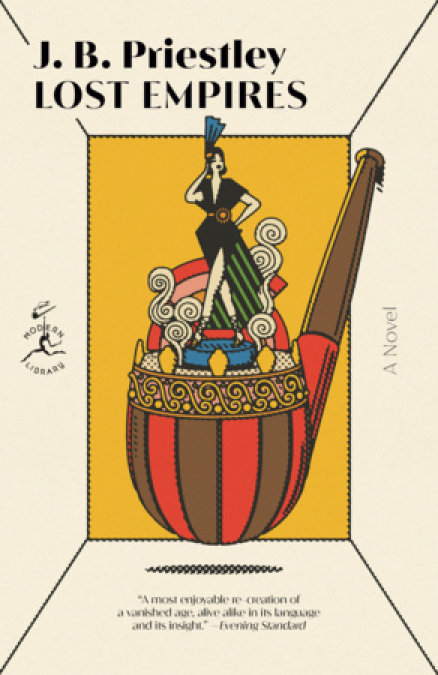
On the eve of World War I, a young painter is swept into the heady, now-vanished world of England’s traveling theater circuit in this lively coming-of-age novel by one of the twentieth century’s great, underappreciated masters.
England, 1913. Richard Herncastle is a young man who has recently found himself at a loose end, mourning the death of his mother and disillusioned with his office job. When his enigmatic Uncle Nick—an illusionist who takes his craft seriously—offers Richard a position as general assistant for his traveling variety act, it sounds like a fresh start, and an opportunity to stretch his creative wings as an aspiring painter.
As Uncle Nick’s troupe embarks on a grueling but often invigorating tour of England’s theaters and music halls, Richard finds himself immersed in a world of illusion and artifice. The performers he meets—magicians, comedians, dancers, singers, actors—are by turns eccentric, ambitious, cynical, and striving. But underneath the sheen and sparkle of showbusiness, there are darker currents: even as Richard embarks on a doomed affair with a beautiful older actress, Uncle Nick’s company becomes embroiled in a murder investigation.
Lost Empires captures a vibrant era of mass culture and entertainment, one that had already disappeared by the time of the novel’s first publication in 1965. With his hallmark mastery of colorful detail, snappy dialogue, and Dickensian character portraits, J. B. Priestley delivers a rich coming-of-age story, both nostalgic and timeless.
Release date:
September 29, 2026
Publisher:
Modern Library
Print pages:
384
* BingeBooks earns revenue from qualifying purchases as an Amazon Associate as well as from other retail partners.
To explain how my Uncle Nick asked me to join him, I have to go back to my mother’s funeral. This was late in October 1913. It was a raw day up at North Top cemetery, with not much light about; we looked like a lot of figures in an old wood engraving. It was a land of Christmas gone mad, because so many of the other mourners were ancient relatives I never saw except at Christmas, great-aunts with huge clicking sets of false teeth and accents so broad, with so many dialect words, they might have been talking a foreign language. I remember I felt nothing but the cold and a vague sense of depression. My mother had died after four months in the Infirmary, worn almost to a skeleton by the cancer that had been eating her alive, and after seeing her so often like that, only wanting to be released, I had no feeling left for her death and burial. But I was not enjoying myself, as the ancient relatives soon began to do after the coffin had vanished and they had dried their eyes. My Aunt Mary, mother’s only sister, was providing the ham and tongue and tea with a drop of rum in it; and I was wondering how soon I could escape from the rattle and chatter. Then I saw Uncle Nick, who had hardly spoken a word and had been looking disgusted, get up and beckon me to follow him out. I muttered something to Aunt Mary, and then went after him.
“You don’t want to stay with that lot, do you, lad?” He was climbing into the longest and thickest overcoat I had ever seen.
“No, I don’t, Uncle Nick. I was wondering how to get away.”
“You come with me. I want to talk to you anyhow.” He jammed on his head something rarely seen in the provinces in those days—a black trilby. “We’ll run down to the Great Northern. I need a drink. And one wouldn’t do you any harm, lad.”
It was only the middle of the afternoon, but bars were open all day then. I liked the idea of sitting in the Great Northern having a drink with Uncle Nick, especially at that time of day when I ought to have been staring at a ledger in the West Bruddersford Spinners’ office. I followed him eagerly into his motorcar, which was all new and shining and, he explained proudly, had just been delivered to him from France. It was the third car he had owned, and he said he could drive it, even though it was new, as well as any chauffeur. On the way down to the Great Northern, he was busy dodging the trams and the big horsedrawn drays, so he hardly spoke. But once inside the bar, leathery but cozy, and empty except for two wool men arguing about merinos and crossbreds and getting sozzled, he was a different man, easy and relaxed.
The oldish waiter recognized him at once. “Mr. Ollanton, isn’t it? Not on here this week, are you? No, I thought not.”
“Manchester,” said Uncle Nick. “And I won’t have to be too long starting to motor back there. So let’s have a bottle of Pol Roger sec in an ice bucket, sharp as you can.” He turned to me. “Never drink anything except champagne. It’s not showing off. I like champagne, and it likes me. If and when I can’t afford champagne, I’ll drink nothing. Care for a cigar, lad?”
“No, thanks, Uncle Nick. I’ll stick to my pipe, if you don’t mind.”
I watched him cut and then light his cigar, which he did slowly and carefully, with a sort of precision that was very characteristic of him, I realized. Not that I knew him very well, though he was my mother’s only brother. I hadn’t seen much of him before he went on the stage, chiefly because he and my father didn’t like each other; and then for the last ten years he had been touring in variety, not only in this country but also in America and on the Continent, for his Indian Magician act, not depending on language, could be played anywhere. After my father died, when I was fifteen, I had seen him several times as Ganga Dun, his stage name and suggested of course by Kipling’s Gunga Din, because whenever he was appearing in Leeds or Bradford he always sent mother and me passes for the stalls. These were nearly always for the first house, so that when we went round to see him he would be still in his Indian makeup, and I had hardly ever seen him without it. Now I looked hard at him.
He was tallish, thin, and very dark, with a hooked nose and a slight cast in his eyes that gave him a sinister look, which I think he cultivated. His real name was Albert Edward Ollanton, but he had been known as Nick long before he went on the stage; even my mother, who had clung to Albert Edward, had had to let go of them; and to me he had always been Uncle Nick.
When the waiter had poured out the champagne, Uncle Nick said to him, “Don’t go for a minute. Give you a free show. Got a ha’penny, one of you?” I had, and produced it. “Right, lad, now mark it so you’ll know it again. That’ll do. Now give it to me.”
He put it in his right-hand coat pocket, and then, only a moment later, brought out a small metal box, which he placed carefully on the table between us. “Now watch.” He opened the metal box and took out of it a matchbox, which had several elastic bands round it. When he had taken these off, he opened the matchbox and showed us a tiny silk bag, sealed by very small elastic bands. “Now you open that bag, lad.” I did, and of course inside it was my ha’penny.
“That’s clever,” cried the waiter. “My word, that is clever, Mr. Ollanton.”
“I’ve dozens of ’em,” said Uncle Nick. “Only thing that amuses me nowadays—miniature pocket tricks. But the show’s over—and I want to talk to this nephew of mine, so off you pop. We’ll take a drink first, though,” he added, to me.
I didn’t like the champagne, which seemed to me to have a metallic sort of taste and also stung the inside of my nose, but I pretended to be enjoying it and grinned across at Uncle Nick, who was now staring at me in his saturnine fashion. I don’t often come across stage people nowadays, and when I do they look like anybody else; but in 1913 they seemed like specimens of an alien race. The men at least had a curious sallow-shiny look and their eyes were dark-rimmed as if they couldn’t get rid of the black on their eyelashes; and this made my uncle all the more Nickish and sinister. It would be too much to say he frightened me—after all, he was my uncle—but it was no joke being stared at by him across a table, and I couldn’t imagine myself disagreeing sharply with anything he might say.
“Now, Richard lad, I want to know how you stand—what you’re doing—what you’d like to be doing. Just tell me straight. No fancy work. And short as you can make it because I haven’t all that time.”
“I want to be a painter, Uncle Nick—watercolors mostly. And if my father hadn’t died, I was going to the Art School. But as it happened—”
“You’re a clerk in an office—”
“Yes, they gave me a job because my father had been cashier there. I’m getting twenty-two-and-six a week now—”
“But you don’t like it—”
“I hate it. But what could I do? I’ve been going to some evening classes at the Art School, and I do some sketching on Saturday afternoons and Sundays—”
“Yes, yes, yes.” Uncle Nick waved his cigar between us. “Your mother needed the money and you did what you could. You’re a decent lad, Richard.”
“You helped too, Uncle Nick.”
“Ah—you knew that, did you? Well, she could have had more, if she’d wanted it, but you know how she was. Now let’s see how you stand, Richard. Your mother’s gone—you earn twenty-two-and-six pen-pushing—and you’ve got no girl expecting you to marry her, have you, lad? No? Good! Well, you can have a job with me at five pounds a week.”
“Five pounds a week!” I couldn’t believe it. I had never seen myself earning five pounds a week for years and years. It seemed a lot of money then. I knew chaps who lived the life of rollicking men-about-town on far less than five pounds a week. “But what could I do that would be worth so much?”
Uncle Nick stared at me almost malevolently. “Don’t get wrong ideas. This is business, lad. You’ll earn your money, though you’ll be free in the daytime to do your painting. I’m paying you exactly what I’ve been paying the young man whose place you’ll take. He’s leaving—going into the fish-and-chip trade with his older brother in Sheffield— and that’s all right to me because he’s such a miserable empty-headed young bugger I could never spend ten minutes talking to him. You might be a bit of company for me. Or am I wrong?” He didn’t smile but just looked hard at me.
“I hope not, Uncle Nick.” I tried to give him a smile. “But what would I have to do? And could I do it? I don’t know anything about conjuring.”
We hope you are enjoying the book so far. To continue reading...

 Please log in to recommend or discuss...
