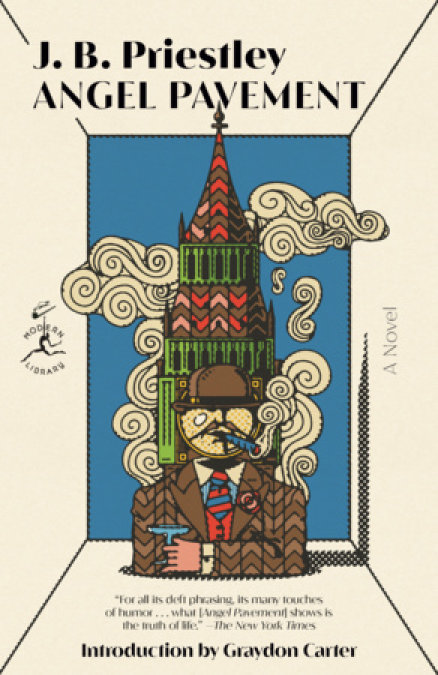
The struggling firm of Twigg & Dersingham is brought to riches—and ruin—in this kaleidoscopic portrait of late 1920s London from one of the twentieth century’s great, underappreciated masters.
On a grim sidestreet of the City of London called Angel Pavement, the office of Twigg & Dersingham carries out its day-to-day operations far from the decadence of the Roaring Twenties. The firm is now run, less than competently, by the nephew of the original Dersingham; to cut costs, he knows he must fire one of his few employees to have any hope of keeping the business afloat. Longtime head clerk Mr. Smeeth is desperate to not lose his job, but Mr. Dersingham really has his eye on junior clerk Mr. Turgis—awkward, unfashionable, and convinced that he’s about to stumble upon the love of his life—or typist Ms. Matfield, who left her home in the suburbs to live as a modern woman in the city, and who now wonders whether there’s more to modern life than this.
Enter the Golspies. When Mr. Golspie appears at the office on Angel Pavement from whereabouts unknown, his beautiful daughter Lena at his side, he presents a business proposition that Mr. Dersingham feels sure will save them. But of course, offers that seem too good to be true often are—and this one will set the firm and each of its employees on a course for disaster.
First published in 1930, Angel Pavement is a sweeping London novel in the vein of Dickens, Thackeray, Wolfe, and Amis, populated by a cast of richly developed characters and gilded by J. B. Priestley’s deft wit, which feels startlingly fresh in our own rapidly changing world.
Release date:
September 29, 2026
Publisher:
Modern Library
Print pages:
496
* BingeBooks earns revenue from qualifying purchases as an Amazon Associate as well as from other retail partners.
Many people who think they know the City well have been compelled to admit that they do not know Angel Pavement. You could go wandering half a dozen times between Bunhill Fields and London Wall, or across from Barbican to Broad Street Station, and yet miss Angel Pavement. Some of the street maps of the district omit it altogether; taxi-drivers often do not even pretend to know it; policemen are frequently not sure; and only postmen who are caught within half a dozen streets of it are triumphantly positive. This all suggests that Angel Pavement is of no great importance. Everybody knows Finsbury Pavement, which is not very far away, because Finsbury Pavement is a street of considerable length and breadth, full of shops, warehouses, and offices, to say nothing of buses and trams, for it is a real thoroughfare. Angel Pavement is not a real thoroughfare, and its length and breadth are inconsiderable. You might bombard the postal districts of EC1 and EC2 with letters for years, and yet never have to address anything to Angel Pavement. The little street is old, and has its fair share of sooty stone and greasy walls, crumbling brick and rotting woodwork, but somehow it has never found itself on the stage of history. Kings, princes, great bishops, have never troubled it; murders it may have seen, but they have all belonged to private life; and no literary masterpiece has ever been written under one of its roofs. The guide-books, the volumes on London’s byways, have not a word to say about it, and those motor-coaches, complete with guide, that roam about the City in the early evening never go near it. The guide himself, who knows all about Henry the Eighth and Wren and Dickens and is so highly educated that he can still talk with an Oxford accent at the very top of his voice, could probably tell you nothing about Angel Pavement.
It is a typical City side-street, except that it is shorter, narrower, and dingier than most. At one time it was probably a real thoroughfare, but now only pedestrians can escape at the western end, and they do this by descending the six steps at the corner. For anything larger and less nimble than a pedestrian, Angel Pavement is a cul-de-sac, for all that end, apart from the steps, is blocked up by Chase & Cohen: Carnival Novelties, and not even by the front of Chase & Cohen but by their sooty, moldering, dusty-windowed back. Chase & Cohen do not believe it is worth while offering Angel Pavement any of their carnival novelties—many of which are given away, with a thirty shilling dinner and dance, in the West End every gala night—and so they turn the other way, not letting Angel Pavement have so much as a glimpse of a pierrot hat or a false nose. Perhaps this is as well, for if the pavementeers could see pierrot hats and false noses every day, there is no telling what might happen.
What you do see there, however, is something quite different. Turning into Angel Pavement from that crazy jumble and jangle of buses, lorries, drays, private cars, and desperate bicycles, the main road, you see on the right, first a nondescript blackened building that is really the side of a shop and a number of offices; then The Pavement Dining Rooms: R. Ditton, Propr., with R. Ditton’s usual window display of three cocoanut buns, two oranges, four bottles of cherry cider picturesquely grouped, and if not the boiled ham, the meat-and-potato pie; then a squashed little house or bundle of single offices that is hopelessly to let; and then the bar of the White Horse, where you have the choice of any number of mellowed whiskies or fine sparkling ales, to be consumed on or off the premises, and if on, then either publicly or privately. You are now halfway down the street, and could easily throw a stone through one of Chase & Cohen’s windows, which is precisely what somebody, maddened perhaps by the thought of the Carnival Novelties, has already done. On the other side, the southern side, the left-hand side when you turn in from the outer world, you begin, rather splendidly, with Dunbury & Co.: Incandescent Gas Fittings, and two windows almost bright with sample fittings. Then you arrive at T. Benenden: Tobacconist, whose window is filled with dummy packets of cigarettes and tobacco that have long ceased even to pretend they have anything better than air in them; though there are also, as witnesses to T. Benenden’s enterprise, one or two little bowls of dry and dusty stuff that mutter, in faded letters, “Our Own Mixture, Cool Sweet Smoking, Why not Try it.” To reach T. Benenden’s little counter, you go through the street doorway and then turn through another door on the left. The stairs in front of you—and very dark and dirty they are, too—belong to C. Warstein: Tailors’ Trimmings. Next to T. Benenden and C. Warstein is a door, a large, stout, old door from which most of the paint has flaked and shredded away. This door has no name on it, and nobody, not even T. Benenden, has seen it open or knows what there is behind it. There it is, a door, and it does nothing but gather dust and cobwebs and occasionally drop another flake of dried paint on the worn step below. Perhaps it leads into another world. Perhaps it will open, one morning, to admit an angel, who, after looking up and down the little street for a moment, will suddenly blow the last trumpet. Perhaps that is the real reason why the street is called Angel Pavement. What is certain, however, is that this door has no concern with the building next to it and above it, the real neighbor of T. Benenden and C. Warstein and known to the postal authorities as No. 8, Angel Pavement.
No. 8, once a four-story dwelling-house where some merchant-alderman lived snugly on his East India dividends, is now a little hive of commerce. For the last few years, it has contrived to keep an old lady and a companion (unpaid) in reasonable comfort at The Palms Private Hotel, Torquay, and, in addition, to furnish the old lady’s youngest niece with an allowance of two pounds a week in order that she might continue to share a studio just off the Fulham Road and attempt to design scenery for plays that are always about to be produced at the Everyman Theatre, Hampstead. It has also indirectly paid the golf club subscription and caddie fees of the junior partner of Fulton, Gregg, and Fulton, the solicitors, who are responsible for the letting and the rents. As for the tenants themselves, their names may be found on each side of the squat doorway. The ground floor is occupied by the Kwik-Work Razor Blade Co., Ltd., the first floor by Twigg & Dersingham, and the upper floors by the Universal Hosiery Co., the London and Counties Supply Stores, and, at the very top, keeping its eye on everybody, the National Mercantile Inquiry Agency, which seems to be content with the possession of a front attic.
This does not mean that we have now finished with No. 8, Angel Pavement. It is for the sake of No. 8 that we have come to Angel Pavement at all, but not for the whole of No. 8, but only for the first floor. No doubt a number of tales, perhaps huge violent epics, could be started, jumped into life, merely by opening the door of the Kwik-Work Razor Blade Co., Ltd., or by trudging up the stairs to the Universal Hosiery Co. and the London and Counties Supply Stores, or by looking up at the grimy skylight, and giving a shout to the National Mercantile Inquiry Agency; but we must keep to the less mysterious but more respectable first floor—and Twigg & Dersingham.
We hope you are enjoying the book so far. To continue reading...

 Please log in to recommend or discuss...
