
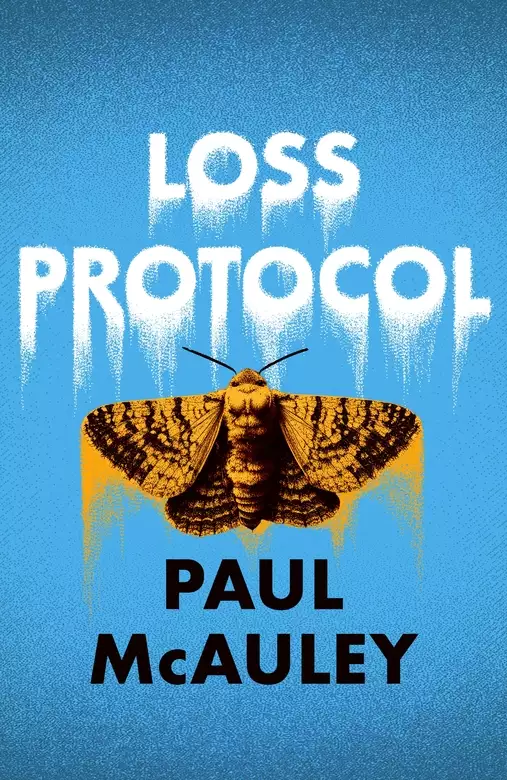
Loss Protocol
- eBook
- Audiobook
- Hardcover
- Book info
- Sample
- Media
- Author updates
- Lists
Synopsis
Eight years after the catastrophic downfall of the cult his sister Izzy had joined, Marc Winters has at last found a refuge from unwanted attention. The wildlife ranger of a small, unremarkable island, he's quietly helping to preserve what survives of nature in a world wracked by climate change and chaotic weather, and trying his best to put his past behind him.
But then his narrowboat is burgled, the counterterrorism police come calling, and everything he thought he knew about the cult and his sister's fate is turned upside down. A cabal of so-called deep dreamers has revived the cult's crazy belief that the world could be healed by collective dreams fuelled by psychotropic mushrooms. They appear to think that Winters possesses information crucial to their success, and when he tries to discover more about them, he becomes inextricably entangled in plans that challenge his very existence.
Blending noir-inflected conspiracies and double-crosses, fantasies of dream science and elegiac evocations of a depleted world, Loss Protocol's chimerical story keeps its secrets until the last page
Release date: February 12, 2026
Publisher: Orion
Print pages: 384
* BingeBooks earns revenue from qualifying purchases as an Amazon Associate as well as from other retail partners.
Reader buzz
 Please log in to recommend or discuss...
Author updates
Loss Protocol
Paul McAuley
When it was light enough Winters pulled on his clothes and set off around the perimeter of the island to check for storm damage, following the boardwalks and raised paths that snaked through the marsh and the salt-willow brakes. He visited the bird hide that overlooked a pond circled by reeds, walked to the platform at the far end of the marsh where a pair of composting toilets stood, and climbed through the patchwork woods strung along the shallow rise of the island’s backbone.
Cynsea. His little kingdom. A world entire.
The wet planks of the boardwalks were littered with smashed leaves and broken twigs, washouts had bitten into edges of the path to the tidal causeway that linked the island to the mainland, and a freshet snaking downslope had undercut a flight of steps at the seaward end, but there wasn’t anything that required immediate attention. Still restless, he stripped the cover from the skimmer and took it out on a loop around the archipelago of mudbanks that curled downstream. Rain had rinsed the air clean. The sky was a cloudless dome of unblemished blue. In shallows fringing the remnants of the island’s old breakwater, shoals of tweaked mussels were pumping water through their gills and filtering out microplastic particles, layering them into the world’s ugliest pearls. A troop of flamingos, descendants of escapees from a private zoo, browsed at the edge of a mudflat, strutting and dipping like regal stiltwalkers. Swallows traced erratic arcs above the river’s flood, their twittering cries carrying faint but clear across the water. And further out, high above the navigation channel, a scattered cloud of airjellies was drifting towards the north shore, their black, fist-sized bells trailing tangles of delicate filaments.
Winters aimed his phone at the cloud and asked his assistant to check its direction and speed, blipped the data to a couple of drones and let the skimmer drift on the outgoing tide as they whirred out from the island, square catchnets strung beneath their landing gear. After they’d made their first cut through the airjellies, he restarted the skimmer’s motor and made a wide turn and headed back towards Cynsea, planning to log the sighting and make his daily count of victims of the crab die-off before the island’s first visitors arrived.
He was halfway home when he spotted the dark shape on the grassy hump of a mudbank. About the right size for a seal, although seals had vanished from the coasts of England, Scotland and the Principality more than twenty years ago, killed off by a virulent strain of distemper. Still, there was the small possibility that it was a vagrant from the last surviving pods in Norway or Iceland, and even if it was dead it would be a solid tick mark. A mention in the agency’s dispatches, might even make the local newsfeeds. As he nosed the skimmer towards the mudbank’s blunt crescent half a dozen gulls lofted into the air and tilted away, more than he’d seen in any one place for a while, and the shape shortened and stood up and he realised that it was a person, arms raised above their head and crossing and uncrossing in the classic semaphore for help.
The castaway was a slender androgenous kid dressed in an old, oversized wetsuit, cuffs bunched at wrists and ankles, a long rip in one calf exposing a nasty looking gash. Black hair clipped short, dried in uneven spikes. Brown skin and solemn dark eyes, good cheekbones and a serene, slightly otherworldly air, as if being stranded on a mudbank in the middle of the estuary wasn’t especially unusual. No big deal. Their name was S Odice, they told Winters. No, the S wasn’t an initial or short for anything. Just S. They/them. On the drift, no fixed address. Reciting these bare facts wearily, as they’d no doubt recited them many times before.
‘That’s a Bristol accent, isn’t it?’ Winters said, trying for a connection. ‘I grew up not far away, in Gloucestershire.’
The kid’s shrug was a minimal twitch of one shoulder. They were standing at the edge of a rippled apron of mud exposed by the receding tide, squinting at Winters and his skimmer riding in shallow water a few metres away.
‘Hop on,’ Winters said. ‘We’ll get your leg fixed up.’
‘No hospitals.’
‘I didn’t say I’d take you to one. We’ll head to my place, over on the island there. I have a good first aid kit, and I know how to use most of it.’
‘Are you some kind of police?’
‘I’m a wildlife ranger.’
‘Of that island?’
‘Cynsea Island, yes. These mudbanks, too.’
‘You going to arrest me?’
‘For what? You signalled, I came to help. Which is my job, or part of it anyway.’
The kid thought about that for half a minute, then picked up a pair of swim fins, a dive mask and a canvas weight belt and waded out to the skimmer. After they’d clambered aboard Winters handed them his steel water bottle and they sucked on its spout greedily, tilting the bottle to get the last drops, asking him if he had any more.
‘There’s plenty in my narrowboat.’
‘I tried drinking the river water, but it’s hella salty.’
‘The tides mix it up with seawater. How long were you stuck there?’
‘Most of the night.’
‘Out in the rain?’
For the first time a trace of animation broke through the kid’s laidback demeanour.
‘That was interesting. Thought I might drown, or be washed away. Had to dig in and hunch down until the worst was past.’
Winters reversed the skimmer in a churn of silty water and turned its blunt prow towards the island. ‘How did you end up there?’
‘Was working a car reef,’ the kid said, addressing the air off to one side of Winters. ‘One of the ones off Mersea? Got caught in a current and swept downstream, washed up here.’
Winters knew about the car reefs, where thousands of scrapped vehicles had been dumped in an attempt to prevent coastal erosion; knew that a crew of local chancers, the Lamb brothers, hired drifters to work as salvage divers, paying them a pittance and selling the electronics and catalytic converters they recovered to the recycling plant over in Gravesend. Blatant exploitation, though legal. But the reefs were more than twelve kilometres away, near the mouth of the estuary, and he thought it more likely that this castaway had been raiding one of the nearby oyster farms. They’d been working alone and got into trouble and ended up here, or had been working with a crew who’d dumped them on the mudbank after some kind of disagreement.
‘If you were working on the car reefs, what happened to your salvage?’
‘My what?’
‘Reef divers usually have net bags they hang from their belt, fill up with the stuff they find. Their salvage. Looks like you lost your air bottle and regulator, too.’
‘Didn’t have an air bottle.’
‘You were free-diving the reefs?’
‘I’m a good swimmer.’
‘But not good enough to stay out of trouble. Even if you know the tides and currents, you can easily get into serious difficulty out here. You were lucky to have ended up on that mudbank. Lucky I spotted you.’
The kid shrugged.
‘If I were you, I’d take it as a sign,’ Winters said.
‘A sign?’
‘That you should find another line of work.’
In the narrowboat’s cabin, the kid drank two glasses of water, wriggled out of their wetsuit and, in shorts and a frayed T-shirt, sat with a kind of rigid stoicism while Winters examined the gash in their leg. It was long and ragged but not especially deep, and had mostly stopped bleeding. Winters soaked cotton pads in boiled water and cleaned the gash and patted it dry, painted it with prion solution and closed it up with wound glue and bandaged it. Told the kid to keep it clean, try to keep their weight off it as much as possible and see a doctor if there was any sign of infection, and found them a freshly laundered T-shirt.
‘Your feet are about half my size, so you’ll have to go barefoot.’
‘Okay.’
‘I have to ask – how old are you?’
‘Old enough.’
‘How old’s that?’
‘Eighteen.’
‘You have some ID?’ Winters said, because the kid looked a year or two younger than that. A possible school-age runaway from some crisis or horrorshow. There were far too many like that on the drift.
The kid pulled a zipbag from the back pocket of their shorts and took out their ID card and handed it to Winters. Under a long string of numbers and letters, a photo of the kid rotated to the left and rotated back to face forward again. S Odice, born April 28th 2060, non-binary, a Bristol address.
‘So you’re eighteen, but only just,’ Winters said.
The kid shrugged.
‘You look younger.’
‘I get that a lot.’
‘This address, is that where your parents live?’
‘Where I was living, once upon a time.’
Winters gave the ID card back to the kid. ‘Before you went on the drift.’
The kid shrugged again, dropped the ID card into the zipbag and stuck it in their pocket.
‘When did you leave?’ Winters said.
‘A few years ago.’
‘Two years? Three?’
‘Something like that.’
‘Are you still in contact with your parents?’
‘Not really. And it isn’t any business of yours.’
‘It would have been my business a month ago. Before your eighteenth birthday. But not any longer. Is there anyone who might have reported you missing, might be worried about you?’
The kid shrugged.
‘How about someone you could call, ask to come pick you up? If you’ve lost your phone you can use mine.’
Another shrug.
Winters knew he wasn’t getting anywhere and pointed to the head, told the kid that they could wash up there. When they came out, face scrubbed and hair slicked down, the hem of their new T-shirt around their knees, Winters had brewed a pot of tea and was sitting on the L-shaped couch behind the little table, smoking what was left of last night’s joint. The kid sat as far away from him as possible, wary as a cat in a strange house, but accepted a mug of tea and an energy bar, asked Winters how long he’d been living there.
‘Coming up for two years.’
The kid unwrapped the energy bar and took two big bites. ‘Looks like you just moved in, you don’t mind me saying. Could do with, I don’t know. Some pictures. Flowers. Unpacking those boxes.’
‘It suits me,’ Winters said, and took a long drag on the joint and blew out a riffle of smoke and offered the stub to the kid.
‘I don’t do that stuff.’
‘Good for you,’ Winters said, and licked his finger and thumb and pinched out the stub’s coal.
The kid took another bite of their energy bar and said around it, ‘You seem pretty cool, for the law.’
‘I’m not anything like the law. More a sort of caretaker.’
‘Did you set those drones on the jellies?’
‘You saw that, huh?’
‘Jellies are mostly harmless, aren’t they? Why you so down on them?’
‘They’re proscribed biotech, designed by some hobbyist to absorb pollutants from the air. But they also sweep up insects, so if too many people release too many jellies it could cause all kinds of harm. Crops failing because there aren’t enough pollinating insects. Fledglings starving in nests because birds can’t catch enough insects on the wing.’
‘Everything’s connected to everything else,’ the kid said.
‘Yeah. Kick a rock, start an avalanche. So I had a thought while you were washing up. Someone I know, Teddy Stokes, might need some help. He grows all kinds of produce in his allotment, has a gleaner’s licence too. You know anything about gardening, or foraging for wild food?’
The kid shrugged.
‘Doesn’t matter. Teddy can teach you all you need to know, and he sort of owes me a favour. If you like, I’ll give him a call, let him know you’re looking for work. He lives over in Tollesbury, but your best bet is to catch him at his stall in the green market. He’s there every Saturday.’
The kid ate the last chunk of their energy bar. ‘Why are you doing this?’
‘I don’t know. Maybe it’s my turn to help someone out. Reckon you can walk on that leg?’
The kid nodded.
‘I’ll walk you to the causeway. Take another energy bar for the road. Grab a handful if you want.’
The causeway was a sandy path just wide enough for a single vehicle, raised on a low embankment curbed by boulders and swatches of seaweed and looping away towards the mainland shore like a child’s scribble, its far end obscured by a shimmering haze. The freshness after the rain had burned off and the morning was growing ever hotter.
The kid shielded their eyes with their forearm and studied the causeway and said, ‘Can’t you take me in your boat?’
‘I have things to do here. As long as you’re quick you won’t get washed away again.’
‘Really?’
‘No, I’m kidding. Tide’s just about on the turn, but you have plenty of time to get across. Even with that gimpy leg.’
‘My leg’s good.’
‘Keep that cut clean,’ Winters said. ‘And don’t forget about Teddy Stokes. You can’t find his stall in the green market, just ask around. Everyone there knows old Teddy.’
He watched as the kid limped away down the causeway, wetsuit rolled up and tucked under their right arm, swim fins dangling from their left hand, dive mask hung around their neck. A small stubborn figure dissolving into the glare of light on water. Winters sometimes took in injured or exhausted birds, tried as best he could to nurse them back to health, and felt the same way now as when he let one of those birds go. Knowing that it was the right thing to do, but also knowing how hard it was for a broken thing to survive in this world.
‘Here he comes, the hero of the mudbanks,’ Mic Thomas said, when Winters came into the room, and Embry Clarke turned in his chair and greeted him with a slow handclap and a couple of high-pitched yelps.
‘If I had to guess what that was meant to be, a seal would be the last in a very long list,’ Winters said.
This was in the back room of Heybridge Basin’s harbour office. The monthly meeting of the rangers in charge of reserves in and around the Blackwater Estuary. Half a dozen people in agency jackets and shorts sitting on stacking chairs in a loose semicircle. Evening sunlight burning at the edges of blinds pulled down over a pair of windows. A ceiling fan stirring soupy air.
Embry laid an arm along the back of his chair and smiled at Winters. ‘And how is your seal boy?’
‘They aren’t a boy. Or a girl, either. And they’re doing fine, as far as I know.’
‘My bad,’ Embry said, not at all abashed. ‘So were you really hoping you’d found an actual live seal?’
‘For maybe half a minute.’
‘A grey seal or a harbour seal? Or maybe a Weddell seal, on holiday from Antarctica.’
‘Give it a rest, Embry,’ Jude Lee said.
‘Walruses,’ Jon Holderness said.
‘Even more unlikely than a seal,’ Mic Thomas said.
‘They’d visit now and again, back in the day,’ Jon said. He was the oldest of the group, white hair pulled back from his weather-beaten face and tied with a black ribbon at the back of his neck. ‘Young males, usually, on what you might call a walkabout. Looking for new territory or maybe just seeing something of the world. They’d lounge about on slipways or buoys, climb on boats at anchor. And they’re big animals, walruses. Weigh a tonne or more. Nothing you could do if one decided to settle on your shrimper or sailboat. You’d just have to wait until it lost interest and left of its own accord.’
‘Well, they’re all gone now,’ Mic said.
‘There’s still a few in Canada,’ Jon said. ‘I don’t know if one could make it all this way, but it wouldn’t surprise me if it did.’
Embry looked at Winters and said, ‘Would you have checked him, excuse me, checked them out if you’d known they were just a drifter from the get-go?’
‘What would you have done?’
‘I wouldn’t have left them there, but I wouldn’t have turned them loose until I’d found out what they’d been up to.’
‘They claimed they were working on the car reefs.’
‘I mean what they’d really been up to.’
‘Embry has a point,’ Honey Yong said.
‘The point being that maybe it’s a good thing it wasn’t his call,’ Jude said.
‘It was Marc’s rescue, his decision,’ Nina Patel, the senior ranger, said. ‘And I don’t see any harm in treating a drifter with a little kindness. If you’re all done with that topic, let’s make a start on our actual agenda. We’re already running late.’
Winters filled a chipped mug with tea from the big aluminium teapot and took a seat as Nina announced that the first item was a note about the crab die-off.
‘Tell me they’ve finally found what’s causing it,’ Embry said.
‘Unfortunately, that’s still undetermined,’ Nina said. ‘We’ve been reminded that it is important to collect carcasses from our chosen strips of shore every day, and log species counts as well as overall numbers. Apparently some gaps have begun to appear in the records. I know it’s been several months now, and I’m as tired of it as anyone else, but we need to stay on top of it. And also make sure we burn everything we collect.’
The die-off had begun late that spring, when thousands of Chinese mitten crabs had crawled out of estuaries and rivers along the east coast. Aimless armies wandering across mudflats and nearby fields and roads before expiring. At first, there was no particular urgency to investigate. Mitten crabs were a prolific and widespread invasive species that would never make a red list anytime soon, even in these parlous times. But then the corpses of other species, green shore crabs and edible crabs, spider crabs and velvet swimming crabs, began to wash up, there were mass deaths in offshore crab farms and hatcheries, and catches in the few licensed traps still in operation dropped precipitously. Water temperatures along the east coast were no higher than average, there weren’t any toxic algal blooms and the crabs weren’t suffering from excessive parasite infestations or from shell disease, white leg disease or other common bacterial or viral infections, didn’t have unusual loads of dioxins, PCBs, organochlorides or heavy metals. The cause of the die-off appeared to be a synergistic combination of sub-lethal factors. As if the environment itself had become toxic.
‘There haven’t been so many to collect and count in the past couple of weeks,’ Honey Yong said. ‘Maybe it’s easing off.’
‘Or maybe there aren’t many crabs left,’ Embry said. ‘The agency really doesn’t have any strategy but watch and wait?’
‘I don’t like it any better than you do, but those are our instructions,’ Nina said, and crisply moved on to the other items on the agenda. Short- and long-range weather reports, precautions for the fire season, and an announcement that the new eelgrass initiative had been green-lit. Which was, Mic Thomas pointed out, no different from the old eelgrass initiative, five years ago. It had failed then, she said, so why was the agency wasting everyone’s time by trying again?
‘Try again, fail better,’ Embry said. ‘Our unofficial motto.’
‘If you’d read the briefing, you’d know that this is a new strain, with new tweaks,’ Nina said. Standing straight-backed at the lectern, fixing her gaze on Embry like a school teacher challenging a disruptive pupil. ‘First tested in Spurn Bight last year, now approved for testing in several new locations. Including Blackwater. The team which ran the Spurn Bight project will set up the trial beds, and most of the monitoring will be done remotely. If those trials are successful, the beds will be expanded, creating new habitats for marine life. Increasing species diversity, and also acting as an efficient carbon sink.’
‘This is the official word,’ Embry said.
‘That’s what you’ll tell anyone who asks about it, yes. No talk about failing better.’
Embry touched his brow with a forefinger. ‘Whatever you say.’
‘And if anyone asks about disturbances this experiment could cause?’ Honey said. ‘If fishers and gleaners, the owners of shellfish and kelp farms, are worried about effects on catches and productivity. What do we tell them?’
‘The outreach team will be in contact with people who have commercial interests in the estuary,’ Nina said. ‘But if anybody raises a concern, you can tell them that the project involves only a small number of carefully chosen and rigorously monitored sites. And that it has the potential to increase fish populations and the estuary’s overall health.’
‘And if it doesn’t work out, like last time? Or like the bumblebees?’ Embry said. ‘What’s our script then?’
‘It’s too early to think about that, but I’m sure the agency has it covered. Planting out the trial beds will begin in four weeks. And we will of course fully cooperate,’ Nina said, and asked if there were any matters outwith the agenda.
Mic wanted to know if there had been any movement on her request to repair last winter’s storm damage to the causeway to Northey Island, it wasn’t getting any better by itself and couldn’t be fixed by a few bags of gravel. Nina promised that she’d chase it up, and Jude raised his hand and said that a white-spotted bluethroat had been seen in the reedbeds along the edge of St Lawrence Creek. ‘It’s only been a couple of days since the first sighting was posted, but it’s already attracting birders. We should expect more as word spreads.’
‘Remind them that if they want to visit Northey they’ll need to book,’ Mic said.
‘I’m sure they will,’ Jude said. ‘They’re generally a well-behaved bunch.’
‘If there’s nothing else,’ Nina said, and as usual closed out the meeting with the little ceremony, the loss protocol, that memorialised a species recently pronounced extinct in totality.
Most were obscure, because part of the point of the loss protocol was to remember everything that was gone from the world. Not just the charismatic and keystone species, but also the foot soldiers, the marginal and overlooked plants and animals whose disappearance made only the smallest of holes in the world. This time it was the Lesser Lichen Case-bearer moth, Dahlica inconspicuella. An image of a drab insect with dusty brown wings kindled in the air beside Nina, and Winters and the other rangers watched in deferential silence as a sequence of short sentences scrolled up, explaining that the Lesser Lichen Case-bearer moth had been locally common in parts of England, but was found nowhere else in the world. The specimen displayed was a winged male. The females had been wingless, emerging from cocoons and mating and laying a clutch of eggs and dying, the eggs hatching into larvae which, protected by cases got up from silk and sand grains and lichen fragments, grazed on lichen and grew and eventually spun cocoons and transformed into short-lived adults.
There were people who had, over years and decades, mapped the moth’s locations, catalogued variant styles of larval casings and wing patterns, and monitored its slow decline, but this, the official recognition of its final end, was the only moment when it achieved any kind of significance. An exemplar of all that had been lost. The most beautiful and most wonderful forms that couldn’t be saved.
I never knew you, Winters thought, as he often did, but I’m sorry that you’re gone.
Later, sharing a joint with Jude after the communal meal, he said, ‘I’ve come to the conclusion that I shouldn’t have mentioned seals in my report.’
‘It was a nice touch,’ Jude said. ‘And pay no mind to Embry. He can be an asshole sometimes. Doubles down when someone calls him on his bullshit.’
The two of them were sitting on a bench on the patch of scorched and threadbare grass between the Old Ship pub and the sea lock and floodgates which, at high tide, allowed passage of boats between Heybridge Basin and Colliers Reach and the rest of the estuary. The last of the sunset was fading from the darkening sky. Lights shone on the decks and in the portholes of boats moored two or three deep in the basin and the moon-coloured streetlamps along the basin and the promenade behind the sea wall had switched on.
‘What did he mean by that remark about bumblebees?’ Winters said.
After almost two years on post, he still hadn’t untangled the old disputes and rivalries, the losses and small victories, that informed the back-and-forth between the rangers.
‘One of the agency’s first attempts at reintroduction hereabouts,’ Jude said. ‘They bred up two species of bumblebee and released them in the reserves. Both species were once native here, and both died out inside a year. The agency tried it again, same result. Things had changed too much. The bees couldn’t hack it anymore.’
Winters passed the joint and said, ‘So Embry had a legitimate point, Mic too, if this is the second go-around with eelgrass.’
Jude sucked on the joint and breathed a long riffle of smoke into the hot dark air. He was the youngest of the estuary’s five rangers, a calm, amiable, self-sufficient person with elf-locked red hair and a broad sunburnt face who seemed to have unfolded smoothly and completely from child to adult without any of the usual transitional stresses, crises and doubts.
‘Maybe this new strain will take hold,’ he said. ‘I hope it does. But sometimes it’s hard to justify trying to bring back what’s been lost when we barely have the resources to protect what’s survived.’
‘That’s kind of cynical, you don’t mind me saying.’
‘It’s the nature of our work,’ Jude said, and took another puff on the joint and handed it back to Winters. ‘What is this weak shit?’
‘Goodberry Tea.’
‘You’re still buying from Teddy Stokes.’
Winters took a long drag on the joint and breathed out smoke and said, ‘He’s the only one who sells it.’
‘He knows what his customers like. Something homegrown, but innocuous. Something that’ll give you the same kind of buzz as a nice Chardonnay,’ Jude said, and shook his head when Winters offered him the joint again. ‘Hit me up in a few days. I should have some new stuff you can try.’
‘This would be more of that weird gear peddled by drifters,’ Winters said, and took a last quick puff and ground out the nubbin’s last spark in the dry dirt between his boots.
‘The last batch you tried was pretty good.’
‘It was still kicking me in the head the next day, if that’s what you mean.’
‘I’ve been told that this new stuff is strong but mellow,’ Jude said. ‘“A ride as smooth as silk” was the sales pitch.’
‘I’m not sure if any of it can even be called marijuana.’
‘It mostly is. Just tweaked in interesting ways. Speaking of drifters, do you know what happened to your castaway?’
‘I made Teddy Stokes an offer. Said that if he threw a little work the kid’s way I’d overlook the fact that his gleaning licence had expired a couple of months ago. And so far it seems to be working out. I told the kid to look up Teddy at the green market, but instead, after I turned them loose, they walked all the way to Tollesbury. Found Teddy on his allotment.’
‘You’ve got your castaway working for your drug dealer?’
Winters smiled. It might be weak shit by Jude’s standards, but the joint had nicely blurred the edges of the world and set his thoughts adrift, little clouds softly bumping around in his skull.
‘Sounds sort of bad when you put it like that,’ he said. ‘I found them work and a place to stay is all, and they seem to like it.’
He’d pitched up at Teddy’s stall in the Green Market, bought his usual bag of Goodberry Tea as a pretext for an unofficial welfare check. Teddy and a couple of his pals were sitting on upturned crates, drinking beer from waxpaper cartons and gossiping, and S was serving customers and seemed happy and well, said that they’d been taking care of their leg and it was almost healed.
‘Teddy told me the kid had been double-digging his allotment, and has a fair eye for foraging. Which is high praise, as far as Teddy’s concerned. He’s paying them minimum wage, as we agreed. Drifter scrip, not credit. S doesn’t have a phone.’
‘One of those folk who want to drop all the way out of society?’
‘Or maybe they have a good reason for not wanting to be found. I didn’t ask,’ Winters said, and told Jude that he’d also stopped by the produce stall run by the Lamb brothers. There were four of them, operating a variety of dubious businesses, including the car reef thing, out of a smallholding near Mersea. The youngest, Luca, had been manning their stall that Saturday.
‘You know him?’
‘Scary big fellow,’ Jude said. ‘But good-natured, as long as you don’t get on the wrong side of him.’
‘I wante
We hope you are enjoying the book so far. To continue reading...
