
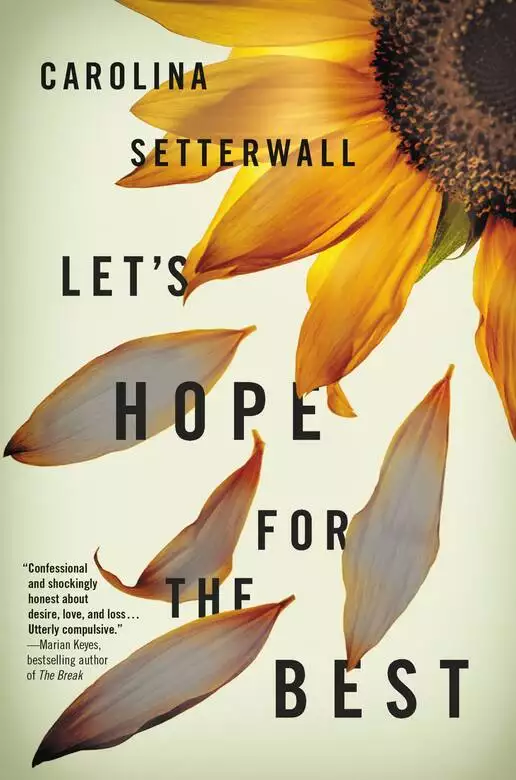
Let's Hope for the Best
- eBook
- Paperback
- Audiobook
- Hardcover
- Book info
- Sample
- Media
- Author updates
- Lists
Synopsis
One day while nursing her young son, Carolina receives a strange email from her boyfriend Aksel, detailing computer passwords and other instructions in event of his death. She grows worried at first, then irritated — this is so typical of her unsentimental partner. Aksel ends the message: Let's hope for the best!
Five months later, he is dead.
In her debut novel, Let's Hope for the Best, Carolina Setterwall recounts the intensity of falling in love with her partner Aksel, and the shock of finding him dead in bed one morning. Carolina and Aksel meet at a party, and their passionate first encounter leads to months of courtship during which Carolina struggles to find her place. While Aksel prefers to take things slow, Carolina is eager to advance their relationship — moving in together, getting a cat, and finally having a child.
Perhaps to impose some order on the chaos, Carolina devotedly chronicles the months after Aksel's passing like a ship's log. She unpacks with forensic intensity the small details of life before tragedy, eager to find some explanation for the bad hand she's been dealt. When new romance rushes in, Carolina finds herself assuming the reticent role Aksel once played. She's been given the gift of love again. But can she make it work? A striking feat of auto-fiction, written in direct address to Setterwall's late partner, Let's Hope for the Best is a stylistic tour-de force..
Release date: July 9, 2019
Publisher: Little, Brown and Company
Print pages: 336
* BingeBooks earns revenue from qualifying purchases as an Amazon Associate as well as from other retail partners.
Reader buzz
 Please log in to recommend or discuss...
Author updates
Let's Hope for the Best
Carolina Setterwall
IT’S A SUNDAY in October. We’re both tired and not particularly kind to each other. I’ve hardly slept; Ivan was at my breast for the whole of yet another night. I still haven’t mastered the trick of falling asleep between feedings, and now that Ivan is eight months old the future doesn’t look particularly bright on that front. So I’m always tired. Today I’m also annoyed and feeling sorry for myself. You’re stressed out and trying to finish some project. You still haven’t told your clients that next week you’re going on parental leave half-time. We argue about that a lot. I want you to lighten your workload so you’ll have the time—and energy—for our life, our child, our world. You don’t want to. Or you say that you want to but you can’t. Freelancing doesn’t work like that, you tell me. You’ve worked hard to build your clientele, and if you disappear for six months, they’ll find someone new. Replace you. You’re tired too. When you relax, your face looks sad. You don’t have the energy to even think about your imminent paternity leave, mornings with Ivan followed by a full day of work. I’m stressed too. Grumpy. Anxious. This isn’t what I imagined family life would be like. You tell me I knew what I was getting into when I chose to have a child with you. I tell you I was hoping things would be different. We don’t want to make each other sad, but lately that seems almost impossible. Still, we keep trying.
Three weeks ago we moved, a move we had no time for, but which we pushed through anyway. We packed at night during the brief periods when Ivan was sleeping by himself. We packed in silence, avoiding any conversations that might cause pain or end in an argument. We moved the same way. We’ve almost unpacked everything now. Today we have to take a break because our car has started acting up. We’re going to drive out to your parents’ house and have your dad take a look at it. We load Ivan into the car seat in the back, you climb in next to him, and I drive. I can’t help pointing out for the hundredth time in a cheery tone of voice that’s fooling nobody how handy it would be if you had a driver’s license too. You clench your jaw and tell me you’ll get to it soon. I don’t ask when because I don’t have the energy to argue today. I already feel guilty just mentioning it. We both fall silent. Ivan is in a good mood, and you keep him that way by distracting him with funny sounds and toys. I find it hard to drive when Ivan cries, and no one makes him laugh like you do. Listening to the two of you playing in the back as we get closer and closer to your parents’ house, I think: I love my little family. Things are just a bit tough for us right now.
At your parents’ place, you work on the car with your dad while I drink tea with your mom. She interrogates me, discreetly and respectfully, about how things are going for us. I answer, less discreetly but still respectfully, that life’s a lot to handle right now. We don’t get much sleep, and you’re stressed out. The move was rough, and Ivan’s having nightmares. He wants to breastfeed all night. “We don’t even have time to think about how we feel right now,” I say, which is a lie.
Your older brother pulls into the driveway. His visit is unexpected, and through the kitchen window I see how surprised you both are to see each other. You laugh as you hug each other. He thumps you on your back. You are engulfed by his arms. He’s always been much bigger than you. Shorter, but wider and stronger. You light up, laughing at something he says, as the two of you head into the house. Your step is quick on the stairs. You’re in a hurry to get to the kitchen and show off Ivan. Your big brother has met Ivan only once before. Not for lack of interest, but everyone’s just been so busy lately. Your brother coos over Ivan, says he’s gotten so big, that he looks just like you. He calls you “little bro.” He slurps down his coffee in large gulps. You drink a glass of Coke. Then you both go back out to the car, and I follow with Ivan strapped to my waist in his carrier. I take out my phone and snap a picture of all three of you standing by the car, trying to figure out what’s wrong with the wipers, not yet able to fix them. In the picture, your backs are toward the camera; one of you is scratching his head. You are two brothers and a father who will never again meet in this life, but nobody knows that yet.
April 2009
I’m headed to a former schoolhouse on the island of Adelsö. Friends of mine have rented it and transformed the old building into a summer paradise. They always throw amazing parties. They invite hundreds of people, tickets go fast, and the lucky ones end up with a seat on a chartered bus before it sells out. Inside the school’s pine-scented assembly hall, with its high ceilings and creaky floors, there’s cheap wine and beer for sale. The hosts are musicians and creative types, so there are usually live performances by bands I like. This is the fourth or fifth time I’ve been to one of these parties, and I’m pumped.
I’m thirty, and my love life is a mess. I just broke up with a guy from the north of Sweden a few days ago. For a moment I thought he might be the one, but a short affair was enough to realize I was wrong. I reacted in my usual way. I twisted myself out of the whole thing through writing, blasted off an email telling him it wasn’t his fault, it’s me, I’m not in the right place in my life right now. I don’t know why I always find it so hard to reject people. The thought of hurting someone gives me tremendous anxiety. I imagine them destroyed for days or weeks, their self-esteem damaged, their will to live gone. Ending a relationship makes me feel so guilty—even when I need to in order not to continue with something that makes me anxious—that often I’ve stayed much longer than I should. Since I’ve made a promise to both myself and my therapist to break that pattern, these days I end things more quickly than before. But I still have just as much anxiety. It’s always been like this. And now it’s happened again.
It went fairly well this time. Probably because we’d been seeing each other for only a few weeks and maybe because he wasn’t particularly into me either. In fact, the breakup went so smoothly that he decided to keep his ticket to this party, which I’d insisted he buy, and attend anyway. With a friend. As a friend.
I feel self-conscious when I see him on the bus but say hello and hug him. Pretend everything is normal. Like I don’t have a hint of guilt. I’m just a liberated woman who happens to know what she wants in her life. The truth, of course, is that I have no idea what I want. I haven’t for a long time. A vague desire to stop messing around and find the right person hasn’t proved sufficient to actually make things right. My love life has been messy for a few years now. But the Northerner doesn’t need to know that. We’re not going to spend our lives together anyway. And on the bus, with every glass of wine I drink and every mile I put between myself and Stockholm, I feel better. After all, things are pretty much as they should be.
I dance and dance, and my feet never want to stop moving. My throat never wants to stop swallowing wine. I climb up into a deep window casement in the old school’s assembly hall and dance all by myself, enjoying the feeling of being unreachable, people’s eyes on me. I’m notorious among my friends for climbing up onto furniture or bars or chairs or speakers or stages or window frames in order to dance. Preferably by myself. It’s sort of a tradition. So I do it again tonight. I switch between the dance floor, the window, and bellowing with my friends who are spinning records. I go outside to pee in the woods when the line to the bathroom is too long. Every now and then I see the Northerner in the crowd, and every time he stares straight back at me. He nods a greeting, but his eyes are sad. My friend starts calling him Sad Puppy Eyes. I laugh. We’re being mean, but I don’t care. I’m going to dance and get drunk, and everything is as it should be.
And then, suddenly, there you are. I’ve never seen you before. You couldn’t have been on the same bus as me. Your friend, an acquaintance of mine, says he wants to introduce me to somebody who “loves” me. And suddenly you are standing there. A grin on your face. Tall and lanky with a smile like a horizontal triangle. A cowboy’s smile in an old movie. Crooked and twisted and wide and genuine. It covers your whole face. I can’t help thinking you’d make a really good cartoon, the kind that makes you happy when you look at it. You’re wearing a hoodie. I have to bend my neck back to look up at you. You didn’t hear the words our mutual acquaintance used to introduce you, but I get the feeling it doesn’t matter. You don’t look like someone who would care anyway.
I have a bad habit of taking command when I’m drunk. As a kind of protection against the possibility of rejection, I take the opportunity immediately when it reveals itself, and this evening that opportunity is you. I have decided that I think you’re attractive. Tall and crooked and then there’s that smile. Your eyes are huge. You really would be so fun to draw. I take you by the hand, you don’t protest when I do so, and I drag you outside. It’s still light. It can’t be later than nine. But who cares about mundane things right now? Not me and not you. In the light, I notice your eyes are almost absurdly blue. I am going to ask you if you’re wearing contacts. But not yet.
Outside in the yard there’s a hot dog stand set up inside what was once a pigsty. We get in line. You keep a firm grip on my hand. You look like you’d kiss me with the slightest encouragement. I hold back. I ask how old you are. You say twenty-eight. I’m relieved; I thought you were much younger. I ask what you do for work. You say media. I’m preparing to analyze your reaction when I tell you I work in the music industry, with big concerts, but you don’t ask. You don’t seem to care about my age or my job. You look like you want to make out with me. Your smile is infectious, and I decide that’s enough. Enough for me to lead you away from the hot dog line and out toward the back of the school. We make our way to a birch tree standing in a small meadow. I peed somewhere in the vicinity about an hour ago. The bass line is thumping from the dance floor in the building behind us. I kiss you. Or maybe you kiss me.
I kiss you, you kiss me, your hands cup my face, and I love it. I love the way you kiss, and I love your hands, and I love how tall you are, and I love that crazy crooked mouth that never stops grinning, even when we’re making out. We neck like teenagers, you pressing yourself against me, me pressed against the birch tree, the back of my shirt covered with bits of bark. If I were more gracefully built, I would lift myself from the ground and wrap my legs around you, but that’s not what happens. Instead, we end up pinned against each other and the birch tree like two overeager fourteen-year-olds.
I tell you we can keep doing this later, but not inside, not around all those people. I tell you there’s a man inside who is sad, and I’m not sure if I’m telling you this to brag or to seem thoughtful or because I actually am thoughtful. Everything is blurry now, driven by impulse. For the rest of the evening we alternate between dancing with our friends and running out to the birch tree to make out. These sessions become more intense as the night goes on. At one point we exchange phone numbers to make it simpler to set up our meetings by the birch tree.
At one o’clock the party ends, and two buses transport us all back to Stockholm again. The two of us make sure to sit in the front row of the bus that Sad Puppy Eyes is not on, and so I give myself full permission to kiss you passionately in the darkness. People are screaming drunkenly in the back. Between kisses, you make me listen to AC/DC in one of your earbuds. I say I’m not a fan, and then ever so casually mention that I worked with the band a few times. The information doesn’t seem to impress you. You say, “Listen here. Listen to this,” and then you kiss me again. You lift me up and park me across your knees. I love being lifted by you, and I love sitting on your lap. Finally, astride you.
When the bus arrives an hour later, I have a red rash from your stubble on my chin and cheeks. It’s been so long since I made out with anyone like this. We get off the bus, and you want to go home with me. I won’t allow it. You ask again and get another no. You suggest I go home with you instead. “Come on,” you say. “I just want to sleep next to you.” “No,” I say. “I’m sleeping alone tonight.” I suppose I want to seem like the kind of person who doesn’t have sex on the first night. If we were to go home together, that’s definitely what would happen. I don’t want that to happen. I do want that to happen. But more than that, I want there to be a next time for us. We say goodbye, and I see your head bumping along to the music as your back disappears down Folkungagatan. Before I fall asleep, I get a text message from you. You tell me I’m hot and that you want to see me again.
October 2014
I wake up next to Ivan at six thirty in the morning. We actually got a good night’s sleep. Well, everything is relative, but good by our standards. Ivan—soon nine months old and sleeping in his own room since the move three weeks ago—is having night terrors. I still breastfeed between three and six times a night. I mostly end up sleeping on a mattress on the floor of his room, even though the plan was that you and I would finally spend our nights together again. Yesterday evening, after trying to comfort Ivan from ten to eleven, then nursing for what seemed like forever, while you sat in the kitchen working, finally I just texted you from the bed. I wrote that I’d have to stay with Ivan again, and you answered with a simple “Okay” and “Good night.” Not long after that, I heard you moving between the bedroom and the living room. You turned off all the lights, brushed your teeth, and went to bed.
I didn’t fall asleep right away. Instead, I googled “night terrors in infants” and read the official Swedish health recommendations and posts in a bunch of online parents’ forums. After reading more and pondering whether or not Ivan could be suffering from something that’s more common in older children, I felt quite convinced. Ivan is having night terrors; that’s why he’s inconsolable. It almost always happens about an hour after he falls asleep for the night, which fits the descriptions online. I took a screenshot of one of them and texted it to you with this: “I think Ivan’s having night terrors. Check this out.” You didn’t answer. Your bedroom was quiet. I assumed you’d fallen asleep, or maybe you were just reading and didn’t feel like answering. I fell asleep shortly after that.
I wake up almost rested. The cat hasn’t been whining outside Ivan’s room as she sometimes does, and Ivan only needed to breastfeed two times after his outburst just before midnight. He’s in a good mood, ready to crawl out of our temporary bed on the floor, aiming for the door and an adventure in the rest of the apartment. I lift him up, tell him it’s time to go wake up Daddy. When I open the door, the cat’s waiting for us and allows us to pet her. She too seems newly awake. We all head toward your room.
I put Ivan down on the bed so he can crawl over to you, be the first thing you see when you open your eyes. I say, “Good morning, Daddy,” in that tone I use when I’m speaking to Ivan but directing my words toward another adult. Mostly to you. Ivan takes aim for your head, but before he can really get going I notice that something’s wrong. The way you’re lying is unusual. Crooked and bent, in the fetal position, your face pressed against the pillow. There’s also something odd about your skin. It’s paler than usual. Lifeless.
I don’t want to touch your ankle, which is sticking out from under the blanket near where I’m standing, but I do anyway. It’s cold. Pale. Stiff against my fingers. There’s no blood flowing inside. You’re not there anymore. You’re dead. I just know that now.
My reflexes take over. I lift up Ivan and hold him in one arm while my brain shuts down all emotion and I start to act rationally, more rationally than I have ever acted before. I call the emergency services number, and when a woman answers, it all flows out in a single breath: what’s happened, my name, your name, where we live, what our door code is. “Come quick,” I say. “Right now. I can’t stay here anymore.” Ivan stretches for the bed, and I hold him tightly, a little too tightly, against my hip.
The woman on the phone asks me to slow down and check your neck for a pulse. I tell her there’s no point, but I obey her and do so anyway. With Ivan on one hip and the phone balanced between my shoulder and my ear, I run my hand along your neck. It’s cold. Lifeless. Again, I tell the woman it’s no use, there’s no pulse, there’s no one there, you’re no longer alive.
I don’t know why I do it, but I grab your shoulder. I turn your body over, even though I know you’re dead. You’re heavy, and I almost lose my balance and fall onto you as I turn your face upward. Your left cheek has an imprint from the fabric of your pillow, and your skin is a pale yellow. One of your eyes, the one that was on the pillow, is slightly open. Your blue eye is no longer as blue as it used to be. Now it’s gray, and it will never see our son or me again. I let go of your shoulder when I see the open eye. Your body falls back into the same position I just dislodged it from. You’re as dead as a person can be, and I can’t stay in this room another second.
I tell that to the woman on the phone, and then I hang up. I wrap a blanket around Ivan and put him in his baby carrier, then drape a sweater around my shoulders. I lock the cat in the bathroom, put her food and water in there with her before I go. I know that the next person who enters this apartment won’t be me, and I don’t want her to escape.
I go out the front door. Take the elevator down to the ground level, go out into the courtyard, and sit down on a bench. Waiting for the ambulance. The sun is just starting to rise.
It takes at least a half hour for them to arrive. I’m lying. It only takes a few minutes, but it feels like a half hour. Our neighbors pass by us on their way to work or to drop their kids off at school, and they glance over at us where I sit in my pajamas with Ivan in his carrier and a blanket. Nobody says a word. One neighbor turns their eyes away. Another nods a greeting first. I nod back. I realize I need to call someone. I don’t know who. I call your big brother. The ambulance arrives.
May 2009
“I’ll never be unfaithful,” you say, staring at me from less than a foot away in bed. I wonder if you mean to me specifically or if you’re just sharing a general moral principle. It’s unclear. A common occurrence with you. You tell me something, no frills, a deceptively simple statement that leaves me full of questions I don’t yet dare to ask you. I find it enthralling. You’re different and I like you. A lot.
We’re both lying naked in bed in your sparsely furnished apartment on Långholmsgatan in the Hornstull area of Stockholm. It’s suffocatingly hot inside, with windows on just one side of your apartment. There’s no air circulation. There are also no curtains for shade, and the sun beats down inside almost all day. But we’re at your place because this is where you like to be. And I’m not picky. We spend quite a lot of time here now. In your apartment, in your bed, naked.
The day after our first meeting, we ended up here after another party, which we also spent entangled, this time under a blanket, on a sofa, at an outdoor bar. It felt impossible to put it off anymore—apparently twenty-four hours was enough for me to prove whatever I was trying to prove, and obviously it was long enough for you too. Now we’re lying here, and you tell me you’ll never be unfaithful. I mumble an “Oh, good” and think about all the times I’ve been unfaithful. I find it hard to return the promise, but I like the way you think. It says something about you. I’ve known you for two weeks now. I want to know everything about you, but I hold back. I try not to ask more questions about you than you ask me. And you don’t ask much. So I return the favor.
The first time I saw your apartment I asked if you’d just moved in. You have almost no furniture. An empty hallway, a living room with only a sofa, a TV, and a small desk in one corner. On the desk, your work computer and some Post-its with small notes written on them. Your handwriting is beautiful, the letters tiny. Even the capital letters are small. I didn’t know it yet, but the names on those Post-its belong to various production companies you work for. “Backup Callboy” says one. “Fix Annelie’s email” says another. “Server Camp David” stands on a third. One Post-it reads only “NEVER AGAIN.” When I asked you what it meant, you told me it was a reminder never to take on so much work again. You told me you almost had a breakdown last year. You had to work around the clock and lost a lot of weight. You never want to do that to yourself again. I told you I could relate, mentioned that my job requires a lot of late nights. And to that you shrugged and answered, “Well then, just quit,” as if it were the easiest thing in the world. As if my job didn’t impress you at all. I think I fell even more in love with you then.
In your bedroom: a bed and a bench press. Nothing else. No rugs, no curtains, nothing on the walls except a print of a skyscraper with a single cloud hanging in the sky beside it.
You didn’t seem to understand why I asked if you’d just moved in. You told me you’d lived here for eight years. According to you, this was the perfect amount of possessions. You hinted that you’d grown up surrounded by a lot of stuff and didn’t want that for yourself. Collections, knickknacks, dust—it makes you nervous. I thought maybe you had taken it to an extreme. And did you actually use that bench press regularly? I thought you were an oddball. It made you even more interesting to me.
But for the time being, all we need is your bed. This is where we spend our evenings, our nights, our mornings, and a good portion of our weekends. When we’re hungry, we go out to eat, and when we go out, we take long walks. You keep your arm around me, and I love how tall you are. I like the feel of your arm around my waist, and secretly I hope we’ll run into people we know as we stroll along Årstaviken, between Skanstull, where I live, and Hornstull, where you live. I want to be seen with you. I want my friends and acquaintances to run into us. “Oh, who was that?” I want them to whisper afterward. “What a cute couple,” I like to imagine them saying. “What a tall, beautiful person,” I want them to think. I’m proud to belong to you, and even though we haven’t talked about it yet, that’s how I feel. I belong to you.
We’ve met basically every other day since that first night, and when we don’t meet, we keep in close contact via chat and text message. I’ve learned several things about you already. You don’t like talking on the phone. You’re like two different people in text and in person. When you write, you sound almost harsh, go straight to the point, and that’s it. But in person, you’re warm, thoughtful, funny, physical, and always on the verge of laughter. You like kissing and holding hands, even when we’re not in bed. And, yes, you wear contact lenses. They intensify those clear blue eyes. You can’t see much without them. When you’re home at night, you take out your contacts and put on a pair of glasses, which you hate but I love. They’re lopsided like your smile. Everything’s a little lopsided on you. Everything’s beautiful.
When we say goodbye in the mornings, we rarely make detailed plans to meet again. “Talk to you soon,” you say, and I’m not brave enough to ask you exactly what that means. You never ask me about my plans, and I feel intrusive when I tell you about them. I’m fascinated by your double nature. You are complicated, paradoxical, absent and present at the same time. You are so close and far away by turns. I think about you almost constantly. I long to hear from you and find each hour I must wait excruciating.
But I do hear from you. I always end up hearing from you. If I just wait a few hours, you come back. I’m starting to learn your patterns. I’m starting to figure out how to exist in your world. I’m in love with you. It took me two weeks or two days—it’s hard to say which.
October 2014
The ambulance has arrived, and a kind EMT has been up in our apartment for a few minutes. He comes back down now. Ivan and I are still on a bench in the entrance hall when the EMT tells me I was right, my partner is dead. He also tells me, “If it’s any comfort, he didn’t die in pain. It seems to have happened peacefully, in his sleep.” It’s no comfort.
The EMT wants me to come back up to the apartment. I know I should do it, I know I should at least go up and change Ivan’s diaper, but I can’t move. I never want to go up there again.
I called your brother, and your brother called your parents. I also called my stepmother, and everyone is on their way now, racing from wherever they’d started a seemingly normal Monday morning. I tell the EMT that I want to sit here until someone I know arrives. He says that’s okay. Tells me a police officer is on the way and emphasizes that this is standard procedure when a young person dies suddenly. I shouldn’t feel like I’m a suspect or that anyone believes there’s been a crime. This is just what they have to do. He says more, but I’ve stopped listening, because a neighbor is coming down the stairs and into the hall. The neighbor has her child with her, and the child stares at us. I’m in my pajamas, Ivan is in his carrier, the EMT is wearing a loud neon-yellow vest with a dark green overall underneath. The child seems curious about us and asks his mother who we are, what happened, what’s our name. I don’t respond. Nor does the mother. The EMT is silent as well. The neighbor hurries out, picks up the child, hushes his questions, and exits quickly onto the street. I stare down at the gray concrete floor. I feel like I no longer have a home.
The police arrive at the same time as your brother. I don’t know how he has the strength, but somehow he succeeds in taking command of the situation. He leads me up into the apartment with a tight hold around my shoulders. I keep repeating myself: “I refuse to enter the bedroom ever again.” He tells me I don’t have to. I can stay in the kitchen. The police are there, and they need to ask me a few quick questions.
In the kitchen, the police have started going through our medicine cabinet. I hear one say to the other that it’s impossible to know where to start. She looks at my over-the-counter American sleeping pills and asks whom they belong to. I say they’re mine and feel ashamed for picking up so many random pills over the years. I’ve collected all these American pills and almost never taken any of them. Still, every time I traveled to New York I brought a new box home. It sounds insane when I try to explain it to the police. It sounds like something only a crazy person would do. The police just nod and continue sorting through medications while asking me if I’d noticed anything different about you lately. I say no. She asks why we have prescription sleeping pills. I tell them they were prescribed to me so I could sleep after being up with Ivan for so many nights in a row. I explain how he nurses constantly and has night terrors, and I’ve been having a hard time sleeping in between. I ask her to open the package so she can see that I haven’t taken a single one—not a single pill will be missing. It’s important to me that she sees I haven’t taken any. As she opens up the package, I’m suddenly afraid. What if it’s empty? What if you took your own life? It’s the first time that thought occurs to me. It feels like her fingers move in slow motion as she opens the small cardboard box with a red warning triangle on the side. The pill bottle is full.
The police officer writes everything down and pours pill bottle after pill bottle out onto the kitchen t. . .
We hope you are enjoying the book so far. To continue reading...
