
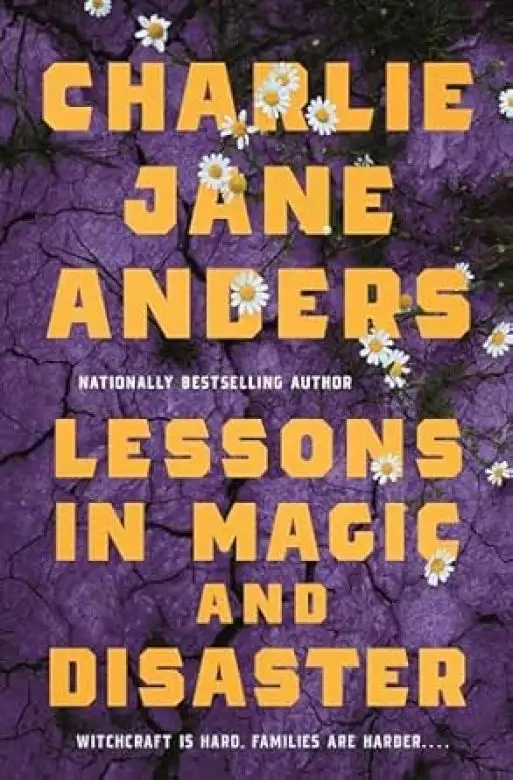
Lessons in Magic and Disaster
- eBook
- Hardcover
- Book info
- Sample
- Media
- Author updates
- Lists
Synopsis
In the vein of Alice Hoffman and Charlie Jane Anders's own All the Birds in the Sky comes a novel full of love, disaster, and magic.
A young witch teaches her mother how to do magic--with very unexpected results--in this relatable, resonant novel about family, identity, and the power of love.
Jamie is basically your average New England academic in-training--she has a strong queer relationship, a working esoteric dissertation proposal, and inherited generational trauma. But she has one maybe extraordinary secret: she's also a powerful (though fledgling) witch.
Jamie's mother Serena has been hiding from the world in an old one-room schoolhouse for several years, grieving the death of Mae (her wife and Jamie's mom), as well as the simultaneous explosion in her professional life. All she has is her memories--and those aren't always as comforting as they could be.
It's not like Jamie doesn't have enough on her plate, but she wishes she could have Serena back still, so now she's decided to teach Serena to cast spells, so her mother can get her life back.
But Jamie doesn't know the whole story of what happened to her mom years ago, and those buried secrets lead Serena to do some destructive magic. Now it's up to this grad student and literature nerd to understand the secrets of a three-hundred-year-old magical book before her mother ruins both of their lives.
Release date: August 19, 2025
Publisher: Tor Publishing Group
Print pages: 368
* BingeBooks earns revenue from qualifying purchases as an Amazon Associate as well as from other retail partners.
Reader buzz
 Please log in to recommend or discuss...
Author updates
Lessons in Magic and Disaster
Charlie Jane Anders
1
A hermit’s life may appear the most pleasant thing in the world—until one requires a proper cup of coffee.
—EMILY: A TALE OF PARAGONS AND DELIVERANCE BY A LADY, BOOK 1, CHAPTER 1
Jamie has never known what to say to her mother. And now—when it matters most of all, when she’s on a rescue mission—she knows even less. What the hell was she thinking?
Somehow Jamie had imagined just marching up to the bright red door of her mother’s tiny house. She’d knock, and then proclaim: “Listen Mom, I’m a witch, and I’m here to teach you how to do magic.”
As if that was a thing a person could say to her mother, after years of barely speaking to each other.
So Jamie stands frozen. She tries instead to gather her thoughts, and stares at the ancient one-room schoolhouse where her mother, Serena, has hidden from the world for the past six and a half years, ever since her life fell apart.
The schoolhouse is a box covered with flaking red paint, fifteen feet by fifteen feet, suitable for educating half a dozen children. A narrow gravel path skirts a garden where pansies, carrots, basil, and cilantro shimmy in neat rows, like spectators cheering a team that’s already lost the season. In the distance, past a row of trees and a sloping lawn, Jamie can just make out the mock-Colonial pile belonging to the Fordhams, who let her mother live here rent-free in exchange for various favors. The air swims with grit in the late-August wind; smoke from the first burning leaves of the season turns the world into a fireplace.
Jamie breathes and finds her center. Time to be a witch about it, she tells herself.
Meaning: Time to put everything out there, with no control over the outcome.
She marches up to the windowless front door and knocks, then hears stumbling on the inside that seems to go on for a long time. The door yawns, and Jamie’s mother blinks at the unexpected visit. Serena is about to say something, some pleasantry.
As it turns out, Jamie doesn’t utter the words “witch” or “magic.”
Not just because of how ridiculous those things might sound—it’s actually that Jamie is convinced that the mystical energy, or whatever force she cadges favors from, doesn’t like to be spoken of so openly.
Even so, Jamie speaks before she can lose her moment.
“Mom. I have something important to show you. I can’t explain, but I know a major secret. And I think you need to know about it.”
* * *
Coming to see Serena wasn’t a conscious decision, not really.
A few hours earlier, Jamie was sitting in a cafe near Central Square, crafting a syllabus for her freshman composition class, and she found herself obsessing about her mother.
Back when Jamie was growing up, Serena used to stomp around and speak truth to whomsoever would rather not hear it, returning home an hour before Jamie’s bedtime full of curses, like the occluded front of an oncoming thunderstorm—but now here she was, rotting away in some semi-suburban stale box. Jamie never visited, but every now and then she and her mother had the same blandly pleasant conversation over the phone.
Suddenly, with an acid shock, Jamie realized that her mother was going to die: maybe in two years, maybe in twenty. And when that happened, Jamie would do all the funeral crap you’re supposed to do, go through some therapy, and maybe put up Serena’s picture somewhere on her desk—but she wouldn’t have a living relationship to mourn. Not like last time.
All at once, this situation felt unbearable. Jamie leapt out of her chair and bolted, leaving half a scone and most of a coffee.
Perhaps the downside of being a witch is too much awareness of your own feelings. You spend so much time trying to sink to the bottom of your own emotional lagoon so you can dredge up one honest want, that you stop being able to hide your feelings from yourself. This is annoyingly therapeutic, and it’s ruined Jamie for Jacobean theater and Romantic poetry. Whenever Jamie experiences a strong emotion, she’s the first to know, which never used to be the case. And most of the time, Jamie has to act on it.
* * *
“Do you want to come in?” Serena shuffles backward.
Jamie can’t help feeling like a giant, towering over her mother in a fake-leather jacket and wide hiking boots.
The air in here smells like cedar, but with a musty undertone that prickles Jamie’s nose. Two corners of this tiny room are never properly lit by the sun or by the single overhead bulb. A metal bedframe supports a futon mattress and duvet, near a writing desk and a single dresser with one rod to hang things that need hanging. Jamie sits at a folding card table in the center of the room, her left leg jiggling—because now that she’s here, she cannot wait to get into it.
Let’s gooooo.
Jamie can’t untangle her feelings, looking at Serena’s bony white face: gray eyes sunk deeper than Jamie remembers, brown hair steelier.
Here, in one frail body, is the person who held Jamie until the nightmares went away; who taught Jamie how to tie her shoes, skate, and dance; who once accused Jamie of stealing; who crouched in front of tiny Jamie and said, You will always be loved, you cannot mess up so badly that you will not be loved; who instilled in Jamie a deep paranoia about the world that still snags her when she’s trying to be generous; who walked Jamie home from school when bullies were after her. Jamie was all set to breeze in and drag Serena out of this psychic prison, and now a part of her regresses to early childhood, swinging her legs under the table.
But adult Jamie can’t help thinking about the trope in eighteenth-century lit where adults meet their mothers for the first time and do not know them. This gets downright squicky in Fielding’s Tom Jones and Defoe’s Moll Flanders, and the notion of mother-as-stranger is clearly a compelling one during a time where ideas of women’s roles in the domestic sphere are shifting.
Bleh.
Jamie’s brain will not stop churning, no matter how much she wants to be present.
“What’s this secret you want to tell me?” Serena heads for the little kitchen counter and pours coffee. “Why show up out of the blue like this? Is everything okay?”
Somehow Jamie forgot about Serena’s habit of tossing out questions like bombs with lit fuses. How is it that tenderness and annoyance go fist-in-palm? “I need to show it to you. I can’t explain. Let’s just say, it’s something that could turn your life around, or maybe turn your life sideways. Do you want to see or not?”
Serena pauses, coffee in hand. Her head swivels by instinct, as if to ask Mae what she thinks.
But of course, Mae hasn’t been available to ask such things for a long time.
So her head turns back, toward the one person who’s living and present. “Sure. Yes.”
Jamie takes a sip of bitter chicory and pushes the chipped mug away. “Okay. Let’s do this.”
“Where are we going?”
“I figured we could start with the woods out back.”
Serena thumbs through her clothing rack and digs out a magnificent blue peacoat, with a crushed dried flower pinned to one lapel.
* * *
The woods seemed an easy hike from the schoolhouse, but they’re farther than Jamie realized. The wind grows colder and Serena keeps griping, to the point where Jamie wonders when her mother last left the schoolhouse for any length of time. Jamie doesn’t have a plan exactly—maybe having a plan is a hindrance for the sort of thing she’s hoping to do.
Once in the woods, Jamie scans in all directions. A soda can flashes candy-apple red under the maroon of dead leaves. They’re close, she can tell.
“What are we looking for?” Serena sounds curious, rather than impatient.
“Hard to describe. It’s a ‘know it when you see it’ thing.” Jamie is low-key terrified that speaking out loud about magic will ruin it forever, and then where will she be? Still, she set out to teach her mom, and pedagogy is always at least partly a matter of providing a conceptual framework.
“I did a lot of trial and error.” Jamie chooses her words with care. “Back in Wardmont.”
“When you were in eighth grade?”
“Eighth through tenth.” Jamie nods. “I used to sneak off by myself and go to the warrens. I found it only worked in certain spots.”
There’s a whisper of a trail between birch trees with flaking bark and a few grouchy evergreens.
“Is that why you used to disappear?” Serena steps over a bulbous tree root with caution. “We never figured out why, and we couldn’t just ask, I guess.”
This land once belonged to the Nipmuc Nation, but they were forcibly relocated in the seventeenth century, and this whole area was formally ceded to white settlers via the misleadingly named Massachusetts Indian Enfranchisement Act of 1869. These grungy woods were mostly chopped down by loggers in the late nineteenth century, then slowly grew back. People have hunted, gathered, played, and hidden among these trunks, but they’ve also sat empty for years at a time.
So this should be ideal, but Jamie can’t seem to find the right spot as they walk. You need someplace that’s halfway in between: neither wild nor tame, neither occupied nor unoccupied.
When Jamie was a teenager, she found a community vegetable garden that had gone to seed—plants grown out of hand, rabbits chewing through everything, bugs all over the splintering sticks that once supported vines or saplings. That garden was the best magical cauldron a girl could ever wish for. Those neat rows covered by messy greenery brought Jamie her first guitar, the first blowjob she ever gave, her first kiss—which happened way later than her first blowjob—and her ticket to the best music camp in the state.
“You were a strange child, always rushing someplace, making up your own games,” Serena says. “Do you remember when you tried to give me an acorn of perfect knowledge?”
Jamie shrugs; she doesn’t remember that.
Forests don’t go on forever, not anymore, there’s always a development or a hunting trap, a clearing or a dirt road. People have carved up these woodlands so much, they’ve created an incalculable number of new magical places.
Still no luck, but Jamie keeps pressing forward.
“If we get lost in the cellphone dead zone, I plan to be quite passive-aggressive,” Jamie’s mother says.
“We’re not lost yet. Still working on it.”
Serena starts quoting some Thoreau pomposity about losing yourself in the woods—as if getting lost is intrinsically better in the woods than in a suburban IKEA. The whole concept of “getting lost” implies that at some point we are in fact oriented, which flies in the face of everything Jamie has ever known about people.
Jamie finds it: an in-between place. A spot where someone had tried to build a shed, or a hut, or some kind of gazebo, but the wood rotted away and a few rusted nails splay on the peaty ground. The whole thing smells of mulch.
“Oh, this is perfect,” Jamie tells her mom. “It’s big but totally disintegrated.”
What Jamie can’t explain out loud—for fear of wrecking these perfect conditions—is that this is a spot where people tried to impose their will on the forest, but they failed, or gave up. A place between grown and built, where someone took care of things, for a while. A neglected place, Jamie calls it.
The ideal spot to do some magic.
“So we found it,” Serena says in her most patiently matter-of-fact tone (the one she used to use when Jamie was a kid who occasionally made up weird stories to explain her messes). “Now what do we do?”
“Just watch.”
Jamie had the whole drive down to the schoolhouse to think about what spell she could do in front of her mother, and luckily she already had the perfect thing in her rucksack. She pulls out an egg-white cardstock envelope with the Rugby College crest on one corner. Inside, a letter explains that due to changes in the college’s endowment, Jamie’s graduate-student stipend is being reduced by $5,000—leaving her to starve or take on more debt. (The college has wasted a small fortune on the Quantified Text initiative, using algorithms to identify patterns in classic works of fiction, so nobody actually needs to read them. A total disaster, and now belts are being tightened.)
She lays the stipend-reduction letter (“We regret to inform you…”) in the center of the decaying structure. On top of it, she places some dandelions she picked: a good symbol of abundance. And then she adds an offering, a cow heart that she bought from the butcher. Hope you like big hearts.
Serena peers over Jamie’s shoulder, puzzled.
Explaining a ritual is worse than explaining a joke—it makes Jamie’s skin itch. But she has to try. “It’s not about power. It’s not. It’s about knowing what you really want, in your fucking secret heart, and putting your wishes into the world in a way that can be heard.”
“Heard by whom?” Serena asks.
Jamie just shrugs in response.
“And now?” Jamie’s mom asks.
“Now, we forget we did this, and head back. I know the way to the schoolhouse from here.”
At least, Jamie’s pretty sure she can figure out how to get un-lost.
“So doing that makes you feel better?” Serena asks. “Or do you really think it has a material impact? Was I supposed to feel something? At my age, I’m used to dismissing my own sensations so I don’t turn into a hypochondriac. How do you tell if you accomplished anything? How often do you do this sort of thing?”
Questions, questions, questions, coming too fast for Jamie to answer any of them.
If Mae was here, she’d be saying, Stop giving our child the ninety-ninth degree—but of course if Mae was here, everything would be different.
Jamie stops and wheels around to face her mother.
“Look, I can’t really explain. Not properly. Maybe in a few days, something will happen—like the department secretary will tell me that they found some money for me in a research fund, or they’ll change their minds about this cutback. You never get help in the way you expect, and it’s best not to be too prescriptive. But I’ve already said too much. This thing only works if you don’t think too hard about it, much less speak of it out loud.” But Jamie keeps seeing the tiny schoolhouse in her mind’s eye.
“The woodland exercise that can be spoken is no woodland exercise?” Jamie’s mom only rolls her eyes a little.
“You’re half right.” Jamie turns and keeps walking. “There’s more than a small element of the Dao in this practice, but it’s also way too anchored on desire, want, craving, self. That’s the whole reason I wanted to teach you: you need to let yourself want things again.”
“Who says I don’t want anything?” Serena bristles so hard, it’s like a crackle of static electricity on the back of Jamie’s neck. “And what’s so great about wanting things?”
Jamie can’t find a way to state the obvious: Serena has been unmotivated since she crawled into her box to hide, and it’s heartbreaking for anyone who remembers how alive she used to be.
The woods darken. Serena’s footfalls land heavier. Jamie decides to change tack. “It’s not just about goals or whatever, it’s about self-knowledge. A person can’t really know who they are unless they know what they want. That’s a big part of why I do this thing: I can read the ransom notes left by my own heart.”
“Doesn’t obsessing over everything you crave just lead to bitterness, though?” Serena says.
“No, no, no.” Jamie hears her own voice go up, pushes it back down. “No, not at all. That’s the other part, see? You put your desires out there into the world, and then you can let go of them a little bit. I never know if anything will come of it, but I find I can obsess about something less once I’ve made an offering.”
Serena doesn’t talk for a while. Jamie glimpses the Fordhams’ manor through the trees.
“So how often do you do … that?” Serena asks when they get back to the schoolhouse.
“Once in a while,” Jamie says. “Just finding the right locale usually takes forever. And then I have to get in the right headspace.”
“Hm. Do you need to find a new place every time?”
“Not always. But once I’ve disturbed a location, it’s no longer as untouched as before. So I usually can’t go back to the same spot too often.”
Jamie’s mother is being shrewd, avoiding any awkward questions that might stray too far into demanding an Explanation. And either it hasn’t occurred to her to think her daughter is delusional, or she’s giving Jamie the benefit of the doubt. (Why do we say, “benefit of the doubt”? Why not “benefit of the belief”?)
Serena insists on making dinner before Jamie drives back to the city, so she texts her partner, Ro, that she’ll be home late. She hasn’t eaten her mom’s cooking in years, and of course food is basically pure nostalgia in chemical form. Soon Serena is whipping up her healthy versions of Midwestern comfort food, all cheese curds and veggie sausage.
Jamie keeps expecting to see Mae wander in the front door, shucking an oversized bomber jacket with a grin on her round craggy face, under henna-red bangs.
When Jamie’s clearing the table and getting ready to leave, Serena looks her in the eye and says, “Thanks for showing me. I think I’ve wondered for a long time.”
And that’s it.
She always knew something, and now she knows something more.
2
Grief, nobly expressed in small portions, may be the surest sign of a refined sensibility. Yet an excess of grief soon appears wicked and selfish, and none will tolerate it for long.
—EMILY: A TALE OF PARAGONS AND DELIVERANCE BY A LADY, BOOK 1, CHAPTER 7
Jamie keeps meaning to go back and check on her mother, to see if Serena was able to make anything out of the lesson in the woods. I’ll make the trek down to the schoolhouse in a few days, she tells herself occasionally. They can go for another walk and do another working, and Jamie can give Serena a few indirect pointers. Jamie’ll probably have to take Serena through it a few more times before everything falls into place. But meanwhile, she has a dissertation on eighteenth-century lit to finish, and Professor Zhang keeps nagging her for a chapter, and magic really can’t write her thesis for her.
(Though, on the bright side, the department did come up with enough money to restore the full stipends for Jamie and the other PhD students. As usual, Jamie tries not to wonder if her spell had anything to do with this windfall, because overthinking will ruin it.)
Each morning, Jamie revels in the abundance of a whole day, stretched out before her—a dozen hours in which to write epic sentences and accomplish great things—and she looks up, and suddenly it’s evening and she’s gotten nowhere. Somehow a month and a half pass without Jamie going anywhere near the schoolhouse.
Copyright © 2025 by Charlie Jane Anders
We hope you are enjoying the book so far. To continue reading...
