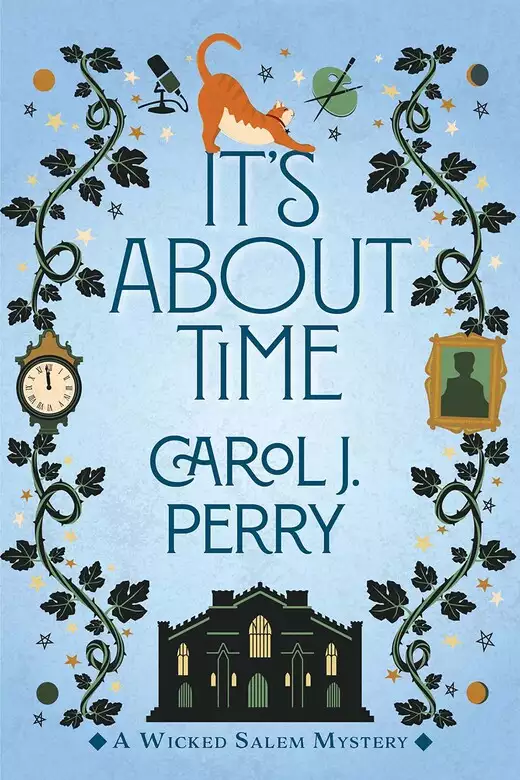
In this delightfully spooky series spin-off of Carol J. Perry’s beloved Witch City Mysteries, Lee Mondello and her detective husband have plenty of experience solving crimes in Salem, Massachusetts—and now Lee’s Aunt Ibby is starting a sleuthing career of her own in the witch city…
Nothing can spoil the mood at a one-year-old’s birthday celebration like the cops arriving—but it’s not because the party got too rowdy. Instead, Detective Pete Mondello has a search warrant for a tenant’s apartment. When Lee’s aunt Ibby leads the police to Josh Alper’s locked door, she’s surprised to learn that her renter has redecorated . . . with what appear to be masterpieces stolen from a museum back in 1972.
The paintings may be found, but Alper—an artist involved with a shady, cult-like group—is officially missing. So Ibby and her pals, who hold weekly watch parties of their favorite show, Midsomer Murders, decide to jump in and do some real-life sleuthing using the skills they’ve learned from DCI Barnaby. Ibby, a semi-retired librarian, may be in her sixties, but her tech skills are top-notch . . . and with some help from her friends Betsy and Louisa, as well as O’Ryan the clairvoyant cat, that spells trouble for any criminals in Salem.
But when Alper’s body is found in the Salem Woods—felled by an unusually sophisticated weapon—Ibby must buckle down with her team and prove that she’s just as talented an investigator as her beloved niece . . .
Release date:
June 30, 2026
Publisher:
Kensington Books
Print pages:
272
* BingeBooks earns revenue from qualifying purchases as an Amazon Associate as well as from other retail partners.
Right smack in the middle of my grandniece Ella Marie’s first birthday party, a pair of uniformed Salem police officers knocked on my door with a search warrant. I’m no stranger to the Salem police. Ella Marie’s daddy, Pete Mondello, is a detective sergeant on the force. But cops on the front steps with a warrant to search my Winter Street house was a first for me.
I’m Isobel Margaret Russell. Most folks call me “Ibby.” I’m a sixtysomething, happily single, part-time research librarian, living in the fine old house in Salem, Massachusetts, where I was born. Generally speaking, I’m quite content with my life. I love this interesting, ever-fascinating north-of-Boston city that some persist in calling “the witch city,” which attracts a lot of business for a main street full of witch shops, and a well-paying side hustle for year-round Halloween costumed buskers on every corner. It’s so much more than that, though. Salem is a world-famous maritime center, an architectural gem—and big enough to have its cosmopolitan aspect, but still small enough for a good walkabout.
Some might call me an old maid, but I’ve had my share of marriage proposals—just never the right man at the right time. I raised my orphaned niece Maralee, baby Ella Marie’s mom, in this house and after she grew up and moved out, I made her third-floor rooms into a couple of small rental units. They’re usually short-term rentals—summer vacationers, fall leaf-peepers, or Halloween fun-seekers. That’s what the party-pooper warrant was all about. Both units were rented, and one of my October tenants was apparently in trouble somehow with the local law.
It couldn’t have happened at a worse time. Ella Marie, adorable in a blue princess dress, protected with a large pink bib, was seated in her high chair, awaiting her special “smash cake.” In case you’re not familiar with the custom, a smash cake is basically a small cake meant to be enjoyed on baby’s first birthday. It’s heavy on the frosting, and the birthday child will likely dig in by using her fingers or smooshing her whole face into it—usually resulting in great photos that she probably won’t want her friends to see when she’s a teenager. All of the guests awaited Ella Marie’s special moment: Ella Marie’s mom, Lee (just about everybody calls her Lee instead of Maralee); her dad, Pete; my besties Louisa Abney-Babcock and Betsy Leavitt; and several of Lee’s friends from WICH-TV, where she works part-time making TV documentaries, along with her best friend, River North, late-night scary movie host and tarot card reader. Lee and Pete’s next-door neighbor Michael Martell, along with our curious cat O’Ryan were there too, all crowded around the high chair, cameras poised for the expected action when the doorbell rang announcing the intrusive police presence.
With the smash-cake ceremony on hold, and with Pete looking over my shoulder, I read the warrant. The document indicated that there was probable cause that a search of my guest Josh Alper’s premises could uncover evidence related to a criminal investigation. It seemed to me pretty darned unlikely that Mr. Alper—a quiet, polite, and quite ordinary-looking middle-aged gentleman, fond of tea and given to early morning walks—was involved in anything remotely criminal. I knew he wasn’t in his apartment.
“Do you know anything about this, Pete?” I asked, handing him the document. “Mr. Alper isn’t home. I saw him leave at around seven this morning, as he has most days.”
“His name rings a bell,” Pete said. “Joshua Alper. He goes by Josh. It was a cold case involving some kind of art heist back around 2010 or so, I think. He was on the scene at a number of high-profile art heists—fast rip-and-run jobs where if the art was behind glass it was smashed, then the paintings were cut out of the frames with a razor blade and stuffed under the thief’s clothing. He was singled out for questioning because he had a long rap sheet. Petty thefts, mostly—shoplifting, handbag snatching, a couple of B and Es. He was investigated about the robberies, but he had a high-priced lawyer who claimed he was just in the wrong place at the wrong time—that he’d traveled to art shows all over the world for years. His name showing up locally must have triggered this warrant. It’s legit, though. Do you want to go upstairs with these guys and unlock Alper’s door? I’ll go with you. I guess the cake ceremony can wait for a few minutes.”
There were a few groans of protest, and Lee whisked the cake away from the high chair before Ella Marie could smash it, while Betsy tried to distract the by-then crying birthday girl with a pink stuffed bunny.
Pete was in the lead, the uniforms behind him, me with the master key in hand and my promise that we’d be right back. We climbed the two flights of stairs to the third floor. One of the cops knocked first, and called out, “Police. Open the door,” a couple of times. I didn’t expect any response from inside the apartment, and there was none. The other apartment was rented too, but that guest, a fall-foliage photographer here for the weekend, had left the house early too so I didn’t worry about disturbing him. The officers each pulled on blue latex gloves. One of them produced what I recognized as an evidence bag. (Louisa and Betsy and I watch Midsomer Murders on TV every single week and they use evidence bags sometimes, only Scotland Yard calls them “murder bags.”) I stuck the key into the lock and pushed the door open.
I’d rented the apartment as furnished, of course. I’d used some of the spare furniture from my commodious top floor attic, supplemented with a new queen-size bed and mattress and living room couch, along with the kitchen appliances Lee had used when she’d lived there. I’d supplemented the décor with some pretty framed prints I’d bought from a neighbor’s yard sale, along with a few artificial green plants in inexpensive colorful pots.
At first glance, the place looked just about as I remembered it. After a brief moment I realized that my inexpensive Utrillo prints had been replaced with some much larger works—larger, better framed, and clearly more important, and the artificial plants had been swapped for real ones. One of the officers verified my hasty observations. He peered closely at one of the paintings, consulted a sheet of paper, then pointed to a stylized claw. “I think that’s supposed to be part of a bird.”
“It has a kind of Picasso vibe,” I whispered, remembering researching the man’s significant contributions to the art world, “but it doesn’t have his usual crispness.”
“That’s supposed to be the Picasso,” the pointing officer announced aloud, verifying my impression.
“And there’s the Monet,” said the other, checking his own printout. I nodded hesitant agreement, although the hazy landscape didn’t seem to me to have the artist’s usual subtle play of light and dark. I remembered that there’d been a Monet among the paintings stolen from a Netherlands Museum in a highly publicized robbery back in 2012. Both were bordered by ornately scrolled gold picture frames.
I looked a little closer at the mid-century modern coffee table I’d placed in front of the new couch where one of the fake plants had been. The plant there now was a lush golden pothos and beside it was a blue-and-white vase, exquisite in its simplicity. “Ming Dynasty.” I pointed. “Be careful.” Pete had obviously been right about his art-heist suggestion. It appeared that my mild-mannered gentleman tenant had either an expensive hobby or a criminal past—or both.
“How long has Alper been living here, Ms. Russell?” Pete wanted to know.
“About two weeks,” I said. “He’s looking for something permanent. He says he likes Salem.”
“You say he usually leaves at around seven every morning?” Pete asked. “Do you know where he goes?”
“For a walk before work,” I reported. “He says it clears his mind.”
“Do you know where he works? What he does for a living?”
“Sorry, no,” I said. “But wait a sec. He paid his rent by check. I think there’s a company name on it. I’ll check my bank statements right here on my phone.” I pulled up the bank info.
“Could you do it now?”
I had it on screen already. “IAHA,” I read aloud. “The International Art Hobbyists Association. It’s a nonprofit.”
“Is there an address?” There was. I read it and watched as Pete wrote the street address and suite number in the small, worn, leather-covered notebook he keeps in his jacket inside breast pocket.
A research librarian’s mind is not a particularly orderly place. It’s filled with bits and pieces of information—a jumble of facts and fiction, truths and lies, wisdom and foolishness. Sometimes circumstances cause some pieces of flotsam or jetsam to float to the surface. This was such an occasion. I’d seen this address before—and recognized it as one of those pack-and-send places, where you can get things packed properly and shipped to anywhere in the world. It was also a place where you could rent a box for mail—similar to a post office box. Some, like Josh Alper, referred to the box number as a suite number. It classes the address up and nobody cares.
I explained as much to Pete. “It’s a convenience for somebody who’s going to be in an area for a short time. Or, I suppose, for somebody who is actually homeless.” Years ago, a writer of my acquaintance had used that same address, also “classed up” with a suite number. Of course, that was before her books each consistently spent months at the top of the NYT bestseller list. Back then, this famous writer—who shall remain nameless—spent her days in the public library, minding her own business, tapping away on her laptop at a corner table, taking advantage of the heat in the winter, the air-conditioning in the summer, the facilities in the ladies’ room for personal hygiene, happily surrounded by the vast amount of information available for her considerable careful research. She used the mailbox address because she’d been living in her car.
I watched from the doorway as the gloved officers opened the doors to the bedroom and bathroom, aiming their cameras as they moved from place to place. I assumed that they’d opened the closet doors in those areas, but didn’t witness that. The kitchen was part of the open-plan living room, separated by a serving counter with bar stools. They opened the coat closet just inside the entrance. It didn’t contain coats. Visible was an easel and a stack of blank canvas boards, along with a tall roll of what may have been artist’s canvas. On the top shelf was a jar full of paintbrushes. Anyway, it looked as if Mr. Alper had been doing some painting.
Pete studied the address I’d given him. “Is Mr. Alper one of your breakfast people?” he asked. I knew what he meant. Although my apartments are not listed anywhere as B&Bs, there is an aspect of bed-and-breakfast about the place. I usually invite my tenants to join me for coffee and something homemade, like muffins or waffles, most mornings at around seven a.m.
“He stops by occasionally for coffee and a bite of whatever I’m cooking,” I admitted. “I enjoy the company.” Some of my Winter Street neighbors stop by occasionally too—including Pete, Lee, and the baby, so he knew all about the ongoing custom.
With a reminder to call them right away if Alper showed up, the officers left with several sealed bags and boxes, and Pete and I returned to the cake-smashing event in the kitchen. I mentally calculated how long it would take to restore order in Mr. Alper’s rooms, if indeed, my tenant was going to be free to return at all. Those paintings looked pretty darned suspicious to me.
The cake smashing was a huge success. I wouldn’t have missed it for the world, and I could tell by the broad smile on Pete’s face that he loved it too. Before long, though, the presence of that much law had apparently dampened the spirits of many of the partygoers, and by the time the cops had left with their boxes and bags, many of the birthday party guests had said goodbye too and the crowd dwindled down to family and close friends. The remaining sweet evidence on Ella Marie’s smiling face, hands, and hair spoke of the success of the cake-smashing exercise and fortunately we had plenty of pictures and videos to share.
“She loved every minute of it,” Louisa said. “I wonder if she’ll remember this day.”
“We’ll show her the pictures often,” I promised, “so she won’t forget. And let’s schedule a viewing party for us tonight before our regular TV show.” It was a good idea. It was Midsomer Murders night. Rewatching the smash-cake video would add a light touch to the evening. Besides that, I’d made a full-size cake along with the one the baby had had so much fun with, and I was sure our enjoyment of it would be more decorous but enthusiastic nonetheless. It would also be a good time for me to share what I’d observed on the third floor, and I knew the other two were anxious to hear about it too.
Maybe we’d come up with some ideas about my once ordinary, but now mysterious—and missing—tenant.
My niece, Maralee Mondello—known to her WICH-TV audience as Lee Barrett—had carefully cleaned up any remnants of crumbs and frosting before the little family had left for their home just a few houses down Winter Street from mine. I could tell that the girls were anxious to get our meeting started. We had enough time before the scheduled episode of Midsomer Murders would start to have another look at the birthday party. We’d all shot videos so we each shared our favorite clips, oohing and ahhing about the cuteness of it all right up until it got close to time for the TV show to begin.
The storyline of “The Oblong Murders” seemed eerily appropriate for the current situation—a young woman goes missing after she joined a New Age foundation. “Maybe,” I said, “the plot will give us some direction in figuring out how and why Josh Alper hasn’t come home yet.”
“First, let’s hear all about what the cops have learned about this guy, Josh,” Betsy insisted. “Alper, is it? The only Alpers I know personally live down on the Cape and have a bakery. Three daughters, no sons. I already checked. There are some Alpers in Beverly but they’re transplants from Colorado. No Josh that they know of in the family tree.”
Since Betsy knows absolutely everybody who is anybody north or south of Boston, there probably wasn’t much use in checking local family ties further, but I was sure the Salem police would knuckle down on their efforts in finding the man—considering the art-theft angle. I’m no art expert, but those paintings on the walls of the apartment were certainly suspicious.
“I guess you heard them say they had a warrant to search Mr. Alper’s room,” I began. “It seems that a long time ago he was questioned about some stolen artwork but he wasn’t found guilty of anything. ‘Wrong place at the wrong time,’ according to Pete. One of the first things they figured out was that some of the furnishings in my little furnished apartment had been seriously upgraded.” I proceeded to describe, as best I could, the two paintings. “One had a Monet look about it and the other had a definite Picasso vibe. There was a blue-and-white vase on the coffee table too that isn’t mine, and I’m almost positive it was a Ming Dynasty piece.” I paused, thinking about that view from the doorway. “Where do you suppose a man like Josh Alper got such things?”
“Are the police through up there?” Louisa asked.
“They seem to be. They carried away a lot of what I guess they think is evidence,” I told her.
“Evidence of what?” Betsy asked. “Did they tell you?”
“No. Just what Pete said about it having something to do with a cold-case art theft.”
“That makes sense,” Louisa allowed. “There can be a great deal of money involved in art.” Louisa is our expert on matters financial. She sits on the boards of several important New England banks. “The most famous art robbery in history happened right in Boston at the Isabella Stewart Gardner Museum—half a billion dollars’ worth.”
“Ibby is familiar with what the missing Gardner artworks looked like,” Betsy pointed out, “and the paintings Alper had weren’t any of those. Right, Ibby?”
“Right. These were definitely not part of that theft,” I assured them. “But once an artwork has been stolen, its value nosedives. Stolen pieces lose most of their market value because they can never be openly sold or displayed or insured.”
“There’s still some kind of market for them though, isn’t there?” Betsy wondered.
“Sure. There’s a black market for stolen art underground, so to speak,” I explained. “It operates secretly, of course. The thief might sell pieces to unscrupulous collectors who are willing to hide it, never to be seen publicly.”
Louisa shook her head. “Finding a buyer wouldn’t be easy. Nobody wants to be caught with high-profile stolen art. I’ve read that some crooks try to ransom the art back to the original owners.”
“I read about one art thief who finally gave up trying to sell his hoard and dumped it all into a trash barrel,” I told them. “But none of Josh’s paintings even pretend to be the real thing. Just copies.”
“And you’re sure the police are through up there?” Louisa asked.
“Yep.”
“Then what are we waiting for? Let’s take a look at what they left.” Betsy stood and headed for the staircase.
“Wait a minute,” I said. “Alper’s rent is up to date. I have no right to show you his apartment. I only opened it for the police because they had a warrant.”
A typical Betsy eye-roll. “Oh, Ibby. Why are you such a stickler for playing by the rules?”
“Not always,” I admitted. “Sometimes I don’t charge an overdue library fine.” Betsy pretended shock and Louisa somehow kept a straight face. “Anyway,” I continued, “I’m not positive that the police are finished with their work up there. I meant to check with Pete, but Baby Ella’s party was such fun I forgot to.”
“Did they put up any of that yellow ‘do not enter’ tape?” Louisa wanted to know.
“I think that’s for crime scenes.” I spoke hesitantly. “I’m not sure this qualifies as a crime scene.” I looked at the clock. “It’s time for the show. Let’s see if ‘The Oblong Murders’ is any help at all.” I’d already handed out the usual lined notepads and Salem Public Library pencils. “Be sure to take a lot of notes. Inspector John Barnaby might give us some helpful hints on solving our own missing person case.”
“His missing person was a member of some kind of cult,” Betsy recalled. “That’s a lot different from just a short-term tenant who’s wandered off somewhere.”
“Mr. Alper is a member of something called IAHA,” I pointed out. “All we know about it is that it stands for International Art Hobbyists Association.”
“What if it is some kind of cult, though?” Betsy waved both arms dramatically. “Maybe it really stands for … let’s see. Maybe it means Interplanetary Alien Homeowners Association!” She collapsed into giggles.
Louisa spoke up. “No. I think it means Independent Acrobatic Hawaiian Ancestors.” More giggling. I couldn’t resist adding my own silly definition of Alper’s organization’s initials, and in my opinion, mine was the best. I managed to deliver it with a straight face and serious tone. “I’ve Always Hated Acronyms,” I said firmly.
It was nearly Midsomer Murders showtime. All three of us are devoted fans of the long-running series that’s focused on various murder cases that happen in small villages within a fictional English county called Midsomer. There’s a super-smart police detective—Chief Inspector John Barnaby—on the show who unfailingly solves each crime so cleverly that we try to adapt his methods to our own investigations. I turned on the television and picked up my pencil for note-taking. The preview had told u. . .
We hope you are enjoying the book so far. To continue reading...

 Please log in to recommend or discuss...
