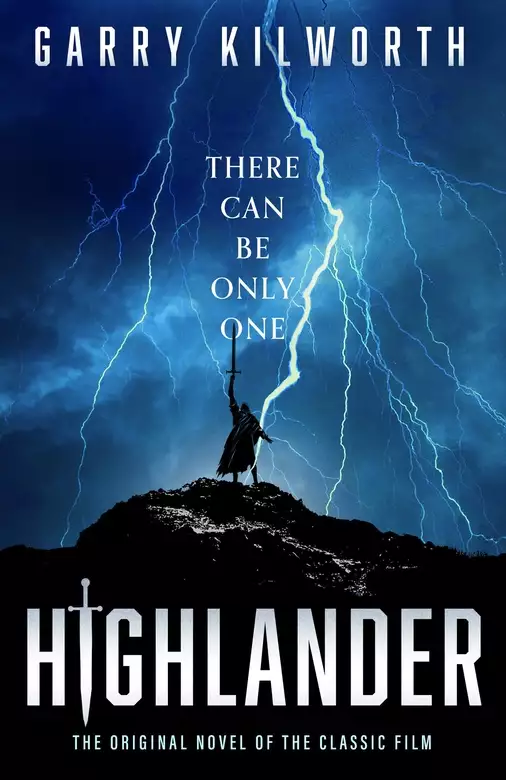
The much-praised novel of the original 1980s classic film, the inspiration for a new major blockbuster starring Henry Cavill
'There Can Be Only One'
The battle rages across the centuries, from the wind-scoured Sahara to the wild Russian steppes to the rocky crags of Scotland. And only one Immortal can survive.
MacLeod is the Highlander. A Scottish clan warrior from the 16th century, he was taught the deadly arts by an ancient mentor, who then suffered the only wound that can end an Immortal's life: decapitation.
Now, seven lifetimes later, MacLeod faces the final test. The Kurgan, his ancient adversary, has tracked him all the way to the streets of New York City.
The fight will be the same: blade to blade. Only the outcome is in doubt. Will the Highlander win? Or will the Kurgan's scimitar stop him with a blow that will plunge the earth itself into an era of darkness and chaos?
Based on the cult film classic, the original novel, republished for a new generation.
Release date:
July 2, 2026
Publisher:
Little, Brown Book Group
Print pages:
630
* BingeBooks earns revenue from qualifying purchases as an Amazon Associate as well as from other retail partners.
MacLeod’s restless eyes scanned the other spectators filling Madison Square Garden. As usual with such events there was a strong smell of human sweat in the air brought on by the close proximity of many bodies, and an atmosphere of anticipation. MacLeod’s damp raincoat was uncomfortable, and he sat partly sideways in his seat to avoid pressure on the object he carried strapped to his back.
A scattering of applause broke out, which increased in volume as seven hundred and forty-five pounds of wrestling flesh climbed into the ring in two giant lumps: the Tonga Kid and the Blond Backbreaker. Their opponents were already in there, snarling at the audience and flexing their muscles. All four wrestlers began prancing around and making threatening gestures towards one another.
The crowd loved it. It was what they expected. MacLeod began to take an interest in the forthcoming battle, though his attention remained partly on the tiers of spectators that lined the ring, looking for old, familiar faces amongst the crowd. Would any of them be here tonight? He must expect them at any time, in any place, and he could never fully relax – to do so might prove fatal. He scratched at his two-day growth of beard as the M.C. was calling for a lull in the pandemonium.
‘… the toast from the coast … from Brad Street, USA …’ cried the M.C.
The words were drowned occasionally in the roar of the spectators. As one of the wrestlers was being introduced he suddenly ran across the ring and slammed his head on one of the corner posts. Women leapt from their seats, some of them cheering, some of them screaming abuse, depending upon the their partisanship.
Show, all show. But it was what they wanted. It was what they had paid to see.
The Blond Backbreaker leaned forward on the ropes, leering at the crowd, and seductively unzipped his jacket to reveal the solid chest beneath, covered in wiry hair.
There were screams of delight from the spectators. A little girl, sitting on her mother’s lap, looked across at MacLeod, possibly wondering at his lack of enthusiasm in the bedlam around her. The Blond Backbreaker finally wriggled out of the slinky snakeskin jacket, which he threw into the crowd, playing to their expectations.
Bloodlust, thought MacLeod. It was like a tangible thing in the air around him. Yet there would be no blood, not here: merely an enactment. If you couldn’t get the real thing, you went to a place like this, which pretended well enough to satisfy but was actually quite safe, quite harmless. He had known other battles, other fights, where the gore had run in rivers, soaking the heather, turning the green and purple plants to scarlet. There had been spectators at those gatherings too – the camp followers – but there had been far fewer of them than the combatants.
Here the watchers outnumbered the combatants more than a thousand to one. A gladiatorial spectacle.
The sound of the bell interrupted his thoughts and he watched as the four wrestlers moved in on one another.
The Tonga Kid immediately ran at his opponent and butted him in the belly, carrying him back and slamming him into a corner post. Then he gripped him by his long, black hair and began hammering his head with his fist.
While the referee was engaged in this exchange, the Cruncher took a flying kick at the Blond Backbreaker, his feet hitting just below the other’s neck, sending him spinning out of the ring. The crowd screamed at the referee, the referee screamed at the wrestlers, the wrestlers screamed at each other. Flesh met flesh. Bone met bone. Each blow looked a crippling one. Each armlock appeared to be delivered with enough pressure to snap a three-inch-thick pole. Yet always the combatants parted, turned, gestured, snarled, and went in for more.
A spectator near MacLeod shrieked, ‘Kill them,’ though who was supposed to kill whom he didn’t specify. Presumably it was enough for him if somebody killed somebody. The chant was taken up around the Gardens: kill, kill, kill. Gradually, it dissolved into more specific requests for maiming and the sight of blood again. There were those who were happy with the old, banal phrases, and those who were more inventive, more poetic in their demands for broken bodies. MacLeod remained silent, staring with weary eyes at the scene before him. The little girl was sucking on a candy bar now, still staring at him rather than the wrestlers, and he grimaced at her, receiving a faint, uncertain smile in exchange. The girl tried to whisper to her mother, but the woman’s attention was completely taken up by the four mounds of blubber and muscle in front of her, pounding away at each other’s bodies. Her eyes were wide and shining and there was a faint smile on her face. Her absorption in the scene before her seemed more complete than that of a Tibetan monk attempting to reach Nirvana. The little girl might just as well be talking to a brick wall.
Suddenly the woman shrieked, ‘Tear his head off!’
MacLeod jerked upright in his seat at these words as they triggered a reaction in him. For one second he was alert, but then he relaxed again, and stared at a Chinese spectator whose face told him he had his shirt on the Tonga Kid and his partner. His expression altered alternately from one of dismay to one of delight, as the battle swayed, first one way and then the other. It almost seemed as if he were feeling the blows of his favourites himself. From time to time he’d touch his breast pocket where, no doubt, his wallet was situated.
The Blond Backbreaker was lifting one of his opponents high above his head now, ready to slam him down on the canvas. Both the woman and the Chinese were crying, ‘Yes! Yes!’ They wanted to see him go down, hard, and stay there, permanently. The referee was caught between two battling giants and was himself in danger of being crushed or strangled.
MacLeod glanced towards the exits, but there was no one leaving or entering. Flashbulbs were filling the stadium with lightning – a silent storm – as all four wrestlers were locked together in one writhing mass in the centre of the canvas. The referee was getting his breath back, as no doubt were the wrestlers themselves.
On the opposite side of the stadium, one of the spectators held up a hand-painted sign, which read ‘KILL THE PIGS’. At that moment the man behind MacLeod, slammed a hand down on his shoulder and MacLeod twisted round to look into his face. It was not familiar.
‘God – you’ve got to love it,’ said the man, his eyes shining.
MacLeod nodded, pulling his shoulder from underneath the hand. The battle below continued, unabated, with grunts and phrases like, ‘That son of a bitch,’ drifting upwards in the brief lulls in the shouting of the crowd.
MacLeod closed his eyes, seeing a different scene, from a different time …
The sun was low over the Glenfinnan hills, filling the valleys with long shadows and dark lanes of purple. A golden eagle wheeled in tight circles above a tall pinnacle of rock: a stack on which MacLeod guessed it kept its eyrie.
The clansman breathed the sweet scent of the heather, drawing it deeply into his lungs, and wondered how such perfect scenery could have so many faces.
He turned to his two companions, his cousins, Dugal MacLeod and Angus MacLeod, but their eyes were not on the eagle. They were studying the rocks ahead of them and Connor could feel the tenseness in the air. In that year of 1536, Connor MacLeod and his clan had decided to settle their differences with the Frasers. His cousins were ever watchful for the ambush which might come at any time on their ride back to their village.
All three men were riding bareback and their thick Celtic legs gripped the sides of the sturdy mounts, gently applying pressure to maintain direction. Each of them carried his claymore and targe in the right hand, while the left loosely held the reins.
‘We’ll be back long afore nightfall,’ said Angus, in a satisfied tone. ‘Mind I said it would be so.’ His beard glistened with drops of sweat, which ran down from his cheeks into the matted tangle of hair.
Dugal said, ‘You’re never wrong, Angus. That’s one thing we could never accuse you of – being wrong.’
Dugal’s face was staring away from Angus at the time and the older man strained in his saddle to attempt to look at the other’s expression. He was never sure whether he was being made a fool of or not. Dugal turned to him now with a face full of seriousness, though a muscle was twitching in the corner of his mouth.
Connor, who knew full well that Dugal was being sarcastic, smiled at the irony of his cousin, careful not to let Angus see. His kinsmen were not above fighting him and amongst themselves, even though the Frasers might descend upon them at any time. The maxim of the MacLeods might be, ‘I am against my cousin, but my cousin and I are against the stranger.’ They were a warlike people, by necessity, having to guard their crofts and huts against marauders from all sides of the Scottish hills.
Suddenly, Connor’s mount shied slightly. Angus had already paused, his huge nose sniffing at the air.
‘What is it?’ said Dugal.
‘If I knew, I wouldna be worried,’ said Angus. ‘Ah’m not a-feared of things I can see.’
Beyond the rocks were some pines, a clump not much bigger than a spinney, but large enough to hide several men, if they were disposed to wait in ambush. Connor’s horse was doing a sidestep now, clearly feeling its rider’s agitation. The sun had been sliced in two by a flat-topped peak and the light was beginning to fade rapidly. Connor listened hard, but all he could hear was the gargling of the burn as it struggled to find a downward path through the peat.
‘The trees …’
Angus sniffed again. He maintained he could smell a Fraser from a quarter of a mile away, but Connor suspected that it was because the older man was going a little deaf that he trusted to this sense when his sight would not tell him what was going on.
‘Well, man? We canna stay here all night,’ said Dugal.
At that moment they came; not out of the trees, but from the rocks above. There were five of them, all wearing the Fraser tartan and even the hard-of-hearing Angus must have been deafened by their yells.
‘Right again, Angus,’ cried Dugal, though whether he was talking about the fact that the enemy were present, or whether he was being sarcastic again, and referring to the pines, no one stopped to ask.
The claymores were out, catching the last rays of the sun on their blades. Connor held his tard low, to protect his thigh and the horse’s flank, since the Frasers were on foot. One of them, a red-bearded man with wild eyes, came pounding over the turf to slash at the horse’s head.
Connor turned his mount. He brought down the claymore in a wide sweep at the Fraser’s head. But the clansman was too quick for him, bringing up his own blade to block the blow. Both men were jarred to the teeth from the clash of weaponry. Connor’s horse sidestepped then, onto the Fraser’s foot, and the man yelled, striking its head with the boss of his targe.
With the Fraser’s shield arm thus occupied, Connor thrust with the point of his sword. The blade entered the man’s cheek, just below the bone. It was not a death blow, but the other, his foot free now, ran backwards.
Connor could see him sticking his tongue through the new hole in his face.
An axe hit Connor’s shoulder, but the blade was almost flat on impact because the wielder had to stand on tiptoe.
Connor recognised the attacker as Ian Fraser, a youngster not more than fifteen years of age. Connor backed his mount into the lad, sending him sprawling on the heather.
‘Away an’ home to your mother,’ yelled Connor, ‘before I have to split your ears.’
‘Boys,’ cried Dugal. ‘Just wee laddies.’
One of them lay dead on the turf, half draped over a rock. The others had scattered now, all except the one that had first attacked Connor. He began scrambling up the escarpment, but Angus was quick to follow, dismounting and chasing him on foot. The Fraser turned to face him on the slope and blades clashed, metal biting metal. The Fraser’s bonnet came off, revealing a bald head that shone in the gloaming. Angus kicked him high on the leg and the other went over. The MacLeod’s sword came down, point first, and pinned the writhing Fraser to the hillside. There was a brief yell from the victim, a spurt of blood from his mouth, then the evening was quiet once more.
Angus came down, wiping his blade on his kilt.
‘What was the man thinking of?’ he grumbled. ‘Bringing youngsters o’ that age?’
Dugal said, ‘If they’re old enough to lift a weapon, they’re old enough to fight.’
Connor said nothing. He was leaning over from his horse, looking at the young man sprawled over the rock.
The darkness had descended now, like a black shroud.
He was thinking about a pig they had slaughtered a few days back and how the eyes of the animal had been wide with stark terror as the spear went into its throat. The lad’s eyes were like that of the pig’s – wide and full of the horror of death. He was saddened by the youthful blood that had been spilled like water on the heather.
‘Did you have to cut his throat, Dugal? Could you not have stunned him?’
Dugal sounded incensed, but Connor guessed this was partly defensive.
‘He was coming at me, man. I didna stop to question his age. The laddie had a claymore, an’ that was what I kept my eyes on, not his face. It’s no my fault. It’s his …’
He pointed with his own sword at the body lying on the side of the hill.
Connor rubbed his shoulder where the battle-axe had struck him. It had not even broken the cloth but still there would be a bruise the size of Angus’s fist there in the morning.
Angus was collecting the weapons dropped by the Frasers when they had fled. They would be useful in the coming battle. There was a certain amount of satisfying irony in killing a Fraser with one of his own clan’s weapons.
The three men then continued their journey, over the low hills, until the lights of the village came into view.
Sentries called out to them as they approached, an edge to the voice which revealed a nervous tension. There was the smell of boiled vegetables in the air, underlined with the odour of cooked meat. Connor’s stomach began to respond to the stimulants, churning over. He had not eaten since the early morning.
At their approach, a figure came out of one of the peat-and-stone crofts, standing in the light of the dim candles within.
As Connor and his companions passed the bonfire in the middle of the village, she came running towards them, crying, ‘Connor!’
Dugal said, ‘Somebody’s pleased to see somebody.’
‘I’ll thank you to keep your thoughts to yourself, cousin Dugal,’ said Connor, but he was pleased to be greeted in such a fashion.
Kate caught hold of his mount’s reins as she arrived breathless, by the horse’s side. He looked down on her and smiled.
Her thin face broke into an impish grin.
‘Did you bring me a present, Connor MacLeod?’
‘We’ve been out gathering recruits woman, no on a spree,’ Angus said testily, replying for him.
‘I brought you myself, Kate MacLeod. Is that no good enough?’
She sighed. ‘It’ll have to do, won’t it?’
Connor MacLeod’s eyes opened just as the Blond Backbreaker was slammed face-down onto the canvas. The big man hammered the boards with his fist, as if in great pain. The crowd cheered, delighted. His opponent pranced around the ring clapping his own hands above his head, applauding with the spectators.
MacLeod had had enough.
He rose from his seat and began threading his way to the end of the row to the indignation of the people he had to pass. He ignored them. They were soon back to their yelling and screaming in any case.
Once in the centre aisle, he made his way to the underground garage where he had parked his automobile.
On reaching it he stopped and scanned the silent cars standing in neat rows beneath the jaundiced light. It seemed empty, but he wasn’t sure. There was a small nagging doubt in the corner of his mind. He took a few steps forward and there was a crunch from underfoot.
Looking down he saw that he had stepped on an empty coke can. He kicked it away and it went skidding along the floor to hit the wall.
He continued walking, along the line of cars, his eyes still probing all the dark corners. He stayed away from the pillars, walking in the centre of the aisle. From outside came the rumble of traffic on the New York streets and the faint sound of a police siren.
When he came abreast of a Chevrolet he stopped suddenly and turned. A whisper of cloth against the metal of a car had caught his attention. Then a man stepped out of the shadow of a pillar and stood there regarding him silently for a moment, before saying, ‘MacLeod.’
He nodded. ‘Fasil … wait.’
The man threw open his coat and reached inside.
Something flashed in his hands as he took up a fighting stance in the middle of the garage floor.
It was a sword with a golden hilt and Fasil held it like a man who knows how to use what he holds in his hands. The weapon was obviously very familiar to the thick-set Fasil. MacLeod could see the grey head nodding slightly, as if to say, this is it. The time …
‘Wait,’ cried MacLeod again, b. . .
We hope you are enjoying the book so far. To continue reading...

 Please log in to recommend or discuss...
