
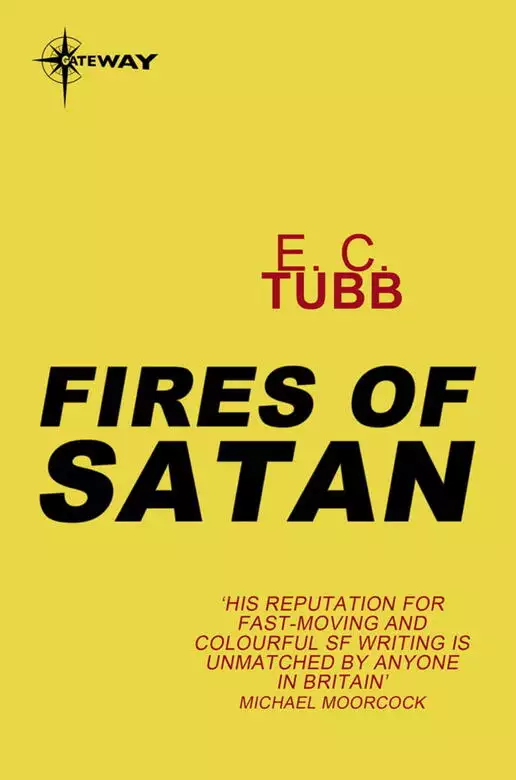
Fires of Satan
- eBook
- Book info
- Sample
- Media
- Author updates
- Lists
Synopsis
Imagine a day, not too far from today, when you pick up the newspapers to find them free of the usual accounts of crime, corruption, violence and war. There's no politics or politicians, no sporting results, speculation or scandal. There is only the asteroid: newly-discovered, enormous and on a collision course with Earth. Imagine a time, not too far from today, when the world itself stands helpless before the Fires of Satan...
Release date: November 30, 2012
Publisher: Gateway
Print pages: 124
* BingeBooks earns revenue from qualifying purchases as an Amazon Associate as well as from other retail partners.
Reader buzz
 Please log in to recommend or discuss...
Author updates
Fires of Satan
E.C. Tubb
Experience dictated that he was warmly dressed and carried a flask despite regulations. Rules easy enough for Hammond to make but the Director didn’t have to spend a freezing winter’s night in the opened dome. To hell with him.
Ice crunched beneath his boots as Spragg left the house, slamming the door then pushing against it to make sure it was locked. Up here there was little risk of vandals but old habits died hard. Ice crunched as he strode down the path and on the road, which led up the hill. Above him, touched by the snow with an air of enchanted mystery, the great dome loomed. Time and custom had changed that but, for some, it still remained.
‘Professor? Is that you, Professor Spragg?’
She stepped towards him from the shadows, tall, lithe, her body shapeless beneath a fringed garment. Despite the cold her head was bare, dark hair hanging in an untidy mane. In the softly luminous light cast by the reflective snow he could see wide, deep-set eyes, a generous mouth, dimpled cheeks.
‘Yes,’ he snapped. ‘Who are you?’
‘Myrna Parkin. I’m doing post graduate work and –’
‘You’re here to assist me.’ He closed the space between them. ‘Why didn’t you wait inside?
‘I couldn’t. The door is locked.’
As he should have known. McGregor was on vacation, Reilly was sick and Dowton would have locked up at dusk. A habit permitted by Hammond for the sake of the saving in overtime – unlike astronomers the janitor worked by the hour.
‘Sorry,’ said Spragg. ‘I should have remembered. Were you coming to meet me?’
‘To visit you, actually.’ Shivering the girl added, ‘It was better than just standing around to freeze. Please, Professor, couldn’t we go inside?’
A decade earlier Spragg would have joked, insisted she called him ‘Mal’, trying to warm their relationship in optimistic anticipation of potential reward. Now he busied himself with the keys, throwing open the door and passing through before her in order to switch on the lights. The place was as cold as an iceberg and he hurried into the small compartment used for recreation; a place where those who smoked could and hot drinks and snacks could be made. Radiators glowed to life as he hit the switches.
‘Tea?’ He gestured towards the electric kettle. ‘Make some and I’ll join you.’
‘I’d prefer coffee if there is any.’
McGregor drank the stuff and there was a jar of instant tucked away at the back of the cabinet. Sipping his tea, Spragg stared at the girl.
‘Postgraduate, you say?’
‘Yes.’
‘Studying?’
‘Quarks, quasars and black holes,’ she smiled. ‘Physics and astronomy fascinate me. The universe – the secrets waiting to be solved out there –’ She dropped her hand, a little self-conscious, he guessed, of the displayed enthusiasm and not sophisticated enough to be careless of his reaction. ‘The majesty of it all. The splendour. The tremendous implications of the discoveries we are making.’
He said, dryly, ‘Is this your first stint in an observatory?’
‘I’ve been in others.’
‘But this is your first time as an acting assistant?’ She nodded. ‘I thought so, but don’t be ashamed of it. We all have to learn.’
‘You think I’m foolish?’
‘No.’
She put down her cup. ‘Sometimes I get carried away but how can anyone not respond to the mystery of the universe? It’s so enigmatic and yet, all the time, I’ve the feeling that if we only had one more scrap of knowledge, one more piece to fit the jigsaw, the whole puzzle would become clear and we would have the answer to everything. Is that being childish?’
‘No,’ he said quickly. ‘It’s just that it’s been a long time since I’ve met anyone honest enough to admit to such enthusiasm. I find it a refreshing change.’
‘Which means that you had it once yourself,’ she said.
‘A long time ago, perhaps.’
‘You talk like an old man.’
‘I am an old man.’
‘Not that old. When I first heard about you I thought you’d be stooped and grizzled and –’
‘Absent-minded and senile and on the make?’ He shrugged. ‘Why not? We are like other men.’
‘No.’ Her hair flew as she shook her head, her eyes serious. ‘Not as other men. You belong to a dedicated breed.’
A monk, he thought bitterly, they too were dedicated to something larger than themselves, restricted by onerous duties; hours governed by a bell which was governed by a clock which, in turn, was governed by the stars. And they too could be tempted by someone coming to them in the night. Damn the girl, why had she displayed such enthusiasm? It gave them something in common, a shared emotion, a shared motivation.
‘Professor?’
His tea was cold. Irritably he flung it into the sink.
‘Impatient, Miss Parkin? We have the entire night before us.’ He smiled, remembering the impetuosity of youth. ‘You saw the sky out there and must know it won’t clear for a couple of hours at least. Which means there is no point in opening the dome just yet. But, I’ll admit, we can check the instruments and you need to be taught the basic routines and the system we use here. And, of course, you’d like to inspect the installation, right?’
‘That’s why I’m here, Professor.’
He looked at her appraisingly. The fringed outer garment she wore was a poncho of some kind. Below her legs were covered with the inevitable jeans, her feet with the inevitable boots. ‘You’ll have to get rid of the poncho. It swirls too much and could hit things or catch in things and the equipment costs too much to be risked. Now get it off while I find you something better.’
Beneath it she wore a uniform-like shirt and he paused as he turned from the cabinet, McGregor’s parka in his hands, staring at the taut fabric.
‘Here.’ He handed her the parka. ‘Belt it tight and if you get too cold don’t be afraid to let me know. You’ll find gloves in the pocket but you won’t be able to wear them all the time. Those other observatories you’ve been to,’ he said shrewdly. ‘All down south?’
‘Yes.’
‘Well, up here things are a little more primitive.’ He smiled. ‘The Director would say we operate in a more old-fashioned way which is another way of saying we’re so far behind the times it’s a laugh. In fact you’re standing in the middle of a scientific fossil. I’m sorry.’
‘Why? You have a telescope, haven’t you?’
‘Yes,’ he admitted. ‘We have a telescope. In fact we’ve had one for a long time now. Too damn long.’ He resisted the impulse to take a drink. ‘That’s half the trouble.’
When the eccentric Lord Althene had been smitten with the urge to dabble in Natural Philosophy his interest in astrology had directed his attention towards the stars. If the course of the planets could be plotted with greater precision then it was obvious horoscopes could be cast with a higher degree of accuracy and more definitive predictions made. Fired with enthusiasm and brooking no opposition he had been checked by only one consideration – where would the proposed observatory be sited? Ivegill had seemed ideal. A few miles to the south of Carlisle, served by roads and water, an area rich in stone and timber and with plenty of cheap labour to construct the essential buildings. Lord Althene owned the land for miles around and had large holdings close to the city itself. In the early spring of 1857 the first sod was cut and the first dirt removed for the foundations.
Seven years later the observatory was complete.
But, in the late nineteenth century the internal combustion engine was yet to come and, while the smoke from open fires was a nuisance, there weren’t enough of them to create a problem. At the turn of the century the old 6-inch refractor was replaced by a 32-inch reflector and later photographic equipment was added. The Althene Observatory gained a modest reputation for efficiency and strengthened that reputation when, in 1927, several small discoveries were made as to the disposition of some of the larger asteroids.
Then came the second world war, the massive increase in the use of cars, the population explosion, the motorways, pollution, death-duties and near-chaos. Things Spragg explained as he guided the girl around the installation.
‘So now we’re a trust,’ he said. ‘Enough was saved from the estate to provide an income from a scientific foundation. It suited the government to give its seal of approval and so we get certain tax advantages. But as far as real use is concerned we’re in the same class as the dodo.’
‘Why? It seems a nice place to me. Better than others I’ve seen.’
‘Better, maybe, but in the wrong place. You’ve visited Greenwich? You know the Royal Observatory had to be moved to Herstmonceux?’ He didn’t wait for an answer. ‘Pollution, that’s why. And the traffic – the vibration was hell. The same here.’ He gestured beyond the walls. ‘The M6 runs past barely a half mile distant. Big lorries carrying loads to Carlisle, not to speak of the endless stream of cars. And we mustn’t forget the airport, planes with lights and turbulence and heat-distortions from their jets. A mess. If we get a couple of prime hours seeing a week we’re lucky.’
‘Then Althene –’
‘Is a mess.’ Spragg was blunt. ‘We do our best but the odds are against us. This is a backwater, girl, a dead end. You should be in a place where you can meet the right people, make contacts, sow the seeds for later advancement. A few years and you’d be climbing and, if you’re lucky enough, then –’
‘I know,’ she said bleakly. ‘A discovery, my name in the papers, my report published in the journals and all those who want to jump on the wagon will be offering me posts and position. But if I don’t make a discovery? If I don’t get the publicity? What then?’
‘You’d make out.’
‘Yes,’ she said and, subconsciously, inflated her chest. ‘I guess I would but maybe I’d rather not do it that way. I want to be known for my achievements not because I was born with a good body. I want what you have, Professor Spragg.’
‘Me?’
‘You’ve made your mark and it hasn’t been forgotten. You’re respected and admired and none can argue with your reputation. That’s why I wanted to come here. To learn what you can teach.’
She was putting him on, she had to be, and yet it was impossible to resist the glow of satisfaction from the knowledge that he hadn’t been forgotten. Someone had remembered, had thought him worth seeking out to share his labours. Then he shook his head, remembering, the small discovery he had made years ago now quickly swallowed in the doors it had opened. Had Hammond used it to obtain a willing girl to act as cheap labour?
‘I need the experience,’ she said when, bluntly, he asked. ‘Theory isn’t enough, you know that.’
You had to sit and freeze or roast according to the season, to fight cramps and thirst and impatience and learn not to cavil against circumstance when, after days of patient waiting, some trifle ruined everything. Like the time when a complete batch of recordings had been wiped because an assistant had misread an instruction. Like the time when some fool had set the woods aflame at the time of a critical observation, the distortion making all measurements useless.
And the time when Jashir had slipped and fallen to his death when climbing up to the eyepiece to make an adjustment.
A bad time and he had seen it all. Heard it all too, the gasp, the strangled cry, the scream and then, after too long a time, the sickening, squashy thud as a head had hit metal and burst like an overripe melon. A bad time and he had been fortunate not to have been alone for the police, oddly, had seemed suspicious and were probing with their questions. Yes, he had ordered the adjustment. No, he had no reason to suspect Jashir had been drinking. The reverse in fact, the man was a Moslem – had been a Moslem and no believer in Islam drank. No, he had not tried to help. Yes, it had been an accident.
Cold and heat and boredom and disappointment and even death – the girl was right, theory wasn’t enough.
He said, ‘Are you living in the village?’
‘Yes. I’ve got a room with Mrs Turney. The Director recommended her to me.’ She looked at him. ‘And you? I suppose you’ve got a house.’
‘Yes.’
‘Married, of course?’
‘Of course.’ He wondered at her directness then realised it could be the product of shyness. In his own time such shyness would have found refuge in silence and a reserve which had too often been mistaken for sullenness but times changed and so did customs. ‘But not any longer,’ he added. ‘Astronomers shouldn’t marry.’
‘The hours?’
‘She grew tired of sleeping alone and decided to do something about it. I discovered what was going on. There were no children so –’ he made a gesture ‘ – end of marriage.’
And the end of a friendship, which could have meant so much. Later, thinking about it, he realised that his anger had been directed more at his loss than at Irene’s infidelity. Bob could have grown so close but had turned from him to accept the forbidden fruit so freely offered. A stupid metaphor – since when had sex been forbidden to any thinking and intelligent person?
‘So you’re free,’ said Myrna, ‘Don’t you ever get lonely though?’
‘At times. I’ve a woman who comes in to clean up.’
‘And?’
‘You haven’t met Mrs Elphick.’ He looked into her eyes, searching for mockery but finding none. ‘And you? I guess you have a man.’
‘I had. He didn’t want me to come. In fact he threatened not to see me again if I did. So, naturally, I had to take the position. I’m selfish.’
‘If wanting to do what we want to do is selfish then yes, we are,’ he said. ‘As I’m going to be now. I want to open the dome and get to work. Let’s move!’
Once it had meant sweat but now electric motors did the job and Spragg watched as the segment moved to one side exposing a narrow section of sky. It was clearing, stars winking through a faint scud of cloud, the cold increasing as the trapped heat escaped from the building. A moment and he completed the cycle, the segment wide open now, held fast, the lattice of the telescope etched against the heavens.
There was a moon for which he was thankful but from the city a suffused glow rose to paint the thin wisp of cloud a rosy pink while lower-lying mist held a deeper hue. High above the winking signal lights of a jet made traces towards the west while, from the motorway, the sound of traffic made a loud thunder.
‘I don’t believe it.’ Myrna tensed. ‘It sounds so close.’
‘It is close but this makes it worse.’ Spragg gestured at the interior of the dome. ‘Open, it acts like an ear catching and concentrating the noise. You’ll get used to it.’
If she stayed which was doubtful but, would he ever get used to her? Already she had won him so that, even when not looking at her, he was conscious of her presence. An old man, old enough at least to be her father – he should have more sense! And yet, why not?
‘Ready, Professor?’ She was standing at the foot of the lattice waiting for instructions.
‘Did Hammond explain the programme?’
‘Only roughly. He said you’d fill in.’
He would, his golf would be waiting, but maybe he shouldn’t judge the man too harshly. It couldn’t be easy to act the professional beggar, which, basically, was what the Director really was.
‘We’re running a correlation check on the Jovian Moons,’ said Spragg abruptly. ‘Just an excuse for staying in business, to let others know we’re alive. Others being the government and various benefactors who are willing to make a donation that they can set against taxes. With me?’
‘You’re bitter,’ she said quietly. ‘You shouldn’t be. There are those who would –’
‘Give their right arms to be able to play with an installation like this. I know. I get letters from idiots who want to send messages. Nuts who are convinced there are secret symbols on the moon. Fools who know just where to look to find the aliens who are manipulating us.’
And the others, she thought, the dedicated amateurs who were often more skilled than the professionals. A professional was merely someone who got paid and a person who worked for love was surely more worthy than one who laboured simply for gain
Spragg?
She had been warned about his temper, his irascible nature and gratuitous sarcasm. Warned too about his penchant for women, a trait he had betrayed with his eyes when handing her the parka. But there was more and she had caught a hint of it when talking about his circumstances. A yearning, an empty longing quickly masked with a brash facade which she knew too well. And the taint of alcohol on his breath when they had met, normal enough at such a time on a man who worked during the day, but for him it was tantamount to drinking at breakfast.
A man under strain, she decided, and perhaps one who was slipping and knew it. The Dutch courage, the irritability, the attack when there was no cause and the defence when there was no need. The demeaning of his chosen profession. The cynicism, which he wore like armour.
‘As I was saying,’ said Spragg. ‘And if I continue to hold your interest, we are checking the Jovian system of moons.’
Spragg blew on his hands, his breath a cloud of vapour.
‘It is barely possible that we may be able to isolate and identify the satellite in question and, if we can determine that it is hitherto unknown as a moon of Jupiter we shall have made history. But don’t hope for too much. Personally I believe the mysterious object to be a wandering asteroid, which has an erratic orbit. A few more years and it will have vanished from the vicinity of the planet.’
‘An asteroid?’
‘Why not?’ He guessed her objection. ‘The size? All we have seen is a speck of light. A high albedo would give the impression of great dimension if the reflected light were diffused. But you know all this. What you may not know as yet is how we work here. It is a matter of making the best of a bad job. As we can never be certain of clear skies we have to rely more on records than direct observation.’
‘That’s normal.’
He shrugged. Given time she would learn but for now it was best to use her as a pair of hands. ‘It’s time we got to work. Aim for Capella. You –’
‘It’s in the constellation Auriga,’ she said coldly. ‘There’s no need to treat me as if I were an ignorant child.’
‘I was going to say that you may find it difficult to maintain alignment,’ he said. ‘The drive mechanism is a little sloppy so we’ve worked out a system of signals. When I give the word you make sure we’re on target. When you’re satisfied let me know. I snap the shutter and we wait to do it over again. With luck we’ll get maybe a dozen useable exposures.’
‘That many?’
‘We’re using a special emulsion coupled with a light magnifying analogue device rigged up by McGregor. It isn’t as good as the commercial installations used by the big observatories, but it’ll do.’ Spragg glanced at his watch. ‘Up you go now. Watch yourself and, if you get too cold, let me know.’
She climbed with the easy agility of youth and he looked away, remembering Jashir falling. An incident which, tonight, was not repeated. As the girl settled he checked the equipment, electric motors humming as the telescope moved to point at the selected region of sky – an eye peering into the universe.
And, despite his age and the coating cynicism, the magic remained. The stars, the mystery they held, the enchantment. The endless spaces illuminated with scattered suns. The whole glory of the universe spread out before him to be probed and questioned, explored and chartered, loved and feared and, even, worshipped a little.
‘On target,’ said the girl. ‘Clear se. . .
We hope you are enjoying the book so far. To continue reading...
