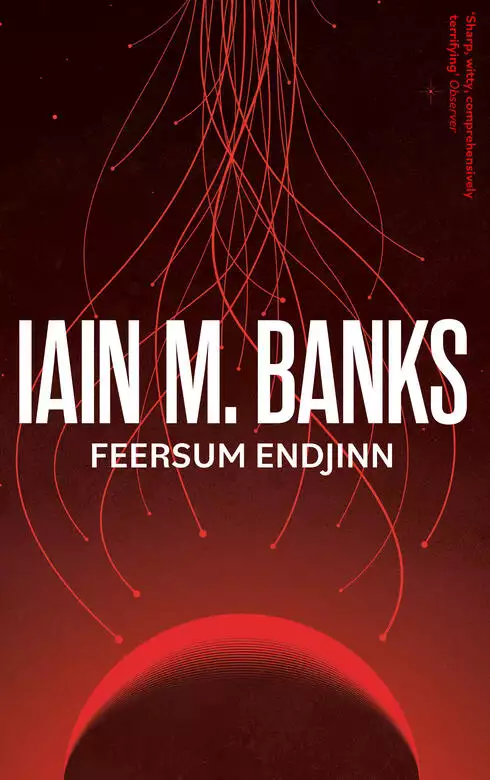
The novels of Iain M. Banks have forever changed the face of modern science fiction. With breathtaking imagination and extraordinary storytelling, they have secured his reputation as one of the most extraordinary and influential writers in the genre.
"Banks is a phenomenon." William Gibson
Count Sessine is about to die for the very last time . . .
Chief Scientist Gadfium is about to receive the mysterious message she has been awaiting from the Plain of Sliding Stones . . .
Bascule the Teller, in search of an ant, is about to enter the chaos of the crypt . . .
This is the time of the encroachment and everything is about to change. Although the dimming sun still shines on the vast, towering walls of Serehfa Fastness, the end is close at hand. The King knows it, his closest advisers know it, and the crypt knows it too; so an emissary has been sent - an emissary who holds the key to all their futures.
Praise for the novels of Iain M. Banks:
"Epic in scope, ambitious in its ideas and absorbing in its execution. " –Independent on Sunday
"Banks has created one of the most enduring and endearing visions of the future." –Guardian
"Jam-packed with extraordinary invention." –Scotsman
"Compulsive reading." –Sunday Telegraph
Books by Iain M. Banks: Consider Phlebas The Player of Games Use of Weapons Excession Inversions Look to Windward Matter Surface Detail The Hydrogen Sonata The State of the Art Against a Dark Background Feersum Endjinn The Algebraist
Also now available: The Culture: The Drawings- an extraordinary collection of original illustrations faithfully reproduced from sketchbooks Banks kept in the 1970s and 80s, depicting the ships, habitats, geography, weapons and language of Banks' Culture series of novels in incredible detail.
Publisher:
Orbit
Print pages:
464
* BingeBooks earns revenue from qualifying purchases as an Amazon Associate as well as from other retail partners.
Then, it was as though everything was stripped away: sensation, memory, self, even the notion of existence that underlies reality—all seemed to have vanished utterly, their passing marked only by the realisation that they had disappeared, before that too ceased to have any meaning, and for an indefinite, infinite instant, there was only the awareness of something; something that possessed no mind, no purpose and no thought, except the knowledge that it was.
After that came a rebuilding, a surfacing through layers of thought and development, learning and shape-taking, until something that was an individual, possessing a shape and capable of being named, woke.
Buzz. Buzzing noise. Lying on something soft. Dark. Try to open eyes. Something sticking. Try again. Light flash shaped 00. Eyes feel open, un-gummed, but still dark. Smells; at once vital and decadent, lush with death-life, stirring some memory, recent and forever-far at the same time. Light comes; a small… searching for the name of the colour… a small redness hanging in air. Move arm, hand coming up; right arm; noise of skin on skin, feeling coming with it.
Arm, hand, finger: rising, positioning, eyes focusing. Red patch of soft light disappears. Press on it. Arm shaking, feeling weak; falls back to side. Skin on skin.
Click.
Noise of buzzing, something sliding again but not skin on skin; harder. Then light from behind/above. The small red light has disappeared. Then movement; darkness above/around sliding back, face neck shoulders chest/arms trunk/hands in light now; eyes blinking in light. Light grey-pink, shining down; blue-brightness through hole in curved cliff above/around.
Wait. Rest. Let eyes adjust. Songs around, wall around/ above (not cliff; wall), curving round, curving over (ceiling; roof). Hole in wall where the brightness is called a window.
Lie there, turning head to one side; another hole, glimpsed over shoulder; goes down to ground, and called doorway. Daylight there beyond, and the green of trees and grass. Floor beneath where lying; pressed earth, light brown with a few small stones set in it. The song is birdsong.
Get up slowly, arms back, resting on elbows, looking down towards feet; woman, naked, colour of the ground.
Ground is quite near; might as well stand up. Sit up further, swivel (dizzy for a moment, then steady), then feet/legs over side of… of… tray thing that has appeared out of hole in wall of building, tray thing lying on, and then… stand.
Hold onto tray, legs feeling funny, then stand properly, unaided, and stretch. Stretch feels good. Tray slides back into wall; watch it go, and watch part of wall slide down to cover hole that was there, hole came out of. Feel… sadness, but feel… good, too. Deep breath.
Breath makes noise, then cough makes noise, and… voice is there. Clear throat, then say:
“Speak.”
Slight startle. Voice makes a feeling in throat and face. Touch face, feel… smile. “Smile.” Feel something building up inside. “Face.” Still building. “Face smile.” And still. “Face smile good alive hole red wall me look door doorway sun garden, ME!”
Then the laughter comes, bursting out, filling the little stone rotunda and spilling out into the garden; a small bird hurtles into the air in a commotion of leaves and flies away upon a wake of song.
Laughter stops. Sit on floor in the building. Feeling empty inside; hunger. “Laughter. Hunger. Me hungry. I am hungry. I laugh; I was laughing, I am hungry.” Get up. “Up.” Giggle. “Giggle. Get up and giggle, me. I learn. I go now.”
But turn and look at inside of building; the curved walls, stamped-earth floor, the polished rectangular stones with lettering on them which are set into the walls, some of them with little cups/baskets/holders. Not sure which one was the one with the tray and the little red light now; not sure which one came from, now. Sadness, a little.
Turn again and go to door and look out over shallow valley; trees and shrubs and grass, a few flowers, stream in bottom of valley.
“Water. I thirst. I have thirst, I am thirsty; I will drink. Go for drink now. Good.”
On the morning of the one hundred and forty-third day of the year which by the new reckoning was called second-last, Hortis Gadfium III, the chief scientist to the pan-alignment clan Accounts/Privileges, sat on a steel girder and looked up at the almost-finished bulk of the new Great Hall oxygen plant number-two liquifier unit, and shook her head.
She watched a crane swing a palleted load of steel-plate towards the workers waiting on the summit of the structure, while above the crane’s delicate web-work the ponderous mass of a lufter drifted, engines droning, delivering a new batch of supplies. She looked around at the swarm of human-scale toil that was the new oxygen works, where engines laboured and variously puffed, grumbled and hummed, where machines crawled, floated, rolled or just sat, where chimerics sweated, strained, lifted and pulled, and where humans too laboured, shouted or simply stood scratching their heads.
Gadfium drew one finger through the layer of dust on the girder beneath her, then held the begrimed finger up to her face and wondered if in that smudge there lay a nano-machine capable of creating within the day machines which would create machines which would create machines that would give them all the oxygen they would ever need, and by the end of the season, not by the end of next year. She wiped her finger on her tunic and looked up again at the number-two liquifier unit, worrying whether it would ever work properly, and, if it did, whether there would be any workable rockets for it to supply.
She gazed towards the Hall’s three vast windows, where—beneath high, rainless ceiling-cloud—sunlight shone slanting down in great broad bands of dust-struck radiance, illuminating a swathe of landscape a few kilometres away and sparkling on the towers and domes of Hall City, two thousand metres beneath the pendulously extravagant architecture of the Lantern Palace.
It was bright outside, and on such days you could deceive yourself that all was still well with the world, that there was no threat, no shadow on the face of the night, no remorseless, system-wide, approaching catastrophe. On such days one might persuade oneself that it was all a huge mistake or mass hallucination, and that the view last night, when she had stood outside the observatory dome above the darkened Palace, had been a figment of her imagination, a dream that had not vanished or been properly sorted by her waking mind, and so which lived on, as nightmare.
She stood up and walked back to where her junior aide and research assistant were waiting, conversing quietly in the midst of the oxygen works’ constructive chaos and looking about occasionally with a kind of disparaging indulgence at the undignified physical clamour such mere technology required. And, Gadfium didn’t wonder, probably amusing themselves discussing what the old girl was doing, not wanting to linger any longer than absolutely necessary at this building site.
There probably had been no need for her to attend the site conference at all; the science in this project had long been settled and the burden of effort passed to Technology and Engineering; still, she was invited to such meetings out of politeness (and her rank at court), and she attended when she could because she worried that, in the rush to recreate technologies and processes which had been obsolete for thousands of years, they might have missed something, forgotten some simple fact, overlooked some obvious danger. Such an oversight might be quickly dealt with, but they had anyway so little time that any interruption at all to the programme might prove disastrous, and while in her lowest moments she sometimes suspected such an interruption was almost inevitable, she was determined to do all in her power to ensure that if it did befall them it would not be for want of any diligence on her part.
Of course, it would all have been a lot simpler if they had not been at war with the clan Engineers, headquartered (and besieged) in the Chapel, thirty kilometres away on the far side of the fastness, and three kilometre-high floors higher than the Great Hall. There were Engineers on their side—just as there were dissident Cryptographers, Scientists and members of other clans on the other side—but too few, and like so many Scientists Gadfium had had to shoulder the extra burden of trying to think on an industrially practical scale.
As for her desire simply to sit and look at the plant, that was probably a function of her doubt that what they were doing here was going to make any difference to their plight even if it went exactly according to plan; she suspected that subconsciously she hoped the sheer presence and scale of this industrial enterprise—and the physical energy of its creation—would somehow convince her there was a point to it all.
If that had been her wish, it had not been granted, and no matter how much of the oxygen works filled her field of vision, always lurking at the edge of her sight she seemed to see that hazy spread of darkness, rising from the night’s horizon like an obscene inversion of dawn.
“Chief Scientist?”
“Hmm?” Gadfium turned to find her aide, Rasfline, standing a couple of metres away. Rasfline—thin, ascetic, stiffly correct in his aide’s uniform—nodded to her.
“Chief Scientist; a message from the Palace.”
“Yes?”
“There has been a development at the Plain of Sliding Stones.”
“A development?”
“An unusual one; I know no more. Your presence there has been requested and the relevant travel arrangements made.”
Gadfium sighed. “Very well. Let’s go.”
The piker swept out of the oxygen works and headed for East Cliff along a dusty, winding road filled with heavy traffic both machine and chimeric. The groomed, carefully landscaped parkland that had graced this part of the Great Hall for a thousand generations had been ripped up without a second thought when the Encroachment’s implications had—apparently—been driven home to the King and his more sceptical advisers; normally any such industry would have been banished to the inner depths of the fastness, where there was little natural light and objectionably ugly or effluent processes could safely be housed without disturbing either the view or the air, and where only the desperate or outlawed would ever choose to live.
Still—for all the outrage, and the suicides of a number of gardeners and foresters—when the King had decided such a plant must be built, and must be built quickly, and under the eye of the Palace, the earth-movers—themselves newly constructed for the purpose—had been sent in, and woods, lakes and glades which had delighted all castes and classes for millennia were levelled under their ploughs, scrapes and tracks.
The chief scientist watched the oxygen works disappear behind a wooded hill, until the construction site was marked only by a haze of smoke and dust hanging in the air above the trees. It would reappear as they headed out across the plain to East Cliff; the oxygen works was sited on a small plateau and so visible from almost everywhere throughout the ten-kilometre length of the Great Hall. Gadfium wondered again whether the real reason the King had had the works built here was to impress upon his subjects the full gravity of their situation, and give them a preparatory hint of the kind of sacrifices that would need to be made in the future. Gadfium shook her head, tapped her fingers on the seat’s wooden armrest and opened a vent by the side of the window to let the warm air in. She looked at the man and woman sitting opposite her.
Rasfline and Goscil had been with her since the start of the present emergency, ten years ago, when science had started to matter again. Rasfline epitomised the officer caste, and seemed to take pride in making himself as much like a machine as possible; in all those ten years he had never called Gadfium anything other than “Chief Scientist” or “ma’am. ”
Goscil—plump-faced, wild-haired, and whose tunic never seemed to quite fit properly or ever be entirely free from stains—had seemed to grow more dishevelled over the years, as though in response to Rasfline’s severe tidiness. She had uploaded some files from the oxygen works, and sat with her eyes closed now, reviewing this information and occasionally making small involuntary noises; tutting, hissing, snorting, humming. Rasfline set his jaw and looked away out the window.
“Any more details from the Plain?” Gadfium asked him.
“None, ma’am.” Rasfline paused, making it obvious he was communicating, then shook his head. “As before; the observatory there has reported something unusual and the Palace has granted their request that you attend.”
“Plain of Sliding Stones?” Goscil said, opening her eyes suddenly. She blew hair away from the side of her face, glancing at Rasfline. “I heard some gossip on the science channel about the stones doing something weird.”
“Really,” Rasfline said drily.
“And how did this weirdness manifest itself?” Gadfium asked.
Goscil shrugged. “Didn’t say; there’s just a filed report from some junior timed about dawn that the stones were moving and something strange was happening. Nothing since.” She glanced at Rasfline again. “Probably been clamped down.”
Gadfium nodded. “Has there been much wind and precipitation up there lately?”
Both Rasfline and Goscil went still for a moment. Goscil answered first: “Yes. Enough melt for them to move, and some wind. But…”
“Yes?” Gadfium said.
Goscil shrugged. “The way that junior reported; said there was a… may I repeat it verbatim?”
Gadfium nodded. “Go on.”
Goscil closed her eyes. Rasfline looked away again. “Umm,” Goscil said, “…Usual identifiers; Plain of Stones Observatory, etc., then, quote:”—her voice changed here to something like a chant—“something odd going on. Something very odd. Oh shit. Let’s see, right, general data first: wind blowing; north-west, force four, precip; three mill yesterday, plain friction factor; six. Oh, look at them! Look at that. They can’t do that! They’ve never done that, have they? Wait till—(unintelligible)—I’m calling the chief observer… filing this as is. Signing off.”
Goscil opened her eyes. “Unquote. After that, nothing. People have been trying to get in touch with the observatory since, but there’s no reply.”
“When was the report timed?”
“Six-thirteen.”
Gadfium looked at Rasfline, who was smiling thinly. “Has the Palace been in touch with the observatory since?”
“I cannot say, Chief Scientist,” the aide replied, then, as though seeking to be helpful nevertheless, added: “The message I received requesting your presence was timed at ten forty-five.”
“Hmm,” Gadfium said. “Kindly request that the Palace furnish us with more details, and allow us to speak directly with the observatory.”
“Ma’am,” Rasfline said, and took on the glassy-eyed look of someone making it politely obvious they were communicating.
Gadfium’s status decreed that she was above the need for an implanted direct status link, being one of those valued souls whose mind must be left free from the distractions of constant inter-communication to concentrate on undiluted thought, unless they chose to access the data corpus by some external means. She knew she must accept this, but even so oscillated between a guilty pride in her privileged position and an intermittent frustration that she so often had to rely on others to furnish her with so many of the details her work required.
“We’re to take a clifter up the East Face,” Goscil announced after a moment’s pause. “The King’s own machine, just for us,” she told the chief scientist. “They must want us there very quickly.”
The caisson-train lumbered across the broken landscape of the collapsed Southern Volcano Room; a line of huge, cylindrically rotund, multi-wheeled heavy carriers interspersed with smaller vehicles and chimerics. Some of the larger chimerics, all of them of the incarnosaur genus, carried troops; most of the other make-beasts were considered at least semi-sentient, and were themselves soldiers, variously armoured, impedimented and armed.
The other ground vehicles were all-drive holster-buggies, armoured scree-cars, one- or two-gun landromonds and the huge multi-turreted tanks known as bassinals. The struggling convoy accounted for a good sixth of the King’s military transport, and represented either a brilliant flanking manoeuvre to supply the beleaguered garrison of troops guarding the workings in the fifth-floor south-western solar, or a desperate and probably forlorn gamble to win a war that was not only unwinnable but anyway pointless; Sessine had still to decide which.
The Count Alandre Sessine VII, commander-in-chief of the second expeditionary force, looked up and away from the slow-moving convoy of beasts and machines in his charge to gaze at the gaping shell of ruined walls around them, and the revealed topography of mega-architecture and cloud beyond.
Standing waist-high in the turret of the command scree-car, shaken this way and that by the rough, trackless ground the convoy traversed, his body armour clunking dully against the inside rim of the hatch, it took an effort to focus on the vast and sullen grandeur of one’s surroundings, and a further effort to dismiss the apparent irrelevance of such scale to the more immediate task at hand (or rather at foot, and paw, and wheel and track).
All the same, it pleased him to do so every now and again when the steam and smoke-clouds cleared sufficiently, and he judged it no extravagance upon his supposedly valuable attention; keener eyes and more extrapolated senses than his would mind the progress of the convoy over such increments of time as he chose to allow the wider view, and—after all—what was his silent, self-solitary mind left so for (by the King’s good grace) if not to attend to the greater world beyond the vulgar intimacy of the immediate?
The collapsed Southern Volcano Room was really many rooms, and several levels of them, too; the walls still standing formed a huge extra curtain of cliff in the shape of a C between ten and thirteen kilometres in diameter and one and six kilometres in height. The crumpled ground the convoy moved across with such exquisite slowness was the wreckage of five or six floors, compressed by the cataclysm that had befallen this section of the fastness to a height of less than two great storeys, and was still shaken every year or so by smaller earthquakes. Steam and smoke drifted from a hundred different cracks and fissures across the crazily tilted geography of the room, and when dispersing winds did not whip whorling through the vast cauldron, the air was filled with the smell of sulphur.
It was a moderately calm day now, and the clouds of yellow-tinged smoke and brightly white steam that drifted over this tortured legacy of landscape provided cover for the convoy’s painstaking progress, even if they also sporadically prevented one from witnessing the full majesty of the great castle beyond.
Sessine looked behind him, through the high hanging valley that was the breach in the fortress structure created by the buried volcano. The curtain walls made a wavy line on the landscape, blue with distance beyond the hazily glimpsed forests, lakes and parkland of the outer bailey. Beyond was only the vaguest hint of the hills and plains of the provinces that made up Xtremadur.
It looked warm down there, Sessine thought, imagining the smells of summer pasture and woodland, and the feel of pool-water on his skin. Here, though the snow-line was still a good kilometre above, the air was chill when not heated with the rotten smell of the semi-dormant volcano beneath the convoy. Sessine felt himself shiver, for all his armour and furs.
He smiled as he looked around. For the privilege of being here in this gelid hell risking his last life on a mission the point of which even he did not entirely understand, he had indulged in the sort of prolonged and strenuous string-pulling he normally quite thoroughly disapproved of. Perhaps after all I am a masochist at heart, he thought. Maybe it had merely lain latent (he glanced at the pitched upheaval of ground they were crossing)—dormant—these last seven lives. The idea amused. He continued his sweep of the panorama briefly available through the shifting clouds.
At one end of the vast C bitten from the castle a single great bastion-tower stood, almost intact, five kilometres high, and casting a kilometre-wide shadow across the rumpled ground in front of the convoy. The walls had tumbled down around the tower, vanishing completely on one side and leaving only a ridge of fractured material barely five hundred metres high on the other. The plant-mass babilia, unique to the fastness and ubiquitous within it, coated all but the smoothest of vertical surfaces with tumescent hanging forests of lime-green, royal blue and pale, rusty orange; only the heights of scarred wall closest to the more actively venting fissures and fumaroles remained untouched by the tenacious vegetation.
Above, trees grew on the summit of the serrated ridge, which grew haphazardly, jaggedly, as it swept around the huge bowl of the Volcano Room, gradually lifting above the tree-line until directly in front of them it merged with the intact structure of the fastness Serehfa, where the walls—some pierced by enormous windows and clerestories, some plain, some shining sheer and some roughened sufficiently to be coated with snow or the blue-green strain of high-altitude babilia—climbed through the clouds and into the sky.
Sessine was looking almost straight up now, trying to glimpse the summit of the fast-tower itself, the mightiest of Serehfa’s mighty towers, standing glittering in its solitude above all but the most vestigial traces of atmosphere, fully twenty-five kilometres above the surface of the Earth and almost in space itself.
Clouds hid the mysterious summit of the castle, and Sessine smiled ruefully to himself as another veil of steam and foul-smelling smoke drifted across the view, obscuring. The Count held the image of those enormous distant walls for a moment and wrinkled his nose as the vapours and gases wrapped themselves round the slowly moving car. He lifted a pair of all-band field glasses from a hook inside the hatch and scanned his surroundings again, but the effect, and particularly the sense of scale, was not the same.
Still, there was a little added safety in the mists. He wondered—as he always did at some point in one of these recreational panoramas—whether his inspection had been in any way reciprocated.
He knew the King had his own spyers, dispatched to towers and high walls to watch the open areas beneath them and report to Army Intelligence, and he had never entirely believed that the Engineers seemed never to have thought of the same idea. He put the field glasses back. The volcanic mists did not appear to be dispersing; if anything they were growing thicker and more noxious.
There was a crackle of noise from inside the car, then someone spoke. It sounded like a signal-burst had been received. The convoy had to observe complete communicative silence, though the Army could still contact them through broadcasts. It meant that all the men were alone in their own heads, or at least in their own vehicles. To join the Army was to lose the ability to have unrestrained access to the data corpus; everything had to go through the Army’s own network.
Being unable to contact distant loved ones was bad enough for troops unused to war and brought up from childhood with the ability to reach anybody they wanted through the corpus, but at least in most of the rest of the Army they could talk so to each other. For the duration of this mission they were forbidden even that, lest they betray their positions, and only encapsulated within their closed transports could they use their implants.
Sessine glanced back at the bulbous snout of the provisions caisson immediately aft—it was all there was to be seen behind, just as all he could see in front was the rear of a weapon-laden chimeric—then ducked back inside the scree-car, closing the hatch cover after him.
The scree-car’s interior was warm and smelled of oil and plastic; in the two days since they had quit the newly built hydrovator at the breach lip opposite the bastion-tower he had come to regard its humming, machine-scented interior almost with affection. Perhaps there was something womb-like about its hermetic, humming redness.
Sessine settled into the commander’s seat and took his gloves off. “Hatch down,” he said.
“Hatch down, sir,” the car’s captain called out, calling back over her shoulder. The driver at her side twisted the scree-car’s wheel, his eyes fixed on the clear image of the ground ahead produced by the all-band display.
“Communication?” Sessine asked the comms operator. The young lieutenant nodded, trembling. He looked frightened, his skin grey. Sessine wondered what the news was, and felt his guts start to knot.
“We got it too, sir,” the captain called, still watching the screen. “Gistics update code: routine.”
“Routine?” Sessine asked, staring at the lieutenant’s stricken-looking expression. What was happening?
“I—I heard some—” the comms operator began, then swallowed. “I heard something more, sir, over the machine’s hard channel, from Intelligence,” he stammered. He licked his lips and rested one shaking hand on the comms console.
The captain twisted round in her seat, frowning. “What?”
The lieutenant glanced at her, then told Sessine, “They have a spyer on the north rim-wall, sir; he reports… a…” the young man hesitated, then blurted, “an air attack.”
. . .
We hope you are enjoying the book so far. To continue reading...

 Please log in to recommend or discuss...
