
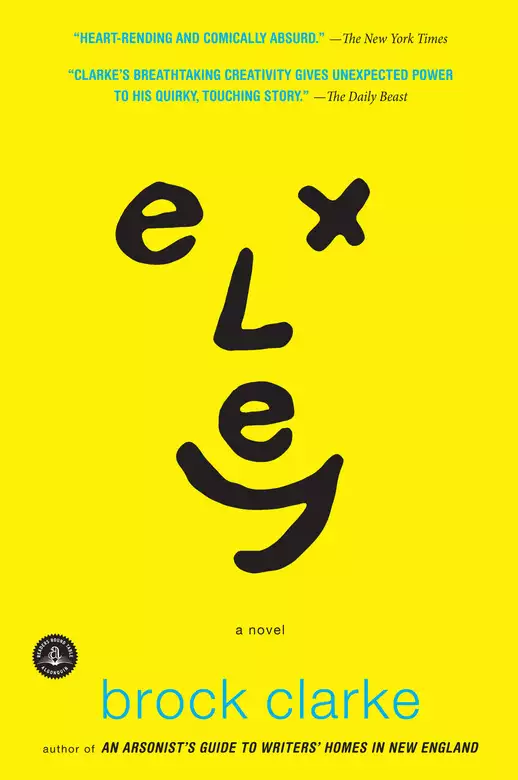
Exley
- eBook
- Paperback
- Audiobook
- Hardcover
- Book info
- Sample
- Media
- Author updates
- Lists
Synopsis
Best-selling author Brock Clarke is acclaimed for his wry, absurdist humor. In Exley, Clarke introduces nine-year-old Miller, who becomes convinced that his father—who left without explanation—must have run away to join the military, and is now lying comatose in a VA hospital. Thinking a visit from his father’s favorite writer will help revive him, Miller decides to track down A Fan’s Notes author Frederick Exley.
“[A] charming story, at times hilarious …”—Library Journal
Release date: September 1, 2011
Publisher: Algonquin Books
Print pages: 320
* BingeBooks earns revenue from qualifying purchases as an Amazon Associate as well as from other retail partners.
Reader buzz
 Please log in to recommend or discuss...
Author updates
Exley
Brock Clarke
“Clarke has a distinctively winning style. He imagines characters so careful in their reasoning that they are deeply, maddeningly unreasonable but also tenderly hapless at the same time. Mr. Clarke is able to make their isolation both heart-rending and comically absurd.”
—The New York Times
“It’s the flashes of insight into what it’s like to fiercely love a far-from-perfect father and his sad-sack hero despite their flaws that will move you.”
— San Francisco Chronicle
“Remarkable . . . In the hands of a less talented writer, the novel’s layers, twists and identity puzzles could strain the belief of even the most credulous reader; but Clarke’s narrative assurance and unfailingly realistic characters allow him to pull off the literary equivalent of a half-court shot. This would have been a hard novel to write even adequately, but Clarke’s performance here is extraordinary; it’s far and away the best work of his career.”
—Michael Schaub, NPR.org
“Clarke expertly evokes other authors who deal with children’s quests in the face of tragedy and mental illness, from J. D. Salinger to Jonathan Safran Foer. In the end, however, the novel comes off as its own original foray into the land of floating realities, and explains why, though so many of us claim to want the truth, in the end we are almost always content to believe in a well-reasoned lie.”
— Time Out New York, five stars
“[Clarke] has created a young narrator as winning and wise as Christopher Boone in Mark Haddon’s 2003 bestseller, The Curious Incident of the Dog in the Night-Time . . . underscore[ing] the gulf that can exist between parents and their children.”
—The Boston Globe
“Brock Clarke reduced large swaths of the literary landscape to ashes in An Arsonist’s Guide to Writers’ Homes in New England, his wickedly funny 2007 novel that skewered everything from book clubs and Harry Potter to falsified memoirs—especially nervy, that last, since Clarke’s text assumed the form of a memoir . . . It seems apt, then, that his new novel pays tribute (if you can call it that) to the real-life American novelist Frederick Exley and his 1968 ‘fictional memoir’ called A Fan’s Notes . . . Clarke pulls off a nice trick here, playing postmodern games while delivering a cleverly plotted story complete with a surprise twist embedded in Miller’s partial understanding of his parents’ tension-riddled relationship.”
—The Washington Post Book World
“Frederick Exley’s classic 1968 account of his epic alcoholism, A Fan’s Notes, bears the oxymoronic subtitle ‘A Fictional Memoir.’ It is the space between those words, between real and fabricated memory, that Clarke examines . . . With humor as black as Exley’s liver, Clarke picks apart the fictions we tell one another—and those we tell ourselves.”
—Entertainment Weekly
“In Brock Clarke’s follow-up to the excellent An Arsonist’s Guide to Writers’ Homes in New England, hidden identities and secret affairs bubble up when a young boy investigates why his father left the family. We laughed. We cried. We wanted to strangle the meddling therapist.”
—Daily Candy
“Wrenching . . . Glimmering in the gloom are some metafictional surprises . . . and some moments of piercing sweetness.”
—The Cleveland Plain Dealer
“The novel unfolds like a murder-mystery without a real murder, just realizations of who is alive and who is dead and why. It explores memory, pain, loss, love and longing with a fresh, lively structure and with a cast of characters both painfully charming and exquisitely flawed.”
—Pittsburgh Post-Gazette
“Oddly brilliant . . . The luminously engaging plot reveals the deceptions we cling to in order to survive . . . Clarke’s breathtaking creativity gives unexpected power to his quirky, touching story.”
—The Daily Beast
“Clarke has managed to explore memory, pain, love and loss. Taking the reader through a maze of stories that may be true and may be pure fantasy, what Miller is making up and what is real is not revealed until the final pages.”
—The Eugene (OR) News-Review
“[A] poignant paean to the powers of books, love, and imagination . . . Exley is worth a little obsession.”
—The Buffalo News
“Exley, Brock Clarke’s latest novel is as intellectually intriguing as it is emotionally chilling . . . The strength of Clarke’s book, narrated so clearly by Miller Le Ray along with his therapist’s easy articulations, is the juxtaposition of that voice with the pure mystery of whether Miller’s assertions spring from his observations or his imagination.”
—The Louisville Courier-Journal
“With this dazzling and hilarious chorus of perspectives—all of them toeing a precarious line between hard reality and redemptive fantasy — Exley marks an artistic leap for Brock Clarke.”
—BookPage
“In his latest brain-teasing raid on literary history, following the much-acclaimed An Arsonist’s Guide to Writers’ Homes in New England (2007), Clarke riffs on a cult classic, A Fan’s Notes: A Fictional Memoir (1968), by Frederick Exley . . . There are hilarious moments; Miller is endearing; and Clarke’s take on the cruel toll of the Iraq War is profound.”
—Booklist
“Another literary high-wire performance by a novelist who is establishing himself as a unique voice in contemporary fiction . . . A seriously playful novel about the interweave of literature and life.”
—Kirkus Reviews, starred review
My name is Miller Le Ray. I am ten years old. I was nine years old when my dad went to Iraq, and I was still nine years old eight months later when I found out he was back from Iraq and in the VA hospital. The day I went to see him in the VA hospital was the day I started trying to find Exley. Exley was the guy who wrote my dad’s favorite book, A Fan’s Notes. Mother calls the Exley I eventually found a Man Who Just Said He Was Exley. But I just call him Exley. Because this is one of the things I learned on my own: you need to say things simply, especially when they’re complicated.
So why don’t I begin there: the day I went to see my dad in the VA hospital. Exley’s book begins toward the end, but he calls it a beginning anyway. Because this is one of the things I learned from Exley: anything can be a beginning as long as you call it one.
I woke up on Sunday, the eleventh of November, 200–, knowing that my dad had come home from the war. I knew this without anyone having to tell me; I knew it in my bones, the way you always know the most important things. I jumped out of bed and ran into my parents’ room. The bed was unmade and there was no one in it. The room was as empty as the bed. I checked the upstairs bathroom. The faucet was dripping, like always. Before my dad went away, Mother sometimes joked that he was the kind of guy who would join up and go to Iraq just so he wouldn’t have to fix the faucet. After he left, she stopped making the joke. But anyway, the bathroom was also empty. I went back to his bedroom, in case my dad had snuck in there while I was in the other rooms looking for him. But it was empty, too. Then I heard a sound coming from downstairs. It was Mother, crying. Mother never cried. The only other time I had ever heard her cry was when my dad went to Iraq in the first place. This was, of course, how I knew my dad was home: I’d heard Mother crying without knowing I’d heard her crying. When we say we know something in our bones, we mean we don’t know yet how we know what we know. This is what we mean by “bones.”
So I ran downstairs and followed the sound of Mother’s crying, which led me to the bathroom. The door was closed. I went to knock, then almost didn’t. Because it was hard to have an intelligent conversation with Mother when she was in the bathroom. I knew, from experience, that if I knocked on the bathroom door, this is how the conversation would go.
“I’m in the bathroom,” Mother would say.
“What are you doing in there?” I would ask.
“Miller, I am in the bathroom,” Mother would say.
“I know,” I would say. “But what are you doing in there?”
But this time was different. It was different because Mother had been crying and I wanted to know why, and my dad was back from the war and I wanted to know where he was. I knocked on the door, and Mother stopped crying immediately.
“I’m in the bathroom,” she said.
“Why were you crying?” I asked. And then, before she could answer, I asked, “Where’s my dad?” Which started her crying again.
I took a step back from the door and thought about what I knew. I absolutely knew my dad was back from Iraq. Except he wasn’t in our house, which he would have been if he’d been able to be in our house. Mother was crying, which she’d never done, as far as I knew, except for that once. All of this was going on in Watertown, New York. Fort Drum is in Watertown. It’s an army fort. I go to school with dozens of kids whose dads and mothers are based at Fort Drum before and after going to Iraq. I knew from them that when their parents left Iraq for Watertown, they went to one of three places. My dad wasn’t in the house — my eyes told me that. My dad wasn’t in the base morgue, either — my bones told me that, just as surely as they’d told me my dad was back from Iraq in the first place. That left only one place where he could be: the VA hospital.
I went upstairs, got dressed, brushed my teeth, walked back downstairs, got Exley’s book from my dad’s study, put it in my backpack, shouldered the backpack, then took a few steps toward the bathroom. The door to the bathroom was still closed, and I could hear Mother still crying behind it, quieter now, but steady, like an all-day rain. Please don’t cry, I wanted to say to her. I’m going to go get my dad and bring him home and everything will be all right. So please don’t cry. But I didn’t think I could say anything like that and not feel ridiculous afterward. I thought of my dad, of what he might say to Mother under these kinds of circumstances. Probably something not exactly comforting, probably something beginning with the phrase “For Christ’s sake.” I didn’t think I could, or should, say that, either. So instead of saying either of those two things, I said, “I’m going to ride my bike,” although possibly not loud enough to be heard over her crying. In any case, Mother kept crying. And so I walked into the garage, where I kept my Huffy, climbed on, and pedaled to the VA hospital.
My second session with M. My area of expertise, of course, is the juvenile mind, but perhaps a physical description is in order nonetheless. M. has light blue eyes and red cheeks that suggest either robustness or shame and hair that one might call dirty blond. In M.’s case, the description pertains both to the color of his hair and to its cleanliness. M.’s hair is not long but high and looks as though it has been slept on: it is flat in sections, unruly in others. I can see comb marks and surmise that someone has tried and failed to tame it. I assume that someone to be his mother. Oh, his mother! I somehow restrain myself from asking if she is well, if she’s waiting for him outside in the car, if she has spoken of me since our first session. I can see her in my mind’s eye: her shiny black hair, her eyes so deeply blue that they, too, look black, her angular white face, the total effect being coal placed on a taut pillow. She is as beautiful in memory as she was in my office four days ago. Despite his hair, and despite his tiny teeth (M. can be mature in most ways except for his dentition, which remains entirely infantile), M. is himself what one would call a good-looking kid, although he looks nothing like his lovely mother. I assume he takes after his father.
On that subject: I begin by asking M. to tell me the circumstances behind his father’s going to Iraq. I make this request as though holding the assumption that the father truly is in Iraq, although I do not, in fact, actually assume that.
“My dad,” M. says immediately, as though waiting for me to ask the question, “went to Iraq on Friday, the twentieth of March, 200–.” This is how Miller speaks the date: “Two thousand blank.” Odd — odd and, indeed, quite strange — although I don’t say so. Instead, I ask M. how he can be so certain about the date.
“Because it was the last day of school before spring vacation,” he says. I am about to ask him how he can be so certain it was the last day of school, but he anticipates the question. “I remember it was the last day of school because I didn’t have to bring any books or folders or notebooks home. Just an empty backpack. I was swinging my empty backpack around by one of its loops as I walked home. It made a whistling sound as I swung it, and then it made a crying sound. I stopped swinging the backpack and listened. The crying sound was still there. I walked toward it, toward my house, which was less than a block away. When I got to the house next to ours, I could see through the neighbors’ hedge that Mother was standing in our driveway, crying.”
“Crying?” I ask.
“Really crying,” M. says. “You could see the tears running down her face, into her mouth. I’d never seen or heard her cry. It scared me. It made me not want to get too close to her, so I stayed on our neighbors’ side of the hedge.”
“Your mother was crying?” I ask again, unable to get past the image. I can feel my eyes water at the thought of hers watering. But M. appears not to hear me. His eyes are closed. It strikes me that this story is something he has memorized — memorized and, indeed, committed to memory.
“My dad was in his Lumina, which was running and pointed down the driveway, toward the street. The driver’s-side window was down and he leaned out of it and said, ‘Maybe I should go to Iraq, too.’”
“How did he say those words?” I ask.
M. opens his eyes and looks at me quizzically. “With his mouth,” M. says.
“No, no,” I say. “In what tone? In what manner? Did he emphasize the word ‘should’? The word ‘I’? Did the sentence sound like a threat? A promise?”
“It sounded sad,” M. says, closing his eyes again.
“Sad,” I repeat. “And what did your mother say in response?”
“‘T.,’” M. says. T., I know, is the boy’s father’s name. M. says the name in his own voice, but I assume he’s repeating what his mother said. M. gulps once, twice, as though trying to catch his breath, and I wonder if the gulping is his or his mother’s. Perhaps it is both. “‘Please.’”
I do not ask how she said the word “please,” because I can hear her voice in his, can see her lovely wet eyes telling M.’s father to stay. I wonder how anyone could go when those eyes said, Stay. But evidently M.’s father went anyway. “Then my dad rolled up his window, pulled out of the driveway, and then drove away.”
“Did he see you standing there?” I ask.
“No,” M. says. “But Mother did. She’d walked to the end of the driveway to look at my dad driving away from her. And then she turned to go back into the house and saw me behind the bush. Then she stopped crying, smiled, and asked, ‘How was your last day of school?’”
“That was most considerate of her,” I say. “Most considerate and, indeed, most thoughtful.”
M. opens his eyes and gives me the look that all my patients give me when they tire of saying “Whatever” with their mouths and instead say it with their eyes. Then he closes them once more and says, “So I asked her why my dad was going to Iraq.”
“And her answer?”
“She said, ‘Lots of people are going to Iraq, M., but your dad isn’t one of them.’ And then she turned around and went into the house.”
M. opens his eyes and considers me as I consider his story. One aspect of the tale seems clear enough: M.’s mother and father had a fight, and his father left them because of it. Either M. is omitting the reason for the fight, or he doesn’t know the reason. But married persons only argue over two things: money and sexual infidelity. Every mental health professional knows this, even those, like me, who do not specialize in the mental health of married persons, and who do not have great piles of money, and who have never been married and who have never been sexually unfaithful and who, frankly, have never had much of an opportunity to be sexually unfaithful. But regardless, that part of the tale seems explicable enough. Other aspects of M.’s story seem inconsistent—M. knows the exact month and date of his father’s departure but can’t, or won’t, specify the year? — but are most likely neither here nor there: I suspect, as with the cause of M.’s parents’ fight, we will “get to the bottom of it” soon enough. But the most troublesome aspect of M.’s tale is his belief that his father’s saying that “maybe” he “should” go to Iraq constitutes proof that the father, in fact, did go to Iraq. Does M. really believe this, or is he merely pretending to? And if the latter, does he know he’s pretending, or does he think he’s telling the truth? I decide to press M. on the matter. “So that’s how you know your father went to Iraq?” I ask him. “Because he said that ‘maybe’ he ‘should’ go there?”
“You sound just like my mother,” M. says. I thrill to hear those words — I sound like M.’s mother! I have something in common with M.’s mother! — but M. doesn’t appear to feel similarly. His red cheeks go pale and his blue eyes tear up; he runs a hand through his hair, sending it even further ceilingward. When I ask if he’s “all right,” he doesn’t answer. This is both the comfort and the terror of the juvenile mind. One knows that if the juvenile mouth is not moving, then the mind is; but one does not necessarily know what that mind is moving away from or toward. “What are you thinking?” I ask M., as I ask most of my patients when I want to know their thoughts. Most of my patients will, in fact, tell me, a phenomenon I described two years ago at the North Country Mental Health Professionals’ annual meeting in my speech “‘Ask and You Shall Receive’: A Commonsensical Approach to the Juvenile Mind.” But not M.; he simply stares at me with his faint blue eyes. Those eyes are most changeable: one moment they seem unbearably sad, and the next full of danger; one moment M. looks like he’s heartbroken, the next he looks like the hangman. In short, M. appears to be no ordinary patient, just as M.’s mother appears to be no ordinary patient’s mother. As for M.’s father, it is uncertain what he is and what he isn’t. Thus far, he is an enigma, in deed and in word. “Other than your father saying he might go to Iraq,” I ask, “why do you think he would?”
“Would what?”
“Go to Iraq.”
“I have no idea,” M. says quickly, too quickly. Yes, you do, I think but do not say. Instead, I give M. an assignment. I ask him to write down something important about his father.
“Something important?” he asks.
“Something you remember about him,” I say. “Something you love. Some lesson he’s taught you. I’d like you to write this down and then share it with me during our weekly session.”
M. nods like he thinks this is something he can do. “When?” he asks.
“Whenever you feel like it,” I say, and he nods again. This seems like progress, of a sort. But still, something about M.’s story and his father’s role in it nags at me.
“Your father told your mother that maybe he should go to Iraq, too,” I say, and then I repeat the final word: “‘Too.’ What do you think he meant by ‘too’?”
M. nods, then cocks his head slightly to the right. Only now can I tell what M. is thinking. I can tell he’s asked himself the same question. Finally, he says, “Maybe he meant that he was going to Iraq, just like everyone else around here?” And by the way he says this — as a question, not as a statement — I can tell that M. still has not found the answer.
I knew where the VA hospital had to be: on Washington Street. Because that’s where all the hospitals and social services are in Watertown. That’s where Good Samaritan is — the place where I was born and where, I found out later, Exley was born, too — and where the county blood clinic and the county mental hospital and the county welfare office and the county substance-abuse clinic and the county domestic-abuse clinic and the library and the historical society and the YMCA and Watertown Daily Times all are, too. It’s the most popular street in Watertown: people are always outside, lining the sidewalks. Whenever I was with Mother or my dad as we drove down Washington Street, I felt like I was in a parade and the people on the sidewalks were watching me. This time, I was the parade all by myself — me and my bike. I walked my bike past the same people, again and again, as I looked for the VA hospital. Past the five guys outside the YMCA, smoking their cigarettes: one half of their faces seemed to be in shadow even though it was noon and sunny out, and the other half seemed to be winking at me. Past the two fat women standing at the end of a huge line outside the county welfare office but facing away from the office and toward the street: they were dressed in bright green and pink sweatpants and black bubble jackets and were staring at me with their round white faces and tiny eyes, like I had something they wanted, something they didn’t think they’d get from the welfare office. I tried not to stare at them and kept walking, past the soldier wearing his camo and his beret, with his pant legs tucked into his high boots, standing in the middle of the sidewalk and talking on his cell phone. You can’t go anywhere in Watertown and not see a soldier talking on a cell phone, just like everyone else who isn’t in a uniform. I don’t know why this surprised me so much the first time I noticed it, but it did. When my dad first went to Iraq, I used to stop every soldier I’d see and interrupt his phone conversation and ask him if he knew my dad. One time, when I interrupted one soldier’s phone call, he handed me the phone, said, “Here you go.” “Hello?” I said, thinking it’d be my dad. But it wasn’t. It was some woman saying, “Reggie? Is that you? Reggie, I’m talking to you.” I handed Reggie back his phone and said, “That isn’t my dad.” “No,” Reggie said sadly. “But I wish it was.” He put the phone to his ear and said, “I’m here, Sharon,” and then with his free hand he made a gun, put the index finger to the side of his head, pulled the trigger of his thumb, and mouthed the word Pow!
Anyway, none of the soldiers I asked ever knew my dad, and so I stopped asking them. I walked right past the soldier, toward a guy shouldering a duffel bag, coming right at me. He was wearing a jean jacket with the sleeves cut off; there was a black tattoo of a vine creeping from underneath the right sleeve all the way to his knuckles. He stopped in front of me, raking his right forearm with his left hand, tilling the skin, I guess, before he planted another vine tattoo in it. And his eyes were bloody. I don’t mean they were red, like he had allergies or had been crying; I mean they were filled with blood, like he’d been wounded somewhere in his sockets, behind his eyeballs. His hair was military short except for a ridge of slightly longer hair going from his forehead to the nape of his neck. It was the kind of haircut you get when you don’t know what kind of haircut to get. He was young, too. He hadn’t even started to shave yet; he was probably only thirteen years old. That was the scariest thing about him. Like he would do something to me that a normal kid would do, but much worse. I could imagine him taking my bike away from me, for instance, and then strangling me with it.
But he didn’t do that. Instead, he asked, “Yo, where’s the library?”
We were both standing right in front of the library, but I didn’t want to say those words. I was afraid they would sound like this: You’re standing right in front of it, stupid. So I just pointed. The guy looked in the direction I’d pointed, and I kept walking, toward the bottom of Washington Street, where I hit the Public Square, turned around, crossed the street, and walked back. It was the fifth time I’d walked up and down the street, and still, I couldn’t find the VA hospital. I could not find it. I knew there was a VA hospital in Watertown because I knew some of my classmates’ fathers had been patients there. And I knew the VA hospital had to be on Washington Street. Because that’s where all the hospitals were. Because if it wasn’t on Washington Street, then I couldn’t imagine where it was. And if the VA hospital wasn’t on Washington Street, and I couldn’t find it, then how was I going to find my dad? I started to panic a little just thinking about it. Then I saw the guy with the cutoff denim jacket crossing the street, stopping traffic, coming right toward me, and I started to panic a lot more. He looked mad, like I’d given him really bad directions; he looked so mad that it didn’t seem like it would do any good to say I was sorry. This might be why I said, when he reached my side of the street, “Do you know where the VA hospital is?”
His face changed. He stopped looking mad and started looking helpful, like a Good Samaritan with a bad haircut. “You’re standing right in front of it, stupid,” he said, and pointed.
I looked in the direction he was pointing, and there it was, right between the historical society and the Daily Times building. The VA hospital was set way back from the street, with a big lawn and big oak and maple trees between it and me, which is probably why I hadn’t noticed it. The other hospitals on Washington Street had been built sometime after my parents had been born but before I had, but the VA hospital was from another time: it was made of big blocks of gray stone and had two huge Corinthian columns in front. It looked like a temple, not a hospital. We were studying ancient Greece and Rome in social studies and had done a unit on columns. That’s how I knew the VA hospital’s columns were Corinthian and not Doric.
I turned away from the VA hospital and toward the guy to thank him. He looked mad again. He bared his teeth; some of them were missing, and the ones that weren’t were the color of old newspapers. “Yo,” he said, “where is the library?” He asked this like he’d asked me the question many times, and not just once, and like I hadn’t answered him. I had, although not with my mouth. So I said, “It’s right across the street,” and then pointed. He looked where I pointed, and while he was looking away, I ran with my bike toward the VA hospital.
The woman at the VA hospital’s front desk didn’t look up at me as I walked toward her, but instead kept her eyes on her computer monitor, which hummed like a spaceship. I couldn’t see what she looked like from the waist down (the desk the woman was sitting behind came up to the middle of my chest), but from the waist up she looked like a nurse: she was wearing a blue cardigan sweater, and underneath I could see what looked like a lighter blue medical uniform. Her hair was short, curled but not curly, and so black it had to be gray underneath. She looked a lot like the nurse at my school, Case Middle School. The nurse at school was always telling me, when I came into her office with a headache or stomachache, that no, I wasn’t sick, and so no, she wasn’t going to let me go home early. I could imagine this nurse telling me, No, you can’t see your dad. Or even worse, No, your dad isn’t here. No, there’s no patient here named Tom Le Ray.
There was a set of swinging doors to the right of the front desk. I had begun to think about trying to walk toward and then through them before the woman saw me when she said, still looking at her computer screen, “Can I help you?”
“I’m here to see my dad,” I said. “He’s a patient here.”
The woman finally looked away from her computer screen and at me. She pursed her lips, crinkled her eyes, and basically arranged her face to look sympathetic. “What’s your father’s name?” she asked in a voice that was much gentler than when she’d asked, “Can I help you?”
“Thomas Le Ray,” I said.
The woman nodded again, looked back at her computer, typed for a few seconds, and then said, “Room D-1.” She nodded in the direction of the swinging doors. “Right through there, first room on the right.” I thanked her and had turned to walk through the doors when she added, “I wondered when someone was going to come see him.”
“Who?” I said.
“Your father,” she said. Her lips were still pursed, but not as sympathetically as before. “He’s been here two weeks and you’re his first visitor.”
“Two weeks?” I said. I wondered why Mother was crying today if my dad had already been in the hospital for two weeks. Maybe that’s why she was crying: because he’d been there for two weeks and she hadn’t told me about it or gone to see him herself and she felt guilty about it. Or maybe she hadn’t been told until today. I kept hearing — from the news, from Mother, from pretty much everyone — how we were struggling to win the war; maybe we were struggling to call people to tell them their husbands and dads. . .
We hope you are enjoying the book so far. To continue reading...
