
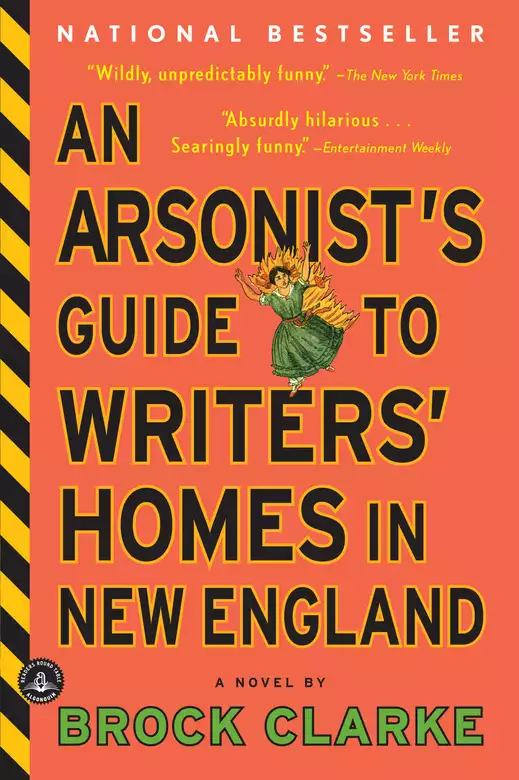
An Arsonist's Guide to Writers' Homes in New England
- eBook
- Audiobook
- Book info
- Sample
- Media
- Author updates
- Lists
Synopsis
Sam Pulsifer, the hapless hero of this incendiary novel, has come to the end of a very long and unusual journey, and for the second time in his life he has the time to think about all the things that have and have not come to pass.
The truth is, a lot of remarkable things have happened in Sam's life. He spent ten years in prison for accidentally burning down poet Emily Dickinson's house-and unwittingly killing two people in the process. He emerged at age twenty-eight and set about creating a new life-almost a new identity-for himself. He went to college, found love, got married, fathered two children, and made a new start-and then watched in almost-silent awe as the vengeful past caught up with him, right at his own front door.
As, one by one, the homes of other famous New England writers are torched, Sam knows that this time he is most certainly not the guilty one. To prove his innocence, he sets out to uncover the identity of this literary-minded arsonist. What he discovers, and how he deals with the reality of his discoveries, is both hilariously funny and heartbreakingly sad. For, as Sam learns, the truth has a way of eluding capture, and then, when you finally get close enough to embrace it, it turns and kicks you in the ass.
Publisher: Algonquin Books
Print pages: 305
* BingeBooks earns revenue from qualifying purchases as an Amazon Associate as well as from other retail partners.
Reader buzz
 Please log in to recommend or discuss...
Author updates
An Arsonist's Guide to Writers' Homes in New England
Brock Clarke
An Arsonist’s Guide to Writers’ Homes in New England
“Wildly, unpredictably funny…. Although it is his fourth book, it feels like the bright debut of an ingeniously arch humorist, one whose hallmark is a calm approach to insanely improbable behavior…. The parodies here are priceless.”
—The New York Times
“Funny, profound…. Clarke’s novel is an agile melding of faux-memoir and mystery. Spot-on timing gives it snap, and a rich sense of perversity … lends texture. It’s a seductive book with a payoff on every page.”
—People magazine, Critic’s Choice, four stars
“Clarke’s novel sizzles. This straight-faced, postmodern comedy scorches all things literary, from those moldy author museums to the excruciating question-and-answer sessions that follow public readings…. They’re all singed under Clarke’s crisp wit.”
—The Washington Post Book World
“[An] absurd, if weirdly compelling faux ‘memoir,’ which takes aim at the danger of stories—at least false ones…. Gets at some unexpectedly poignant emotional truths.”
—USA Today
“An Arsonist’s Guide contains sentences and images that could stand beside the works of the former owners of the literary residences put to flame.”
—The New York Times Book Review
“Absurdly hilarious…. Searingly funny.”
—Entertainment Weekly
“Enormously funny…. A cautionary tale about the strength of stories to burn a path of destruction.”
—The Chicago Sun-Times
“Darkly comic…. Bittersweet and ultimately sorrowful, Clarke’s book suggests that we’re all subject to the whims of the stories we tell ourselves.”
—Los Angeles Times
“This is a sad, funny, absurd, and incredibly moving novel. Its comic mournfulness, its rigorous, break-neck narrative, delight. Bless Brock Clarke and his spookily human arsonist. They’ve given us a wonderful book about life, literature, and the anxieties of their influence.”
—Sam Lipsyte, author of Home Land
“Clarke turns up the heat on New England’s classic novelists—and their homes…. Moving and memorable.”
—The Charlotte Observer
“Clarke has the ability to crack us up with his clever insight into human nature and suburban angst, but there is also a depth to his characters that helps raise the story above straight satire.”
—MSNBC.com
“Every bit as quirky and engaging as its title…. Evokes John Irving, with a dollop of Tom Wolfe tossed in for good measure…. Pulisfer’s disarming charm and witty insight carry the day.”
—St. Louis Post-Dispatch
“While I was reading this dark, funny, tragic novel, I would look at the people around me and feel sorry for them because they weren’t occupying the same world I was; they weren’t living, as I was, inside the compelling, off-kilter atmosphere of Brock Clarke’s pages. This is the best book I’ve read in a long time.”
—Carolyn Parkhurst, author of The Dogs of Babel
“Both philosophical and deeply funny…. Resembles Richard Ford crossed with Borges: a thoughtful, playful exploration of everyday life, as well as a metafictional examination of the purpose stories serve in our lives.”
—Time Out New York
“Sam’s disasters are good news for readers … particularly if they like their comic novels with a sharp edge, witty commentary and hilarious allusions.”
—The Miami Herald
“[A] wacky and wildly imaginative novel…. It’s nearly impossible not to care about and laugh with Sam. He’s a misunderstood outcast, a knight errant on a quest to clear his name. But in this hilarious and original novel he does much more: He appeals to the fool in everyone and comforts us in knowing that we’re not alone.”
—Chicago Tribune
“Part mystery, part comedy, part insightful memoir, Arsonist defies the conventional formula in producing a wildly entertaining novel.”
—Daily Candy
“Brock Clarke flames entire genres of fiction in this clever and often hilarious tale.”
—Paste
“[A] brilliant novel.”
—People, Style Watch issue
“Sam Pulsifer is now one of the great naïfs of American literature…. [This] rollicking, hilariously and subtly heartbreaking novel … is at the same time a wrenching examination of what happens when you pry up the floorboards, flake off the stucco, open up the books and see what’s really going on between husband and wife, parents and children, friends and lovers.”
—The San Diego Union-Tribune
“An incisive satire that takes on everything from authors to reading groups and Harry Potter.”
—Milwaukee Journal Sentinel
“A witty, intensely clever piece of writing that scrutinizes our relationship with stories and storytelling…. Clarke composes with panache, packing his pages with offbeat humor, vibrant characters, and tender scenes.”
—Utne Reader
“Rousing…. The antic goings-on and over-the-top characters are so entertaining.”
—Minneapolis Star Tribune
“Brock Clarke is our generation’s Richard Ford … [and] Sam Pulsifer is an Everyman suburban nomad, a literary misadventurer who is as insightful and doomed as he is heartbreakingly hilarious…. I love this book.”
—Heidi Julavits, author of The Uses of Enchantment
“A loopily shambolic narrative as captivating as its feckless firebug narrator…. The perfect end-of-summer book, funny and sharp and smart enough to ease the transition from beach to boardroom. Just don’t leave it near a pack of matches.”
—Village Voice
“It’s a blast—its story line rollicking and often absurd, its themes satisfyingly hefty.”
—Time Out Chicago
“Like TV analysts who deconstruct Tiger Woods’ swing, it’s not easy to do justice to writers like Brock Clarke. But I know just enough to recommend An Arsonist’s Guide to Writers’ Homes in New England to anyone, and especially to anyone who wants to read the best, newest manifestation of great American writing.”
—Pittsburgh Post-Gazette
“A multilayered, flame-filled adventure about literature, lies, love and life…. Sam is equal parts fall guy and tour guide in this bighearted and wily jolt to the American literary legacy.”
—Publishers Weekly, starred review
“A subversively compelling, multilayered novel about the profound impact of literature…. Rendered masterfully by Clarke, Sam’s narrative tone is so engagingly guileless that the reader can’t help but empathize with him, even as his life begins to fall apart within the causal connections of these fires…. A serious novel that is often very funny and will be a page-turning pleasure for anyone who loves literature.”
—Kirkus Reviews, starred review
I, Sam Pulsifer, am the man who accidentally burned down the Emily Dickinson House in Amherst, Massachusetts, and who in the process killed two people, for which I spent ten years in prison and, as letters from scholars of American literature tell me, for which I will continue to pay a high price long into the not-so-sweet hereafter. This story is locally well known, and so I won’t go into it here. It’s probably enough to say that in the Massachusetts Mt. Rushmore of big, gruesome tragedy, there are the Kennedys, and Lizzie Borden and her ax, and the burning witches at Salem, and then there’s me.
So anyway, I served my time, and since the sentencing judge took mercy on me, I served my time at the minimum-security prison up at Holyoke. At Holyoke there were bond analysts and lawyers and day traders and city managers and school administrators, all of them caught with their hands in the till and nothing at all like me, an eighteen-year-old accidental arsonist and murderer with blood and soot on his hands and a heavy heart and plenty to learn and no high school diploma. I flung in and tried. I took a biweekly self-improvement seminar called the College of Me, in which I learned the life-changing virtues of patience, hard work, and positive attitude, and in which I earned my GED. I also hung around this group of high-stepping bond analysts from Boston who were in the clink for insider trading. While they were inside, the bond analysts had set out to write their fond, freewheeling memoirs about their high crimes and misdemeanors and all the cashish—that’s the way they talked—they had made while screwing old people out of their retirement funds and kids out of their college savings. These guys seemed to know everything, the whole vocabulary of worldly gain and progress, so I paid extra attention during their memoir-brainstorming sessions, listened closely to their debates over how much the reading public did or did not need to know about their tortured childhoods in order to understand why they needed to make so much money in the manner in which they made it. I took notes as they divided the world between those who had stuff taken from them and those who took, those who did bad things in a good way—gracefully, effortlessly—and those bumblers who bumbled their way through life.
“Bumblers,” I said.
“Yes,” they said, or one of them did. “Those who bumble.”
“Give me an example,” I said, and they stared at me with those blue-steel stares they were born with and didn’t need to learn at Choate or Andover, and they stared those stares until I realized that I was an example, and so this is what I learned from them: that I was a bumbler, I resigned myself to the fact and had no illusions about striving to be something else—a bond analyst or a memoirist, for instance—and just got on with it. Life, that is.
I learned something from everyone, is the point, even while I was fending off the requisite cell-block buggerer, a gentle but crooked corporate accountant at Arthur Andersen who was just finding his true sexual self and who told me in a cracked, aching voice that he wanted me—wanted me, that is, until I told him I was a virgin, which I was, and which, for some reason, made him not want me anymore, which meant that people did not want to sleep with twenty-eight-year-old male virgins, which I thought was useful to know.
Finally, I learned to play basketball from this black guy named Terrell, which was one of the big joys of my life in prison and which ended badly. Terrell, who had written checks to himself when he was the Worcester city treasurer, was in prison for the last three of my ten years, and whenever he would beat me in one-on-one (this wasn’t often, even when I was first learning to play, because although he was very strong, Terrell was also shorter than I was and about as sleek as a fire hydrant; plus, he was twice my age and his knees were completely shot and would crack like dry wood when he ran)—whenever he would beat me, Terrell would yell out, “I’m a grown-ass man.” That sounded good, and so after our last game, which I won easily, I also yelled out, “I’m a grown-ass man.” Terrell thought I was mocking him, so he started hitting me around the head, and since I get passive in the face of true anger, I just stood there and took Terrell’s abuse and didn’t try to defend myself. As the guards dragged him to solitary, he promised that he would beat on me a little more once he got out, which he shouldn’t have, because, of course, the guards then gave him more solitary than they might have otherwise. By the time Terrell got out, I’d already been released from prison and was home, living with my parents.
That didn’t work out too well, living with my parents. For one, my burning down the Emily Dickinson House caused them some real heartbreak, because my mother was a high school English teacher, my father an editor for the university press in town, and beautiful words really mattered to them; they didn’t care anything for movies or TV, but you could always count on a good poem to make them cry or sigh meaningfully. For another, their neighbors in Amherst weren’t exactly happy that I’d burned down the town’s most famous house and killed two of its citizens in the bargain, so they took it out on my parents. People never had trouble finding our old, creaking house on Chicopee Street: it was always the one with the driveway that had been spray-painted MURDERER! (which I understand) or FASCIST! (which I don’t), or with some quote from Dickinson herself that seemed to promise vengeance, but you could never tell exactly what the vengeance might be, because there were a lot of words and the spray-painter always got sloppy and illegible from fatigue or maybe overemotion. It only got worse when I went home after prison. There was some picketing by the local arts council and some unwelcome, unflattering news coverage, and neighborhood kids who cared nothing about Emily Dickinson or her house started egging the place and draping our noble birches with toilet paper, and for a while there it was like Halloween every day. Then things really got serious and someone slashed every tire on my parents’ Volvo, and once, in a fit of anger or grief, someone hurled a Birkenstock through one of our bay windows. It was a man’s right shoe, size twelve.
All of this happened within the first month of my return home. At the end of the month, my parents suggested I move out. I remember it was August, because the three of us were sitting on our front porch and the neighbors’ flags were out, caught between the Fourth of July and Labor Day and in full flutter, and the light was spectral through the maple and birch leaves and it was all very pretty. You can imagine how much my parents’ request that I leave home wounded me, even though the College of Me said that life after prison wouldn’t be easy and that I shouldn’t fool myself into thinking otherwise.
“But where should I go?” I asked them.
“You could go anywhere,” my mother said. Back then I thought she was the harder parent of the two and had had high hopes for me, so the disappointment weighed on her more heavily. I remember that my mother was a dry well at my trial when the jury brought back the verdict, although my father had wept loudly and wetly, and he was starting to cry now, too. I hated to see them like this: one cold, the other weepy. There was a time when I was six and they taught me to skate on a pond at the Amherst public golf course. The ice was so thick and clean and glimmery that the fish and errant golf balls were happy to be frozen in it. The sun was streaking the falling snow, making it less cold. When I finally made it around the perimeter of the pond without falling, my mother and father gave me a long ovation; they were a united front of tickled, proud parenthood. Those times were gone: gone, gone, forever gone.
“Maybe you could go to college, Sam,” my father said after he’d gotten ahold of himself.
“That’s a good idea,” my mother said. “We’d be happy to pay for it.”
“OK,” I said, because I was looking at them closely, really scrutinizing them for the first time since I’d been home from prison, and I could see what I’d done to them. Before I burned down the Emily Dickinson House, they seemed to be normal, healthy, somewhat happy Americans who took vacations and gardened and who’d weathered a rough patch or two (when I was a boy, my father left us for three years, and after he left us, my mother started telling me tall tales about the Emily Dickinson House, and all of this is part of the larger story I will get to and couldn’t avoid even if I wanted). Now they looked like skeletons dressed in corduroy and loafers. Their eyes were sunken and wanting to permanently retreat all the way back into their skulls. A few minutes earlier, I’d been telling them about my virginity and the lecherous Arthur Andersen accountant. My parents, as far as I knew back then, were both modest Yankees who didn’t like to hear about anyone’s private business, but the College of Me insisted that it was healthy and necessary to tell the people we love everything. Now I was regretting it. Why do we hurt our parents the way we do? There’s no way to make sense of it except as practice for then hurting our children the way we do.
“OK,” I said again. “I’ll go to college.” And then: “I love you both.”
“Oh, us too,” my father said, and then started weeping again.
“We certainly do,” my mother said. And then to my father: “Bradley, quit crying.”
Later that night, after my mother had gone to sleep, my father came into my room without knocking, stood over my bed, then leaned down—either to say something to me or to see if I was asleep. I wasn’t asleep: I was thinking hopeful thoughts about my future, of how I would go to college and make a clean, honest, painless life for myself, and how proud my parents would be once I’d made it. My father, bent over at the waist the way he was, looked like a crane there to either lift me up with its hook or wreck me with its heavy ball.
“Come downstairs,” my father whispered, his face close to mine in the darkness. “I want to show you something.”
I got out of bed, followed him downstairs. My father walked into his study, which was—like most of the rooms in the house—lined floor to ceiling with overflowing bookshelves. He sat in a chair, opened the end table drawer next to him, pulled out a Converse shoe box, the sort of box in which you kept your old photos or Christmas cards, and handed it to me. I took the lid off the box and saw that there were envelopes inside, envelopes slit open with a letter opener. The envelopes were addressed to me, all of them. The letters were still inside the envelopes, so I took them out and read them.
There were at least a hundred letters. Some of them, as I mentioned, were from scholars of American literature, damning me to hell, et cetera. There is something underwhelming about scholarly hate mail—the sad literary allusions, the refusal to use contractions—and so I didn’t pay much attention to those letters at all. I’d also received several letters from your ordinary arson enthusiasts, which were minor variations on the “Burn, baby, burn” theme. These particular letters didn’t affect me much, either. The fact that the world was full of kooks wasn’t any bigger news than the fact that the world was full of bores.
But there were other letters. They were from all over New England and beyond: from Portland, Bristol, Boston, Burlington, Derry, Chicopee, Hartford, Providence, Pittsfield—from towns and cities in New York and Pennsylvania, too. They were all from people who lived near the homes of writers and who wanted me to burn those houses down. A man in New London, Connecticut, wanted me to burn Eugene O’Neill’s home because of what an awful drunk O’Neill was and what a bad example he set for the schoolchildren visiting his home, who needed, after all, more positive role models in the here and now. A woman in Lenox, Massachusetts, wanted me to torch Edith Wharton’s house because visitors to Wharton’s house parked in front of the woman’s mailbox and because Wharton was always, in her opinion, something of a whiner and a phony. A dairy farmer in Cooperstown, New York, wanted me to pour gasoline down the chimney of the James Fenimore Cooper House because the dairy farmer couldn’t stand the thought of someone being from such a rich family when his family was so awfully poor. “I’ve had it harder than Cooper ever did,” the man wrote. “That family’s got money up to here and they charge ten dollars’ admission to their home and people pay it. Won’t you please burn that son-of-a-bitching house right to the ground for us? We’ll pay, too; I’ll sell some of our herd if I have to. I look forward to your response.”
There were more letters, and they all wanted the same thing. All of them wanted me to burn down the houses of a variety of dead writers—Mark Twain, Louisa May Alcott, Robert Lowell, Nathaniel Hawthorne. Some of the correspondents wanted me to burn down the homes of writers I’d never even heard of. All of the letter writers were willing to wait for me to get out of prison. And all of them were willing to pay me.
“Wow,” I said to my father when I was done reading. He hadn’t said anything in a while. It was interesting: when my mother was around, my father always appeared weak minded and softhearted—a slight, unnecessary, and mostly foolish human being. But now, in that room, with those letters, he seemed to me wise—silent and massive like a Buddha in wire-rimmed glasses. I felt the enormity of the situation, in my throat and face and elsewhere. “Why didn’t you tell me about these letters while I was in prison?”
He looked at me but didn’t say anything. This was a test of sorts, because this, of course, is what the wise do: they test the unwise to make them less so.
“You wanted to protect me,” I said, and he nodded. It heartened me to know I could give him the right answer, and so I persisted. “You wanted to protect me from these people who thought I was an arsonist.”
My father couldn’t leave this one alone. He went into a violent struggle with his better judgment, wrestling with his mouth as he started and stopped himself from speaking a dozen times. It was like watching Atlas gear up to hoist that big boulder we now live on. Finally my father got it out and said sadly, so sadly, “Sam, you are an arsonist.”
Oh, how that hurt! But it was true, and I needed to hear it, needed my father to tell it to me, just as we all need our fathers to tell us the truth, as someday I’ll tell it to my children, too. And someday my children will do to me what I did to my father: they will deny it, the truth.
“You’re wrong,” I said. “I’m a college student.” I put the top back on the box of letters, handed it back to him, and left before he could say anything else. When I got back in bed, I made myself promise never to think of the letters again. Forget about them, I commanded myself. I thought I could do it, too. After all, wasn’t this what college was all about? Emptying your mind of the things you didn’t want to remember and filling your mind up with new things before the old, unwanted things could find their way back in?
I left for college two weeks later; it was ten years before I saw my parents again, ten years before I reread those letters, ten years before I met some of the people who’d written the letters, ten years before I found out things about my parents that I’d never suspected and never wanted to know, ten years before I went back to prison, ten years before any of what happened, happened.
But I’m getting ahead of myself. College: Since it was late in the application season, I went to the only school that accepted me—Our Lady of the Lake in Springfield, about twenty miles south of Amherst. It was a Catholic college that had just started accepting men because apparently there weren’t enough Catholic women left in the Western world who wanted to pay a lot of money to get an education with no men around except for Jesus and his priests, and even the priests who supposedly ran it didn’t want to teach there. A few nuns with nothing else to do other than deliver communion at the early, unpopular masses taught a couple of classes—World Religions 101 and 102—and the rest were taught by normal, irreligious teachers who couldn’t get jobs anywhere else.
My first major was English, because I knew what a disappointment and sorrow I’d been to my parents and I wanted them to be proud of me despite everything that had happened. Besides, my mother had read to me all the time when I was young, and then when I was older she’d made me read all the important books and give detailed reports about why the books were so awfully important, and so I figured, at least, that I had the proper training and background to succeed. Plus, there were the bond analysts, with their memoirs and their stories; they didn’t get tired of talking about themselves one bit. Whom else would we talk about? seemed to be their attitude, and maybe they were onto something. Maybe, I thought, by reading these other stories, I could understand something about my own.
It didn’t work out. These things never do. You can’t ever repeat the past, and the books I once believed to be so important and wise now seemed ordinary in the extreme, and I couldn’t concentrate on them. Instead of thinking about how great Gatsby was or wasn’t, I mezzed out on the grilled cheese bits that were lodged in Dr. Melton’s goatee. And then there was the time when we were reading Dickinson’s poetry and the teacher said that she would have taken the class to the Dickinson House for a tour except that it had been burned down years before, and as she tried to remember the name of the arsonist, I realized that I didn’t want to tell my story—I knew it all too well. So in order to interrupt and escape the uncomfortable line of inquiry and the recrimination that was sure to follow, I faked a coughing fit and ran to the bathroom and didn’t come back to that class for the rest of the semester, and the only reason I got a D and not an F in that class was the same reason I got a D and not an F in my other English classes: the school didn’t want anyone to flunk out, because they needed everybody’s full tuition. The school really was in horrible shape. There were piles of fallen plaster in the hallways. The drop ceilings were buckling. Even the crucifixes on the classroom walls were in need of repair.
So the bad grades were one reason I quit English, but there was another reason, a bigger reason: I couldn’t shake the feeling that there was something else I should be doing, something I hadn’t tried or considered, something new and better. There I’d be, sitting in Medieval Literature, supposedly learning to speak the Old English that Beowulf and Grendel spoke, and all I could hear was this voice in my head saying, There must be something else. Asking, What else? What else? This was a surprise, since I wasn’t much of a striver and had never asked that question—What else?—out loud in my life. But there was the voice in my head, asking it for me.
Briefly: I quit English and literature and the people who wrote it—for good, I thought—and became a packaging-science major. This was a good move for three reasons. One, packaging scientists were less likely to know that I’d burned down the Emily Dickinson House, or even know who Emily Dickinson was, or even care. Two, I had a knack for remembering what kind of packing material was best for which fragile object, and I immediately understood why it was better that personal-size bags of chips be torn vertically, while family-size bags be torn horizontally, and where the tabs should be located to allow each sort of tearing. I never got anything lower than a B+ in packaging science and managed to do four years of coursework in two years, and immediately after college I got the job for which I was trained, in product development and testing at Pioneer Packaging in Agawam, just outside Springfield.
So those were two good things about switching over to packaging science. The third thing was that I met my wife.
Her name was (and is) Anne Marie, and I met her in our senior seminar in packaging science, the class where you finally stake your claim and choose your path, et cetera. Anne Marie was pretty, extraordinarily good looking, really, and tall, with long, long legs that looked about ready to run away from her torso, and lovely, curly black hair always fastened and arranged and piled high on the top of her head, and a smart smile that was so beautiful you didn’t mind the way it made you feel so stupid. What else? In moments that required contemplation, Anne Marie smoked the kind of very thin, sleek cigarettes that, in my experience as a watcher of women, only very thin, sleek women are inclined to smoke. All in all, she looked like an Italian goddess, which was about right, since her last name was Mirabelli and her ancestors were from Bologna.
About my looks: I was tall and skinny as a kid, but with a big head. I looked like a vertical matchstick. I lifted weights in prison to some effect, including pulling muscles I didn’t know I had, and this was another thing I bumbled. My face is the most prominent thing about me: it’s red, and sometimes it looks healthy and windburned and full of what you might call life, and sometimes it just looks enflamed. If I were embarrassed, on a dark night you could find your way by the glow of my face. But the College of Me warned against being too hard on oneself, and so it should be said that I’m probably, everything accounted for, ordinary-handsome. My teeth are only slightly crooked, and most of them are white. I have almost all my hair, which is curly and brown. My chest was concave when I was a child, but if you look closely, this is true of most children, and the weight lifting I did in prison helped with that, and while I don’t actually have a barrel chest, I might have a half barrel. My legs aren’t nearly as scrawny as they used to be, and have muscles and definition now. My nose would be Roman if my head were smaller. Even though I’m close to legally blind, I don’t have to obscure my piercing blue eyes with glasses, because I wear contact lenses. They’re the sort of eyes that can see right into your soul, if I’m wearing the lenses. But still, I wasn’t what . . .
We hope you are enjoying the book so far. To continue reading...
