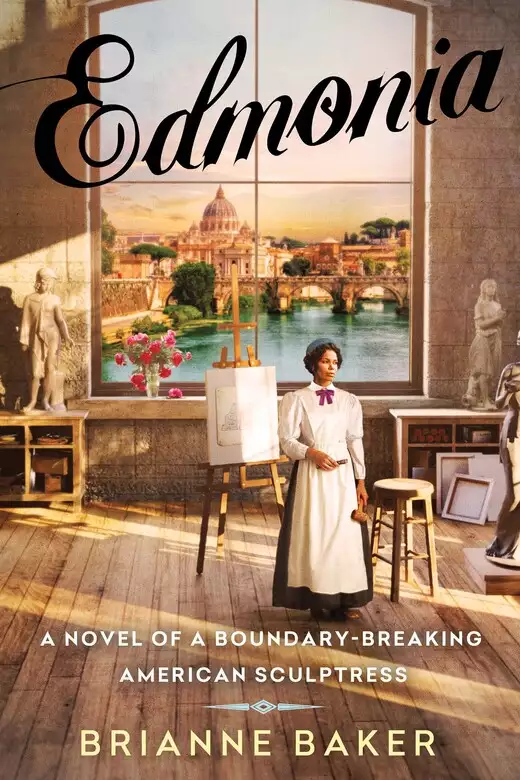
For readers of Vanessa Miller, Sheila Williams, Victoria Christopher Murray and Tracy Chevalier, the story of an unconventional woman who overcame adversity to create enduring tributes in stone to her race and times. The life of pioneering Black Neoclassical sculptor Edmonia Lewis – from the Civil War-era Midwest to Boston’s abolitionist circles, to Rome’s expatriate community – is resurrected in this stunning debut biographical novel.
“I plan to be a sculptor, to memorialize forever the great men and women of my race, and those who have fought for our cause.”
At the age of 8, orphaned, precocious Wildfire seems fated to a life of toil selling her handmade crafts to Niagara Falls tourists alongside her Ojibwe aunts. But Wildfire’s older half-brother, Samuel, has been making other plans for his gifted sibling. Soon, she is set on a new trajectory—and with it comes her birth name, Edmonia, and a revelation about her true origins.
Ensconced at the home of a trusted benefactor while Samuel makes his fortune in California, Edmonia flourishes—despite her abhorrence for etiquette lessons. Privately nurturing artistic ambitions, she advances through the abolitionist’s prep school and lands at Oberlin College. But at Oberlin lies a devastating trap: Edmonia is accused of poisoning, nearly fatally, two friends, with tainted wine.
What ensues is a headline-making trial, a vicious attack by a white mob—and a bold journey that will lead Edmonia from a crucial introduction in Boston to a vibrant community of celebrated expatriate women artists in Rome, and encounters with such distinguished figures as President Ulysses S. Grant, Pope Pius IX, and Frederick Douglass.
Still, Edmonia’s success is plagued by stinging critiques, potent racism, and haunting self-doubt. She must decide, too, whether to abandon her romantic entanglements, or devote herself to bringing to life her visions of beauty and justice—and hopefully, forge her place in a rapidly changing world.
Release date:
April 28, 2026
Publisher:
Kensington Books
Print pages:
288
* BingeBooks earns revenue from qualifying purchases as an Amazon Associate as well as from other retail partners.
THE VISIONS BEGAN WHEN I WAS A CHILD, APPEARING INFREQUENTLY at first, then becoming constant, rapid, relentless, a veritable assault on my young mind. They felt rather more like visitations than visions, the images flashing before my eyes as almost physical, corporeal beings, begging for incarnation, immortalization in some form with more permanence than mere air. The first vision was of my father, a man who had died before I’d ever known him, while away on travel shortly before my birth. He had been a valet, a gentleman’s servant, and would traverse the country with his principal, dressed in the finest apparel, as I had been told. I would not have known this first vision was my father had he not appeared before me in this finery, and had he not resembled so greatly my older half-brother, Samuel, with the only other distinction, aside from his attire and relatively advanced age to that of my brother, being a noticeable scar beside his right eye.
One evening, after dinner, on a rare visit my brother made to the small dwelling where I lived with my maternal aunts in the wilds of northern New York, I questioned him about our father’s exact countenance, and in particular, the mark I’d seen in my vision. I was careful not to reveal the source of my knowledge, lest he deem my vision inappropriate or unearthly, lest, indeed, he deem me unwell for beholding such illusions.
“Had our father a scar,” I asked, touching the same spot on my own face, “just here?”
My brother looked at me strangely, and confirmed that our father did have just such a marking.
“He didn’t like to talk much about how he received it,” Samuel said, looking into the fire before which we sat. “I believe he got it in a duel during his younger years. He was not a man to accept slights quietly.”
Samuel did not belabor the subject, nor inquire as to how I’d gained such knowledge, perhaps assuming that my aunts had told me of my father’s visage during one of their usual tales recounted to me at bedtime.
It was not long after this that a vision of my mother manifested before me in the night, and though I had known her no more than I knew my father, her death happening shortly after, and in consequence of, my birth, her demeanor communicated so clearly that of the maternal, her movements so protective, her aura so compassionate, that I knew at once this was who she was. My mother had been an Ojibwe woman, as were her sisters, the aunts with whom I lived, and she appeared before me in traditional dress, her raven hair flowing freely down her back.
“My child, my child,” she seemed to say, reaching toward me with outstretched hands. I must admit I was afraid to accept her embrace, as she seemed so insistent upon holding me that I thought she might carry me with her into that celestial world that existed beyond our own. I shut my eyes and tried to return to sleep, but found that it eluded me that night, and came but fitfully for several nights following, as my mother’s apparition visited with regularity.
The more I attempted to subdue this vision of my mother, the more she seemed to desire, and even demand, release. I began to sketch her, to give her solidity, using what paper and instruments I could find, but even that was insufficient, as each evening in bed these maternal visions would continue their appearance before me. And so, I began to carve her, to sculpt her, to give her a more durable form than a sketch or a painting, something closer to life itself. I worked with oak, maple, or birch wood, with clay or what fragments of flint I could find. I knew she would not let me rest until I got the sculpture just right, until she, in her ethereal home, could feel pleased by the figure, through my unpracticed efforts, I’d wrought.
I was laboring away on just such a sculpture, having retired to a quiet, and, as I thought, unknown place in the woods during a break from my daily chores with my aunts. My progress was interrupted by two men who approached me, suddenly, from the forest depths, causing me to bolt upright from the spot where I worked, and retreat, slowly, like the prey I then felt myself to be. They were clad all in black, their collars high, their complexions so pallid as to appear almost gray, as if they had sacrificed all sunlight, all recreation, in pursuit of some somber objective.
“You needn’t be afraid, child,” one of the men said, reaching a thin and pale hand toward me. “We’re here to help you.”
I had long heard stories of the black-robed men from other members of the Ojibwe tribe, and from such tales I’d surmised that these men offered not help, but a hindrance to the relative freedom with which we lived and roamed on what land had been left to us. These men would want to civilize me, to send me away toward that effort, to steal from me the singularity I’d had since birth, as I’d heard had been done to many other Ojibwe children with whom I’d played and had never heard from again. With that in mind, I fled from that space, and from those men, running swiftly through the woodlands, taking a circuitous route I knew these missionaries, in their restrictive clothing and shoes, could not follow. I was surprised to find, then, that after some moments in what I’d considered relative safety—behind a boulder by a rushing brook whose noise, I believed, would further obscure my movements—I saw my brother leading the black-robed men toward me, ever nearing my hideaway.
“She often hides here,” I heard Samuel say, surprising me in his easy betrayal. “Come out now, sister,” he went on. “There’s no need to run. These men are Baptist missionaries. They mean you no harm.”
I shrank still farther into my seclusion, hoping the black-robed men would relinquish their efforts, and yet, my brother continued. “This is Minister Wells, and Minister Smithson. They’re here to offer you an education.”
“An education in what?” I rejoined after a momentary pause, seeing that these men would not soon leave me be.
Minister Wells smiled at this. I resented his amusement, his seeming assumption that my earnest question could be used toward his entertainment.
“An education in literature, Latin, and grammar,” the minister replied, “in history, but most of all in politics, the occurrences of our era, and the ways that strong Christian guidance can lead this country onto firmer ground.”
I did not respond to the minister, but still he persisted, speaking assuredly, someone certain that he would receive what he desired, if not by persuasion, then by force.
“Your brother tells us that you are a young lady twelve years of age. Wouldn’t you like to learn how to read, how to write?” he asked, daring to step yet closer to me.
“I know very well how to read,” I replied, thinking of the ways that I could discern the land, how the rivers and lakes and mountains, the stars and the very air were all as legible to me as if they had been bound within the leather covers of a book. I could see by the mere appearance of this man that he could claim no such knowledge, and yet he deigned to consider me the uneducated one.
“Dishonesty won’t do, sister,” Samuel said, and he, too, emitted a small chuckle, as if all of my impudence was too juvenile to consider with any seriousness. “You do not yet know how to read, nor write, and you would be a silly girl to refuse this opportunity to learn.”
Samuel approached me then, leaving the black-robed men some space behind him, a distance from which they could not hear our short conference. “Come, now,” Samuel entreated, “their school is just across the way, in McGrawville. You will not be so very far away. It’s even closer to town, so I can visit you there often, if so desired, but I am sure that within just a few days you will have made so many friends, and will have learned about such wondrous subjects, that you would scorn my presence there.”
I made no reply, allowing my silence to communicate my vexation. Samuel went on. “They say that their school is called New York Central College, a new institution founded by the Baptists and the abolitionists of this state. They’ve raised enough funds that you can attend without me needing to pay tuition, nor room and board,” he eagerly added.
“I will not go,” came my cold reply, as I remained obstinate in my refusal.
“You haven’t a choice in the matter,” he said, and then, seeming to sense my youthful determination, and perhaps wanting to avoid further conflict, he quickly added, “Surely you know that I would not steer you wrong. This is for the best. This is for your personal improvement.”
I did not show any pleasure at this idea of personal improvement, and only said, “I like myself as I am,” in the futile hope that this would terminate our deliberations.
“But should you want to always remain here,” Samuel pressed, “selling Ojibwe souvenirs to condescending tourists by Niagara Falls?”
I had never known that my occupation with my aunts was thought to be demeaning, and in fact I had always enjoyed the opportunity for the creative release provided through our work, as I would sit beside them and weave baskets and bead moccasins for amazed travelers from across the country, and from Europe. But as I would soon learn that the eyes of Adam and Eve were opened with the first taste of forbidden fruit, so were my own eyes opened at these words from my brother, and I began to see myself, and the life I had lived thus far, in a newer, harsher way, and would never be able to return to the naïveté, the disregard for what the wider world thought of me, that had thus defined my existence.
And so it was with great haste that preparations began for me to attend school, that my farewells to my aunts and the other tribe members were dispensed, that my few belongings were packed and corded and loaded onto a coach. However, it seemed that the only element I could not leave behind were the visions, which plagued me for days before my departure to McGrawville, though now it was not only my mother who visited me, but numerous other unnamed and unknown personages who likewise called out for liberation. I hoped that I would be able to find a mode of expression for these visions within those schoolhouse walls, as I knew that I would not be able to fully concentrate on my studies while they tormented me.
After a coach ride of some miles, we arrived in McGrawville, and I alighted before a building more massive than any I had ever previously beheld. Students bustled about, conversing in groups of twos and threes, all seeming delighted to be at school, comfortable with their place here. Very few of these students, I noticed, resembled me in either color or attire, as they were all of the fairer race, and I stood momentarily petrified before them until Minister Wells ushered me, with much haste, into a small reception building adjoining the main school.
Minister Wells led me down an echoing hallway into a wide, wood-paneled gymnasium. After directing me to join a line of students with whom I shared a greater resemblance, at least in terms of our race, Minister Wells left me there, friendless and alone, standing timidly behind the other young students who appeared equally bewildered. The room smelled of lye soap, and was heavy with the steam of boiling water, the perspiration of the anxious students. I looked around, seeing that the space was divided into stations, with a different woman, appearing to be a nurse, presiding over each spot, taking several other children of about my age behind separate screens to submit to I knew not what procedures. Finally, I myself was directed, by a tall and severe woman, to step behind just such a screen.
“Remove your shoes,” the woman said, with no introduction, no preamble. I obeyed her, kicking off the brown moccasins my aunts had given me before my departure. “And your dress,” she added, almost as an afterthought, though this instruction left me yet more stunned. Still, after a short hesitation, I did as I was told. The woman then directed me to step into a tub of steaming hot water, and once I complied, she scrubbed at my arms and back until I felt that I might bleed, then moved in front of me and repeated the process. She poured buckets of hot water upon my head, then roughly parted and combed my hair, seeming to closely examine each strand, each inch of my scalp. These procedures completed, the woman dressed me in a frock of all white, then pushed me toward the next station.
“She is clean,” the woman told the lady at the next station. “No nits.”
“Name?” the next woman demanded, bringing me behind her own screen and sitting me in a hard wooden chair.
“Wildfire,” I replied, answering her with the only name I’d been called by my aunts and the other Ojibwe I had lived among. Even my brother, though I knew he was not of the tribe, had always addressed me thus, and it was a name that I appreciated, and felt aptly described my general disposition.
The woman stared at me for a moment as if I were in jest, as if such joking were inappropriate for the solemnity of the occasion, of my enrollment to this school.
“A heathen name,” was her terse reply. “It won’t do at this institution,” she said, writing something upon a piece of paper before her. “And your surname?”
“Lewis,” I replied, giving the last name of my father, and my older brother. The woman scribbled upon the sheet of paper. “You’ll receive a new Christian name at your baptism this evening,” she declared, without waiting for my reply, or my consent. “And your birthdate?” she continued, looking at me impatiently.
I hesitated at this question, for I knew that I had been born around 1844 or thereabouts, as my brother had often told me that I was then twelve years of age. I could not mark the exact date of my birth with any certainty, as in those days, and among my mother’s people, such matters were not recorded with paper and ink, but rather, were spread about through tales told around evening fires, or morning washing in the riverbed. As such, I chose the only date I thought the woman might appreciate, one that I had been told held much importance, and was the birthdate of our very nation, in fact.
“July the Fourth, 1844,” I declared, with some pride, as if I, too, believed myself to be an inheritor of the ideals espoused on that date.
If I had expected some grand reaction at this revelation, the woman did not give it, and only wrote upon the paper for several moments before ripping the sheet from her notebook and roughly passing it to me. “Hand this to the lady at the next station, just there,” she said.
I looked down at the paper, wishing I could make sense of its characters and symbols, to know what sorts of notes the woman had made about me, as her stony visage betrayed very little of her true emotions.
“Move along now,” the woman said, dismissing me with a shooing hand, stopping my scrutiny of her notes.
The final station was cluttered with papers and pencils and an array of other instruments that, though I did not then know their names, would soon learn were rulers, protractors, dividers, compasses, and all other matter of tools for drawing and measuring. I found that I could not readily compose myself before this display of strange instruments, so nervous was I at the thought of what was to come.
“Be still, child,” the final woman commanded, indistinguishable now from the others, in her stark white frock and tight brown bun. “And look forward, chin up.”
I complied, and the woman began to take my measurements, first my height and arm span, then the circumference of my head, the width of my nose, the space between my eyes, and so forth. She carefully recorded each measurement, and as she did so, I looked at the other young boys and girls in the line before me, quietly submitting to the very same close appraisal of their physiognomies by the other nurses. I tried to discern whether they found this treatment as strange, as demeaning, as I did, but I could see only resignation on their faces, evidence that they had undergone such treatment before, that they had long ago learned their bodies were always susceptible to the whims of such people as these nurses and administrators.
“You may go now, child,” the woman finally said, interrupting my observations of the other students. “Your phrenology report is complete.”
Though I had never before heard of phrenology and had no knowledge of its import or implications, I could tell by the way that she pronounced the word, by the cold and assessing expression she wore as she spoke it, that it meant I was a sort of specimen, a strange and curious study in her eyes, and that my fate at this school was beholden to forces beyond which I had any control.
As the afternoon went on, we students were fed a meager lunch of bread and cheese, and we dined together, seated on the gymnasium floor, though none of us conversed, and not one of us so much as dared offer another a glance, so depleted were we by the morning’s physical examinations. At dusk, we children were shepherded out to a wide field overlooking a still and tranquil lake, the first indications of fall just beginning to show on the trees around us. Minister Wells again appeared before me, there, by the lake, addressing all of us young students as we were ushered, by one of the nurses, ever closer toward the water.
“Here at New York Central College, we take it as our creed that all followers of Christ are our brethren, that we are all equal before His eyes,” Minister Wells began, looking out at us students solemnly, his voice growing clearer as we drew nearer to him.
“Even you all, of the darker race, are worthy of redemption, of salvation.” He paused for a moment to allow these words to take their effect upon us, though it seemed that very few of us children understood his import. “Your people may have wandered for centuries in the wilderness, in the jungles of Africa, or the wilds of North America, worshiping idols and pagan gods, but here, you may find absolution for any transgressions you have committed before, however unknowingly.”
Some of the children, seeming then to comprehend what was expected of us, called out their thanks to the minister for this largesse. “And so you will be baptized here,” Minister Wells declared, “in the lake, that you might be converted to the faith, and may receive your education at this Baptist institution.”
I knew not what it meant to be baptized, but as I saw the first group of children enter the water and allow themselves to be fully submerged, I felt the act was a redundancy of the earlier bathing to which I’d been so rudely and uncomfortably subjected. I stepped out of the line and took a seat upon a boulder nearby, resolving to observe the festivities without partaking in them. Seeing this, one of the nurse women approached me and bid me to rejoin the line of children entering the lake.
“But I’ve only just had a bath,” I protested, unmoving from my perch.
“That was for the cleansing of your body,” the woman said, slowly, as if I might not understand her words, “and this is for the cleansing of your soul.”
“My soul is quite clean,” I replied, still uncertain of exactly what was meant by this term, but sure the woman who had bathed me earlier must have made that organ pristine with her incessant scrubbing. “It has no need of further—”
A girl hastily approached me then, thus stopping my sentence and leaning close to my ear, she began to speak. “A child must not challenge her elders in that way,” she whispered, seeming to think herself my keeper, though she appeared to be only slightly my elder. “You’ll find yourself in great trouble if you continue on like that.”
I observed this young girl for a moment, slightly taller than I, and much thinner, as if many weeks had passed since she’d had a good meal, but the warmth and radiance that emanated from her dark skin and darker eyes rendered this gauntness barely noticeable. Still, despite her seeming warmth, I thought to challenge this young girl on her words as well, but she took me, roughly, by the arm and led me back to the lake before I could do so, instructing me quietly all the while.
“Watch how I behave when they take me into the lake,” she said. “Do exactly as I do. Say exactly the words that I say.”
With this direction thus dispensed, the girl was swept into the water by a clergyman and led toward the waiting Minister Wells and Minister Smithson, themselves dressed in white robes for the occasion, and submerged waist-deep in the lake water. “Clara Mae Wilder,” Minister Wells said, reading from a paper the clergyman passed to him.
I could not then ascertain the exact words the minister spoke to this girl, this Clara Mae Wilder, who evidently thought herself my guardian, but I saw that she nodded her head silently and answered affirmatively the minister’s interrogations, then allowed herself to be swiftly and fully submerged within that clear water, and held beneath its surface for some seconds by the ministers’ firm grips.
Finally, Clara emerged from the water’s depths seeming renewed, refreshed, utterly transformed. She gave first a tentative smile, then a laugh, then a shout with raised arms that so surprised me it caused me to start, and to fear that her emaciated frame might collapse under the effort. Clara’s exultations thus completed, she was led out of the lake and back toward the field to watch the remaining baptisms. I noticed that Clara’s jubilant countenance had strangely dissipated just as quickly as it had appeared, as she seemed to grow, with each step farther away from the lake, as proportionately dejected as she was formerly joyful.
I could not long ponder this change in Clara’s aspect, as it was then, apparently, my own turn to be baptized, as the same young clergyman ushered me forward into the lake with much more force than I thought necessary.
“The child who fled,” Minister Smithson intoned upon seeing me, with another one of his unsettling smiles. “And so, you have found your way back to the flock.”
I did not return Minister Smithson’s smile, and hardly deigned to meet his eye, leaving him with no other choice but to sigh at my insolence, and recommence his words.
“Let me prepare you for what is to come, lest you attempt another escape,” he said. “I will ask you a few questions, first, and you will answer as truthfully and faithfully as you can. If your responses are acceptable, I will then purify you in the very lake water in which you stand. Do you comprehend this, child?”
I said that I did, and both Minister Wells and Minister Smithson, appeased by my words, began their insistent questioning, a litany of doctrinal interrogations I found myself unable to fully comprehend, though I answered each in the affirmative, as Clara had instructed me to do. The final of these questions, however, I understood by the ministers’ changed tones, was most critical.
“Do you accept Jesus Christ as your personal Lord and Savior?” Minister Wells asked me, with a lowered voice and unblinking gaze.
I had never heard of this name, so I looked out at the other new students gathered at the shores of the lake, hoping to gain some understanding of how I should respond. Each student stared at me with the same expectant gaze that the ministers maintained, until finally, I saw Clara, who gave me a small and almost imperceptible nod, bidding me to answer the minister’s question affirmatively. I took a moment to ruminate on the question, as I knew that this acceptance would remove me in a way from the beliefs and lifestyle of my aunts and the Ojibwe with whom I had lived before, and I knew, too, that I would be a person transformed upon entering into this new faith that governed all who attended this school. It seemed to be a decision too profound for a mere child to make on her own, without careful counsel nor the opportunity to weigh the relative merits and difficulties of this new life in McGrawville, but I took courage in that quiet certainty that Clara sent toward me, and I took a breath, faced the ministers, and spoke my affirmation.
“Yes,” I replied, in a voice barely above a whisper. The ministers nodded then, evidently pleased by my response.
“I now baptize. . .
We hope you are enjoying the book so far. To continue reading...

 Please log in to recommend or discuss...
