- Book info
- Sample
- Media
- Author updates
- Lists
Synopsis
How far will his loyalty go?
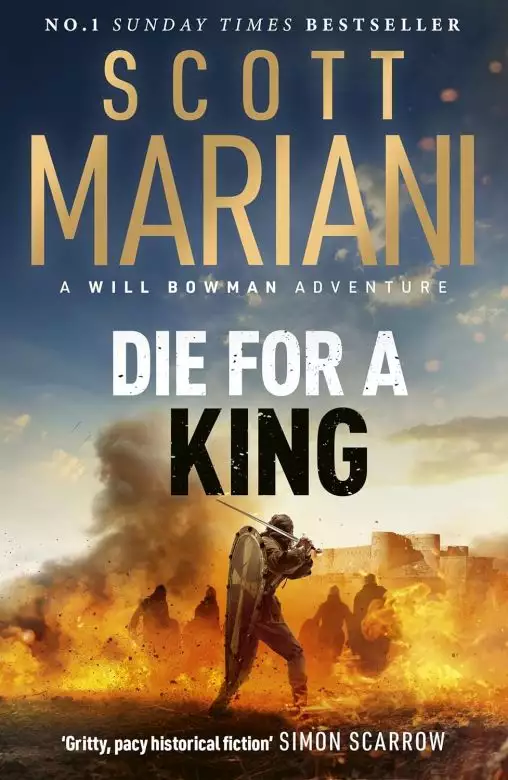
The year is 1191, and for young knight Will Bowman, newly restored to the service of King Richard 'the Lionheart', the savage conflict in the Holy Land continues unabated. In the wake of their victorious siege of Acre come battle after battle, with the forces of Christendom locked in deadly struggle against the might of the great sultan, Saladin.
By a miracle, Will and his loyal companions Gabriel, Samson and the rest of his unlikely gang of comrades have managed to survive this far. But as the slaughter rages on there seems to be no end in sight. To make matters worse, even when the fighting in the Holy Land is finally winding to a close - for now - the skullduggery of traitors conspiring against Richard's kingdom back home threatens the outbreak of yet more brutal and bloody wars to come.
Torn between his own destiny and his allegiance to his king, Will must somehow find a way out. But just as he might have discovered peace at last, his world is turned upside down once again by the appearance of a surprise visitor bringing shocking news from abroad. Now it's King Richard's life that is hanging in the balance, and it seems that Will is the only man who can save him.
To do that, Will and his companions must embark on their most dangerous voyage yet, penetrating deep into the heartlands of a ruthless foreign power to launch a covert rescue mission. The potential rewards are huge . . . but the chances of success are minimal, and it's more likely that Will and his friends are walking into a death trap. Is his loyalty to King Richard strong enough to die for him?
Release date: April 23, 2026
Publisher: Hodder & Stoughton
Print pages: 320
* BingeBooks earns revenue from qualifying purchases as an Amazon Associate as well as from other retail partners.
Reader buzz
 Please log in to recommend or discuss...
Author updates
Die For A King
Scott Mariani
The Holy Land
The summer of 1191 had been long and wearisome. Now as the month of September drew to a close, the scorching heat showed no sign of abating and the landscape thirsted desperately for the first rains of autumn.
Little stirred in this parched and dusty valley some miles inland to the east of the coastal city and port of Jaffa, and the cypress and olive trees sparsely dotted here and there about the landscape offered scant shade under the vast great dome of perfectly unbroken sky in which the sun’s flaming orb was just reaching its zenith. A sharp-eyed watcher scanning the terrain might have spotted a lone quail that was scratching among the yellowed grass, foraging for beetles or crickets. Now and then the quail would pause to dart its beady gaze left and right, then detecting no threat it would resume its assiduous search for insects. But while it might have prided itself on being a keen observer of approaching predators, being largely a terrestrial creature with little interest in flight, it seemed foolishly ignorant of the mortal danger that was about to strike from directly overhead.
Quick as an arrow and with absolute efficiency of purpose, the peregrine falcon came plunging down out of the sky, its talons spread wide. The poor defenceless quail never stood a chance against this fearsome hunter: in a matter of moments it was hanging limp and lifeless from its killer’s hooked beak. The falcon barely touched the ground before it took flight again. In just three beats of its broad wings it was soaring high, carrying its prey up and up into the blue where it circled around in a graceful arc far and wide across the sky before flapping down to land upon the outstretched arm of its owner.
He was an unusually tall and powerfully built man seated astride a dun warhorse and clad in a snowy-white surcoat bearing the crimson cross of a holy warrior over his hauberk of wedge-riveted chainmail. He had removed his helmet in the heat of the sun, welcoming the slight breeze that ruffled his long reddish-gold hair and cooled the sweat on his brow. A handsome man: very much in the prime of his life, with keen blue eyes that gleamed with intelligence and, though at other times he could look very forbidding indeed, a broad white smile on his face as he admired the falcon perched with wings outspread on his arm.
The horseman was not alone, having ridden out that morning from the city of Jaffa accompanied by a dozen of his fellows and a variety of squires and assistants. The twelve were warrior knights similarly clad and mounted, whose sworn duty it was to protect his life with their own. For the handsome man on the dun horse was none other than Richard, King of England, Duke of Normandy, Gascony and Aquitaine, and Count of Anjou, Poitiers, Maine and Nantes. This being the Holy Land rather than the green pleasant fields of his own immense kingdom, they were dressed for war, and on this day of September twenty-ninth their small band had ventured from the comparative safety of the city into the dangerous enemy territory inland – much to the consternation of the king’s personal advisors who did all they could to dissuade their monarch from taking part in such risky outings. But Richard was Richard, and if there was a risk to be taken or a fight to be had, iron fetters could not stop him from rushing into it as a newly wedded man to his marriage bed.
‘Ha ha, my beloved Holdfaste,’ the king chuckled to his prized bird. ‘Once again you show us that no creature in God’s domain is quick enough to escape your clutches.’ The falcon folded its wings and made no objection as the king plucked the dead quail from its beak and tossed it to one of his other men, who stuffed it in the bag containing the rest of the day’s quarry. Smiling, the king affectionately stroked the falcon’s tawny plumage. ‘In that respect, my noble friend,’ he told it, ‘you remind us of ourselves.’
‘Not even the noblest of falcons could match thy prowess, Sire,’ the knight mounted to his right said with an obsequious smile. He was a minor Norman lord by the name of Renier de Marun who had recently been placed in command of the royal men-at-arms, and was somewhat given to currying the royal favour.
‘Hmm,’ said the king, who valued Renier for his military skills but disliked the man’s toadying ways. Quickly losing interest in his bird he passed it to a handler who slipped a hood over its head, attached its leash to a portable perch and took it away. ‘Bowman!’ the king called out in a strong voice designed to reach from one end of a crowded battlefield to another. ‘What see you?’
Richard’s hail was directed to a solitary rider on the brow of a shaley rise some distance away, seated astride a large, strong white warhorse. He was another member of the king’s personal knightly retinue, who had been posted up to the higher ground to act as a lookout. This was by virtue of his superb eyesight, which indeed did not fall far short of a falcon’s. Like his king, the rider had removed his iron helm as well as the bulky padded coif beneath it, and the headpiece of his chain-mail hauberk hung down the back of his neck like a hood. He preferred to go bare-headed when he could, the helmet being heavy and stifling and tending to impair his peripheral vision. His long dark hair was loosely tied back, wisps of it breaking free and blowing in the soft wind.
His name was William Bowman – nowadays more properly Sir William, though he much preferred to go by the simple name of Will, by which he had always been known. ‘Will the bowman’ was what folks had called him when he was just a plain and ordinary freeman of the parish of Foxwood back home in England, plying his skill at hunting in the forest, tending to his smallholding and caring for his beloved young wife Beatrice, the miller’s daughter. So much had changed about his life since then, but in his heart he remained Will, and would do so until his death.
Another aspect of Will Bowman’s character was that, quite unlike his higher-ranking fellow knight Renier de Marun (and more than a few others he could mention) he was not at all inclined to sycophancy. On the contrary, despite being the youngest and most junior of the royal retinue, Will was quite capable of speaking very directly to a superior, even to the king himself, and had done so on at least one notable occasion. Relations between the English monarch and his newest man-at-arms had not always been comfortable.
‘I see nothing,’ Will called back down the rise. Then, remembering himself, as an afterthought he added, ‘Sire.’
‘Pity,’ replied Richard, partly to himself. ‘We had so hoped we might catch a Saracen or two while we were here, so that we could squeeze them for information about enemy movements. How we long to know what fresh capers that cunning dog Saladin has got up his sleeve. Come on down, Bowman,’ he called more loudly. And to Renier de Marun at his side, ‘Is our tent ready yet?’
‘I believe they are setting it up at this very moment, Sire.’
‘Make it quick, de Marun. In this wearisome heat we wish to take some refreshment and rest a while.’
‘At once, Sire.’
While the king was being ushered inside the cool shade of his tent, up on the rise Will made a last scan of the empty landscape. Still seeing nothing, he reined his horse around to rejoin the others. ‘Easy, Grisel,’ he said, leaning back in the saddle and keeping the lightest touch on the reins as the big white destrier made his sure-footed way down the loose, shaley slope. Before being promoted to knightly status Will could never have dreamed of owning such a fine, prohibitively expensive mount. Grisel had been a gift from the king, in one of the latter’s more generous moments, and he was one of Will’s most trusted companions in the world.
Will’s closest friend of all, however, was the slightly older fair-haired man who stood waiting for him at the foot of the slope. Gabriel O’Carolan had been his shipmate on the long, dangerous voyage from England the previous year. Along with their circle of comrades they had travelled together first to Sicily, then Cyprus, then finally to Outremer where their firm friendship had been cemented more strongly still by the fortunes of war. Gabriel now held the position of squire to ‘Sir William’, though not in a thousand years could Will have regarded his friend, confidant and brother-in-arms as a subordinate.
‘Nothing?’ Gabriel asked as Will reached level ground.
‘Nothing,’ Will replied. ‘But I don’t like it.’ He swung himself down from the saddle and handed the reins to Gabriel to hold the horse steady as he strode, spurs jangling, across the parched ground to where Renier de Marun was standing talking to a group of three other men-at-arms. One was Renier’s nephew, Walter, along with the brothers Alan and Luke de l’Estable. In the background more tents were being erected, following the king’s example. Some of the other men-at-arms were seizing the opportunity to remove their helmets, rack their weapons and take their ease, as though this were just another camp being set at the end of a day’s march in neutral territory.
‘What does the king think he is doing?’ Will asked, interrupting their conversation. He wasn’t smiling.
‘Taking his rest,’ replied Renier. ‘Sir William,’ he added in a particular tone, raising an eyebrow. In fact Renier de Marun had been one of those of the royal retinue who had never quite accepted the presence of a mere commoner in their midst, despite the fact that Will had once saved several of them from being blinded, castrated and beheaded by the Saracen emir Shīrkūh Ibn al-Shawar. Will’s only real ally and mentor among the king’s knights had been a Cornishman called Robert Leighton. But he had been killed at the battle of Arsuf, just three weeks earlier. His painful loss had left Will feeling isolated among his peers.
‘It’s taking a foolish risk to linger any longer than necessary in this place,’ Will said to Renier. ‘Aside from anything else, it is too exposed a location to set up camp. You need to go and tell him we should move on as soon as possible. Better still, we should return to Jaffa. This little falconing expedition has gone on long enough.’
Renier stared at Will for a moment, then shook his head with a cold smile. ‘Is that so? Then perhaps it would be better that you inform his majesty yourself of your decision, now that a lowly so-called knight, little better than a peasant, has taken it upon himself to dictate commands to his lord. I would love to see his reaction.’ Indeed, the last time Will had openly contradicted the king in such a blunt manner he had landed up in prison for it, under sentence of death.
‘Then I shall do just that,’ Will replied. He was turning to head for the king’s tent when Renier, who in fact was quite terrified of how this might rebound on him, blocked his way. ‘So tell me, Bowman, why do you believe we are not safe here? Did you not yourself report only moments ago that there is no enemy presence in this vicinity?’
‘I said only that I could not see them,’ Will replied. ‘Only a fool would depend on an observation from such a poor vantage point as that rise.’
‘You call the king a fool now, do you?’
‘Hell’s teeth, the man knows no bounds,’ said Walter de Marun.
‘You see that taller hill over there, to the east?’ Will pointed. ‘Any Saracen patrol who had got wind of our movements’ – and the Lord knew they had done precious little to prevent them being detected from a mile away – ‘could easily be gathering their forces to the far side of it, waiting for the moment to attack. I ask permission to lead a scouting party over there to carry out a reconnaissance.’
‘I see. And on what grounds do you suppose that Saracens may be hiding behind that hill?’ asked Renier suspiciously.
‘Grisel is acting nervous,’ Will replied. ‘It is as though he could sense something, and I have learned not to ignore his wisdom.’
‘You ask us to act on the say-so of a dumb beast?’ laughed Luke de l’Estable. ‘And make ourselves appear ridiculous in the king’s eyes?’
‘Grisel’s wits are sharper than those of many a man I have known,’ Will replied, looking hard at them. ‘If he tells me there is danger nearby, then I must believe there is danger. His instincts have proved true before now.’
‘Absolutely out of the question,’ snapped Renier. ‘Permission denied. And if you dare to take but a single step in the direction of his majesty’s tent, Bowman, I shall have you clapped in irons myself. Do you hear me? The king is not to be disturbed on any account. Horse, my arse. Even if the animal was once the king’s own mount. God alone knows how he came to his present master,’ he added, unable to resist the temptation to add some more vitriol to his words.
‘Very well,’ Will replied. ‘Let it be on your heads, if you are mistaken.’
He left the four knights standing there scowling at him, and walked back to rejoin Gabriel and Grisel.
‘That seemed to go well, brother,’ Gabriel said. ‘What now?’
Will grabbed the unstrung yew longbow stave from the back of his saddle pack, bent it against the ground and hooked the loop end of the string around its top horn, then slung the weapon around his head and shoulder. His quiver was bristling with a full sheaf of arrows, each fitted with a needle-pointed, fire-tempered iron bodkin head capable of penetrating chain mail and thick leather armour from a long distance. Taking the horse’s reins back from his friend, he thrust his foot in the stirrup and swung himself back into the saddle. ‘I tell you what now,’ he replied. ‘If my brave fellow knights cannot ride out to reconnoitre our position, then that duty must fall upon the rest of us more equal to the task.’
‘I am coming with you.’ Gabriel stuck his fingers in the corners of his mouth and blasted out a piercing whistle. A tall black horse that had been grazing on what little parched greenstuff was to be found nearby instantly wheeled around at his master’s call and came cantering over. This was Brân, whom Gabriel had named after a raven in his native Irish tongue. He jumped nimbly into the saddle, from whose pommel hung his bladed weapon of choice, a long curved scimitar that had been a captured trophy from a dead Saracen but closely resembled the falchion sword he had carried with him through Ireland, Wales and England. Gabriel’s expertise with a sword was far beyond Will’s, though by his own admission he was a lamentably poor shot with a bow.
‘Let’s go,’ Will said, wheeling Grisel around. By taking matters into his own hands like this he risked incurring the king’s wrath yet again. At this moment he was happy to run that risk, there being too much to lose if his and Grisel’s instincts happened to be right.
But then Will saw the hesitant look that had suddenly come over his friend’s face, as though he had had second thoughts. This was most unlike Gabriel O’Carolan, who in Will’s experience had never been known to shrink for a moment from even the most extreme danger. Was he concerned about the reaction of the king if Will were to disobey a direct order from his superior? Had Will at last overstepped the line between daring and lunacy?
‘On reflection, brother,’ Gabriel said, ‘I do not think it necessary for us to ride out in pursuit of a hypothetical enemy.’
Will looked at him. ‘Why not?’
Gabriel pointed toward the east. ‘Because they are already riding out to meet us.’
Chapter 2
Will jerked his head around to look to the east. From behind the very same sparsely wooded rise he had been about to ride over to reconnoitre, were streaming a large body of fast-moving light cavalry. How many exactly was hard to say at this distance, but it was clear that they greatly outnumbered the party of pilgrim knights now setting up camp in blissful ignorance of this imminent attack. Perhaps by as many as eight or even ten to one: a ratio rapidly growing more disadvantageous with every passing moment that he went on watching the long line of riders emerging into the open, riding hard and sending up a dust cloud that rose like smoke and then was whipped away by the breeze. Curving around due west. Heading straight towards them. At their head fluttered the black and white Mussulman banner of holy war. Already Will could hear carried on the wind their blood-curdling cries of ‘Allahu Akbar!’ Ours is the greater god. We will destroy you in the name of Allah.
Grisel was prancing and tossing his head nervously, snorting and rolling his eyes with his ears laid flat back. Will could feel the latent power of the stallion fighting to break free. ‘Steady, steady, boy,’ he murmured reassuringly, patting the horse’s thick neck. ‘You were right. Renier may wish he had taken heed of our warning.’
‘I would say that somebody should perhaps go and wake up King Richard,’ Gabriel said dryly. ‘He is about to get an unpleasant surprise, else.’
But there was no need, as the alarm was already being raised across the camp with urgent cries of ‘Attack!’ and ‘They are coming!’ Those knights who had relieved themselves of their bothersome helmets, shields and weapons now hurriedly prepared for the imminent assault. Horses whinnied and reared up; one got loose of its handlers and galloped off in a panic. Men ran here and there, squires racing to get agitated animals under control; knights grabbing lances and spears from the rack, pulling on armour, helms, shoes; scurrying back from the privacy of the rocks where they had been urinating; yelling or receiving orders.
Amid this scene of woeful confusion King Richard burst out from his tent with his drawn sword in his hand, glanced about him and quickly grasped the situation. Thankfully for him, he had had the foresight not to remove his hauberk, belts or boots in order to rest. Pulling the coif over his head and strapping on his helmet he leaped astride his tall dun warhorse, Fauvel, and began marshalling the men to repel the attackers. Meanwhile the charging Saracen cavalry column was fast closing in, and Will’s fear was confirmed that this had been an ill-chosen spot to make camp. The valley was far too open, with no natural cover, permitting the enemy enough space to surround them and close in for the kill. They must be stopped before that could be allowed to happen.
Will’s powerful bow was the best longer-range weapon the king’s men possessed, markedly superior in both reach and accuracy to the handful of crossbows some of the squires and one or two of the knights had brought along. But unlike the handy little bows that the Saracen riders favoured, it did present the serious disadvantage of being virtually unusable from the back of a horse, on account of its unwieldy length. Will had faced an enemy cavalry charge on foot before now, and he was loath to repeat that experience, given the choice: so, reluctantly abandoning the use of the bow for now, he hurried Grisel over to where a couple of lances remained among the rack of weaponry.
Will was as yet no great expert in the use of the lance, but under the tutelage of his mentor Robert Leighton he had come to appreciate its great effectiveness to the mounted warrior. Grabbing up one of them by its long, slim oak shaft he reined Grisel back around to face the incoming Saracens.
They had now almost reached the camp. The pounding of hooves shook the ground and their terrifying war cries filled the air along with the dust of their charge. So close now that Will could clearly make out the faces of the leading riders. Three, four, five of his fellow knights had gathered to his left and right, among them the l’Estable brothers and Walter de Marun, lances at the ready or swords drawn, spurring their mounts into the counter-attack. Will’s heart was thumping hard under his hauberk. Every shred of his being jangled with the strange thrill of battle that seemed to magnify the senses and turn a man’s blood to wine. At such moments, when life hung so precariously in the balance and might be snatched away from one instant to the next, it was more intensely, palpably experienced than at any other.
‘Deus vult!’ cried Walter de Marun. And then they were off, galloping with all speed directly towards the approaching enemy. Will could feel the pounding, surging power of Grisel under him, moving so fast that he might almost take off and fly. He gripped the shaft of the lance hard and couched it under his right arm, close to his body, in anticipation of the jarring impact. Closer. Closer. Dust thick in the air. Vision blurred by speed, the wind in his face and the movement of the horse. The formation of knights spread out to meet the attack; and the Saracens did the same, each man marking his target. Two of them now came straight at Will; he steered Grisel straight between them and aimed the point of his lance at the one on the right.
No expert, perhaps – but all those arduous training sessions with Robert Leighton had not been without effect. Will’s aim was true and as the opposing sides closed with one another his lance point smashed into the rider on the right, the shaft shattering on impact but delivering enough force to propel him violently backwards out of the saddle while his light, fast Arabian pony charged on riderless. The horseman to Will’s left flashed by at full gallop, close enough for their knees to brush; the Saracen’s whirling scimitar slashed at Will’s chest, gashing the white cloth of his surcoat but unable to hurt the iron ring mesh of his hauberk beneath it.
Not slowing for an instant Will threw away the shattered lance, reached across his body to grip the hilt of his sword at his left hip, and wrenched the blade from its scabbard as Grisel cut a path through the screeching Saracens to both sides of them. Another scimitar came slicing towards him, the blade glittering in the sun, but before its stroke could fall Will had struck out with his own, a downward diagonal chopping blow of such power and momentum that it clove the scimitar in half. The edge of his blade caught the Saracen where he was most vulnerable, in the unprotected gap between the leather plates of his shoulder armour and the base of his helmet. From the corner of his eye as they raced past one another, Will saw the man’s head spinning away from his shoulders. For what distance a headless rider could remain in the saddle, he would never know, because now he was deep in the midst of the enemy horde, surrounded on all sides and cutting and hacking left and right with all the speed and energy he could muster.
The fighting was intense, close-packed, violent and bloody. Some distance away through the chaotic, heaving morass of men and horses he could see the l’Estable brothers, Luke stabbing and thrusting for all was worth with a lance, Alan swinging a war axe. There too was Walter de Marun, heavily beset but valiantly beating back all comers. And Gabriel, blood on his scimitar, Brân wheeling this way and that, rearing up and lashing at the enemy with his flailing front hooves. The noise and confusion were absolute, so much dust rising from the ground that at moments it was like being enveloped in thick fog and barely able to see past the horse’s head. Will heard a bubbling scream and snatched a glance away to his right to see Alan de l’Estable pierced through by a Saracen spear and tumbling from his horse. His brother fought on, but then Will could no longer see him. From another direction a familiar roaring voice reached his ears: King Richard had ploughed headlong into the closest-packed crowd of the enemy, along with Renier de Marun and another Norman knight by the name of Guillaume des Préaux, and were furiously cutting them down left and right.
Then suddenly, unexpectedly, the Saracens were falling back; circling away at a gallop, regrouping, racing off in a long line as fast as their ponies would carry them. ‘They retreat!’ Renier de Marun shouted in triumph. But Will suspected otherwise, for he had seen it happen before. ‘This is one of their favourite tricks,’ Robert Leighton had taught him. ‘To instigate the fight, goad us to anger and then run off as though they were retreating in disarray, in the hope that we give chase so that they may lead us into an ambush. Many a foolish knight, too used to our Western ways, has fallen for their deceptions and been cut to pieces.’
King Richard surely also had enough experience of this style of warfare to know his enemy well enough. But at this moment, perhaps carried away in the heat of battle or so incensed at having been caught unawares by the surprise attack, with sword raised high and a bellowing shout he turned Fauvel around and went charging off after the retreating Saracens. Renier de Marun and Guillaume des Préaux unhesitatingly followed their king’s lead and raced off at Fauvel’s heels.
‘God’s bones,’ Will said to himself as he watched them gallop away after Richard. ‘What can he be thinking?’ There was little time to take stock of the carnage around him, the bodies of both of the l’Estable brothers now lying lifeless in the blood and the dust, surrounded by any number of slain enemies and many mortally wounded or dead horses. Will knew he must go after the king, for he feared the worst. ‘Run, Grisel!’ he shouted, spurring him into action. Behind him, Gabriel thankfully still astride Brân and apparently uninjured, gave chase as well.
Fauvel was a swift runner, and so were the warhorses of Renier de Marun and Guillaume des Préaux – but Grisel, with a chest like the vault of a church and a heart of oak, had the edge over all of them. Within moments Will was beginning to catch up. The Saracens had retreated right away from the camp, heading at speed further along the valley where higher ground to both sides rose steeply up to form something like a gorge, a narrowing funnel from which, once entered, there was no escape to either left or right. The king and his two men-at-arms were in close pursuit. Will realised to his dismay that his suspicion had been correct once again: the retreat was only feigned, a deliberate strategy on the part of the Saracens to lead them into what might very well turn out to be the perfect ambush.
Sure enough, moments later the trap was sprung. The gorge had narrowed to a high-walled canyon hardly wide enough for three horses abreast; then it suddenly opened out again with rocky outcrops to each side. At almost the same instant that Richard and his two knights reached that point of no return, from behind the rocks came a sudden flood of Saracen foot soldiers who had crouched hidden in wait for their golden opportunity. Scores of them. And now the king was in serious trouble, as the mounted Saracens reined their horses to a standstill and blocked off the end of the canyon while those on foot swarmed by the dozen into the narrow passage. Some carried bows, but not an arrow was shot. There could be no doubt as to their intention. Those wily Saracens knew the ways of their Christian enemy all too well, and those of their leader even better. Having succeeded in luring the reckless, impetuous King Richard away from the rest of his men they meant to unhorse and take him captive. And what a trophy to deliver alive, bound and humbled, at the feet of the great sultan.
In that chilling moment Will realised what should have been obvious all along: that this entire attack had been purposely directed at the king himself. Saladin must have gained some manner of inside knowledge of Richard’s combined falconing and reconnaissance mission. The sophistication of the sultan’s well-developed spy network was no secret – but even so it was shocking to think his agents could have penetrated so deep into the king’s inner circles.
Little time for contemplation, however. Will glanced behind him: Gabriel on Brân was a good way back and would take a few moments to catch up. Those few precious moments would be critical. Already the Saracen foot soldiers were swarming all around the three riders, closing off their escape to the rear. Dozens of hands were reaching up to grab the knights by the legs and ankles and haul them down from the saddle. Richard, Renier and Guillaume were all determinedly swinging down at the assailants with their swords, but there were too many to drive back all at once, and they were afraid of hurting their own horses.
In the next moment a spear thrust caught Guillaume in the side and took him down out of the saddle. Instantly he was being grappled with and scimitars and daggers descending on him, some glancing off his mail and others slashing at his exposed face and limbs. Then Guillaume des Préaux did something that took Will completely by surprise and would remain with him for a long time afterwards. In a hoarse, strident cry he began shouting out in the Saracen tongue, of which the only word Will could understand was ‘melech’, their language for ‘king’. Suddenly, as one, the Saracens drew back their weapons and ceased trying to kill him.
It took only a brief instant for Will to realise that Guillaume was trying to convince them that he, not Richard, was the king. The man would voluntarily sacrifice himself to save – or at least to try to buy some time for – his lord and master. Will was stunned by the selfless courage of his ploy and the depth of his loyalty. But could the Saracens possibly be taken in by the deception?
It seemed that they could. As poor Guillaume des Préaux was being dragged
We hope you are enjoying the book so far. To continue reading...