
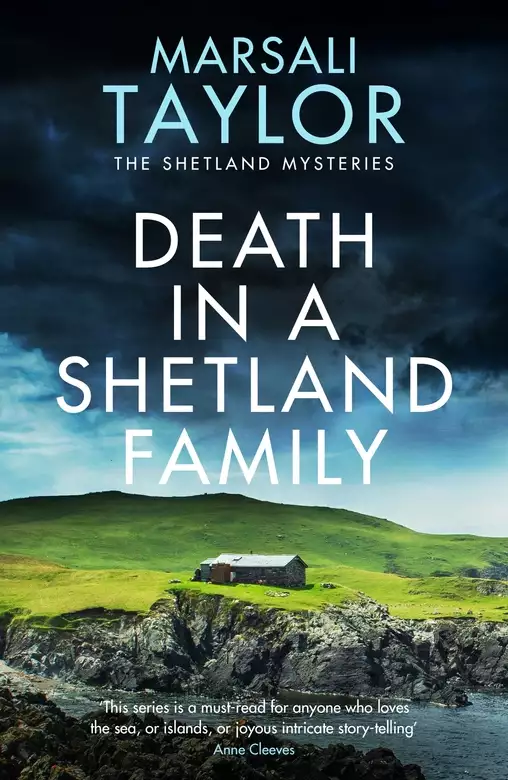
Death in a Shetland Family
Available in:
- eBook
- Book info
- Sample
- Media
- Author updates
- Lists
Synopsis
This series is a must-read for anyone who loves the sea, or islands, or joyous, intricate story-telling.' ANN CLEEVES
Release date: April 16, 2026
Publisher: Headline
Print pages: 352
* BingeBooks earns revenue from qualifying purchases as an Amazon Associate as well as from other retail partners.
Reader buzz
 Please log in to recommend or discuss...
Author updates
Close
Death in a Shetland Family
Marsali Taylor
Der mony a göd horse snappered: Misfortunes or mishaps can occur to the best. [Literally, There’s many a good horse stumbled.]
I was on my way back from Bergen to Lerwick. We’d not long sighted the cliffs of Noss, a misty triangle on the horizon, when my phone pinged: two messages from my partner, Gavin. The first one said Mother’s had stroke call me asap xxx and the second one was Heading for Inverness xxx.
I moved away from the trainees and called him. ‘Gavin?’
‘Cass, thank goodness. I wasn’t sure if you’d get me before the flight. I’m on my way to Inverness. Mother’s had a stroke.’
I looked out at the shifting sea and didn’t know how to comfort him. ‘Oh, Gavin. I’m sorry.’
‘Pray for her. I’m going down now.’ His voice shifted to organisation mode. ‘I don’t know how long I’ll be. When do you expect to be home?’
‘ETA midday, to Lerwick. We can see Noss.’
‘I’ve organised Rainbow to call in and feed the animals tonight, in case you didn’t get in as expected, but she’s back at school, so she can’t do it all.’ He hesitated. ‘I was looking at your trips . . . I’ve got a week’s compassionate leave.’
‘I’ll sort it,’ I said firmly. ‘You just worry about your mother, and helping Kenny.’
There was a bing-bong in the distance behind him, and the sound of an airport voice. Gavin listened. ‘That’s me,’ he said. ‘I’ll phone you once I get there. Once I know more.’
I put the phone down and stared blankly at the shining water. Gavin’s parents had married late, and his father had been dead for a long while. Morag, his mother, had been forty-three when his brother, Kenny, was born, and forty-five with Gavin, so she was in her early eighties now, but she was always so busy about the farm, between hens and cows, washing and baking, that I couldn’t imagine her lying in bed. Gavin hadn’t said whether she was still at home. I’m on my way to Inverness.
That could be the flight, or the hospital there.
‘Cass?’ Anders said from behind me. ‘Is something wrong?’
I nodded, and turned slowly to face him. ‘Gavin’s mother’s had a stroke. He’s flying down there.’ I realised how little I knew. ‘He didn’t say how bad it was. He was at the airport, on his way. He’ll phone me once he gets there.’
Anders made a sympathetic face. He was the engineer for this trip, and Kathleen, standing aft beside a trainee on the helm, was our skipper. We’d sailed Shetland’s tall ship Swan over from Lerwick to Bergen three weeks ago, with ten trainees squeezed aboard, and set off for home from Leirvik on the Søgnefjord the day before yesterday. Now the trainees were on deck watching Shetland appear in the distance: the cliffs of Noss outlined on the horizon, Sumburgh Head to the south, the hill of Saxa Vord in Unst to the north. Gannets flew around us, paper-white against the blue sea.
I put my phone back in my pocket. It would be a couple of hours before Gavin got to Inverness. Meanwhile, I had sightings to take with the trainees and a course to plot. I needed to radio the Coastguard and Lerwick Port Authority to let them know we were on our way in. I squared my shoulders, nodded at Anders and got on with it.
I kept worrying all the way through the journey in, the bustle of berthing, immigration control and waving the trainees goodbye. When the last of them had gone, we sat down for a mug of tea on deck, and I told Kathleen the news.
‘Do you want to go down there?’ she asked.
I shook my head. ‘Not immediately, anyway.’ I wanted to be with Gavin, but if Morag was in hospital, there wouldn’t be much I could do. ‘I need to be in charge of the animals. Gavin usually does that. I’m not sure I can be a night away from home, and of course I won’t have road transport.’
Kathleen nodded. ‘Let’s think . . . we all have tomorrow and Thursday off while the volunteers do a deep clean. Friday’s the weekend trip to the Unst show.’
I’d planned it: a day’s sail up the east coast, Friday night in Fetlar, on to Unst, Shetland’s most northerly isle, for a day at the Unst Agricultural Show, then Sunday either going over the top of the British Isles, weather permitting, or along the top of Yell and back down the west coast to Aith. I’d been looking forward to it, but now it was three days away from the house. There were the cats, the hens, the horses, the sheep; I couldn’t do it. I shook my head, and met her eyes in a dismayed look.
‘Never worry,’ Kathleen said. ‘I bet Magnie can do it.’ Magnie was a retired fishing skipper, a regular Swan volunteer, and one of my best friends.
‘But I can do the school trips from Aith,’ I said, ‘and the sail round to Walls with all the P7 bairns. I’ll find a way of getting back to Aith.’ It was ten miles, too far to walk. ‘Isn’t it a Walls man who drives the school bus?’
‘It’s Trevor Mullay crewing,’ Kathleen said. ‘The lifeboat second coxswain. He bides in Aith, so as to be handy for a shout. I’m sure he’ll run you back there.’
‘That’ll work,’ I said. ‘I’ll speak to him tomorrow or Thursday. Then the women’s weekend trip to Scalloway, St Ninian’s and back to Lerwick . . .’ I shook my head, as if the movement would clear my brain and let me think.
‘Don’t fret,’ Kathleen said. ‘That’s a week and a half away. Focus on now. Phone round for a substitute skipper. Tomorrow and Thursday, at home for us all. Anders, you’re welcome to bide onboard, if that makes life easier.’
‘I’m going to Cass’s,’ Anders said. He put up one hand to caress his pet rat, who’d emerged from the cage he’d had to stay in during the crossing and was now comfortably ensconced on Anders’ shoulder. He’d had to be left with Anders’ parents in Norway for the whole length of the fjords voyages, because of passenger sensibilities, but Anders was staying on in Shetland for the Unst trip and then a Warhammer three-day competition, so he’d insisted on bringing Rat back with him, and Kathleen had agreed, on condition that he stayed in the crew’s quarters. They were a striking pair: Anders was a classic Norwegian seaman, of medium height and muscular build, with shining fair hair, tanned skin, blue eyes, a straight nose and a neat Elizabethan beard. It was a great pity for Norwegian girls that he was also a serious engine nerd. Rat was an equally handsome specimen: nearly sixty centimetres from nose to tail-tip, with black and white markings, intelligent dark eyes and whiffling whiskers at least ten centimetres long. Anders took him everywhere, tucked inside his shirt or curled round his neck inside his hood. Most people had a moment of thinking he was a cat, then realised and were either fascinated or recoiled in horror.
Thinking about Rat brought me a whole new set of problems. The plan was, as Anders had said, for him to stay at our cottage. Rat and my Cat had been friends from when I’d found Cat as a tiny, starving kitten, but I feared that Cat’s sidekick, Kitten, might have other views, especially as she had a kitten of her own to defend. I hoped it would be okay if Rat stuck with Anders, or went out with Cat to charge round the garden.
Then, I realised, there was getting home. I’d been expecting a lift home with Gavin once his police shift was ended, but that wasn’t going to happen. I didn’t even know where our car was - probably down at Sumburgh Airport - nor if Anders could sit as passed driver for me to fetch it back.
Kathleen echoed my thought. ‘How are you going to get home?’ She glanced at her watch. ‘Five to one.’
‘That’s good,’ I said. I took a deep breath and found the world starting to click into place in my head. The car could stay wherever it was; my own yacht Khalida was waiting for us in Brae, a convenient hundred metres from the bus stop, and home, the Ladie, was only two miles by sea from there. ‘There’s a bus to Brae at ten past two. We’ll go there and sail Khalida home to the Ladie.’
Anders nodded, and rose. ‘Then we’d better get on with tidying up this ship.’
‘I’ll phone Magnie now,’ I said. I visualised him as the phone rang, into his seventies now, with a round cheerful face, pebble-green eyes and red-fair hair only just starting to grey. He’d likely be in the house putting the kettle on the Rayburn for a lunchtime cuppa – and on the thought, the ringing cut out, and his voice sounded in my ear. ‘Aye, aye, Cass. I was about to phone you. I’ve been watching you dock on the Marine Traffic tracker. Your man got hold of you then?’
‘Just as we spotted Noss. Nine o’clock.’ I glanced up at the clock and realised that was four hours ago. ‘I haven’t heard back from him yet.’
I must have sounded worried, for Magnie cut in quickly. ‘The Inverness flight goes by Kirkwall, and then he’ll need to get to the hospital . . . no point in calling again till he has news.’
‘No,’ I agreed. ‘And they might have taken her to Fort William, that’s nearer the loch than Inverness, but further for him to go.’
‘And folk get over strokes, even someone the age of Gavin’s mam. Wi’ good physio she’ll come at, God willing.’
I nodded, and got to the point. ‘But it means I can’t go jauntering off to Unst this weekend. Are you free? Could you skipper in my place?’
‘No bother, lass. I was hoping you’d ask me. The bag’s ready to be packed, and I’ve had a word wi’ me neighbour to look after my animals. He’s got a teenage lass always blyde for some pocket money.’
‘Thanks,’ I said, and fell into formal old-fashioned Shetland. ‘I’m truly obliged to you.’
‘You’ll be vexed to be missing the trip,’ Magnie said. ‘Your first shot at skipper too.’
‘Can’t be helped,’ I said.
‘And you’ll be giving me that young Anders as engineer?’
‘He’s looking forward to it.’
‘And his rat too?’
‘Confined to the crew quarters during the voyage.’
Magnie grunted, which I took to mean acceptance. ‘I’m just about to come into town. I could easy give the two of you a lift out west.’
‘Oh, that’d be great!’
‘About half past two, mebbe?’
Half past two would give us time to tidy up in good order. I thanked him again, reported the good news to Kathleen, then flurried round shoving my gear into bags. I’d just stuffed the last of my dirty washing in when the phone went. I snatched it up. ‘Gavin?’
‘Hey, Cass. Mother’s holding her own. She’s in the Fort William hospital. I got a quick look at her. I’ll go back in a moment. The nurses say she’s stable. She’s conscious. She can’t speak or move her left arm, and she’s on a drip to keep her hydrated until they can check her swallowing mechanism, but I could see she recognised me. She lifted her other hand, and her lips moved. I haven’t seen a doctor yet.’ He paused to take a breath. ‘It all happened so fast – I just leapt into the car and drove. It’s still at Sumburgh.’
‘Don’t worry about that. It can sit till you get back. Magnie’s doing the Unst trip, so I’ll be at home all weekend.’
‘Good.’ His voice was distracted. ‘That’s a doctor. Dear Cass, I’ll speak later.’
Magnie’s mustard-coloured Fiat arrived on the pier on the dot of half past two. ‘Aye, aye,’ he greeted us. ‘Fine to see you back. So,’ he added, coming forward to take one of my bags, ‘how was Norway?’
‘Grand,’ I said. ‘We were lucky with the weather, only two days of rain, and the fjords were thatna bonny in summer. The trainees had a great time, and the Viking festival went down well. It was a bit of a marathon. I’m no’ sure I’m sorry for a weekend off.’
‘Any word o’ Gavin’s mam?’
I nodded. ‘She’s in Fort William, and stable. She can’t speak or move one arm, but Gavin said she recognised him. He was about to talk to a doctor.’
‘That’s all good.’
We had a cup of tea with Kathleen, and Magnie checked through the Unst trip with us and took over the paperwork, then we squeezed our bags and ourselves into the car and headed off west: between the houses, past the power station, up the hill and into the country at last. I’d insisted on Anders taking the front seat, with Rat inside his shirt. I relaxed in the back, and looked out at the passing scenery.
I’d left in the height of summer, and come home to early autumn. Even though it was a bonny day, blue and warm as summer, the colours had turned. The orange hens-and-chickens along the Tingwall verges had withered to brown lollipop heads, and the royal purple of the heather on the hill behind them had bleached to a creamy white, with blue pincushions of scabious growing through. There were swans with cygnets as big as themselves by the pool of Nesbister. The house beside where the Loch of Strom flowed into the sea had set up a tidal generator. I looked at the turbulence it was causing in the water, and betted it probably made the house self-sufficient in electricity. There were the small wind turbines too, I reflected. Nearly every village hall had one, to back up the heating when the hall was closed, which was most of the time, and save the cost of keeping it damp-free in winter. I wondered how far Shetland could get back to the self-sufficency of a century ago, if need be. I suspected folk would manage, with lambs on the hill, several dairy herds, hens in the yairds and fish in the sea. The problem would be fruit and vegetables; Shetland didn’t have a market gardening climate.
Now we were properly on the westside. At Weisdale there were immaculate lawns surrounded by curved feathers of pampas grass, and two fishermen had set up tripods at the loch. There were three Mirror dinghies sitting at the Tresta pier. We came through Bixter, up the brae, and were just past the Twatt turn-off when suddenly there was a whirl of something black at the corner of my eye, and at the same time Magnie slammed on the brakes. The car slid sideways onto the hard shoulder and juddered to a stop. We were all jolted forwards.
‘Sorry, folk,’ Magnie said. His face was white as he turned around. ‘There’s a horse running loose on the road. I came as near as dammit to hitting it.’
I rolled the window down and leant forward to look. It was a black Shetland pony charging along the road at full gallop, mane and tail flying. It was the quiet time now, but the school buses would be along at any moment, and the cars of parents collecting children. It definitely wasn’t a good place for a loose horse. Magnie followed it cautiously as it reached where the road narrowed to thread between the houses. There was a field of horses there; it slowed as it saw them, and they came over to the fence. The black horse paused, tossed its head, then sidled towards them, nostrils flaring. I heard squeals as two noses touched, but they couldn’t harm each other on opposite sides of the fence, and at least the black one was on the verge, instead of in the middle of the road. A man in a boiler suit came down from one of the houses to stand at the side of the road, one hand out. The horse flung its head up, then shied away to the other side of the road, kicked out as he took a step towards it, and clattered on, tossing its head. It galloped around the bend, past the Vementry turn-off and headed straight for the school, where the buses were lined up in the car park, with the first one starting to move towards the exit.
Magnie pulled into the Michaelswood car park, and took out his phone. ‘Aye, aye, Aidan, it’s Magnie here. There’s a black horse loose in Aith, heading for the school right now, and just at bus time too. It’s no’ your Rainbow’s?’
I realised he was talking to Aidan, father of Rainbow, who was feeding our animals tonight. I should have thought of her. I knew her because she was one of my sailing pupils, and best pal of my schoolfriend Inga’s oldest lass. She looked after several ponies belonging to her granny’s stud, including the five who lived in our back park, and a beauty of a black stallion, Redsand Yahbini.
Aidan’s voice came over clearly. ‘It’s no Yabbi, for he’s in the park right now, grazing peaceably. That main road’s no place for a loose horse. I’ve got the trailer hitched on anyway. I’ll come and get him.’
He clicked off. The pony had got as far as the school turn-off and paused, then when the bus came out of the gate towards it, it set off again, around the school. The turn-off to the hill road was opposite the kirk; it might go up there. If not, the road was fenced right to East Burrafirth, and I had a feeling there was a cattle-grid between us and the scattald.
Magnie echoed my thought. ‘There’s a cattle-grid at East Burrafirth, where the hill-grazing ends. The state he’s in, he’d break a leg in it, if we can’t get him stopped.’ He put the car back into gear. ‘We’ll follow him along, slowly, and try to pass him. The Cake Fridge horses’ll maybe divert him.’
Since it wasn’t Yahbini, I wondered where the horse was from, and how it had come to be loose. Most crofters were particular about their fences. It had been just past the Twatt turn-off when we’d met it; maybe it had come up from there. We lost sight of it as it went on northwards, but when we came around the Purliegert corner it was standing in the middle of the road, head turning uncertainly, flanks heaving.
‘Good,’ Magnie said. ‘He’s tiring himself out.’ He opened his car door. ‘Anders, you take the car. No more as five miles an hour, just drittling behind him to keep him going forwards. If he goes to the side, see if you can pass him and keep going at the same steady pace to stop him running again. Cass and me, we’ll coax him along to where the Cake Fridge horses are, and by then Aidan’ll be here wi’ the trailer.’
I slid out of my side of the car and closed the door gently.
‘Careful now,’ Magnie said. ‘No sudden movements, and dinna try to close in on him. Just walk along with your arms spread, so that he doesn’t try to go back into Aith again. The school bus is ahint us, that’s one good thing, and the driver kens there’s a loose horse, so he’ll be on the lookout. Easy does it, now.’
The horse was shifting nervously sideways, eyeing us up. He’d got himself into a right state, poor beast: his brown eyes were showing their whites, his mouth was open, gasping for breath, and his black coat was streaked with white foam. He flung up his head and jumped sideways as we came towards him, but didn’t try to run again. Magnie was talking soothingly to him in a low rumble of words: ‘Now then, boy, this is no place for you to be, and a fair way from home too, I’ll be bound. Easy now. I’m no trying to catch you. Let’s just walk along gently.’ He took a step forwards, and the horse eyed him uncertainly, then wheeled round so his powerful back legs were towards us. He stamped one hoof, striking a spark from the tarmac, then began to walk forwards, still in the middle of the road. Magnie and I closed in behind him at a respectful distance, with Anders behind us, and we daandered our way along the road in procession.
‘This might be a chance for you, Anders,’ Magnie said, as we reached the bend where the road widened, above the house with the grassy roof. ‘Geng ahead and block the road at the Cake Fridge, just before the car park. Aidan can turn in there.’ He moved to the verge, and I followed suit. Anders slid the car quietly between us and slipped past the horse, which startled backwards as the car came round, forelegs braced. For a moment I thought he was going to whirl round and run back again, but he’d tired himself out. He snorted, then plodded on, and Magnie and I continued behind him, making encouraging noises.
Even I could see he was a beauty. He was big as Shetland ponies go, his ears at my shoulder level, and shining black all over. He had a neat head, a lot of mane on a broad stallion’s neck, muscular shoulders, rounded quarters and a metre of thick tail. Somebody had to be worrying about him.
A distant rattle of a car and trailer going over the cattle-grid echoed from around the corner: Aidan to the rescue. By the time we got to where we could see, Anders had moved out of the way and Aidan was busy reversing the horsebox back from the Cake Fridge car park. He parked so that it filled the road, gangway end towards us, gave a quick, assessing glance at the horse and began unhooking the ramp. Once it was down, he took a headcollar and began walking towards us, speaking soothingly, just as Magnie had done. The horse flung its head up again and dodged him, swinging its quarters round again.
Aidan shook his head. ‘He’s got himself into that high state where he wants things to be back to normal but doesn’t quite know how to get there, like a toddler refusing to go to bed. We’ll try the bribery approach. He’ll likely be thirsty.’ The pony watched him warily as he went into the box and came out with a yellow bucket and a two-gallon container of water. He poured a bucketful, making sure the pony saw the clear water going into the bucket, then put bucket and drum to the back of the box. The horse flared its nostrils as if it was smelling, took a tentative step forward, then startled back again. ‘I wonder if you’ll take a few pony nuts?’ He reached into the cab for a bag of pony cubes and began sprinkling them in a line up the ramp and into the trailer, then came out and went around the side of the trailer, leaning against it where the horse could see him.
The horse watched warily, forelegs braced, tail swishing, and for a moment I thought he was going to swirl round, shove Magnie and me aside and run back the way he’d come. Then he snorted, sighed and dropped his head to the scattered cubes, hoovering his way along them until his hooves clattered on the ramp. Inside the trailer at last, he drank thirstily, and while he was doing that, Aidan lifted the ramp and Magnie and I scurried forward to push the pegs home.
‘That’s a relief,’ Magnie said.
‘I recognise him,’ Aidan said. ‘He was the one who beat Yabbi to the top prize at the Viking Show last weekend. I can’t remember who he belongs to, but Rainbow’ll know all about him. Meantime, I’ll take him home. He can calm down in the box until we find out where he belongs.’
Der mony a pellit röl come ta be a göd horse: Many a rough youngster becomes a good adult.
‘I was thinking, Anders,’ Magnie said, as we pulled away, ‘that you’d be very welcome to come and bide wi’ me for this couple o’ nights. I hae a spare room, and it would be handier for you getting back to Lerwick on Friday morning.’ He looked doubtfully at Rat. ‘You might need to leave Rat aboard Cass’s yacht. I doubt Tab wouldn’t take to a rat on her territory.’
He didn’t say since Gavin’s not here but it was hanging in the air. I realised he was right. Much as Gavin wouldn’t mind Anders staying over at the Ladie, as we’d planned, it was quite a different thing for him to bide when it was just him and me. I couldn’t have village gossip thinking I was having an affair with Anders while Gavin was away looking to his mother.
Anders came from a village outside Bergen, and understood the unspoken words. ‘I was going to ask Cass if she’d let me sleep aboard Khalida, at the marina.’ He put a hand up to his pet. ‘I’m not sure your lady cats will take to Rat.’
‘I was worrying about that,’ I admitted. ‘Yes, of course you’re welcome to Khalida.’
‘And then after that,’ Anders said, ‘I can be aboard Swan at night.’
‘In that case,’ Magnie said, ‘how’s about we head straight for Brae, instead of going into the Ladie, and you can get Anders settled aboard, make sure he has everything he needs, then I can run you home in my boat.’
I looked doubtfully at Anders. ‘It seems very inhospitable.’
‘It sounds good to me,’ Anders said. ‘The last three weeks have been over-close quarters with too many people. I’ll have a hot shower at leisure, and a fish supper from Frankie’s.’
He seemed to mean it. ‘Well, if you’re sure . . .’
‘I am certain. If I get bored, I can check over that engine of yours, see what you’ve done to it since I serviced it last.’
I didn’t rise to that.
‘That’s settled then,’ Magnie said. ‘There’s a washing machine at the club, if you need clean kit.’
‘And we can take her for a sail tomorrow,’ I agreed. I gave Magnie a sideways look. ‘If you don’t think that’ll cause comment.’
He gave one of his rare smiles. ‘Lass, we’re all used wi’ you. Nothing you’d do in that boat of yours would raise an eyebrow.’
I felt I’d come home as soon as we stepped out of the car. This was the boating club where I’d learned to sail, and there was Khalida’s mast rising among the taller ones.
We lugged our bags along the pontoon. I dumped mine in Magnie’s old-fashioned double-ender, then climbed aboard Khalida and opened the washboards. The familiar smell of diesel met me. I looked with pride into the main cabin, a wooden space two metres wide and three long, with shelves set in the slope of her sides, a settee with navy cushions on one side, chart table, cooker and sink on the other, and my quarter berth projecting back under the cockpit. I’d shift the sails piled up in the forepeak into my berth, so that Anders could have the larger bunk, but otherwise she was neat as I’d left her: the chart table clear of all but chart and logbook, the cooker clean, sink empty, dishes stacked in their rack, little prop-leg table ready for use. Being aboard her again made me want to go sailing. Tomorrow; we could take her out tomorrow. I checked Anders remembered how everything worked, and left him to it. Magnie dropped me off at the cottage pontoon and waved away the offer of a cup of tea. ‘We’ll catch up soon enough. You go and ph. . .
I was on my way back from Bergen to Lerwick. We’d not long sighted the cliffs of Noss, a misty triangle on the horizon, when my phone pinged: two messages from my partner, Gavin. The first one said Mother’s had stroke call me asap xxx and the second one was Heading for Inverness xxx.
I moved away from the trainees and called him. ‘Gavin?’
‘Cass, thank goodness. I wasn’t sure if you’d get me before the flight. I’m on my way to Inverness. Mother’s had a stroke.’
I looked out at the shifting sea and didn’t know how to comfort him. ‘Oh, Gavin. I’m sorry.’
‘Pray for her. I’m going down now.’ His voice shifted to organisation mode. ‘I don’t know how long I’ll be. When do you expect to be home?’
‘ETA midday, to Lerwick. We can see Noss.’
‘I’ve organised Rainbow to call in and feed the animals tonight, in case you didn’t get in as expected, but she’s back at school, so she can’t do it all.’ He hesitated. ‘I was looking at your trips . . . I’ve got a week’s compassionate leave.’
‘I’ll sort it,’ I said firmly. ‘You just worry about your mother, and helping Kenny.’
There was a bing-bong in the distance behind him, and the sound of an airport voice. Gavin listened. ‘That’s me,’ he said. ‘I’ll phone you once I get there. Once I know more.’
I put the phone down and stared blankly at the shining water. Gavin’s parents had married late, and his father had been dead for a long while. Morag, his mother, had been forty-three when his brother, Kenny, was born, and forty-five with Gavin, so she was in her early eighties now, but she was always so busy about the farm, between hens and cows, washing and baking, that I couldn’t imagine her lying in bed. Gavin hadn’t said whether she was still at home. I’m on my way to Inverness.
That could be the flight, or the hospital there.
‘Cass?’ Anders said from behind me. ‘Is something wrong?’
I nodded, and turned slowly to face him. ‘Gavin’s mother’s had a stroke. He’s flying down there.’ I realised how little I knew. ‘He didn’t say how bad it was. He was at the airport, on his way. He’ll phone me once he gets there.’
Anders made a sympathetic face. He was the engineer for this trip, and Kathleen, standing aft beside a trainee on the helm, was our skipper. We’d sailed Shetland’s tall ship Swan over from Lerwick to Bergen three weeks ago, with ten trainees squeezed aboard, and set off for home from Leirvik on the Søgnefjord the day before yesterday. Now the trainees were on deck watching Shetland appear in the distance: the cliffs of Noss outlined on the horizon, Sumburgh Head to the south, the hill of Saxa Vord in Unst to the north. Gannets flew around us, paper-white against the blue sea.
I put my phone back in my pocket. It would be a couple of hours before Gavin got to Inverness. Meanwhile, I had sightings to take with the trainees and a course to plot. I needed to radio the Coastguard and Lerwick Port Authority to let them know we were on our way in. I squared my shoulders, nodded at Anders and got on with it.
I kept worrying all the way through the journey in, the bustle of berthing, immigration control and waving the trainees goodbye. When the last of them had gone, we sat down for a mug of tea on deck, and I told Kathleen the news.
‘Do you want to go down there?’ she asked.
I shook my head. ‘Not immediately, anyway.’ I wanted to be with Gavin, but if Morag was in hospital, there wouldn’t be much I could do. ‘I need to be in charge of the animals. Gavin usually does that. I’m not sure I can be a night away from home, and of course I won’t have road transport.’
Kathleen nodded. ‘Let’s think . . . we all have tomorrow and Thursday off while the volunteers do a deep clean. Friday’s the weekend trip to the Unst show.’
I’d planned it: a day’s sail up the east coast, Friday night in Fetlar, on to Unst, Shetland’s most northerly isle, for a day at the Unst Agricultural Show, then Sunday either going over the top of the British Isles, weather permitting, or along the top of Yell and back down the west coast to Aith. I’d been looking forward to it, but now it was three days away from the house. There were the cats, the hens, the horses, the sheep; I couldn’t do it. I shook my head, and met her eyes in a dismayed look.
‘Never worry,’ Kathleen said. ‘I bet Magnie can do it.’ Magnie was a retired fishing skipper, a regular Swan volunteer, and one of my best friends.
‘But I can do the school trips from Aith,’ I said, ‘and the sail round to Walls with all the P7 bairns. I’ll find a way of getting back to Aith.’ It was ten miles, too far to walk. ‘Isn’t it a Walls man who drives the school bus?’
‘It’s Trevor Mullay crewing,’ Kathleen said. ‘The lifeboat second coxswain. He bides in Aith, so as to be handy for a shout. I’m sure he’ll run you back there.’
‘That’ll work,’ I said. ‘I’ll speak to him tomorrow or Thursday. Then the women’s weekend trip to Scalloway, St Ninian’s and back to Lerwick . . .’ I shook my head, as if the movement would clear my brain and let me think.
‘Don’t fret,’ Kathleen said. ‘That’s a week and a half away. Focus on now. Phone round for a substitute skipper. Tomorrow and Thursday, at home for us all. Anders, you’re welcome to bide onboard, if that makes life easier.’
‘I’m going to Cass’s,’ Anders said. He put up one hand to caress his pet rat, who’d emerged from the cage he’d had to stay in during the crossing and was now comfortably ensconced on Anders’ shoulder. He’d had to be left with Anders’ parents in Norway for the whole length of the fjords voyages, because of passenger sensibilities, but Anders was staying on in Shetland for the Unst trip and then a Warhammer three-day competition, so he’d insisted on bringing Rat back with him, and Kathleen had agreed, on condition that he stayed in the crew’s quarters. They were a striking pair: Anders was a classic Norwegian seaman, of medium height and muscular build, with shining fair hair, tanned skin, blue eyes, a straight nose and a neat Elizabethan beard. It was a great pity for Norwegian girls that he was also a serious engine nerd. Rat was an equally handsome specimen: nearly sixty centimetres from nose to tail-tip, with black and white markings, intelligent dark eyes and whiffling whiskers at least ten centimetres long. Anders took him everywhere, tucked inside his shirt or curled round his neck inside his hood. Most people had a moment of thinking he was a cat, then realised and were either fascinated or recoiled in horror.
Thinking about Rat brought me a whole new set of problems. The plan was, as Anders had said, for him to stay at our cottage. Rat and my Cat had been friends from when I’d found Cat as a tiny, starving kitten, but I feared that Cat’s sidekick, Kitten, might have other views, especially as she had a kitten of her own to defend. I hoped it would be okay if Rat stuck with Anders, or went out with Cat to charge round the garden.
Then, I realised, there was getting home. I’d been expecting a lift home with Gavin once his police shift was ended, but that wasn’t going to happen. I didn’t even know where our car was - probably down at Sumburgh Airport - nor if Anders could sit as passed driver for me to fetch it back.
Kathleen echoed my thought. ‘How are you going to get home?’ She glanced at her watch. ‘Five to one.’
‘That’s good,’ I said. I took a deep breath and found the world starting to click into place in my head. The car could stay wherever it was; my own yacht Khalida was waiting for us in Brae, a convenient hundred metres from the bus stop, and home, the Ladie, was only two miles by sea from there. ‘There’s a bus to Brae at ten past two. We’ll go there and sail Khalida home to the Ladie.’
Anders nodded, and rose. ‘Then we’d better get on with tidying up this ship.’
‘I’ll phone Magnie now,’ I said. I visualised him as the phone rang, into his seventies now, with a round cheerful face, pebble-green eyes and red-fair hair only just starting to grey. He’d likely be in the house putting the kettle on the Rayburn for a lunchtime cuppa – and on the thought, the ringing cut out, and his voice sounded in my ear. ‘Aye, aye, Cass. I was about to phone you. I’ve been watching you dock on the Marine Traffic tracker. Your man got hold of you then?’
‘Just as we spotted Noss. Nine o’clock.’ I glanced up at the clock and realised that was four hours ago. ‘I haven’t heard back from him yet.’
I must have sounded worried, for Magnie cut in quickly. ‘The Inverness flight goes by Kirkwall, and then he’ll need to get to the hospital . . . no point in calling again till he has news.’
‘No,’ I agreed. ‘And they might have taken her to Fort William, that’s nearer the loch than Inverness, but further for him to go.’
‘And folk get over strokes, even someone the age of Gavin’s mam. Wi’ good physio she’ll come at, God willing.’
I nodded, and got to the point. ‘But it means I can’t go jauntering off to Unst this weekend. Are you free? Could you skipper in my place?’
‘No bother, lass. I was hoping you’d ask me. The bag’s ready to be packed, and I’ve had a word wi’ me neighbour to look after my animals. He’s got a teenage lass always blyde for some pocket money.’
‘Thanks,’ I said, and fell into formal old-fashioned Shetland. ‘I’m truly obliged to you.’
‘You’ll be vexed to be missing the trip,’ Magnie said. ‘Your first shot at skipper too.’
‘Can’t be helped,’ I said.
‘And you’ll be giving me that young Anders as engineer?’
‘He’s looking forward to it.’
‘And his rat too?’
‘Confined to the crew quarters during the voyage.’
Magnie grunted, which I took to mean acceptance. ‘I’m just about to come into town. I could easy give the two of you a lift out west.’
‘Oh, that’d be great!’
‘About half past two, mebbe?’
Half past two would give us time to tidy up in good order. I thanked him again, reported the good news to Kathleen, then flurried round shoving my gear into bags. I’d just stuffed the last of my dirty washing in when the phone went. I snatched it up. ‘Gavin?’
‘Hey, Cass. Mother’s holding her own. She’s in the Fort William hospital. I got a quick look at her. I’ll go back in a moment. The nurses say she’s stable. She’s conscious. She can’t speak or move her left arm, and she’s on a drip to keep her hydrated until they can check her swallowing mechanism, but I could see she recognised me. She lifted her other hand, and her lips moved. I haven’t seen a doctor yet.’ He paused to take a breath. ‘It all happened so fast – I just leapt into the car and drove. It’s still at Sumburgh.’
‘Don’t worry about that. It can sit till you get back. Magnie’s doing the Unst trip, so I’ll be at home all weekend.’
‘Good.’ His voice was distracted. ‘That’s a doctor. Dear Cass, I’ll speak later.’
Magnie’s mustard-coloured Fiat arrived on the pier on the dot of half past two. ‘Aye, aye,’ he greeted us. ‘Fine to see you back. So,’ he added, coming forward to take one of my bags, ‘how was Norway?’
‘Grand,’ I said. ‘We were lucky with the weather, only two days of rain, and the fjords were thatna bonny in summer. The trainees had a great time, and the Viking festival went down well. It was a bit of a marathon. I’m no’ sure I’m sorry for a weekend off.’
‘Any word o’ Gavin’s mam?’
I nodded. ‘She’s in Fort William, and stable. She can’t speak or move one arm, but Gavin said she recognised him. He was about to talk to a doctor.’
‘That’s all good.’
We had a cup of tea with Kathleen, and Magnie checked through the Unst trip with us and took over the paperwork, then we squeezed our bags and ourselves into the car and headed off west: between the houses, past the power station, up the hill and into the country at last. I’d insisted on Anders taking the front seat, with Rat inside his shirt. I relaxed in the back, and looked out at the passing scenery.
I’d left in the height of summer, and come home to early autumn. Even though it was a bonny day, blue and warm as summer, the colours had turned. The orange hens-and-chickens along the Tingwall verges had withered to brown lollipop heads, and the royal purple of the heather on the hill behind them had bleached to a creamy white, with blue pincushions of scabious growing through. There were swans with cygnets as big as themselves by the pool of Nesbister. The house beside where the Loch of Strom flowed into the sea had set up a tidal generator. I looked at the turbulence it was causing in the water, and betted it probably made the house self-sufficient in electricity. There were the small wind turbines too, I reflected. Nearly every village hall had one, to back up the heating when the hall was closed, which was most of the time, and save the cost of keeping it damp-free in winter. I wondered how far Shetland could get back to the self-sufficency of a century ago, if need be. I suspected folk would manage, with lambs on the hill, several dairy herds, hens in the yairds and fish in the sea. The problem would be fruit and vegetables; Shetland didn’t have a market gardening climate.
Now we were properly on the westside. At Weisdale there were immaculate lawns surrounded by curved feathers of pampas grass, and two fishermen had set up tripods at the loch. There were three Mirror dinghies sitting at the Tresta pier. We came through Bixter, up the brae, and were just past the Twatt turn-off when suddenly there was a whirl of something black at the corner of my eye, and at the same time Magnie slammed on the brakes. The car slid sideways onto the hard shoulder and juddered to a stop. We were all jolted forwards.
‘Sorry, folk,’ Magnie said. His face was white as he turned around. ‘There’s a horse running loose on the road. I came as near as dammit to hitting it.’
I rolled the window down and leant forward to look. It was a black Shetland pony charging along the road at full gallop, mane and tail flying. It was the quiet time now, but the school buses would be along at any moment, and the cars of parents collecting children. It definitely wasn’t a good place for a loose horse. Magnie followed it cautiously as it reached where the road narrowed to thread between the houses. There was a field of horses there; it slowed as it saw them, and they came over to the fence. The black horse paused, tossed its head, then sidled towards them, nostrils flaring. I heard squeals as two noses touched, but they couldn’t harm each other on opposite sides of the fence, and at least the black one was on the verge, instead of in the middle of the road. A man in a boiler suit came down from one of the houses to stand at the side of the road, one hand out. The horse flung its head up, then shied away to the other side of the road, kicked out as he took a step towards it, and clattered on, tossing its head. It galloped around the bend, past the Vementry turn-off and headed straight for the school, where the buses were lined up in the car park, with the first one starting to move towards the exit.
Magnie pulled into the Michaelswood car park, and took out his phone. ‘Aye, aye, Aidan, it’s Magnie here. There’s a black horse loose in Aith, heading for the school right now, and just at bus time too. It’s no’ your Rainbow’s?’
I realised he was talking to Aidan, father of Rainbow, who was feeding our animals tonight. I should have thought of her. I knew her because she was one of my sailing pupils, and best pal of my schoolfriend Inga’s oldest lass. She looked after several ponies belonging to her granny’s stud, including the five who lived in our back park, and a beauty of a black stallion, Redsand Yahbini.
Aidan’s voice came over clearly. ‘It’s no Yabbi, for he’s in the park right now, grazing peaceably. That main road’s no place for a loose horse. I’ve got the trailer hitched on anyway. I’ll come and get him.’
He clicked off. The pony had got as far as the school turn-off and paused, then when the bus came out of the gate towards it, it set off again, around the school. The turn-off to the hill road was opposite the kirk; it might go up there. If not, the road was fenced right to East Burrafirth, and I had a feeling there was a cattle-grid between us and the scattald.
Magnie echoed my thought. ‘There’s a cattle-grid at East Burrafirth, where the hill-grazing ends. The state he’s in, he’d break a leg in it, if we can’t get him stopped.’ He put the car back into gear. ‘We’ll follow him along, slowly, and try to pass him. The Cake Fridge horses’ll maybe divert him.’
Since it wasn’t Yahbini, I wondered where the horse was from, and how it had come to be loose. Most crofters were particular about their fences. It had been just past the Twatt turn-off when we’d met it; maybe it had come up from there. We lost sight of it as it went on northwards, but when we came around the Purliegert corner it was standing in the middle of the road, head turning uncertainly, flanks heaving.
‘Good,’ Magnie said. ‘He’s tiring himself out.’ He opened his car door. ‘Anders, you take the car. No more as five miles an hour, just drittling behind him to keep him going forwards. If he goes to the side, see if you can pass him and keep going at the same steady pace to stop him running again. Cass and me, we’ll coax him along to where the Cake Fridge horses are, and by then Aidan’ll be here wi’ the trailer.’
I slid out of my side of the car and closed the door gently.
‘Careful now,’ Magnie said. ‘No sudden movements, and dinna try to close in on him. Just walk along with your arms spread, so that he doesn’t try to go back into Aith again. The school bus is ahint us, that’s one good thing, and the driver kens there’s a loose horse, so he’ll be on the lookout. Easy does it, now.’
The horse was shifting nervously sideways, eyeing us up. He’d got himself into a right state, poor beast: his brown eyes were showing their whites, his mouth was open, gasping for breath, and his black coat was streaked with white foam. He flung up his head and jumped sideways as we came towards him, but didn’t try to run again. Magnie was talking soothingly to him in a low rumble of words: ‘Now then, boy, this is no place for you to be, and a fair way from home too, I’ll be bound. Easy now. I’m no trying to catch you. Let’s just walk along gently.’ He took a step forwards, and the horse eyed him uncertainly, then wheeled round so his powerful back legs were towards us. He stamped one hoof, striking a spark from the tarmac, then began to walk forwards, still in the middle of the road. Magnie and I closed in behind him at a respectful distance, with Anders behind us, and we daandered our way along the road in procession.
‘This might be a chance for you, Anders,’ Magnie said, as we reached the bend where the road widened, above the house with the grassy roof. ‘Geng ahead and block the road at the Cake Fridge, just before the car park. Aidan can turn in there.’ He moved to the verge, and I followed suit. Anders slid the car quietly between us and slipped past the horse, which startled backwards as the car came round, forelegs braced. For a moment I thought he was going to whirl round and run back again, but he’d tired himself out. He snorted, then plodded on, and Magnie and I continued behind him, making encouraging noises.
Even I could see he was a beauty. He was big as Shetland ponies go, his ears at my shoulder level, and shining black all over. He had a neat head, a lot of mane on a broad stallion’s neck, muscular shoulders, rounded quarters and a metre of thick tail. Somebody had to be worrying about him.
A distant rattle of a car and trailer going over the cattle-grid echoed from around the corner: Aidan to the rescue. By the time we got to where we could see, Anders had moved out of the way and Aidan was busy reversing the horsebox back from the Cake Fridge car park. He parked so that it filled the road, gangway end towards us, gave a quick, assessing glance at the horse and began unhooking the ramp. Once it was down, he took a headcollar and began walking towards us, speaking soothingly, just as Magnie had done. The horse flung its head up again and dodged him, swinging its quarters round again.
Aidan shook his head. ‘He’s got himself into that high state where he wants things to be back to normal but doesn’t quite know how to get there, like a toddler refusing to go to bed. We’ll try the bribery approach. He’ll likely be thirsty.’ The pony watched him warily as he went into the box and came out with a yellow bucket and a two-gallon container of water. He poured a bucketful, making sure the pony saw the clear water going into the bucket, then put bucket and drum to the back of the box. The horse flared its nostrils as if it was smelling, took a tentative step forward, then startled back again. ‘I wonder if you’ll take a few pony nuts?’ He reached into the cab for a bag of pony cubes and began sprinkling them in a line up the ramp and into the trailer, then came out and went around the side of the trailer, leaning against it where the horse could see him.
The horse watched warily, forelegs braced, tail swishing, and for a moment I thought he was going to swirl round, shove Magnie and me aside and run back the way he’d come. Then he snorted, sighed and dropped his head to the scattered cubes, hoovering his way along them until his hooves clattered on the ramp. Inside the trailer at last, he drank thirstily, and while he was doing that, Aidan lifted the ramp and Magnie and I scurried forward to push the pegs home.
‘That’s a relief,’ Magnie said.
‘I recognise him,’ Aidan said. ‘He was the one who beat Yabbi to the top prize at the Viking Show last weekend. I can’t remember who he belongs to, but Rainbow’ll know all about him. Meantime, I’ll take him home. He can calm down in the box until we find out where he belongs.’
Der mony a pellit röl come ta be a göd horse: Many a rough youngster becomes a good adult.
‘I was thinking, Anders,’ Magnie said, as we pulled away, ‘that you’d be very welcome to come and bide wi’ me for this couple o’ nights. I hae a spare room, and it would be handier for you getting back to Lerwick on Friday morning.’ He looked doubtfully at Rat. ‘You might need to leave Rat aboard Cass’s yacht. I doubt Tab wouldn’t take to a rat on her territory.’
He didn’t say since Gavin’s not here but it was hanging in the air. I realised he was right. Much as Gavin wouldn’t mind Anders staying over at the Ladie, as we’d planned, it was quite a different thing for him to bide when it was just him and me. I couldn’t have village gossip thinking I was having an affair with Anders while Gavin was away looking to his mother.
Anders came from a village outside Bergen, and understood the unspoken words. ‘I was going to ask Cass if she’d let me sleep aboard Khalida, at the marina.’ He put a hand up to his pet. ‘I’m not sure your lady cats will take to Rat.’
‘I was worrying about that,’ I admitted. ‘Yes, of course you’re welcome to Khalida.’
‘And then after that,’ Anders said, ‘I can be aboard Swan at night.’
‘In that case,’ Magnie said, ‘how’s about we head straight for Brae, instead of going into the Ladie, and you can get Anders settled aboard, make sure he has everything he needs, then I can run you home in my boat.’
I looked doubtfully at Anders. ‘It seems very inhospitable.’
‘It sounds good to me,’ Anders said. ‘The last three weeks have been over-close quarters with too many people. I’ll have a hot shower at leisure, and a fish supper from Frankie’s.’
He seemed to mean it. ‘Well, if you’re sure . . .’
‘I am certain. If I get bored, I can check over that engine of yours, see what you’ve done to it since I serviced it last.’
I didn’t rise to that.
‘That’s settled then,’ Magnie said. ‘There’s a washing machine at the club, if you need clean kit.’
‘And we can take her for a sail tomorrow,’ I agreed. I gave Magnie a sideways look. ‘If you don’t think that’ll cause comment.’
He gave one of his rare smiles. ‘Lass, we’re all used wi’ you. Nothing you’d do in that boat of yours would raise an eyebrow.’
I felt I’d come home as soon as we stepped out of the car. This was the boating club where I’d learned to sail, and there was Khalida’s mast rising among the taller ones.
We lugged our bags along the pontoon. I dumped mine in Magnie’s old-fashioned double-ender, then climbed aboard Khalida and opened the washboards. The familiar smell of diesel met me. I looked with pride into the main cabin, a wooden space two metres wide and three long, with shelves set in the slope of her sides, a settee with navy cushions on one side, chart table, cooker and sink on the other, and my quarter berth projecting back under the cockpit. I’d shift the sails piled up in the forepeak into my berth, so that Anders could have the larger bunk, but otherwise she was neat as I’d left her: the chart table clear of all but chart and logbook, the cooker clean, sink empty, dishes stacked in their rack, little prop-leg table ready for use. Being aboard her again made me want to go sailing. Tomorrow; we could take her out tomorrow. I checked Anders remembered how everything worked, and left him to it. Magnie dropped me off at the cottage pontoon and waved away the offer of a cup of tea. ‘We’ll catch up soon enough. You go and ph. . .
We hope you are enjoying the book so far. To continue reading...
Death in a Shetland Family
Marsali Taylor
Copyright © 2026 All Rights Reserved
