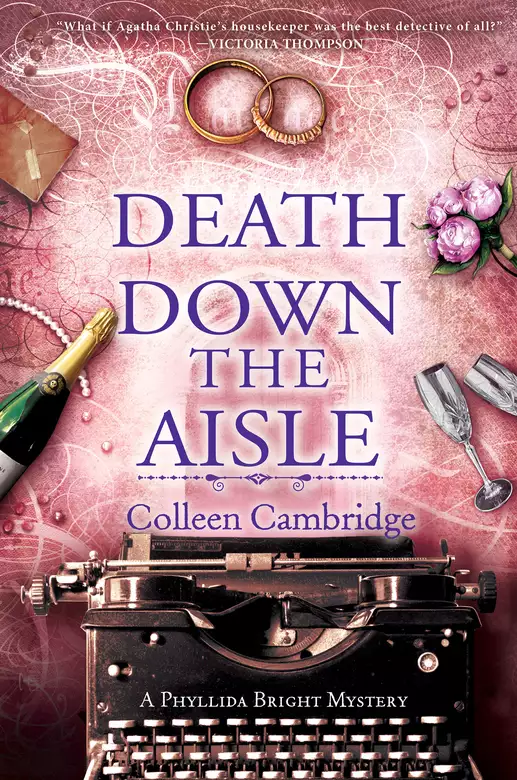
Agatha Christie’s cherished housekeeper, Phyllida Bright, not only keeps the celebrated author’s home running smoothly, but she has also proven herself an accomplished sleuth. So when a murderer brings mayhem to a wedding, in this USA Today bestselling series’ latest installment, she’s on hand to sweep up the mystery…
Phyllida is delighted to receive an invitation to the wedding of her friend Dr. John Bhatt. It’s a chance to get to know his fiancée, Emily Hartparker, and to explore Coatesworth Manor—the grand seaside estate that belongs to Emily’s distant relatives. Coatesworth is now managed by Lady Artemis Coatesworth and offers ample space for a celebration. But it’s soon clear that some of the guests have intentions beyond cheering on the happy couple.
As is often the case when extended family gathers, there is bickering, not to mention an awkward love triangle between Emily’s lovely cousin Lily, her handsome ex-husband Heath, and his new wife, Tibby. Besides that, some of the other cousins—all of whom are there simply to appease Lady Artemis, who has the power to enact a morals clause in her late husband’s will that could impact the heirs’ inheritances—don’t seem to get along. Discomfiting, certainly. Dramatic for sure.
And the drama gets infinitely worse when a wedding guest is discovered dead in the small chapel only hours after the ceremony.
Phyllida immediately agrees to help discover what happened, and brings some of her staff over from Mallowan Hall, Mrs. Christie’s manor house, for cover. But with plenty of dark secrets and ugly family dynamics, it seems the killer could be any one of the Coatesworths—and that killer is dangerously motivated to keep the grisly truth from being revealed . . .
Release date:
October 27, 2026
Publisher:
Kensington Books
Print pages:
272
* BingeBooks earns revenue from qualifying purchases as an Amazon Associate as well as from other retail partners.
PHYLLIDA BRIGHT DIDN’T HAVE ANYTHING AGAINST WEDDINGS. AFTER all, she’d had one of her own a number of years ago. However, the participatory Mr. Bright was now dead, and not the least bit missed, and she had no intention of repeating her mistake.
Nonetheless, she begrudged no one else the joy of planning a blessed union and celebrating their nuptials, and in this case, she was particularly fond of the groom (not to mention slightly relieved that he’d found his bride).
John Bhatt, the local physician in the village of Listleigh—which was the closest town to where Phyllida resided, managing the home of Agatha Christie and her husband, Max Mallowan—was to wed the charming Miss Emily Hartparker (for the second time) in less than two days.
Phyllida highly approved of this match, for Miss Hartparker was not only filled with common sense, but she also possessed a calm demeanor and thus far had proven herself one of the more practical brides Phyllida had ever encountered.
The truth was, there was a time when John Bhatt might have been considering wooing Phyllida to be his bride, which had put her in a difficult situation because, although she very much liked the man, she did not like him in the same way a woman should, should she decide to marry him.
The fact that John and Miss Hartparker had tumbled into love, very nearly at first sight, with the other was delightful to Phyllida because of his obvious happiness, as well as being cause for mild relief that she would not have to rebuff his affections. She much preferred to remain close friends with him (his medical expertise did, after all, come in handy when she was investigating a murder, which happened far more often than one would think), and nothing more.
Phyllida’s own affections had been thoroughly engaged as of late, a happenstance that both pleased and irritated her, since the object of said affections possessed not only a dry, ironic sense of humor and a sharp intelligence she appreciated, but also a rather annoying mop of a dog who found Phyllida irresistible.
The most trying part about this new relational development with Bradford, the chauffeur at Mallowan Hall, was keeping it a secret from the other staff. Phyllida did not want her maids spying on them, or standing about holding up walls whilst they gossiped about her and Bradford—or anyone, for that matter.
So far, she had succeeded in this endeavor and it was her intention to continue to do so.
But it wasn’t the activity of the staff at Mallowan Hall that currently occupied Phyllida’s attention. Her thoughts were focused on the chapel on the grounds of the expansive Coatesworth Manor, where John and Emily were to be married for a second time—having first been wed in John’s traditional Hindu faith during a trip to India.
The couple had kept their first wedding a secret so as not to offend her family by wedding in the Hindu faith first, and were about to celebrate their English nuptials here in the chapel where Phyllida and Emily now stood.
“I cannot thank you enough for helping us out, Phyllida,” Emily was saying as they stood in the small nave. Since they’d met several weeks ago, the two of them had quickly moved past the formality of titles and used each other’s familiar names. “John has told me how incredibly clever and organized you are, and with Mrs. Lentington having to travel to Wales to help her mother at the last minute, why, that just left us in the lurch.”
“Not at all,” Phyllida replied with a smile. “It seems to me that you’re hardly in need of my advice. You’ve got it all planned out, and I think the entire day is going to be quite wonderful. This is such a charming little chapel. The stained glass oriel over the altar is quite lovely.”
“Thank you, but I’m of the mind that it’s never a mistake to have a second set of eyes, and another clear mind assessing the situation,” Emily replied, clasping her gloved hands in front of her.
She was a bit younger than Phyllida, but not by much—perhaps in her mid- to late thirties, but it was difficult to tell her true age due to the smooth, creamy skin she possessed. Still, since she’d spent more than fifteen years at home caring for her fragile and ill mother, she certainly was no young ingenue. Her hair was walnut brown and her intelligent eyes the same color, with tiny gold flecks in them. One of her upper front teeth was slightly crooked, and this resulted in an imperfect but utterly winsome smile.
Emily’s mother, who’d recently died, was a distant relation to the Coatesworths, who owned the large, sprawling estate. Mrs. Hartparker, who lost both her parents at a young age, had grown up knowing the Coatesworth cousins, but not being terribly close to them. She had remained in the area, living in nearby Wenville Heath, once she wed Fred Hartparker, who died during the Great War. When Lady Artemis, the matriarch of the family, learned that the now-orphaned Emily was to be married, she insisted that the ceremony and celebration take place at the manor house.
“You are family, after all,” Lady Artemis had told Emily, who’d recounted the conversation to Phyllida. “And, sadly, much of the time I wonder whether you aren’t the most levelheaded of all my nieces and nephews.” Lady Artemis and her husband had not been blessed with children, and so they’d made their family with nieces and nephews and grandnieces and grandnephews.
“Lady Artemis can be rather intimidating and sometimes outright frightening,” Emily confessed to Phyllida, “but I brought Mama to visit her and Miss Eunice regularly, and read to them all sometimes, and it does seem she has some genuine affection for me. I continued to visit her and Miss Eunice—that’s her old friend who’s been living with her since Lord Kenneth died.”
“I can’t imagine why Lady Artemis wouldn’t have affection for you,” Phyllida said warmly. “It’s very kind of her to offer you to marry here. Now, remind me which flowers you’ve elected to have at the ends of the pews.”
“I just love peonies, and so I’m hoping for pink peonies and roses, with some alyssum and boxwood,” Emily said, her dark eyes sparkling. “And, of course, I’ll carry the same sort of arrangement and we will do the same on the altar as well.”
“That sounds lovely,” Phyllida replied. “With white candles and ribbons, and more boxwood as well?”
“Yes! That’s exactly what I had in mind. It’s only, I’m not certain the peonies will still be in bloom. It is getting late in the year and the ones at my cottage are in full bloom right now, and many are starting to droop. I don’t know if I’ll have enough of them left to use in two days.”
“I was just walking in the gardens at Mallowan Hall earlier today. The peony blossoms there are very squishy, so they’re ready to bloom any day now. I’m certain Mrs. Christie”—she referred to Agatha by her more familiar name than her official married one—“won’t mind if Amsi, that’s our gardener, cuts them for you. She is quite fond of John, you see, and she and Mr. Max left to visit friends in Torquay this morning for the week, so they won’t be here to enjoy them, anyway.”
“Oh, that is so kind of you, Phyllida. It’s not as if the wedding wouldn’t be beautiful if it were only hothouse roses, but I just love the smell of peonies.”
“We have plenty of them at Mallowan Hall,” Phyllida assured her. “Although some are white and others are pink—if you don’t mind the mix of color.”
“That will be beautiful,” replied Emily, her eyes lit with pleasure. “My frock is a pale pink.”
“I’m sure it’s lovely on you, and I look forward to seeing it. I shall advise Amsi about the arrangement, and I’ll bring the flowers with me when I come tomorrow.”
“Speaking of tomorrow,” Emily said, grimacing a little, “and the day of … Oh, Phyllida … it’s just that with Mrs. Lentington gone home—she’s Lady Artemis’s secretary, you see—there’s no one to … well, to actually manage everything the way I was hoping it would be. There is the housekeeper-cook here at Coatesworth, of course, Mrs. Beasley, and she’s quite capable, but she’s only managing the household and guests, not the wedding, and the dinner will be much bigger than she’s used to, and all of that. I wonder …” She drew in a deep breath and exhaled, giving Phyllida a nervous look. “I know you are attending the wedding as a guest, but I wonder if it’s possible I might prevail upon you—John and I, I mean to say—to perhaps just keep an eye on things during the day? It would mean so much to me to have a person such as yourself be the point of contact if anyone has any questions or can’t find something, or—”
“Or if something goes wrong,” Phyllida said with a smile. “Of course I’d be more than pleased to help you out in that way, Emily. To be honest, I find it difficult to simply sit back and enjoy events, because it’s part of my nature to want to make certain things move on smoothly, and so it would be no hardship whatsoever for me to keep an eye on things, as you say. Truly,” she said, giving the bride a quelling look. “You may consider it a part of my wedding gift to you and John.”
“Oh, Phyllida, thank you so very much. John insisted I ask you, but … well, a man can be rather dim about things sometimes, can’t he? It’s only that he knew I was so worried about things, especially with my cousins and the awful situation there, that he insisted I ask you—or he threatened he would do it himself, and I daresay he would have rather mucked it up—the asking, I mean.” She gave a little laugh. “I do love him dearly, Phyllida, but—”
“But he is, after all, a man, isn’t he?” Phyllida grinned, nodding. “I completely understand, and I’m very glad you asked. It would give me great pleasure to take that bit of anxiousness off your shoulders. You ought to enjoy your day and worry about nothing.”
“Thank you, and now I promise to stop saying it,” Emily said quickly, for she must have noted Phyllida’s leveling look meant to silence any more fawning. “I should warn you, however, that it’s not so much the actual wedding and dinner that I’m concerned with. It’s my relatives who will be attending—the Coatesworth cousins. They—well, some of them—don’t get on. And there’s a terribly awkward situation as well.”
“Perhaps we should sit down for some refreshment, now that we’ve finalized the plans for the chapel, and you can tell me all about the potential pitfalls,” Phyllida said. “Forewarned is forearmed.”
“That’s a wonderful idea. We can sit on the terrace and I shall ask Mrs. Beasley to bring us some tea, even though it’s a bit early for it. And before you leave, I really must introduce you to Lady Artemis. I suspect you and she would get along grandly.”
Phyllida smiled, but she did wonder if Emily thought she and the lady of the manor might get on so well because they were both intimidating. Even so, she wasn’t insulted by the implied comparison; Phyllida would far rather be intimidating than a sopping-wet doormat, as far too many women tended to be.
The terrace at Coatesworth overlooked the grounds, and the chapel was nestled just out of sight from a winding path and in a small knoll to the south. The tiny church had been built in the fifteenth century for the convenience of the Coatesworth family, who preferred to worship and pray on their grounds rather than travel all the way into the village. Of course everyone was welcome to attend services in the chapel. Whether it had originally been a Catholic chapel was unknown to Phyllida, and she saw no reason to ask. It didn’t matter, and it was certainly now habituated by clergy of the Church of England.
“The vicar from the church in Wenville Heath will be saying the service,” Emily explained as Mrs. Beasley poured their tea.
Phyllida, who was far more often on the other side of the teapot, pouring and serving for Agatha and her guests, was nonetheless perfectly comfortable being the recipient of such attention.
Though the Great War was long over, its effects still lingered—one of which was a growing softening of the distinction between classes. Phyllida herself was a servant—albeit a high-ranking one—but she had not “come up” in service, and thus moved easily between the roles of housekeeper, detective, and friend and confidante to those in the upper class. Such qualities had served her well as she investigated the murders that tended to occur in her proximity.
The two women chatted about the flower gardens sprawling about the terrace until Mrs. Beasley went back into the house.
“Now, tell me all about what is concerning you, Emily,” Phyllida said, selecting a tiny pecan tart, a smoked salmon crostini, and a small triangular egg salad sandwich.
“Well, first of all, I ought to tell you that everyone who is coming is rather a hodgepodge of people! I wouldn’t have the nerve to invite them at all, but Lady Artemis insisted. Most of my cousins do come for a visit in June every year, and it so happens to coincide with the wedding. And Lady Artemis has been so generous and kind about offering up the house …”
“Of course you couldn’t demur,” Phyllida said.
“Indeed. It’s only that it is going to be quite awkward with a number of—well, they’re almost strangers now, Phyllida, to be honest. I’ve not seen some of them for years.”
“You mentioned an awkward situation?”
“Right. Yes. One of the people who will be here—Lily Wentworth. Or, she was Lily Wentworth until she married Heath Blanton. Do you know him? The actor? He’s Lady Artemis’s great-nephew from Lord Kenneth’s sister’s son. Heath’s only just finished filming a movie, oh, somewhere on the Continent.”
Phyllida frowned. “I’m more familiar with West End stage actors than film,” she said, thinking of her recent trip to London and the alphabetical murders that had taken place in and around the theaters there, “but the name does sound familiar.”
“Heath has done some stage work, but he’s doing more film. Anyhow, he’s taking a break between projects,” Emily went on. “I knew him—and Lily—when they were younger. They’re all eight or nine years or so behind me, you see, so I didn’t go round much with them and Rodger, one of the other cousins, but, of course, I knew them all.
“Lily’s the stepdaughter of one of Lady Artemis’s much younger brothers—Timothy, who died in the war. She was practically raised here, even though she’s not really a Coatesworth. Anyhow, Heath and Lily and Rodger were thick as thieves when they were growing up. No one was at all surprised when Heath and Lily married—it must have been about five years ago. They’ve been inseparable forever.”
Emily frowned a little from some unspoken memory, then went on. “Anyhow, Heath and Lily divorced just last year. The thing is … he’s going to be here. With his new wife.”
“Ah.”
“The worst part about it,” Emily went on, looking miserable now, “is that Heath’s new wife is—was—a friend of Lily’s.”
“Oh my,” said Phyllida, feeling her friend’s pain. “That is awkward.”
“Right.”
“Did the … er … split-up happen because of the friend? Or did that happen after?” Phyllida asked. In general, she felt that indulging in gossip was unbecoming to a person, but there were times when it was instructive to know all of the details—unpleasant or salacious as they were—in order to navigate social situations. Or to investigate murders, where gossip was often instrumental to determining motives—but, of course, there was no murder in question here.
She ignored the little voice in her head that said, “Yet.”
Just because she’d stumbled upon a number of dead bodies over the last several months—and had been called upon to investigate others due to her experience in such matters—did not mean she was destined to encounter homicide wherever she went. It wasn’t as if it were contagious.
“I’m not certain. What I mean to say is, Tibby—that’s the new wife’s name—did know Lily. They all vacation at the same place in Nice. Some fancy hotel on the sea. They all go to the Mediterranean in the winter, that group—the Coatesworths, I mean. All of the cousins: Heath, Rodger, and, I suppose, Cynthia—she’s the last cousin—and her husband too. And Lily as well, of course—when she was married to Heath, anyway.” To her credit, Emily didn’t have any sort of inflection in her tone that suggested envy or even the sense of not being included. “I don’t know whether Heath decided to divorce Lily because he fell for Tibby, or if he and Lily were already on the rocks and he got together with Tibby after. I do know that it’s going to be very awkward with the three of them here. I do hope they all … Well, I hope they’re civil.”
“I’m certain no one wants to ruin your wedding, Emily. Of course they’ll be civil. Do forgive me for saying, but Lily must be very close to you to be willing to attend the wedding, knowing her ex-husband will be here with his new wife,” Phyllida said with an affectionate smile. “That says much of Lily’s esteem for you. But why is Heath insisting on attending? Are you that close to him as well?”
Emily shrugged and spread her hands. “To be truthful, I’m not that close to any of the Coatesworths—and I include Lily in that group as well. I suspect it’s because Lady Artemis invited them, and none of them dare decline an invitation from her. Especially the ones who are remembered in her will—rather, Lord Kenneth’s will,” she added with a quirk of her brow and a knowing smile. “And they all are.”
“Ah, yes, of course,” Phyllida replied. Some people, she’d learned, would do just about anything in the name of money—including murder.
Attending a wedding with one’s new wife when the ex-wife was present could be considered only a minor inconvenience if a significant amount of money was involved.
“Then one would assume they’ll all be on their best behavior.” She patted Emily’s hand. “And if they aren’t, well, I shall take them to task.”
“I truly do appreciate it, Phyllida. I’m so very glad you and John are friends … and that you and I have become friends as well.” Emily looked at her, tilting her head a little, seeming to probe her with her gaze. “If you don’t mind my saying, Phyllida … I do hope I can be candid … but I must ask whether you … er … had any, well, I shall just say it—were you upset at all about John and me? I mean to say, I understand that the two of you were … close.”
“Not at all,” Phyllida replied firmly. “Not in the least. I am quite fond of John, but I have never had any sort of romantic feelings toward him, and I’m so very happy that you and he have found each other. Truly. You needn’t worry about the possibility of me making up the third part of a tragic love triangle. I suspect the one with Lily, Heath, and Tibby will be quite enough.”
“I was fairly certain, but I had to ask,” Emily said. “And you’ve guessed the reason why—I suppose I was just feeling conscious about the love triangle with my cousins and it made me worry too much about it all.”
“You’ve plenty to worry about without creating things to be anxious over,” Phyllida told her. She looked at her wristwatch, a relatively new piece of jewelry of which she’d become quite fond. It was a dainty gold thing with a hexagonal face, and it informed her that it was nearly half past two. It was well over an hour’s drive to Mallowan Hall, and Bradford ought to be here with the Daimler any moment now to drive her back. “I’m confident everything will go off just wonderfully in two days.”
“Of course. And it’s time for you to get back to your other responsibilities.” The practical and sensible Emily rose even before Phyllida had made the overture to leave. “Thank you again, and I’m sure I shall see you before then.”
“Quite certain of that. And might I add that I am very much looking forward to you moving to Listleigh, where you and I can have tea and visit as often as possible.” Phyllida realized as she said this that it was very true.
While Agatha was her dear friend and confidante, she was often traveling with Mr. Max or for her books, and she also spent most of her time ensconced with her typewriter, along with Poirot and Marple and Battle and other detectives.
Phyllida realized that she didn’t really have a close female friend, and that was something she hoped would develop with Emily soon-to-be Bhatt.
“Oh, Phyllida, I feel exactly the same way!” Emily’s eyes filled with tears as she reached over to touch Phyllida’s forearm. “It’s just that I don’t have really any close friends. I was so busy caring for Mum for all those years, I never had the chance to socialize. It’s rather a miracle I met John the way I did—that is, when he came to see her while our regular doctor was on holiday—and that we fell in love. I think that’s why Lady Artemis was so intent on having all the cousins be here for the wedding. So I wouldn’t feel alone or abandoned.”
“She seems a very kind woman,” Phyllida said as she and Emily started back inside. “I look forward to making her acquaintance tomorrow.”
Mrs. Beasley met them just inside the doorway. She was a large, capable woman of fifty, with iron-gray hair and a square chin. “There is a gentleman in a Daimler here for you, Mrs. Bright.”
While Phyllida would probably not describe Bradford as a gentleman, she knew he did sometimes come across as particularly charming—especially to older women. And to younger women, to be fair. They all thought he was terribly winsome and gallant, and he was … when he wanted to be. And he could also be a literal gentle man, as well as a passionate one, and why on earth was she thinking along these lines? Good heavens. One would think she was a besotted teenager.
“Thank you,” Phyllida said, then turned and did something she rarely did: offered an embrace to Emily. “Your wedding is going to be wonderful, dear, and I am looking forward to celebrating with you and John.”
As Phyllida came out of the front of Coatesworth Manor, she found Bradford standing next to the Daimler, waiting for her.
To her surprise and mild consternation, however, he wasn’t waiting for her in order to open the passenger side door, but at the rear one, behind the driver’s seat.
“Good afternoon, Bradford,” she said in a tone that was a mild question.
“Hallo, Mrs. Bright,” he said in that dry, ironic manner he used purposely, she thought, to nudge at her. The fact that he continued to refer to her by her formal title even in private—sometimes especially in private—was a source of both amusement and exasperation. Of course she wouldn’t want him to be informal in front of the staff, but when it was just the two of them it was quite unnecessary.
“I hope you don’t mind sitting in the back this time,” he murmured, sliding his hand down her arm, then slipping a quick finger beneath the cuff of her glove for a little stroke on her skin. “But Kitty here has even more trouble with feeling ill in a motorcar and she’s already feeling a bit ill.”
Kitty?
Phyllida hid her surprise and confusion and slid into the back seat of the Daimler, where, to be fair, she had ridden equally as often as in the front before she and Bradford had become … well, involved.
Was he speaking of a pussycat? She was a great lover of felines—she had two of her own—but if one were to measure Bradford’s choice of pet by the drooling, leaping, barking Myrtle, she wasn’t certain his selection of a cat would be tolerable.
Kitty was not a pussycat.
She was a young woman. Younger than Phyllida by quite a lot. She was twenty-three, certainly no more than twenty-five, if she was a day. She was a slender blond thing, with a narrow nose and a chin and throat that had not yet begun to soften.
“Oh, you must be Mrs. Bright,” she gushed, turning around to look at her. She had blue eyes, bright like cornflowers, with patently false lashes on them. “Josh has told me all about you. Do you really solve murders? Why, that’s fascinating and rather terrible, one would think.”
“It is rather terrible,” Phyllida replied in a mild tone that did not, in any way, suggest the ma. . .
We hope you are enjoying the book so far. To continue reading...

 Please log in to recommend or discuss...
