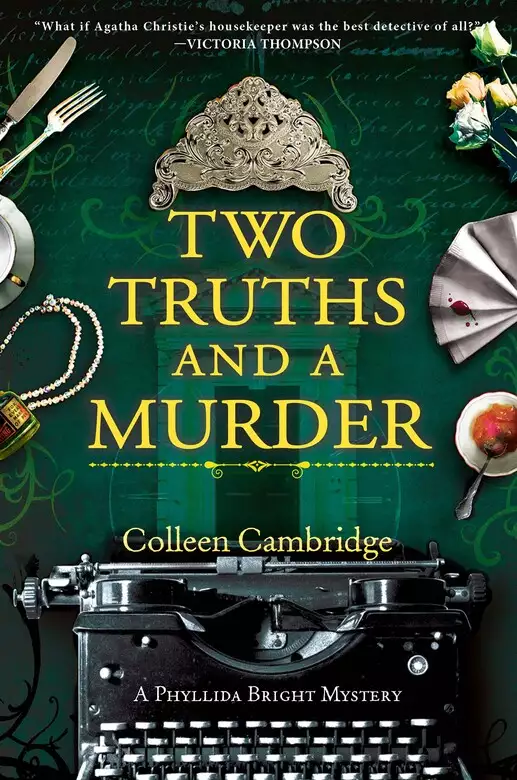
Agatha Christie’s trusted housekeeper, Phyllida Bright, has become an amateur sleuth in her own right, using her little grey cells to solve crimes. When a party game leads to murder, she decides to crash the investigation in this latest sparkling mystery from Colleen Cambridge.
While her famous employer is happily back home at Mallowan Hall, wrestling with her Belgian detective’s dilemma on board the Orient Express, Phyllida is finding her local renown as a sleuth has put her in high demand. A distraught Vera Rollingbroke suspects her husband of infidelity and has invited Phyllida to a dinner party to observe his behavior, particularly in regard to one Genevra Blastwick.
What she does observe at the party is that Genevra craves attention, in contrast to her shy sister Ethel. Genevra introduces a game called Two Truths and a Lie, and one of her questionable statements is that she once witnessed a murder. At this bold claim, the guests react with disbelief and pepper her with questions. Genevra remains cagey, withholding details, but insists this is not her lie.
The next morning Phyllida learns poor Ethel was purposely run down by a motorcar the previous night while inexplicably walking home alone from the party. She fears Genevra may have been the target, which means someone at the party is a killer—twice over. A chilling thought. With Genevra in potential danger—and Inspector Cork proceeding ponderously as usual—Phyllida takes it upon herself to unmask the killer. With two murders to solve, she will need to grill Genevra and the guests as well as re-examine any past sudden deaths or disappearances. And if she’s smart, she’ll look twice before crossing the road . . .
Release date:
October 28, 2025
Publisher:
Kensington Books
Print pages:
272
* BingeBooks earns revenue from qualifying purchases as an Amazon Associate as well as from other retail partners.
She happily and deftly managed Mallowan Hall—the large home of Agatha Christie and her husband, Max Mallowan, located outside the village of Listleigh, in Devon—but she also had a number of hidden talents, including the ability to pick locks, climb into a second (or third, when necessary) story window, and sense from two floors below when her housemaids were holding up the wall and gossiping instead of holding up their feather dusters and employing their mops.
And she had lately come to realize she had a knack for solving murders.
Aside from this recently discovered penchant to follow in the footsteps of the fictional Tuppence Beresford, Bundle Brent, and others, Phyllida, who’d been friends with Agatha since the Great War, was also the recipient and keeper of a number of secrets. Not only her own secrets—and there were many—and those of her employer, but also those of a number of other people—both famous and infamous, in the highest levels of government, of the wealthiest of the wealthy, and even of the lowliest servant in the grandest of homes.
For some reason, people tended to think of Phyllida as a sort of impervious cistern of information and confidences … as well as a sage of wisdom for advice and pragmatism.
And that, Phyllida could only conjecture, was why she was currently sitting in the front parlor at Mallowan Hall with Mrs. Vera Rollingbroke—who was married to the wealthy and affable Sir Paulson Rollingbroke, better known as Sir Rolly.
Mrs. Rollingbroke was an attractive woman in her early thirties with an air that sometimes bordered on birdbrained. Yet Phyllida had come to discern a subtle layer of shrewdness in the younger woman’s mien. And, she knew, the woman’s skill in writing detective stories seemed to have improved over the last two months … possibly because Mrs. Rollingbroke had been involved—on the periphery at least—with some of Phyllida’s murder investigations.
But the two of them had been sitting here for more than ten minutes discussing the weather and little else, and Phyllida was still mystified as to specifically why Mrs. Rollingbroke would have requested a private meeting with her at Mallowan Hall. Although Phyllida was a high-ranking servant who had an unusually familiar and egalitarian relationship with her employer, she was still, after all, a servant in the eyes of everyone else.
“I do appreciate your meeting with me, Mrs. Bright. May I call you Phyllida?” said Mrs. Rollingbroke as she leaned forward, her voice low as if in confidence. “I feel as if we’ve become friends over the last several months, you see.”
“Of course,” replied Phyllida encouragingly.
Mrs. Rollingbroke was wearing one of her extremely fetching hats. This one was dark red with a swath of netting over one eye and a jaunty bright red feather arching toward the back. Silk roses in shades of crimson, pink, and other similar hues were tucked in along the brim. As usual, Phyllida admired and mildly coveted the woman’s chapeau. Mrs. Rollingbroke, whose figure was slender and lithe, was always dressed in the most flattering and newest of fashions.
She had dark blond hair and vibrant blue eyes. Her features were nothing less than patrician, enhanced by the subtle employment of cosmetics. Her fingers were long and elegant, and studded with bejeweled rings. But today, they trembled ever so slightly.
“What can I do to help you, Mrs. Rollingbroke?” Phyllida asked in an effort to get the woman to come to the point. She might have an excellent group of maids in the kitchen and working in the parlors and upstairs chambers, but they still needed overseeing and supervision. And there were menus to finish so that Agatha could review and approve them, along with placing orders with the merchants for supplies and tending to the distillations in the back room—currently those of elderflower syrup and chamomile tincture. She had some cheque drafts to write for suppliers and other vendors, as well as some correspondence to complete.
Aside from that, it was a lovely day, and there was no need to avoid going outside to have her tea in the rose garden. Myrtle was gone with her master and would not be barking, leaping, or otherwise expressing her pleasure at seeing Phyllida.
“Please do call me Vera,” replied the other woman with a warm smile. Her eyes sparkled cornflower blue from beneath slender, carefully plucked brows. “After all, Phyllida, we got to know each other quite well during the terrible events of the Murder Fête.” The other woman gave her a meaningful look. “And at Mr. Wokesley’s … erm … Murder Party.”
“Ye-es,” Phyllida said, drawing out the word in an effort to encourage her to go on.
Mrs. Rollingbroke—Vera—gave her a little, uncomfortable smile and settled back into her chair. She was holding a cup of tea that, so far, remained untouched by her lips, as evidenced by the lack of red lipstick on its rim. The cup rattled a little in its saucer and a bit of pale, cream-laden liquid splashed over the top.
Then Vera leaned forward again. “I’d like to engage your services,” she said quickly, as if she’d had to force out the words before she lost her courage.
Phyllida blinked, hiding her surprise. “Why, Mrs. Rollingbroke, I’m quite humbled and honored by your interest in employing me, but I’m very happy here at Mallowan Hall with Mrs. Christie. I truly have no intention—”
“Oh, no, not at all. Not those services, dear Phyllida. But the other … erm … I mean to say, your investigative services. You see”— Vera leaned forward even further, her voice dropping lower, her wan smile fading—“I … I need you to find out something for me. To—to investigate s-something.”
“And what is that?” Phyllida replied, intrigued in spite of herself. As much as she did enjoy her position here at Mallowan Hall— despite Mr. Dobble and his persnickety, nosy ways—she also found crime scene investigation quite stimulating and a trifle more challenging than overseeing a passel of well-trained servants.
Here Vera’s courage wilted. “It’s simply … oh, dear, I can’t … why, I-I …” To Phyllida’s surprise, the other woman’s eyes suddenly filled with tears and she blinked rapidly, setting down the teacup with an alarming clatter as she moved to fish a handkerchief from her pocketbook.
“What is it, Mrs. Rollingbroke?” Phyllida’s impatience with nonsensical babbling ebbed in the face of such emotion. “What’s wrong?”
“It’s—it’s Rolly,” she said tearfully, barely above a whisper. “I think … I’m afraid … I b-believe … oh, Phyllida, I’m quite certain he’s h-having an affair.” Mrs. Rollingbroke dissolved into quiet sobs as Phyllida took in this shocking information.
Her immediate reaction was to flatly decry such a possibility. She’d witnessed Sir Rolly’s affection and and regard for his wife many times. Even during Mrs. Rollingbroke’s silliest and most vapid moments, he’d doted on her without being impatient or, more importantly, condescending. It was obvious at least to Phyllida that Sir Rolly loved his wife.
That didn’t mean, of course, that he hadn’t strayed from his marriage vows. Many men were of the belief they could have a wife and a mistress, in some cases having deep regard for both of them. Still. Sir Rolly simply didn’t seem the type.
“Tell me why you think this, Vera,” she said, using the woman’s familiar name even though it felt odd to do so.
“He’s—well, I’ve caught him speaking on the telephone and his voice suddenly goes very quiet when I walk into the room. Or he hangs up abruptly. And I … well, he got all queer the other day when I mentioned Genevra and Ethel coming to my dinner party.” Vera’s face had acquired a slight greenish cast. “You see, I—I think it’s Genevra. The other woman.”
“Genevra? Do you mean Miss Blastwick?” Phyllida said, successfully hiding her surprise.
She didn’t know Genevra Blastwick—or her sister Ethel for that matter—all that well, but she’d certainly encountered her at some of the social events in Listleigh. The daughters of a retired professor of anthropology, they were in their late twenties and unmarried. They spent much of the year at their family’s small manor house called Ivygate Cottage, just a few miles outside of Listleigh. The cottage was conveniently located near a significant earthen depression, where Dr. Blastwick apparently spent many happy hours digging in the dirt, hoping to find the next Stonehenge. Apparently, an old Roman coin had been unearthed in a plow furrow some years ago, leading Dr. Blastwick to believe there was more to uncover.
While Genevra was the more attractive of the sisters, as well as the more outgoing and friendly of the pair, she struck Phyllida as a sort of self-involved braggart. Unlike Vera Rollingbroke, who could be scatterbrained and chatty, but was also warm and kind, Genevra had a desperate edge to her personality—as if she was always trying to steal the scene or to one-up those around her.
All that was to say, if Sir Rolly was indeed enamored with Genevra Blastwick, Phyllida could not imagine what was the attraction other than her obvious physical attributes.
“I think it’s her,” said Mrs. Rollingbroke, clearly unconcerned by the rules of proper grammar. Fortunately, she took more care with those rules during her story writing.
“I see.” Phyllida lifted her own teacup and took a sip as she collected her thoughts. “And you would like me to … do what, precisely, Mrs. Rollingbroke?”
“Vera. Oh, do call me Vera. I simply can’t abide knowing that someone who calls me Mrs. Rollingbroke knows that I’m a—a cuckold! It’s the sort of thing one would prefer to keep between friends, you see, Phyllida. You do see, don’t you?”
Phyllida nodded. “Yes, of course.” Having never been a cuckold herself, she had to take the other woman’s word for it.
“Right, then. What I want you to do is to find out whether … well, whether I’m correct. Whether Rolly”—her voice broke momentarily—“is—is having an affair with Genevra Blastwick.”
“Do you want me to find out whether he is having an affair with Genevra Blastwick, or do you want me to find out whether he is having an affair … at all?” Phyllida asked.
“I want to know,” Mrs. Rollingbroke—Vera—said, looking at her with blazing but sad blue eyes, “I want to know all of it. If it’s her or someone else. But I’m certain it’s her.”
“Why are you certain it’s Miss Blastwick?”
“Because she is always giving him those looks. Those languishing, ‘take me away’ looks. And she laughs so very hard at all of his jokes.” She dabbed at her eyes. “I love Rolly, Phyllida, I truly do— there is no other man for me—but the truth is, his jokes are often not very funny. In fact, sometimes they are quite painful. I do chuckle at them most times, and I tell him how amusing he is— but I’m his wife. You see?”
“Quite,” Phyllida replied, for she did see. In her experience, men required efficient and careful handling.
“And I was in Pankhurst’s last week, it was, giving Myrna Crestworthy my condolences—tragic, that, about the poor chap; he was Rutherford’s secretary I believe—and Genevra came into the shop. She was ever so polite, but when she stopped to speak to us, she had this—well, this smile. Like she had a secret and she was daring me to guess what it was.” She gave a little shudder, her lips quivering, her eyes blinking rapidly. “I think that is when I became certain, you see, Phyllida. It was the way she looked at me. That catlike, sly way.”
Phyllida made a quiet sound of consolation. It certainly sounded as if Mrs. Rollingbroke had reason to wonder.
“I want you to attend a little dinner party I’m giving on Monday night,” Vera went on, suddenly the brisk society lady. “Genevra and Rolly will be there, of course, and I want you to observe them and see what you can find out.”
Phyllida’s brows rose. “Monday night?”
“I’ve invited Mrs. Christie as well,” Vera explained. “She hasn’t said whether she’ll attend, but I do hope you will, at least. It’ll be the perfect opportunity for you to observe them. Rolly and Genevra. And I’ll be so busy playing hostess that it’ll give you the chance to … well … to see what happens when—when they think I’m busy and not paying a-attention.” Her voice choked up and she lifted the handkerchief to her eyes again.
“I’ll have to speak with Mrs. Christie about the situation,” Phyllida said. “Monday is not my usual night out. But I’m certain I can arrange to be there considering the circumstances, even if Mrs. Christie is not. She’s rather soft-hearted when it comes to my investigations.”
“Oh, thank you, Phyllida! And I shall thank her too, of course.” Vera reached over and took up Phyllida’s hands in hers, squeezing them tightly. “Thank you so much. I do hope … I do hope I am proven wrong,” she said unsteadily. “But if I must learn the worst, then I shall have to gird myself and buck up. Stiff upper lip and all of that. I can put the pain into my writing, I suppose,” she said, dabbing at her eyes. “That’s what writers do, isn’t it? They inject the pain and sorrow from their lives into their work. It makes the stories more authentic.”
Phyllida could only nod, knowing it was best if she held her tongue. Vera Rollingbroke wrote short crime stories featuring a young and wealthy society woman nicknamed Biscuit—whose original nickname, Bunty, had been noted as too similar to Mrs. Christie’s intrepid “Bundle” Brent, so it was changed. Biscuit solved mysteries and conducted investigations with the help of a long-haired cat named Mrs. Cuddlesworthy. A cat who, apparently, talked.
Phyllida was uncertain what sort of sorrow and pain would be included in such fanciful stories. She expected she would never have the courage to read them, as the inauthenticity of a talking cat was a cause of great agitation for her.
“I do appreciate it, dear Phyllida,” Mrs. Rollingbroke said, releasing her hands and rising. “Oh, heavens! I almost forgot to tell you.” The tension disappeared and her eyes sparkled once more as she clasped her hands to her breast. “I’ve just heard from an editor at The Queen. He’s interested in reading some of my Biscuit stories!”
“Why, that’s wonderful!” Phyllida said with genuine enthusiasm and, to be honest, a flare of surprise. “Congratulations!”
The Queen was a women’s society magazine that had been started by the husband of the great Mrs. Beeton, whose tome on household management was the bible for any wife or housekeeper. Phyllida had the latest edition of the book—which was five inches thick—sitting on her desk at this very moment, for she was reviewing the process for distilling elderflowers into a sweet liqueur.
Mrs. Rollingbroke’s smile faltered a little. “It’s only that I’m so nervous about it. I have to send three of them, and what if he doesn’t like any of them? I haven’t even told Rolly about it, you see, because … well, because.” Now the smile fled.
“Quite understandable,” Phyllida replied, patting the other woman’s hand. “I do hope you have good news from the editor. It would be quite a success to have one’s stories printed in The Queen.”
“It’s not about the money,” Mrs. Rollingbroke went on. “I mean to say, I feel that receiving money for one’s writing is at least some measure of success … but it’s only that I just hope for Biscuit and Mrs. Cuddlesworthy to find an audience. You see?”
“Indeed. I hope they find an appreciative audience” (whoever it was) “as well.”
“Thank you. Your encouragement means quite a bit to me.” She stood, giving Phyllida a hopeful yet sad look. “I’m so very glad you are willing to help me about this … the problem with Rolly. The truth is, I’m placing all of my trust in you. You’re just ever so capable. Thank you once again.”
Phyllida walked with her to the door and waved her off as she went down the steps. Just as Mrs. Rollingbroke climbed into her sporty Excelsior, another motorcar trundled up the drive.
It was not the Mallowans’ Daimler, Phyllida noted, squelching what was absolutely not a tiny flicker of disappointment. Not at all. It was relief that had caused her belly to give that subtle lurch.
Bradford—the Mallowans’ chauffeur—and his impertinent dog, Myrtle, had not driven back to Listleigh with the rest of the household staff when they returned from London several weeks ago. Man and dog had merely dropped them at the railway station in London and not been heard from since.
Therefore, Phyllida had had several weeks of calm and quiet, uninterrupted by barking and leaping and soulful canine gazes, not to mention unwanted verbal masculine commentary and all-too-knowing sidewise looks.
She had no idea where Myrtle was and why she hadn’t yet returned and she certainly hadn’t asked the whereabouts of the dog and her master. Although Agatha had returned a few days after Phyllida, Mr. Max had remained in the city due to some arrangement with the British Museum whereby he was cataloging a small collection of pottery fragments or whatnot from some recent bequest, but it wasn’t necessary for him to have the Daimler or a driver in the city. He hadn’t even kept Elton, his valet, with him— to the delight of the housemaids, who were all sweet on the handsome valet.
Phyllida might not know where Myrtle was, but she certainly knew what the wild little beast was doing: attempting to ingratiate herself with the cook at whatever locale she and her master were staying, barking at every leaf, squirrel, wheeled conveyance, or bee that happened by, panting loudly and damply whenever possible, and attempting to climb into the laps of anyone who might be sitting.
The canine seemed to prefer the laps of females, if her attention to Phyllida was any indication. Phyllida suspected that was due to the fact that skirts provided a more comfortable hammock than trousers, which was certainly understandable.
The arriving vehicle came to a stop and Phyllida noted that it was a basic, elderly lorry that probably didn’t go any faster than five miles per hour. On the side of one of the doors were painted the words HATTEN’S DELIVERY SERVICE. The person who climbed out wore the cap of a courier but moved with the deliberateness of one who was aging as he went around to the boot of the vehicle that still rumbled quietly in place.
Phyllida waited at the entrance as he opened the back of the lorry and extracted a crate.
It appeared to be a rather weighty object, not to mention ungainly, for the container was large enough that the delivery person couldn’t see around it as he carefully walked toward the steps leading to the front door.
Phyllida wasn’t aware of any delivery being expected for the household, but it was possible Mr. Mallowan had ordered some archaeological tool or had purchased an antiquity for his collection. Even so, it was a bit surprising that the crate was being taken to the front entrance and not to the rear where the staff and most deliveries went.
Noting the creaky sort of movements of the delivery person, she ducked back inside the house and quickly rang for one of the footmen. Mr. Dobble, who most often answered the door, would be useless in such a situation; he was very nearly as rickety as the deliveryman. Aside from his questionable ability to do so, the butler would never lower himself to conduct any sort of task that required physical exertion.
But to her surprise, Mr. Dobble followed Stanley, the head footman, when he came out of the front door.
“Do be careful,” snapped Mr. Dobble when Stanley hurried to wrest the crate from the deliveryman.
Phyllida looked at the butler, whose attention was fastened on the box with the same unwavering attention Myrtle’s would be on a ham bone being dangled in front of her.
“Inside, and take care I said!” Mr. Dobble gestured sharply toward the door, watching Stanley like a hawk.
It was only then that Mr. Dobble saw Phyllida standing at one side of the wide porch; his attention had been so focused on the delivery that she’d escaped his notice.
“Mrs. Bright,” he said stiffly as he stepped inside. “I suppose you find it necessary to greet every delivery person now, do you?”
Phyllida lifted her brows, following him into the foyer. “Not at all, Mr. Dobble.” And because she sensed he absolutely did not want to acknowledge the fact that he had rushed to the door to greet Mr. Hatten’s delivery, she went on. “But what a very large and intriguing package that is. And heavy—not to mention fragile—if your reaction is any indication. A person might begin to wonder what’s inside.”
Mr. Dobble’s eyes narrowed. “One might wonder if one had a habit of sticking one’s pointy nose where it didn’t belong.”
As Phyllida’s nose was indeed a trifle pointed, charmingly so (as she’d been told), she had no doubt to whom he was referring. “I suppose it must be for Mr. Mallowan. A collection of bones or skulls or pottery, perhaps. Surely Stanley can manage to deliver it to Mr. Max’s office without supervision.”
She smiled pleasantly at the footman, who stood there holding the cumbersome crate as he watched the two of them uncertainly.
Mr. Dobble looked as if he’d just swallowed a very tart lemon. “The delivery is not for Mr. Max.”
“For Mrs. Agatha, then? Copies of her new book, perhaps. Stanley, if you would please take it up—”
“The package is mine.” Mr. Dobble’s voice was so cold she practically felt her nose go icy at the tip. “This way.” He whipped out an imperious hand, pointing down the hall toward his pantry.
Phyllida watched the two of them go, with Stanley nearly staggering down the hall with his burden and coming far too close to a candelabrum on one of the side tables as he did so. The poor boy couldn’t see around the crate, and—
Crash!
There went the tall blue and white vase Mr. Chesterton had given Agatha after the Murder Fête. Ginny, the parlourmaid, rushed from the study, feather duster in hand, but Mr. Dobble didn’t even give Phyllida a glance of apology over the mess of shattered pottery, water, and strewn roses as he ushered Stanley into his pantry.
A mere second or two later, the footman rushed out and the door slammed shut so closely it bumped his heels.
“I’m sorry, Mrs. Bright,” Stanley said, looking abashed. “I’ll get it cleaned up right away.”
“Right then, of course you will. Ginny has already gone for a broom and mop. Thank you, Stanley.” She decided for now not to ask him any questions about what might have been in the crate. It wouldn’t do for Mr. Dobble to get even a suggestion that she was interested.
Because of course she was.
What on earth could the butler have had delivered that was so heavy and fragile and large?
Ah well. She’d find out soon enough.
“HOW PRETTY YOU LOOK! AND WHAT A SPLENDID FROCK THAT is!” said Agatha when Phyllida came into the front hall on Monday evening. “Did you get it in London?”
“I did,” Phyllida replied.
She had fallen in love with the material the moment she laid eyes on the dress. It was a soft, buttery yellow that looked well with her unusual rosy-reddish-blond hair. The fabric, which had splashes of large white and cream flowers over it, was light and airy. The skirt was cut on the bias, its hem rippling delicately about her ankles. It was perfect for a summer dinner party.
“I’m not the least bit ashamed to say that I spent some of the money from the Satterwaits on this dress, along with a tiny bottle of Chanel No. 5,” Phyllida said.
“And well you should have,” said Agatha with a fond smile. “I see no need for you to dress like a frumpy housekeeper when you are far much more than that. Incidentally, I did just receive the nicest letter from Mrs. Satterwait expressing her pleasure and relief over how you handled the incident in London, despite the delays with my new stage play.”
“That was very kind of her,” Phyllida replied. The last time she’d seen Mrs. Satterwait, the woman hadn’t been completely pleased with her. Phyllida had managed to expose her nephew’s killer, but her tactics had left Mrs. Satterwait a bit irritated. Still, she’d been paid a surprisingly handsome sum for her investigative work—even though Phyllida had mostly done it to help Agatha, who was friends with the Satterwaits.
“And now Vera Rollingbroke needs your help as well,” Agatha went on, giving her a knowing look. “I told you that your reputation would grow. I only hope I won’t lose you to full-time crime-solving, dear Phyllida.”
“Of course not,” she replied.
But Agatha looked at her closely, her head tilted. “Are you quite certain? Now that you no longer have the need to avoid London, you wouldn’t be required to stay tucked away here any longer … like me.”
“Not at al. . .
We hope you are enjoying the book so far. To continue reading...

 Please log in to recommend or discuss...
