
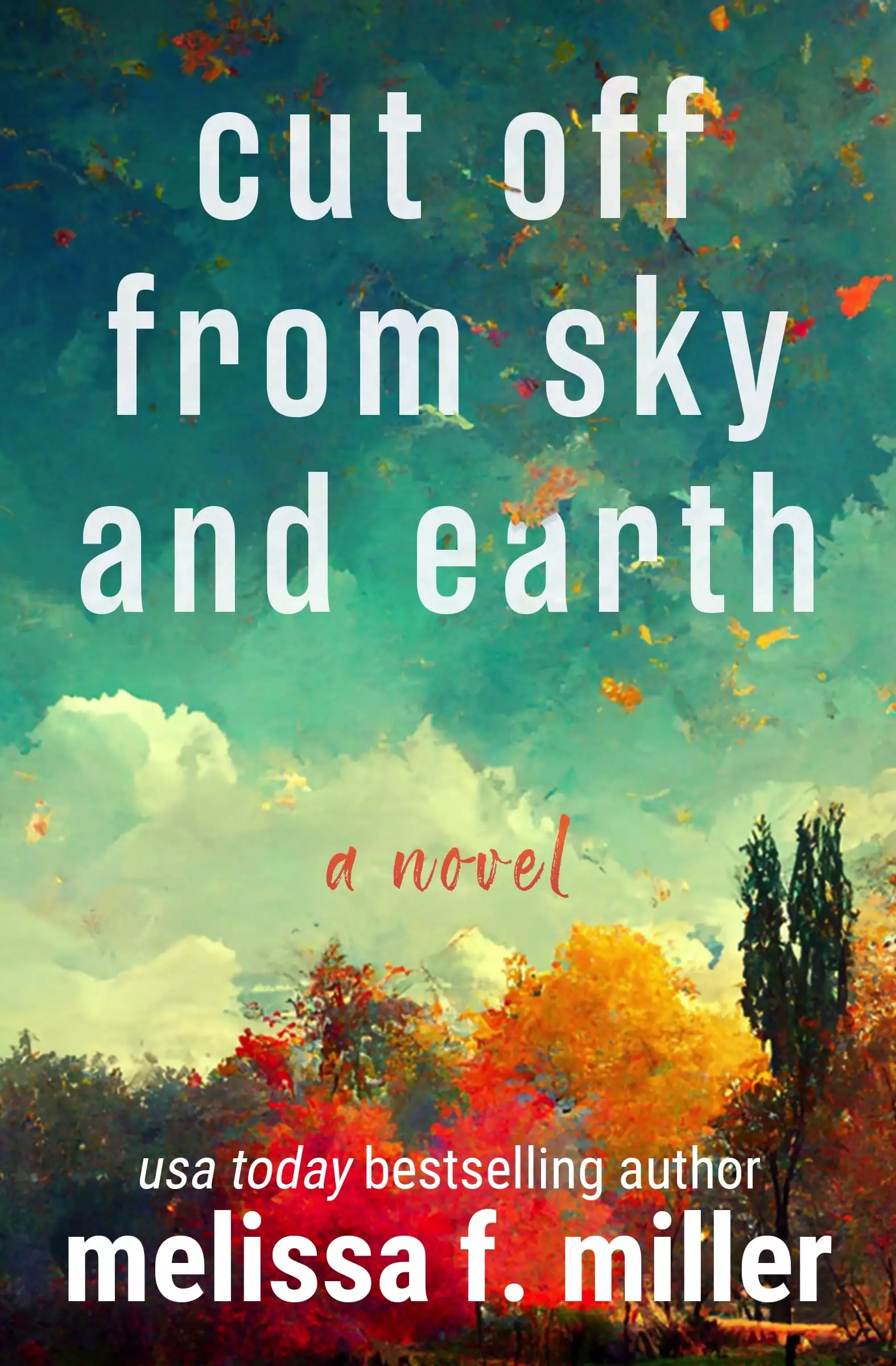
Cut Off from Sky and Earth: A Novel
- eBook
- Paperback
- Hardcover
- Book info
- Sample
- Media
- Author updates
- Lists
Synopsis
A feminist fairytale retelling becomes a real-life nightmare.
From USA Today bestselling author Melissa F. Miller comes a haunting psychological thriller about two women trapped by a storm, tormented by the past, and desperate to survive the present.
A stay in a remote cabin is supposed to help Emily Rose finish her book—a feminist retelling of a fairytale about a princess and her lady-in-waiting imprisoned in a tower. Instead, it becomes the setting for a reckoning seven years in the making.
Emily has spent years hiding her trauma from the night she found her roommate murdered. When her husband, Tristan, arranges a writing retreat for her, she meets Alex, the owner of the isolated property and a woman with secrets of her own—including one that could destroy Emily's marriage.
Trapped by a fierce storm and haunted by the brutal attacks that marked their pasts, a series of unnerving events—a watcher in the woods, a smashed cell phone, slashed tires—forces the women together to rescue themselves from a very real, present danger.
Interspersed with passages of The Tower, Emily’s work-in-progress, Cut Off from Sky and Earth is a chilling exploration of the weight of memory, the burden of trauma, and the courage it takes to break free.
For readers of psychological suspense, feminist thrillers, and literary mysteries with a dark fairytale edge.
Release date: September 2, 2025
Publisher: Brown Street Books
Print pages: 276
Reader says this book is...: action-packed (2) emotionally riveting (2) suspenseful (2) terrific writing (1) thought-provoking (2) unputdownable (1) dark (1) entertaining story (1) plot twists (1)
* BingeBooks earns revenue from qualifying purchases as an Amazon Associate as well as from other retail partners.
Reader buzz
 Please log in to recommend or discuss...
Author updates
Cut Off from Sky and Earth: A Novel
Melissa F. Miller
Part I. The Princess
There was once a King who had a son who asked in marriage the daughter of a mighty King; she was called Maid Maleen, and was very beautiful. As her father wished to give her to another, the prince was rejected; but as they both loved each other with all their hearts, they would not give each other up, and Maid Maleen said to her father, “I can and will take no other for my husband.”
—Maid Maleen, as retold by the Brothers Grimm
Maleen bit down on her lip, then implored her friend, “I’m right, aren’t I? I love him, and I can’t marry anyone but him.”
Ruth hesitated, torn between Maleen’s needs and her own. Of course, the princess should follow her heart and marry for love. Every woman—every person—deserved the freedom to do so. But. But what about Ruth’s freedom? What about Ruth’s agency?
Maleen knew as well as Ruth did that her refusal would enrage her father. But what Ruth suspected, and Maleen would never admit, is that her choice would have disastrous consequences for them both.
Ruth knew, and yet, as Maleen waited, her clear blue eyes anxious and unblinking, she sighed. “You make terrible decisions.” Then she grinned, “But you should do it.”
— The Tower, by Emily Rose
Chapter 1
Tristan
I’m parked behind the organic market located halfway between work and home, waiting for seven o’clock to roll around so I can pop open the video conferencing app on the tablet my wife doesn’t know I own to log in for my semiannual visit with the psychotherapist my wife doesn’t know I see.
Around the corner, the church bells at St. Agnes chime the hour, and I hit the meeting button. Right on cue, Dr. Wilde’s face fills my screen.
“Tate,” he says, “good to see you.”
Even though I’ve been using my brother’s name for these appointments for more than six years now, a frisson of shock runs through me every time the psychiatrist calls me Tate. I have to stop myself from looking over my shoulder to make sure my older brother isn’t looming in my back seat.
“The beard suits you, Doc,” I tell him.
He strokes his chin, pleased I’ve noticed. “I grew it during my last work retreat. I highly recommend it. I booked myself a cabin and managed to crank out three articles to submit for peer review. Really cutting edge stuff.”
I stifle a yawn and hurry to derail any discussion of his academic papers. “Take up any new interests since our last session?”
Mind-numbing academia averted. He gestures to the room behind him and says, “I’ve got a drum kit. I’m going to start hitting the sticks.”
Is hitting the sticks really slang for drumming? I have no idea, and I bet he doesn’t either, but I nod enthusiastically. He has a hip new hobby just about every time we meet, and he loves to recommend them to me. Over the years, he’s suggested I try Tai Chi, rock-tumbling, candle-making, and beekeeping, to name just a handful.
“Cool. I hope you have a soundproofed room,” I say, because he’s clearly waiting for me to respond.
He nods seriously. “I do. After I gave up my office space in town during the pandemic, I upgraded my home office to meet all the requirements for patient confidentiality—secure, encrypted file server, soundproof room, all the goodies. It wouldn’t do for Mrs. Appel in the unit next door to overhear someone’s session. So my treatment room doubles as a kickass music room.”
“Great.”
His concern about patient confidentiality and following the rules cracks me up but I keep a straight face. It was trivially easy to book my first appointment with him using a fake name. Apparently, if you walk into a psychiatrist’s office and say you plan to self-pay and not submit to insurance, they don’t ask a lot of questions. When I agreed to Venmo him the money for my sessions, he became even less interested in verifying my identity. I highly doubt he reports my payments as income to the IRS. In fact, I hope he doesn’t. If he ever finds out I’m not Tate, we’ll have a handy mutually assured destruction situation.
“How have things been, Tate?”
“Good. Work’s going well.”
“And your personal life? Seeing anybody special?”
“No, I’m not dating anyone,” I tell him.
It’s true. I’m not. Emily and I have been married for five years. We’re definitely well past dating. But our marriage is yet another secret I have to keep from Dr. Wilde. He’s also Emily’s psychotherapist, and neither he nor she knows I’m his patient, too. I’m pretty sure even Dr. Venmo would find it a conflict of interest to treat us both individually.
And I can’t risk having him cut one or both of us loose. It would be too disorienting, too upsetting, for Em. My singular goal is to shield her from harm, not subject her to it. Besides, I find my twice-a-year sessions a comforting ritual. It’s odd to admit that. After all, these are psychotherapy sessions based on a series of lies.
I don’t enjoy lying to my therapist. Assuming Tate’s identity just happened. I blurted his name, not my own, at the first session. The reason I started seeing Dr. Wilde was to understand the trauma that shaped my brother and, to a lesser extent, me. So I was nervous, and I guess Tate was top of mind.
Then, once I started dating Emily, I realized using Tate’s name had been a stroke of genius. When she mentions Tristan, her boyfriend/fiancé/husband, to her psychotherapist, it sets off no alarm bells with the good doctor.
He makes some noises about me putting myself out there romantically and gives me the assignment of asking someone out for coffee before our next session. I nod earnestly as I assure him that I’ll try.
He moves on briskly, checks his notes, and asks if I’m still having night terrors. I know lying to him is counterproductive, but I’m not ready to talk about my latest nightmare fodder, so I tell him no.
He doesn’t even blink, just breezes on to the next item on his checklist: Have I talked about the past with my mother since my last appointment?
“God no. I’m still not ready.”
This answer happens to be true. I talk to my mom fairly regularly, but never about what happened. At least she and I talk. Tate and my mom have had no contact for well over a decade. I’ve been estranged from him for nearly as long.
I take advantage of his disapproving silence to ask the question that weighs on me. “Do you think a child can inherit an evil nature from a parent?”
He twists his mouth into a sour bow. “You know I don’t find ‘evil’ to be a useful descriptor.” He draws air quotes with his fingers when he says the word.
I manage not to roll my eyes. “Fine, then. Substitute cruelty, criminality, or depravity.”
He seems to ponder the question, but I catch him checking his watch. In the beginning, our sessions were one hour each week, then an hour every other week, then an hour a month. Eventually, I weaned down to half an hour once a month, then once a quarter. And now I get a thirty-minute session twice a year so he can check some box that allows him to keep me on as a current patient. He’s a safety net at this point. But I’m on a tightrope, so a safety net’s advisable.
He meets my gaze through the device. “I’m not certain those states of being are any better. We’ve discussed how people aren’t bad simply because they do bad—even criminal, cruel, or depraved—things.”
This time, I can’t suppress the eye roll. He gives me a disappointed look and a small sigh. “We’ve also discussed that people can overcome their upbringing. That neither nature nor nurture has the final say.”
“The individual does.”
“Precisely. Some people who were abused go on to become abusers. But others go on to become advocates and helpers. The human spirit is resilient and pliable.”
I’ve asked this question before, but I ask it again. “What about killers? Do you think a propensity for murder runs in families? Not as learned behavior. Genetically?”
He frowns, which isn’t a surprise. Despite what movies and books would have us believe, science hasn’t definitively determined whether a “murder gene” exists. But I keep hoping Dr. Wilde will stake out a position.
“You have genes from two parents, don’t you?” he answers my question with his own. “Have you asked your mother her views on this issue?”
I cock my head at him. “What do you think?”
“I think, Tate, that you’re a good man, and you’re not responsible for the sins of your father—or anyone else.”
Even though he finally takes a position with this answer, it feels like a copout. “You don’t think people can be complicit?”
By people I mean me, but also my mother. He’s not stupid, and he catches it.
“I think that’s a conversation you and your mother need to have. Sooner rather than later.”
I grunt. The sound could be an assent. Or it could be heartburn.
But it doesn’t matter, because just then the digits on my watch flip from 29 to 30, and the session’s over.
He smiles warmly and says, “You’re making a lot of good progress, Tate. I look forward to speaking to you in six months. Don’t forget about your coffee date. And consider talking to your mom about your worries.”
“Thanks, doc. Next time, you’ll have to do a drum solo for me. What are you learning?”
He chortles but doesn’t tell me. He likes to be personable with his patients, but not personal. I don’t know if he has a partner, a child, or a pet, and I respect his boundaries. Apparently drum solos fall on the other side of that line, too.
Instead, he says, “You should consider a solo retreat of your own. Spending some time in a quiet cabin at the end of the world might do wonders for your productivity.”
I make a noncommittal noise. I don’t need a productivity boost. But I know someone who does. I make a mental note to search “quiet cabin remote retreat” as I power off the tablet, slip it into the side pocket of my gym bag, and tuck the towel around it.
I always tell Emily not to worry about washing my gym clothes with her stuff because they’re sweaty and gross. Still, out of an abundance of caution, I keep the bag in the garage. As far as I know, she’s never opened the duffle, and even if she did find the tablet, I doubt she’d think anything of it. Still, it’s easy enough to be careful. So I am.
I Venmo Dr. Wilde a hundred and twenty-five bucks, then pop the locks and walk across the lot to the grocery store. I did the shopping yesterday, but I’m here, and the market’s mango tart is one of Emily’s favorite desserts. I step up to the bakery counter and wait my turn.
Em could use a treat. Stressed-out is her default setting. She wrestles with generalized anxiety disorder, panic attacks, and PTSD. But right now, her primary source of stress is a looming deadline on a book. And, apparently, her writer’s block is worse than all her mental health conditions combined.
After dinner and a slice of mango tart, I’ll suggest she have a soak in the bathtub and turn in to sleep early to get some rest. After all, she’ll be wrenched from sleep before five o’clock in the morning, gasping, trembling, and trying to hide the fact.
Chapter 2
Emily
The Grief Hour
I know before I open my eyes and seek out the illuminated face of the bedside clock what time it is. 4:51 AM. Or, as I call it, the grief hour.
My psychiatrist has patiently (and sometimes not-so-patiently) explained the concepts of circadian rhythms and habituated wake-up times and their effect on the human body. He insists this is why I jolt awake at precisely 4:51 each morning with a dry mouth, racing pulse, and tight chest. The fact that 4:51 is the exact moment that I unlocked the door to a tired rental unit to find my blood-covered roommate half-naked and fully dead is, according to Dr. Wilde, a coincidence.
He’s utterly wrong. But I need him.
Need may sound like a strong verb to describe our useless twice-a-year talk therapy sessions. But, at the end of the forty-five minutes, he writes me a six-month prescription for Lexapro. And that, I do need.
My brother has suggested I trade my biannual appointment for a medical marijuana card. Joey says it’d be a piece of cake to get one, seeing as how I suffer from severe anxiety and a panic disorder. He’s not wrong, but that feels too easy. Like cheating. Like I’m not paying the price for being alive when Cassie is dead.
Dr. Wilde would say this train of thought is unhealthy and punitive. He’d want me to reframe it. Easy for him to say. Don’t get me wrong, I try. I tell myself I’m grateful for every new day. I pay attention to sunsets and songs that make my chest swell and the heady scent of honeysuckle on a hot summer day.
But the story in my head is indelible. I know it could have been me, should have been me, bleeding out on a stained and dirty carpet that early March morning seven years ago. And this unshakable truth has guided my behavior in what Dr. Wilde and Joey would both call unfortunate ways if they knew.
After Cassie’s murder—still unsolved after all this time—I left school. Fled home. But I didn’t withdraw or take a leave of absence. I just ran. And when the mumbling administrator tracked me down to tell me I needed to request a leave, which she assured me would be granted, or risk failing the semester and losing my scholarship, I didn’t ask for the leave.
Instead, I dragged myself back to Ohio and gutted my way through the last six weeks of class while working extra hours for the catering company to cover my new, higher rent in an apartment without bloodstains on the floor. When faced with a chance to give myself grace or grit my teeth, I always choose grit. I owe Cassie that much. I get to live, but I don’t get to forget. And I don’t indulge myself.
The one exception to this admittedly monastic rule against indulgence shifts in the bed beside me. “Em?”
“Mmm?” I murmur, trying to sound as if I’m half-asleep, too.
“What time is it?”
Tristan asks the question but doesn’t care about the answer. This is clear when he rolls toward me and runs his warm hands along the length of my body before nuzzling my neck.
I take one of the long breaths Dr. Wilde is so fond of and relax into Tristan’s touch. Tristan doesn’t know. About Cassie, I mean. Or the grief hour. Or even Dr. Wilde. It’s not like I set out to keep these parts of my life a secret from my husband. Or, if I’m being honest, maybe I did. I have to live with the story; that doesn’t mean I have to tell it.
I melt into the dark, uninhibited and free, and give myself over fully to the experience of making love. Or try to. But Cassie’s damaged and gouged face, the copper smell of blood, and the wind and rain whipping in through the smashed window—the killer’s means of access—are as visceral and real as Tristan’s low-pitched moans, the weight of his hips grinding into mine, and the taste of his salty skin. I shove the memories away and push on his chest, signaling for him to flip over. I ride him with a frenzied, urgent rhythm. I’m desperate to chase the shadows from our bed.
Afterward, I collapse onto the bed beside him. I push my hair, damp with sweat, out of my eyes and place one hand on my bare chest to feel the thrum of my heart under my skin. Tristan reaches for my free hand and laces his fingers through mine. We lay, spent and in silent communion, for a few moments. When I feel his weight shift toward me, I push myself up onto my elbows and drop a light kiss on his lips.
“Don’t even try it.”
“Try what?” His full mouth curves into a lazy grin.
“Try to seduce me into curling up and going back to sleep for a few hours. I know your tricks. And I have a deadline, remember?”
He chuckles. “I thought I just finished the seduction part. I must be losing my touch.”
I laugh, too, and trace my fingers along his collarbone. “Never. But I do have to get up. You go back to sleep, though.”
As I slide over him and roll toward the edge of the bed, he catches my arm.
“I love you, Emily.”
His voice is tinged with sleep and passion, and it sends a frisson of tenderness through me.
“I love you, too, baby. I’m gonna hit the shower. Go back to sleep.”
He doesn’t.
When I step out of the shower, legs red from the as-hot-as-I-can-stand water, he’s leaning against the vanity with my towel in one hand and a mug of steaming coffee in the other. He hands me the thick, oversized towel first.
“Thanks.”
After I dry off and wrap a smaller towel around my wet hair, he presses the mug into my eager hands. As the warmth spreads from the ceramic to my palms, I smile down at the melting heart he’s created from milk foam and cinnamon. Tristan took up latte art a few years ago, during the lockdown, and even now, every so often, a cat, a heart, or a bird taking flight greets me with my morning caffeine delivery. I take a sip and feel an inexplicable pang when the heart breaks, dissolving into the hot drink.
“I have an idea,” he tells me while he watches me comb out my hair.
I meet his eyes in the partially fogged-up mirror. “What kind of idea?”
“This deadline’s really starting to stress you out,” he begins.
I open my mouth to protest. I’m preparing to lie and insist it’s fine. Manageable. But he shakes his head and keeps talking.
“You can pretend it’s not, but I can see it, Em. You’re barely eating. You haven’t been running. You put the milk away in the pantry yesterday. You’re a million miles away all the time.”
He’s not wrong—although the milk in the pantry is news to me. I’ve been living in my story world, trying to immerse myself to make the words come faster. It isn’t working.
I frown. “I guess I am distracted.”
“So I was thinking. Why don’t you actually go a million miles away?” He laughs. “Well, five hundred.”
“What?”
He pulls his phone from the pocket of his pajama pants and reads, “Get away from it all in a quiet cabin at the end of the world. Wooded mountain retreat perfect for escaping the grind and returning to nature. No cable, no cell phone coverage, no distractions. Quaint, well-kept cottage-style cabin with views. On-site owner available if needed. Otherwise, you’ll commune with nature and recharge in solitude. Message Alex for details.” Tristan’s eyes meet mine. “There’s a photo gallery if you want to check it out. But I’m thinking this place is perfect. I’ll bet you can whip out the rest of a draft in one week.”
He wouldn’t make that bet if he knew how little I’ve actually written. But the idea is tantalizing. No Internet. No barrage of notifications. Just me, the mountains, and Maid Maleen. The deadline for my retelling of the German fairytale looms, and I’m blocked. Completely and utterly blocked. This has never happened before. And the timing sucks.
Last year, Jillian James reached out to me through our mutual agent. Sam was practically vibrating with excitement when he told me about the opportunity. “She’s putting together something like an anthology, but not exactly. Twelve writers, each of you choose a fairytale to retell. Any one you want. She’ll pay for themed covers, editing, and printing costs. The group will release one book each month, and they’ll all draft off each other. You’ll cross-promote and share your audiences.”
I was interested but cautious. “But, there’s no publisher? No advance?”
Sam deflated and stared down into his bourbon. “No. It’s a self-published thing. Royalty share, but no advance. Look, Emily, Jillian is the real deal. She’s made the bestseller list more than a dozen times. She has a head for business, too. Frankly, she doesn’t need me. She can negotiate her own deals almost as well as I can. Don’t tell her that.” He pointed at me and winked.
I laughed. “I won’t. I know Jillian is a force to be reckoned with. It’s not that. It’s …”
He sighed. “You’re worried about the visibility.”
I nodded because my throat was too tight to speak. It’s been a longstanding issue between us. I turn down good offers if they include personal appearances, refuse to do signings or interviews, and generally aspire to be a cipher. I claim I want my words on the page to speak for me. Sam thinks it’s some artsy affectation. But it’s simpler than any of that: I’m terrified that if I make it big, Cassie’s killer will come for me. I can hardly tell Sam that, though. And it is a plum opportunity.
So, here I am, eight months later, with a manuscript due to Jillian’s editor in two-and-a-half weeks, and I’m quickly approaching the point where I’m not going to make the deadline. In addition to screwing myself over, I’ll be letting down eleven other authors, which only makes the acid that’s taken up residence in my gut churn more.
Tristan’s idea could work. With no distractions, I might be able to write this book. I want to write it. I know my story idea is fantastic. Sam and Tristan agree. I owe it to myself and to Jillian’s group of authors to at least try to execute it.
I nod to Tristan in the mirror. “Send me the listing when you get a chance. I’ll think about it.”
He wraps his arm around me from behind and presses his lips to my ear.
I lean back against him. “What did I do to deserve you?” I murmur, more to myself than to him.
Chapter 3
Tristan
I’m prepared to have to convince my wife that a writing retreat is a good idea. But the ease with which she agrees to consider the trip proves how much she needs it. She must be in serious trouble on her manuscript to even entertain the idea of spending a week apart from me.
I’m not saying Emily is clingy. Although, in truth, she is. She tries not to be. She takes the train into the city alone to have the occasional lunch with Sam, her agent. And she visits her brother in Colorado once or twice a year, now.
These independent steps are encouraging. Early in our marriage, she wouldn’t fly to see Joey without me. But now, while she definitely prefers if we travel together, she’s willing—able—to go by herself. And, of course, she makes her annual pilgrimage to Cassie Baughman’s grave alone.
But I’m not supposed to know about that tradition. I’m not supposed to know anything about Cassie, including the fact that she ever lived and died.
I watch Emily comb her wet hair. Her hair is her most distinctive feature. It’s long, reaching the bottom of her shoulder blades, thick, and a luminous light red, almost pink, color—strawberry blonde, my mom calls it, marveling at the way it catches the Arizona sunlight whenever we visit Scottsdale to see her. Before he died, my mother’s second husband, Jon, used to tell Emily she looked like Ann-Margret. She’d laugh and assure him she could neither sing nor act.
Although Emily’s gorgeous, she either doesn’t know it or doesn’t care. She’ll dry her hair and twist it up in a bun at the back of her head. Then she’ll moisturize her fair skin and swipe on a tinted lip balm, but that’s the extent of her beauty routine. No makeup to cover the constellation of freckles doting her high cheekbones or to draw attention to her clear, startling blue eyes. I told her once that she’s literally one in a million. Fewer than 0.2 percent of the population has the combination of genes that produces a blue-eyed redhead. She blushed furiously and called me a genetics nerd in a fond, laughing tone.
Now those bright blue eyes lock on me in the mirror. “You could come, too. To the cabin, I mean.”
She makes the suggestion lightly, but I hear the anxiety beneath it.
I keep my voice gentle when I reject the idea. “We’re backed up at the lab. I can’t get the time off. Besides, the whole point is for you to work without interruption.”
And for me to work without interruption, I think.
She nods and drops her gaze, hurt. Or maybe just disappointed. I caress her cheek, and she turns slightly to press her face into my palm.
“And trust me,” I growl, “if I were there, you’d be interrupted. A lot.”
It’s not a lie. My appetite for her is damn near insatiable, even after five-and-a-half years of marriage. She mewls, and the small, soft sound of her desire is like a magnet, pulling me towards her.
It’s always been this way with us, ever since I purposely arranged to meet her by accident outside Dr. Wilde’s office–another secret.
Emily doesn’t know I’m his patient, and she also doesn’t know I know she is. These secrets are easier to protect, now that he’s moved to a teletherapy model and we don’t both have to find excuses to vanish for half a day twice a year to travel back to Ohio to see him.
I wonder if we have time for an encore performance. Then I glance at my phone to check the time and groan. “I gotta go.”
The lab truly is backed up. I have piles of cases waiting for me. Crime is always a growth business, I guess.
In larger crime labs, forensic geneticists specialize in DNA analysis. But in a small community like Little Sweetwater, everybody’s a generalist. Crime scene technicians gather all the evidence, and we analyze it. All of it. Everything from DNA samples to blood spatter to toxicology to ballistics makes its way across my laboratory bench. The saying ‘jack of all trades, master of none’ loops through my mind when I’m at work.
While I do have a heavy case load, the real reason I want her to leave town is this homicide I’m working. I rarely talk to her about my work under any circumstances, but the Giselle Ward murder is definitely off-limits for several very good reasons.
She stretches up on her toes to drop a kiss near the corner of my mouth and murmurs her standard goodbye. “Be safe.”
I caress her shoulders and give her my standard response before I head out of the room. “Always. Write all the words.”
As soon as I close the bathroom door behind me, I hear the telltale rattle of the pill bottle from the other side as she digs it out of her toiletry bag. She’ll swallow her anxiety meds with a gulp of lukewarm coffee. It’s probably not a great idea to store SSRI medication in the bathroom—too much moisture. But since I’m not supposed to know she takes them, I can’t exactly point this out.
Her meds seem to be working okay despite her storage choices. Aside from her daily panicked wake-up just before five a.m., she’s been doing pretty well. Keeping to a schedule, eating well, staying hydrated. These simple routines help her immensely, along with her yoga practice, meditation, and medication.
The book deadline is a problem, though. She’s fraying at the edges, falling out of her good habits as her writer’s block persists. And we’re coming up on the anniversary of Cassie’s murder, which throws her off-balance every spring. I see the telltale signs that she’s about to start a downward spiral. All the more reason to get her up to that cabin, and soon.
Chapter 4
Emily
The small house is quiet after Tristan leaves. He hits the gym before work most mornings, then showers there, ceding our bathroom to me and my morning routine.
I putter around, taking my time. Dry my hair and pull it back. Moisturize my face and apply sunscreen, although odds are, I won’t set foot outside today. I perch on the edge of the bathtub to rub thick lotion into my feet, paying particular attention to my dry, cracked heels.
Then it’s into the bedroom, where I paw through my dresser drawers to find just the right pair of soft yoga pants and an oversized long-sleeved top. I select a pair of fuzzy socks to complete the day’s writing uniform and, finally, head downstairs with my empty coffee mug to start my pre-writing ritual.
A seated meditation in front of the living room windows to center myself in the story. A series of stretches. A few minutes spent writing in my journal, keeping my pen moving across the page even as my hand cramps. By the time I pour a fresh cup of coffee, light my grapefruit-rosemary scented candle (said to improve focus), and cue up my playlist of writing music (for this book, it’s instrumental pieces from the soundtrack to a fantasy video game), I’ve somehow frittered away two hours before I set foot in the cozy sunroom in the back of the house that serves as my workspace.
Time to get serious about writing all the words. I raise my desk to standing height, roll my neck, and open my manuscript document. The cursor blinks at me in expectant anticipation. I blink back at it, summoning the story. The story doesn’t come. My fingers hover over the keyboard. My mind is blank.
After an endless moment of suspended animation, I sigh, close the file, and plunk myself down on the armchair near the window with my story notebook and a pen. I scan my notes, chew on the end of the pen, stare out the window. Then I repeat the process. Scan, chew, stare. Nothing. Frustrated, I toss the pen onto the side table with a loud clatter.
I’ve been stuck like this for weeks, and I don’t know why. The source material is rich and full of promise. In the Brothers Grimm version, Maleen and her lady-in-waiting are locked in a tower for seven years by Maleen’s father, the king, after Maleen defies him. She’s in love with a prince who wants to marry her, but the king refuses. He’s chosen another prince for Maleen, but she digs in her heels. So it’s off to the tower with her and her unfortunate handmaiden. Eventually, the two escape the tower and make their way to the kingdom where Maleen’s true love lives. Through cunning and luck, Maleen gets her happily ever after with her prince. It’s a riches to rags to riches, entombed princess story. A contemporary romance would be the logical choice for my version.
Instead, my story focuses on the seven-year imprisonment, the friendship between Maleen and her lady-in-waiting, and their dramatic escape. When I told Jillian and Sam about my idea, they both squealed with excitement. Jillian assured me that even though most of the writers involved in A Year of Fairytales are romance writers like her, not everyone is. There’s going to be at least one mystery, a space opera, and a historical fiction book.
She encouraged me to write what I wanted, declaring, “All that matters is the story.”
I say the words aloud to myself now as a reminder. “All that matters is the story.”
As I make this quiet pronouncement to my reflection in the window, there’s a flash of movement behind the hedge of scarlet firethorns that screen our backyard from the Simmons’ yard next door. A deer, maybe? I jump up for a better look.
Nobody’s home over there. Tyrone and Lashina Simmons are snowbirds—retirees who spend the winters at their place in Lakeland, Florida. Every winter while they’re away, Tristan goes over and starts their car a few times, checks on their water softener and alarm system, and shovels their walk if it snows. This year, though, Lashina specifically asked me to keep an eye out for deer in their garden because I’m home all day.
Before they left, right after the new year, she came over with a bag full of perishable food–eggs, bread, milk, a fruit and cheese tray from the game night they’d hosted–and pressed it into my hands. She leaned in so close that I could see the individual specks of glitter in her shimmery face tint and stage whispered, “Ty keeps complaining about the deer. The bushes are all trampled, but none of the leaves are eaten. Something’s gallivanting around in the garden, but it’s no deer.”
My pulse ticked up. For days, I’d had the unshakeable feeling that someone was watching me. I’d pushed it away, tried to convince myself it was my imagination. But Lashina’s whispers opened the floodgates, and panic crashed over me in a cold wave.
“A person?” I croaked.
She gave me an odd look. “I was thinking more like a bear.”
It probably says something about my mental state that the prospect of a bear standing ten feet from my house came as a relief.
Now, I race to the back door, Maleen forgotten. My heart hammers against my breastbone as I pull on my running shoes and fly outside. No coat, no phone, no plan.
I sprint to the hedgerow and peer over into the Simmons’ yard. My pounding feet and loud breathing will certainly have frightened off a deer or a person. I guess all I have to worry about now is a bear. When I reach the bright red bushes, I almost wish a black bear were there to greet me. What I find is far more terrifying.
A set of boot prints is sunk into the soft earth of the Simmons’ mostly dormant vegetable garden. Men’s boots, large. I whirl around, searching the row of backyards and the alley that runs behind them. Whoever was here is long gone.
I wriggle between the tall firethorns, line my feet up with the prints, and stare straight ahead. My throat closes when I process the view from this vantage point. The man who stood here had a clear view of the sunroom. I can see my glazed coffee mug on the side table and the chair I’d been sitting in moments ago. He was watching me.
Chilling as that is, it’s not the worst of it. A familiar scent lingers on the still, cold air. Sandalwood. I’d know it anywhere. My stomach lurches and then turns over completely.
I lean over the garden fence and vomit into my bushes.
* * *
January 2017
I was already running late for my Modernism in American and British Literature class when I walked through the kitchen and spotted yet another mouse.
“Thank God Cassie’s not here,” I muttered.
The mice freaked me out—a lot—but Cassie’s reaction was over the top. Lots of screaming and standing on chairs while ordering me to catch the spotted rodent without harming it and take it somewhere else, preferably across a body of water, so it wouldn’t find its way back.
I didn’t have time to catch the rodent and, truthfully, didn’t want to deal with the implications of trapping it and going on a field trip with it. But I could take out the overflowing trash and pull the bedroom doors shut. Finding mouse poop in your dresser drawers is not a fun experience.
I grabbed the trash bag, pushed down the gross contents to compress them enough to tie off the bag, and headed down the hallway to the apartment building’s back door. A row of trash, recycling, and composting receptacles lined the rear wall of the apartment building. I tossed the bag into the nearest bin and wiped my hands on my jeans.
That’s when I smelled it for the first time. Cologne. Woodsy, warm, a bit earthy. The distinctive scent mingled with the fetid garbage odors in a gross, stomach-turning combination, but I bet it was really nice on its own.
After that, I seemed to smell it everywhere I went. In the apartment building hallways, elevators, classrooms. The stacks in the library. The mailroom. A few times, even in my own bedroom.
Cassie, a psych major, told me I was experiencing something called frequency illusion.
“It’s not an illusion, Cass,” I insisted one day after the scent wafted from her car. “You can’t smell that?”
She took a big sniff, then shrugged. “Sorry.”
I couldn’t believe she didn’t smell it. “Is there even such a thing as an olfactory illusion?” I wondered.
I wasn’t imagining it. Was I?
“Illusion makes it sound like it’s not real,” she explained. “But it’s not the thing that’s the illusion. It’s the frequency. Another name for it is Baader-Meinhof Phenomenon. Basically, you’re holding the smell in your mind and that draws your attention to it. You notice it when someone else wouldn’t.”
I frowned. “It’s still weird.”
“Yeah, well, you’re weird. So that tracks.”
We both laughed, and I more or less forgot about it. For a while.
Six weeks later, Cassie was dead. And the smell was stronger than ever.
We hope you are enjoying the book so far. To continue reading...
