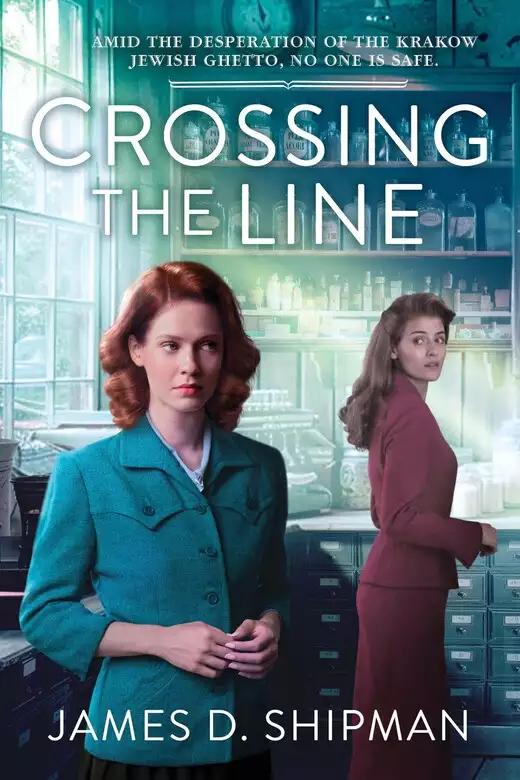
In the dark heart of the Krakow Jewish ghetto, three women—each a world apart—are drawn together by an unthinkable twist of fate. The women must navigate a deadly game of survival, risking everything to outsmart the Nazis and save countless lives. Perfect for readers of Pam Jenoff, Kristin Hannah, Joseph Kanon, and Alan Furst.
In the Podgórze district of Krakow sits the Under the Eagle Pharmacy, a family-run business that has long served Jews and Poles alike. Since Poland’s occupation by German forces, Irena, a pharmacist, has watched and worried as the store’s access to medications is reduced to a trickle. But now come rumors that there is more to fear than dwindling supplies.
A Jewish ghetto is under construction in Krakow, and Under the Eagle lies within its limits. Choosing to stay rather than move to the city’s “Aryan” section, the pharmacy workers offer what medicine, food, and help they can to a population crammed into ever more desperate conditions. Among the ghetto’s new residents is Natalia, once a medical student from a wealthy Jewish family. Securing a job at the pharmacy offers her a chance to do the work she has dreamed of and affords her loved ones some protection from the threat of relocation. Yet here, there can be no such thing as real safety.
For Elsa, a young German woman, recruitment to the SS was the only way to avoid jail after a deep betrayal. Assigned to the ghetto, confronted with the casual cruelty and violence of her commanders, she feels her convictions about the Fatherland crumbling. As restrictions and penalties grow worse each day, Irena, Natalia, and Elsa are drawn toward unexpected alliances—and decisions that could save or jeopardize not just their own lives, but the lives of countless others.
Release date:
December 16, 2025
Publisher:
Kensington Books
Print pages:
336
* BingeBooks earns revenue from qualifying purchases as an Amazon Associate as well as from other retail partners.
Natalia Wajcblum dug the knife into her palm under the table, letting the sharp pain burn through her hand and up her arm. She had to do something, or she would scream. And her father never allowed outbursts at the table. She turned to him now as he concentrated on dipping a crust of bread into his soup. How could he eat, think, breathe right now?
“There is a new production of Chopin’s work coming to Old Town,” he said, turning to her mother. “What do you think, Aleksandra? Should I secure tickets?”
She smiled at him, the cracks and creases around her eyes and forehead rippling like lightning. “Do you know who will be conducting?”
“The paper didn’t say, but it would be a nice evening for all of us. We could use the distraction.”
A servant entered the room and looked over their bowls. He was a Pole, Thomasz, and had been with them since before the occupation. Natalia wondered what he would do next for employment, now that they’d received the notice.
“Should I bring the next course?” Thomasz inquired.
Her father nodded, not deigning to look up. “Natalia, what do you think? Would you like to attend a concert?”
“What kind of dream are you both living in?” she demanded, unable to contain herself any further. “Concerts? Social engagements? It’s over. It’s all over.”
“Now that’s enough of that, miss,” her father interjected. “I won’t have my table interrupted by—”
“We won’t have a table soon enough, Father, or servants, or anything. They’re going to shove us into the worst hole in Krakow. And you want to talk about concerts.” She began to rise. She’d had all of this she could take.
“Sit back down,” her mother ordered. “We are at our meal. And Wajcblums conduct themselves with discipline and decorum. I won’t have you raging like you’re the daughter of a baker or a garbage collector.”
“Are we better than them now, Mother?” she asked. “Father lost his law practice a year ago. We’ve been hanging on here at the house, banned from work, banned from school, and now they’re forcing us to move to some ghetto with the rest of the dregs.”
“It’s a Jewish Quarter,” her father said. “And we’ll make the most of it.” He looked up, eyeing Thomasz, who had returned with their main dish. “Besides, this is hardly the time or place for a family discussion.”
“I thought this was going to be an adventure?” her brother Stefan said. He was not yet thirteen and didn’t fully understand what was going on around them.
“That’s right, my boy. Don’t you worry about a thing.” Her father looked meaningfully at his daughter, his thick, peppered eyebrows furrowing sternly. “Natalia is just having one of her little episodes.”
“When then, Father?” she asked. “We’ve had the eviction notice for a week. When are we going to talk about what’s going to happen to us?”
“Not here, and not now,” her mother said. “Your father will take care of things, as he always has.”
“How? Like he took care of his job? Like he took care of my education? The Germans are the ones making the decisions. I’m supposed to be halfway through my first year of medical school, and instead, we’ve sat here doing nothing, waiting for every new regulation to crash in on us, every new restriction. And they’ve finally done it. They are stripping us of the last thing we have left. Our home.”
“Don’t worry about that,” her father said, winking. “I’ve got inquiries out with friends. We will have something just as nice in the new district.”
Aleksandra scoffed, pivoting on her husband. “How will that happen?” she asked. “The place they are sending us to is the worst. Full of workers and Jews.”
“We’re Jews, or have you forgotten?”
“Yes,” her mother said. “Racially that’s true but it hardly matters otherwise. When is the last time we celebrated a holiday? Even the major ones. Why would the Germans classify us based on our parents and grandparents? It’s ridiculous. So is this move. I know you’ll do your best for us, Jakub, but truly, you won’t find something there that will compare to our home.”
“I intend to secure the finest housing in the Podgórze District.”
“How do you expect to do that?” asked Natalia.
“I’m going to go see Petre.”
Petre Lendowski. He was a longtime friend of her father’s. Petre was a Pole and had been a senior administrator in the old government. “What can Petre do for us?” she asked. “Is he still even working for the government?”
“He is,” said Jakub. “He retained a position after the occupation. When we got the eviction notice, I reached out to him. I have an appointment with him in the morning.”
“Do you think he’ll be able to help us?” her mother asked.
“No doubt he will. He has to have some power left.”
“Why would he assist us?” Natalia asked.
Her father looked at her sharply. “For friendship, of course.”
“What good has that done us this past year?” she asked. “We’ve lost everything except our house, and that’s about to be taken from us. They quashed my acceptance to medical school. Where was Petre when they took my future away?”
“You shouldn’t have been wasting your time with that nonsense in the first place,” her mother snapped. “The one good thing that came out of the occupation was the derailing of your foolish insistence on a practical education. As if a woman in our circle would work a job. I would die if anyone found out you wanted to be a doctor.”
“Mother, I worked my entire life to be able to study medicine. It might be enough for you and your friends to be married to someone who did something in life. But it’s not enough for me.”
“How dare you say something like that to me! You are lucky you—”
“Enough!” her father ordered. “We’re not going through this again. It’s a moot point. Medical school is closed to Jews now. Until the Germans are gone, Natalia won’t be getting the education she wants, and you, Aleksandra, will not have to fight her over it. Now we have more important things to deal with.” He looked at his plate, the uneaten food staring back at him. “I’ve indulged both of you tonight. You know the rules. We don’t talk about problems at the dinner table.” He gestured at Thomasz, who started clearing the plates. “I don’t want to hear any more on this subject. I’m going to go to Petre tomorrow and straighten this out. The two of you have nothing to worry about in the interim. Now if it isn’t too much, I’m going to enjoy my pipe and a good book. Make sure Stefan gets his homework done before bed.”
“I want to go with you tomorrow,” Natalia blurted out.
Her father, who had been halfway out the door, turned to his daughter in disbelief. “What on earth are you talking about?”
“I might be able to assist.”
“How would you do that? By making cookies? This is hardly the place or time for a woman’s—”
“He’s a man.”
“I know he’s a man. What are you suggesting?” His eyes widened and an angry vein materialized on his forehead. “Do you think I would parade my daughter like a common streetwalker just to gain some favor?”
“Father, we need any advantage we can get. It’s not the old days. You don’t know if Petre has any power anymore. Even if he does, he may not be inclined to help you.”
“Why wouldn’t he? We go back two decades. All the way to the university.”
“She’s right.” Natalia was surprised to hear her mother interjecting on her behalf.
Jakub turned on her. “Are you mad as well?”
“I’m not losing my mind, Jakub. I’m trying to be realistic. Natalia is right. Things have changed. When’s the last time you saw Petre? Before the occupation? You don’t know what has become of him, what pressures he is under. He stayed with the government. With the Germans. That’s cause for concern in and of itself. If Natalia is with you, it might soften him up a little. He watched her grow up. He might feel more sympathy for our cause. And after all, she is very pretty.”
“You’d have us prostitute our daughter for housing?”
“Of course not. I’m not suggesting she do anything more than be present. Perhaps a smile and a friendly word. At best, it will remind him of who we are and our histories together. At worst, it might give him another reason to help us despite himself.”
“I won’t,” said Jakub. “My request stands on my friendship with Petre. I would never stoop to such antics.”
“Jakub, you need to take her,” her mother said. “I can’t live in some hovel. We must use any advantage we have—Petre is a man and Natalia is a young woman. A smile could buy us a few extra rooms.”
He hesitated and opened his mouth again to say something, but then seemed to change his mind. “Fine,” he said at last. “But don’t you dare flirt with him, Natalia. You are coming as my daughter, and a family friend. If that helps us in some way, so be it. But I won’t allow anything beyond that. Do you understand me?”
“Yes, Father.”
“Good. And now, if that’s quite enough from the two of you, I’m going to go try to enjoy my pipe. Good evening.”
He stepped out of the room.
“Thank you, Mother.”
“No need to thank me. It will be nice for you to make yourself useful. You’ve moped around here for the past year, pining after school instead of finding yourself a suitable husband. But all will be forgiven if you can secure us decent housing. Now listen to me—don’t you worry about your father. When the time comes, smile for all you’re worth.”
The next morning, Natalia set off with her father toward the Department of the Interior. It was more than a mile away, and they were both heavily bundled against the cold. Natalia shook her head against the bitter wind, amazed at how their life had changed. Before the occupation, they would have been whisked through town in their Mercedes, driven by a chauffeur to the shopping district or one of Krakow’s many restaurants. But the Germans had impounded their car on the first day of the occupation, leaving them to walk from place to place like common workers. That had been the first of so many indignities the Nazis had inflicted on them. And now they were facing the greatest one—the loss of their beautiful house. The only home she’d ever known.
She mustn’t think about that now. Instead, she watched the pedestrians as they marched along. The sidewalks were busy, with people heading into work or walking children to school. A long line snaked out of a corner grocery store, with people queued up for their meager ration of bread, an egg or two, and some vegetables. Meat was difficult, if not impossible, to get now. So were fruits, coffee, chocolate, all of the luxuries. Vodka was the only thing readily available. The Germans must have figured a drunken population would sit by more docilely while they stripped the country of everything else.
“Natalia, pay attention,” her father said, turning back to her. “What are you doing?”
“Just thinking about what’s happened to this country since the Germans came.”
“Not so loud,” he said, looking around. “You don’t know who is listening.”
“What difference does it make?” she asked. “What more could they possibly take from us?”
“Just do as I say. We’re almost there.”
He led her several more blocks until they reached a large, brick nondescript building taking up half of a city block. The Department of the Interior had stayed in the same location after the occupation, but some things were very different. A huge swastika banner adorned the space above the front doors, fluttering in the icy wind. At the entrance, a German guard, rifle in hand, stood at attention, monitoring the comings and goings of those entering the building. Her father paused as they reached the stairs, and she wondered whether he would have the courage to enter. Natalia wondered whether Jews were even allowed to come here anymore.
Jakub squared his shoulders and gestured for her to follow. Fortunately, the guard merely eyed them without any inquiry and nodded for them to enter the building. She followed her father through the glass double doors and into the interior. There were people everywhere, moving this way and that down the long corridor dotted with office doors of various departments. Natalia was alarmed at how many uniforms were here. Almost everyone was a German soldier of one kind or another, and they all seemed to be eyeing the two of them suspiciously.
“Can I help you with something?” a woman at a desk asked them. She was off to the right in the open lobby and served as the receptionist for the place.
“Oh, yes,” said her father. “I’m here to see Petre Lendowski.”
She raised an eyebrow. “Do you have an appointment, Mister …”
“Mr. Wajcblum.”
Her eyes shot up even more. Their last name marked them as Jews. “I’m sorry, sir, but without an appointment I won’t be able to help you today. Perhaps phone ahead and try another time.”
“Can you please call him?” Jakub asked. “I’m a friend.”
She looked skeptical of that, but after a moment she picked up the phone and hit some numbers. “Yes. There’s a man here to see Mr. Lendowski. Yes. A Mr. Wajcblum. No. He doesn’t have an appointment. Yes, I’ll wait.” She sat on the phone for a few moments, looking down at her desk as if it was distasteful to keep eye contact with them. Finally, a voice in the receiver caught her attention again and she nodded before hanging up. “You may go up,” she said. “But you’ll have to wait for an opening.”
“I understand,” her father said. He motioned for Natalia to follow him again and they continued down the hall and then climbed three flights of stairs, finally reaching the top floor. They moved down the tiled hallway, passing numerous departments until they reached Petre’s office at the end of the corridor. They stepped inside. There was another woman here, another desk.
“Are you Mr. Wajcblum?” she asked.
Her father nodded.
“Please take a seat,” she said. “Mr. Lendowski will be with you as soon as he is able.”
Jakub gestured at a chair to his right. He leaned over and whispered to Natalia. “I told you I would get us in. It won’t be long now.”
But much to their embarrassment and dismay, they sat in the reception area for hours. While they waited, various officials came and went. The receptionist ignored them, answering the phone or typing up messages from a tablet of shorthand she must have taken. Natalia kept checking her watch, feeling her irritation turn to humiliation, and then to anger. “Let’s just go,” she whispered to her father. “He’s making a fool of us.”
But Jakub shook his head. “He’s a busy man. We have to stay. This is our chance.”
So they waited, and the morning turned to noon, and then afternoon. It was nearing the end of the workday when the telephone rang and the receptionist rose, gesturing for them to follow her. Natalia was exhausted and starving. At this point, she just wanted to go home. But she rose and followed her father into Petre’s office. The space was large, a corner unit with windows looking down the long avenues of Krakow in two directions. He sat behind a rich mahogany desk, a looming picture of Adolf Hitler perched behind him. The eyes of the German leader scowled down at them, as if he dared them to ask a favor. Petre was on his feet in an instant and stepped around the desk to take her father’s hand.
“Jakub, my friend. You must accept my apologies. You wouldn’t believe the volume of work I am forced to deal with these days.” He turned and noticed Natalia for the first time. He smiled at her and his eyes wandered down her figure, just for the briefest of moments. “And can this be your daughter? Natalia, isn’t it? I haven’t seen you in years. What a lovely young woman you’ve become. And not yet married? Do you still live with your father and mother?”
She nodded. “Yes. I was going to study medicine, but they took—”
“Now, now, Natalia, we’re not here to tell Petre our troubles. Well, not all of them at least.”
“Why are you here?” Petre asked.
Natalia was surprised by the abrupt tone.
“Right to the point, then,” her father stuttered. “I had hoped we could catch up a little.”
Petre smiled again, but not with his eyes. “Another time. As I said, I’m simply too busy, even for old friends. But there must be a reason you’ve sought me out after all this time. What can I do for you?” He sat back down, glancing over at Natalia again, his eyes lingering.
“I’m sure you know about the resettlement to the Jewish Quarter.”
“Know of it? I’ve been dealing with the details for a month. The Germans threw the whole thing in our lap with no notice. You can’t imagine the amount of planning and paperwork it’s taken to even begin the process.”
“We’re losing our home, Petre.”
He looked up at Jakub, embarrassment flashing across his face for the first time. “Of course. I’m sorry, my friend. If there was anything I could do about it, I would.”
“I came here today to ask a favor. To see if you could secure something suitable for us in the district. A townhome, preferably the same size and stature of our current place. I know the area isn’t the best, but surely there must be something. Aleksandra has been positively panicked since we got the notice.”
Petre leaned back and closed his eyes, pursing his lips for a moment. “I don’t know how to tell you this, Jakub, but there is nothing like that available.”
“No townhomes? How about a decent-sized flat?”
“You aren’t listening, Jakub. There won’t be any individual apartments in the ghetto. All spaces will be shared. Any space you receive will be shared with at least one other family, perhaps two.”
Natalia was stunned. Sharing their housing with other people? Her father was evidently facing the same emotion.
“Petre, you can’t be serious.”
“I’m afraid I am. I’m sorry.”
“But can’t you make an exception for us? For old times’ sake.”
Petre shook his head. “There’s just no way. The Germans will be monitoring everything we do. They will inspect the apartments once everyone moves in. Even if I arranged something like that, they would quickly discover the situation and take it away. It would be easier to hide you in the city than to arrange that.”
“What about leaving us in our home?” asked Natalia. “Could you arrange it so we didn’t have to move at all?”
Petre laughed. “I was joking, young lady. No, I can’t do that either. They’d have my head in a noose.”
Jakub leaned forward and whispered. “But perhaps you could arrange it, Petre? Yes? I don’t mean for free, my friend. But what if we could pay you? What if our paperwork was lost somewhere in the shuffle and a new permit issued? We wouldn’t tell anyone; I promise you that. We don’t go anywhere; we don’t do anything. We send our maid out to do our grocery shopping. We aren’t causing anyone any problems.”
“I don’t know how that could be done, Jakub. And if it could, the cost would be astronomical.”
“Then there is a price,” Natalia said, leaning forward and flashing a smile. “Please, Petre. We would be so grateful.”
He was lost in her eyes for a moment. “My, my, you’ve become such a lovely thing.” He turned back to her father. “Go home, my friend. It’s late and we’re closing up for the day. I’ll think about things and if there’s something I can do, I’ll send someone over with a message.”
“Why not call?” Natalia asked.
“Not a good idea. They are always listening.” He rose and gestured toward the door. Jakub stood up and reached his hand out. Petre looked down at the hand for a moment, and then took it. “Be well, my friend. I’ll be in touch as soon as I have something for you.” He turned to Natalia. “And you. Do you have a husband, a fiancé, something?”
She blushed and shook her head.
“What’s wrong with the boys these days?” he asked. “If I was the same age as you, Natalia, I would have snatched you right up. If I was a Jew, of course.”
“Those lines didn’t matter in the past,” her father said.
“They do now,” he said. “In ways you don’t understand, Jakub, they matter.”
They stepped out of the office building and onto the street. It was already dark, and the temperature was dropping. They hurried as best they could back toward their house. “What do you think he meant that it matters we are Jewish in ways that we don’t even understand?” Natalia asked.
“I’m sure he was just being sensational,” said Jakub, although his voice belied the words. “Petre always had a flair for the dramatic.”
“Will he help us?”
“We shall see, won’t we?” He stopped and turned to her. “I thought I told you not to flirt with him. You disobeyed me.”
“Father, he made us wait the whole day in front of his office. Then when we talked to him, he was different from the past. Even I remember what he used to be like, and I haven’t seen him in years. Yes, I flirted with him. But it mattered. Did you see him keep looking over at me? It made a difference. As distasteful as that is, it might have turned the tides.”
Her father looked at her for a long time. “You’ve grown up, Natalia. I guess during all this chaos, I’ve been so focused on my situation, on protecting the family, that I missed that. I am sorry about your education. Sorrier than you will ever know. If there was anything I could do about that, I would. I was so looking forward to you becoming a doctor.”
“Mother is glad at least.”
“Don’t blame her. She’s old-fashioned. In her time, a woman of a certain station, of our circle in society, wouldn’t dream of having a job. But the last war changed that, and everything that has happened since. She’s proud of you too, even if she won’t let herself see it.”
“But what will all of that do for us now?”
He shrugged. “We will see. I know Petre. He likes nice things. He’s always been a little jealous of our life. He’ll be motivated by money and that’s why he dismissed us. He wanted to think about the number. You watch. By the end of the night, that messenger will appear, and we’ll have an answer.”
“How much do you think he will ask for?”
“It won’t be a small amount. I’d guess twenty-five thousand zlotys.”
“But do we have that, Father? The Germans have taken almost everything.”
“Oh yes. When the war clouds rolled in, I was already watching. I knew if we lost, the Germans would enact the same laws against Jews here that they had in their own country. I took much of our savings out. I’ve got that much, with some to spare. We’ll need all of it and more, I’m afraid, before this war is over.”
“And when will it be finished, Father?”
“Who can say? The Germans have won. This is their world now. Unless England can pull off some miracle that I don’t see. But at some point, I’m sure they’ll lift these ridiculous restrictions against the Jews. What benefit could they possibly get from it? To scrape a swath through the doctors, lawyers, musicians, bankers. It’s a self-inflicted wound. No, trust me. This is all theatrics. They want the Poles to blame someone besides their oppressors. But once our countrymen have properly settled into their new shackles, the authorities will come back to us Jews. They need us. They always do.”
“I hope you’re right.”
He smiled. “How often am I wrong? I don’t say that as a boast. But I’m a thinking man. And I know history. All of this mess will come to an end. Mark my words. Now, let’s get home before we freeze to death out here. Besides, your mother will be frantic that something has happened to us.”
They arrived at their town house a few minutes later. As Jakub had predicted, Aleksandra was half mad with worry. He settled her down and then sent Stefan to bed early so the three of them could talk over what had happened.
“But why did he make you wait so long?” she asked when he had finished. “Doesn’t that mean something? Something bad?”
Jakub shrugged. “We can’t worry about that. The Germans who observed us there knew we were Jews. He probably needed to ignore us for their sake. For his own protection.”
“Will he help us?” Aleksandra asked.
There was a knock at the door. “There’s your answer,” he said, smiling at her. They’d dismissed the staff for the night, so Jakub answered himself. Natalia peeked from around the corner and saw a Polish man there, not much older than he, greeting her father with a handshake and an envelope. They spoke for a few moments and then he closed the door and stepped back into the library where they had all been talking. He took his favorite chair, resting against row after row of law books, and ripped open the envelope to examine the contents of the letter. His face grew pale.
“What is it?” asked Aleksandra. “Did he say no?”
Jakub looked at both of them. “He said yes. But he wants one hundred thousand zlotys. In twenty-four hours. The bastard.”
“Do we have that much in cash, Father?”
He looked at Natalia and shook his head.
February 1941
Elsa Baumann sipped her wine as she listened to Erik’s story of his training. The restaurant was busy, and they’d been seated at a tiny table near the kitchen. The banging of pans and shouts of the cooks beat against her ears, disturbing his words, and her evening. She pushed down her frustration. She wanted tonight to be perfect.
“Our stupid lieutenant. The new one. He decided instead of giving us the leave he had promised that we would spend a weekend in the field. While everyone else was in town drinking, spending their pay, we were marching up and down a mountain, conducti. . .
We hope you are enjoying the book so far. To continue reading...

 Please log in to recommend or discuss...
