
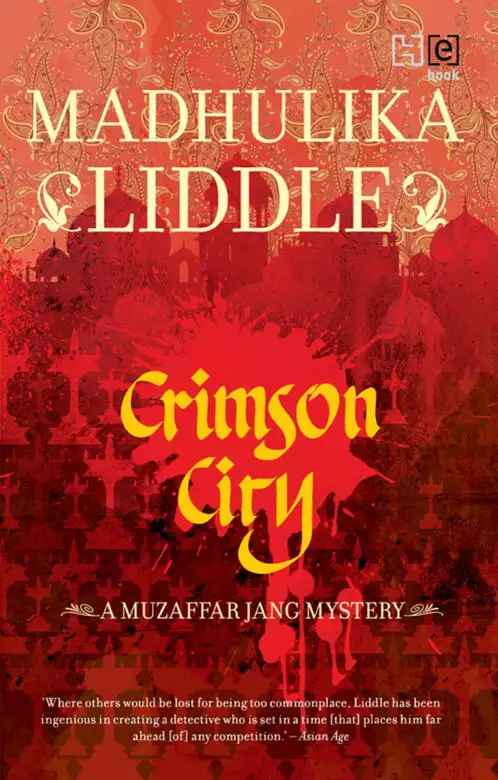
Crimson City
- eBook
- Paperback
- Book info
- Sample
- Media
- Author updates
- Lists
Synopsis
A serial killer is terrorizing Dilli and Mughal nobleman and detective Muzaffar Jang might have finally met his match. In the spring of 1657, the Mughal armies have reached the Deccan, besieging the Fort of Bidar. Back home in Dilli, there is unrest: the empire seethes and stirs, and its capital reflects this turbulence. Muzaffar Jang, newly married to his beloved Shireen and trying to adjust to life as a husband, stumbles into the investigation of a merchant's murder. Even as another crime – the kidnapping of a wealthy moneylender's infant son – occurs, Muzaffar finds himself at odds with his brother-in-law, Khan Sahib, the Kotwal of Dilli. Things get increasingly puzzling as one murder follows another and, soon, it is clear that the streets of Dilli have a serial killer on the loose. Muzaffar, who soon finds himself at odds with the system as well as those closest to him, must follow his gut to unmask this audacious murderer, while trying to obey Khan Sahib's warning: do not get in the way of the law. But has he finally bitten off more than he can chew?
Release date: September 25, 2015
Publisher: Hachette India
Print pages: 336
* BingeBooks earns revenue from qualifying purchases as an Amazon Associate as well as from other retail partners.
Reader buzz
 Please log in to recommend or discuss...
Author updates
Crimson City
Madhulika Liddle
Dilli, Jumada Al-Awwal, March, 1657 CE
‘Jahanpanah, Baadshah Salamat! Refuge of the world, lord of all! This insignificant creature trembles to come into your dazzling presence, my lord. My mind and my tongue cannot begin to find words adequate to express a millionth of the gratitude I feel, Jahanpanah – ’
‘If this is how long-winded he is when he’s so dazzled,’ whispered someone standing behind Muzaffar Jang in the Diwan-e-Aam, ‘I shudder to think what he’s like when he isn’t overwhelmed by his feelings.’ Ahead of them, past the red-lacquered wooden railings that separated the riffraff from the high nobility, past even the silver railings that separated the cream of the land from the Emperor, stood a nobleman, bent almost double in front of Shahjahan.
The Baadshah sat, white-bearded and stooped, his face wrinkled, his eyes impassive. High up on his white marble throne with its curved roof, with only his eldest son and heir, the Shahzada Dara Shukoh, and two guards, each bearing lances and swords, within arm’s reach. Behind the Emperor was the back wall of the Diwan-e-Aam; on three sides, in front of him and on either side, stretched the hall, its red sandstone columns disguised with polished white plaster, its floor covered with rich carpets, and a heavy crimson canopy stretching out from the edge of the building, the Hall of Public Audience.
Muzaffar Jang, twenty-six years old and a notorious nonconformist, had never been a regular at the imperial court. As a member of the minor nobility, he had been easily overlooked and his absence rarely commented upon. His recent activities, however, had made him a more recognizable figure: the cream of the court now were aware that the young brother-in-law of Dilli’s Kotwal, Farid Khan, was no ordinary young man, but one with an uncanny ability to sniff out the truth in matters criminal.
And Khan Sahib was not merely married to Muzaffar’s elder sister Zeenat Begum; ever since Muzaffar had been born, this man – now standing across the hall, his hands clasped loosely below his waist, his face tense – had been the only real father Muzaffar had known. His own mother had died in giving birth to Muzaffar; and his father, the general Burhanuddin Malik Jang, had been too busy fighting battles for his Baadshah to be bothered with bringing up a young child, even if that child was his sole son and heir. Zeenat Begum, twenty-five years older than her infant brother, had picked him up, swaddling clothes and all, and brought him up along with her own children. For the sake of her honour, and that of her husband, Muzaffar was making an attempt to be rather more the responsible courtier he was expected to be. Not by Khan Sahib, who had accepted Muzaffar’s maverick ways years ago, but by those finicky enough to judge Khan Sahib by the demeanour of his brother-in-law.
‘These Hindus,’ said another voice. ‘They make a fine art out of licking boots.’
‘They have to,’ murmured the man who had initially spoken. ‘It is the only way they can hope to make any progress in court. A worthless lot.’ The derision was undisguised.
Muzaffar glanced back over his shoulder, searching the crowd behind him. Ahead, the Emperor had risen from his throne, and had started moving away, heading back for the royal chambers. His departure had caused the massed courtiers to begin moving too, like a series of ripples spreading out from a stone tossed into a pond. Behind him, Muzaffar saw only shifting figures, men moving away here and there, turning to talk to neighbours, beginning to take their leave. He frowned.
Despite the burgeoning buzz of conversation as the assembly disintegrated, Muzaffar heard a voice call, clearly but not too loudly, his name. It was Khan Sahib, making his way through the crowd towards his brother-in-law and sometime foster-son. A stocky man, almost a head shorter than Muzaffar’s own impressive height, with a neatly trimmed grey beard and moustache, his eyes sharp.
Muzaffar’s earliest memories from his childhood had been of Khan Sahib, a Khan Sahib who had fashioned Muzaffar’s first bow and taught the little boy to hook his thumb in the drawstring, aim, pull, release. A Khan Sahib who had taught Muzaffar his first letters. Who had seated him on his first horse, given him his first lessons in riding, brushed away his tears when he had suffered a fall. Scolded him when he had been found guilty of a misdemeanour, and comforted him when a beloved pet squirrel had been killed by a stray cat.
He had changed little, thought Muzaffar with a private smile. Khan Sahib was still as solicitous of Muzaffar as he had been when Muzaffar was a boy. More respectful, of course, and accommodating of the fact that Muzaffar was now a grown man, but still.
‘Why the frown, Muzaffar?’ Khan Sahib said, by way of greeting. ‘I could see you across the hall. That scowl does not suit you.’
Muzaffar had started walking towards the arches that led out; ahead of him, slaves stationed beside the columns were pulling aside the quilted curtains that hung at the arches, blocking the spring breeze, still a little too cool for comfort. Beyond a green-printed chintz curtain tugged back, Muzaffar saw a glimpse of the broad crimson canopy that stretched out from the sandstone overhang of the Diwan-e-Aam. The sunshine was weak, the sky cloudy.
‘Someone said something disparaging about Hindus,’ he replied. When Khan Sahib lifted an eyebrow in query, Muzaffar recounted the incident.
‘And that distresses you, Muzaffar?’
‘Should it not?’
The Kotwal shrugged. ‘You are not naïve. When two different streams of thought – two different beliefs, and that too so diametrically different – are forced to live in close contact, their differences are bound to be accentuated. To be the cause of further differences. There is nothing surprising in that.’
Muzaffar walked on, hands clasped behind his back, chewing at his moustache, for a few paces more, until the two of them had exited the Diwan-e-Aam. ‘You are wrong, I think, Khan Sahib,’ he said eventually. ‘In thinking that I am not naïve. It seems to me as if I have been naïve after all.’ He glanced sideways, meeting Khan Sahib’s gaze. ‘I was under the impression that, at least at court, at least among the nobility, there was harmony between the Hindus and the Mussulmaans. Tolerance, if not more. Do the Hindus not furnish the empire with some of its best warriors? Its treasurers, its clerks, its bankers? If it were not for the Rajputs and the Khatris and the many others who handle its battles and its finances, the empire would never have succeeded.’
A small group of courtiers, their turbans bobbing, the hems of their woollen chogas flapping about their pyjama-clad legs, walked past. Muzaffar held his tongue, letting the men go well ahead of them before continuing. ‘Was not the Baadshah himself inclined to look favourably upon the Hindus? Did he not buy the land for the Empress’s tomb in Agra from a Hindu? Did he not – ’
‘Muzaffar,’ Khan Sahib interrupted. ‘There will always be people who will be prejudiced, to whom it will make not the slightest difference that their homes are being protected or their revenues earned because of a Hindu. Or a Mussulmaan, or whoever. Prejudice is prejudice, and it is invariably selfish. Let it not bother you so much. What you overheard was a chance remark; most men at court do not hold such views.’
They had walked through the painted gatehouse of the Naqqar Khaana, named for the kettle drums that were traditionally used here to play music – throughout the day on auspicious days like Eid and the Baadshah’s birthday, at regular intervals to mark the passage of time on ordinary days. Right now, the Naqqar Khaana was silent but for the murmur of voices as courtiers passed through it on their way out of the Laal Qila, the red sandstone fortress that formed the focus of the city of Shahjahanabad.
The city that was Kotwal Sahib’s domain. A restive, uneasy city, one that had been established with great pomp and show after the Baadshah had shifted his capital from Agra north to Dilli a few years earlier. It was still a grand city, fashionable and busy and glamorous. But, like every other city – even the most beautiful – Dilli had its underbelly, and keeping that clean was Kotwal Sahib’s job.
They walked through Chhatta Chowk, the long arcade that ran all the way to the gate of the fort, the Lahori Darwaza, named for the faraway city that it faced. From here, Lahore could not be seen, but through the open gates of the fort, past the moat, could be glimpsed the spires of the temples, the shops of Chandni Chowk. Khan Sahib’s face clouded over with worry.
‘Let it be,’ Muzaffar said quietly. ‘Tell me, Khan Sahib. How is it with you? You look worried.’
Khan Sahib said nothing for a moment or two, just staring straight ahead as if he had not even heard Muzaffar speak. Then he tilted his chin forward in a quick gesture, indicating the buildings, the long stretch of bazaar-flanked canal that lay beyond the walls of the fort. Through the grey clouds lowering over the city, a stray shard of sunlight lit up the spire of the Jain temple at the very head of the street.
‘Look at that,’ Khan Sahib said. ‘It looks so peaceful, does it not? Quiet. You and I know that it is not.’ He hunched his shoulders. ‘She is like a child, this city. A spoilt child, unruly and obstreperous. So terribly difficult to control.’
‘A child?’ Muzaffar smiled. ‘I wonder.’ They had stepped out of the gloomy shadow of the Chhatta Chowk, and a slave – one of many stationed there to help courtiers with fetching horses or palanquins – came up to receive instructions. As the man sprinted off towards the stables, Muzaffar turned back to Khan Sahib. ‘Do you remember that courtesan who used to live here in the fort, near Hayat Baksh Bagh, Khan Sahib? Mehtab, her name was.’
‘And quite a woman, I believe.’ Khan Sahib’s voice was dry. ‘I never had the pleasure of making her acquaintance – Allah be thanked – but you did, did you not? You seemed fascinated by her.’
Muzaffar shrugged. ‘She was a fascinating woman,’ he conceded. ‘But what I meant was that this city reminds me increasingly of Mehtab. A coquette, scheming and ruthless, but also beautiful. Alluring, charming men into coming to her. And, when they are within her grasp, she winds them round her little finger and proceeds to milk them dry of all they have. Without any compunctions. And the men themselves are happy to give up all they have; such is the magic she weaves.’
Khan Sahib grimaced. ‘You make her sound like an enchantress, a hoor of Paradise itself. Dilli is pure evil; there is nothing alluring or mysterious about it. Just undiluted evil, grime.’ He squinted into the distance, looking towards the city. His gaze flattened as if he was looking further, staring into space.
‘It is not just the city, Muzaffar,’ he murmured, in a barely audible voice. His next sentence revealed to Muzaffar the reason for the sudden drop in pitch and volume. ‘When the empire is tottering on the brink of collapse, it is hardly to be expected that its capital city will flourish. Do you remember what I had told you, when the winter was starting – about four months back, was it, when news had arrived that Bijapur had a new Sultan? When the man’s legitimacy was in question, and the Baadshah ordered Shahzada Aurangzeb to lead a campaign into Bijapur?’
Muzaffar nodded cautiously, aware of all that had happened since, but unable to remember what Khan Sahib had said all those months back. Much had taken place in the interim, not just in Muzaffar’s life – he had investigated several cases of crime; he had met and married Shireen; he had become a little wiser – but also in the life of the empire. It had acquired a new prime minister, the ambitious and ruthless Mir Jumla, who had come north from the Deccan, bearing gifts of precious stones and news of a kingdom ripe for an invasion. This very same Mir Jumla, as the Diwan-i-kul of the Mughal Empire, had been ordered south at the head of a massive army, to rendezvous with Aurangzeb’s forces and invade Bijapur.
‘I had said then that I feared the consequences of the campaign,’ Khan Sahib said. ‘At first glance, it would seem lucrative; nothing but wealth to be had from it, and territory to add to the empire. Not to mention the almost sure chance of a victory.’
‘The Diwan-i-kul’s and the Shahzada’s massed armies far outnumber anything Bijapur may raise up against them,’ Muzaffar agreed. ‘But what is to prevent a repeat of the Golconda fiasco? Aurangzeb lead his army there too, ready to annex Golconda – and all that happened was that Golconda begged Dara Shukoh to have the Mughal armies withdrawn. And because the Baadshah loves his heir far too much, it was done. What if that should happen again? What if this expedition too should prove futile?’
‘Aurangzeb will be furious.’ The slave had arrived with their horses. Muzaffar took the reins of his handsome chestnut stallion, and mounted on his own while the slave held the other horse for Khan Sahib to mount.
‘I fear,’ Khan Sahib added as they moved off, ‘that something is going to go wrong with this campaign too.’
Muzaffar grinned as he glanced over at his brother-in-law. ‘That old adage of yours, Khan Sahib? “You may net trouble if you fish in troubled waters”?’
Khan Sahib did not nod or say anything, but his expression turned even grimmer than before.
‘I hear,’ Muzaffar continued, ‘that the troops under the Diwan-i-kul and Aurangzeb have already besieged the fort of Bidar. Bazaar gossip has it that Bidar will fall any day now and the troops will return to Dilli loaded with plunder.’ Off from the left, a group of young men – none of them more than seventeen summers old – burst into sudden laughter, clapping and shouting as they sprang apart. One of the boys, backing sharply away and laughing all the while, nearly collided with Muzaffar’s horse. He whirled, red-faced and apologetic when he saw the annoyance in Muzaffar’s face. Muzaffar stroked his horse on the neck, soothing the animal. He and Khan Sahib were well past the moat and nearing Faiz Bazaar when Khan Sahib said, ‘I doubt if this is bazaar gossip you should pay much heed to. The garrison at Bidar is commanded by a certain Sidi Marjan. He is a doughty warrior; Aurangzeb will have a hard time breaking down his defences.’
‘The Diwan-i-kul will no doubt find other ways to get around that problem. The Diwan-i-kul’s penchant for offering bribes first and exploring other methods later may work.’
‘Not in this case. Sidi Marjan is also said to be fiercely loyal to his Sultan. The Diwan-i-kul may well find his bribes flung back in his face.’ They had reached the head of the stretch popularly known as Chandni Chowk, the central artery of Shahjahanabad. Down its length flowed the Nahar-e-Bihisht, the ‘Stream of Paradise’, the canal which flowed through the fort before being diverted into the city. Its glittering waters cool and tree-shaded, flanked on either side by broad streets and rows of shops, selling all that the empire produced and imported. You could buy a carpet from Isfahan here, or a handful of saffron. A dancing girl or a glass hookah. A midget, a horse, or a garland of jasmine for a beloved’s tresses. It was an intoxicating place, colourful and rich and noisy.
Khan Sahib reined in his horse. ‘All we can do is wait and see,’ he said, dismissing the topic. ‘Where are you headed, Muzaffar? Home to Shireen?’
‘Home, yes. Whether Shireen will be there or not, I do not know. I believe Zeenat Aapa was to call. And whenever my sister and my bride get together, they invariably choose to spend their time outside the haveli. Zeenat Aapa will probably have taken Shireen to introduce her to some friends, or to buy her something.’ He smiled, half-sad, half-indulgent. ‘Shireen has lived all her life in Agra; Dilli is far too exotic, too exciting for its charm to be over so soon.’
‘We are not immune to its charm, either, are we?’ Khan Sahib remarked, with a trace of sarcasm in his voice. ‘Just like the courtesan you spoke of, this Dilli. Anyhow, if you are headed home, I shall ride alongside. I have to go to a neighbourhood near the Dilli Darwaza. Quite close to your haveli, actually.’
‘Visiting someone, Khan Sahib?’
‘Hardly. A man was killed nearby, in one of the lanes near Dilli Darwaza. The thanedar reported it to me this morning, just as I was setting out for court. And then, as he was stepping out of my office, he stumbled over the threshold and went down like a sack of potatoes. He’s broken his ankle, I think.’
Muzaffar tut-tutted in sympathy. He was slightly acquainted with the thanedar in question, since Muzaffar’s own haveli lay in the jurisdiction of the man’s thana. A conscientious man when it came to his work, and not inclined to shirk his duty.
‘A hakim was sent for. He must have arrived while I was at court,’ said Khan Sahib. ‘The ankle was swollen and painful. I would think it’s a minor crack, but one that will need time to heal. Meanwhile, I’d better go and have a look at his thana, talk to the chowkidars who report to him, and appoint someone to carry out his duties in the interim.’ Khan Sahib turned his horse to the left. ‘And I need to see this murder for myself.’
‘Do you mind if I come along, Khan Sahib? Just out of curiosity. And if it’s somewhere near where I live, perhaps I will know something that may be of help.’
Khan Sahib looked hesitant, as if he were debating the question. It surprised Muzaffar; Khan Sahib, on previous occasions, had never refused a similar request. Muzaffar could even recall instances when Khan Sahib himself had – of his own accord – sent for Muzaffar. This reluctance to let Muzaffar assist in an investigation was uncharacteristic.
‘Very well,’ Khan Sahib said, with a sigh. ‘If you wish. But try and remember that I am the law. I am the official here.’
And on that ambiguous and somewhat ominous note, he moved off.
Dilli Darwaza squatted, grey and formidable, at the end of the straight broad road known as Faiz Bazaar. This was one of the nine gates that pierced the city walls, and like Lahori Darwaza, Kashmiri Darwaza, and Ajmeri Darwaza, was named for the direction it faced. In this case, the old city of Dilli, south of the grand capital Shahjahan had built. Just south of Dilli Darwaza could be seen the ruins of the 200-year old Firoz Shah Kotla, the citadel built by the long-ago Sultan Firoz Shah Tughlaq. Shahjahan’s teams of builders had plundered Firoz Shah’s fortress ruthlessly, stripping it of its red sandstone and its marble, leaving behind only the rubble they did not care to reuse.
The lane Khan Sahib turned his horse into led towards the Kalan Masjid, the ‘large mosque’. Built around the same time as Firoz Shah’s fort, it was aptly named, though the magnificent Jama Masjid next to Chandni Chowk now surpassed it in size and grandeur.
Past the Kalan Masjid and a few dozen yards into the lane, the road went the way of most of Shahjahanabad’s inner area. The lane split into narrower lanes and alleys, branching off like an unpruned tree. Cul de sacs and dead ends, dingy little hovels and old deserted tombs where passing mendicants sometimes stopped for a night’s rest: one could easily get lost in this maze.
Muzaffar, however, was familiar with the area. Khan Sahib, from having visited his young brother-in-law’s haveli countless times over the past years, knew it well enough too. ‘Heading for the chowki?’ Muzaffar asked as Khan Sahib guided his horse between a small well and a row of vegetable sellers.
‘Not just the chowki, but the scene of the crime,’ Khan Sahib replied. ‘The murder was committed a couple of houses from the chowki.’
‘The criminals of Dilli grow audacious.’
Khan Sahib turned his head and directed a look of weariness at Muzaffar. Muzaffar dipped his head by way of apology; the inadvertent hit had struck a sore spot. Taken in conjunction with Khan Sahib’s recent reluctance to have Muzaffar accompany him, it seemed to suggest that the Kotwal was – what? Muzaffar wondered. Had crime in the city really become so rampant that Khan Sahib and his men were finding it difficult to deal with it? Had all his many duties taken their toll on Khan Sahib? Was age catching up with him? Or had someone made a snide remark – Allah forbid – that Khan Sahib was not competent enough? Muzaffar was well aware that the post of the Kotwal of Dilli was a coveted position, and yet one to be feared too. It was a post that could be exploited by the corrupt; a previous Kotwal had been hounded out of the city, disgraced publicly and flogged, for having misappropriated funds and accepted bribes. On the other hand, it was a post that came with a barrage of duties, all the way from preventing and investigating murders and thefts to registering the entry of outsiders, to ensuring shopkeepers used correct weighing scales, to organizing festivities and illuminations at Eid and Diwali. To making sure women did not ride horses, slaves did not abscond, and workers were paid fair wages for their work.
It was a ludicrously long and complex list of duties. If it made Khan Sahib occasionally grumpy, Muzaffar should not be surprised. He mumbled a brief ‘I beg your pardon’, but Khan Sahib did not react.
Muzaffar’s haveli was less than a quarter of an hour’s leisurely stroll from the chowki. It was not the most fashionable part of town; the elite mostly had their havelis nearer to Chandni Chowk – but it was a comfortable neighbourhood. Compared to the immediate surroundings of Muzaffar’s home, the area just before the chowki lacked both charm and comfort. Mud huts made up most of the dwellings around. Recent rains had caused cracks to appear in the less expertly constructed, and fire – a hazard that perpetually hung over much of the city – had left an entire row of huts roofless, their thatch burnt, their walls blackened and partly collapsed. The smell of decay hung on the air.
‘The house is right ahead, huzoor,’ the chowkidar said when they dismounted at the chowki. A young soldier from the chowki hurried forward to take charge of the horses. The chowkidar himself, a man with a grizzled chin and bags under bloodshot eyes, was already beginning to move in the direction he had been pointing. ‘It is just a few yards, huzoor,’ he explained. ‘The horses will be safer here – ’
‘Yes, yes. Lead on,’ Khan Sahib said with a touch of impatience. ‘I want to get this over and done with. This is Muzaffar Jang Sahib, by the way. He lives nearby.’
‘I know of Jang Sahib,’ the chowkidar acknowledged, with a swift look towards Muzaffar. ‘You are well-respected in this neighbourhood, huzoor.’
Muzaffar ducked his head, embarrassed.
‘And here is the place,’ the chowkidar added, stopping at the barred wooden door of a small house. While the area east of the chowki had been one of hovels, this section appeared to be occupied by a somewhat wealthier class of people. True, there were no grand havelis and no expansive gardens – but there was more than the thatch-roofed mud huts of the poor. These were small houses, but built of baked brick, some with their roofs tiled, others thatched. A dirt road, packed hard by thousands of feet, human and animal, over many years, formed the thoroughfare. Occasionally, when it rained hard – as it had on the previous night – the earth was loosened and churned up into a muddy mess that clung to soles and hems.
Outside the second house beyond the chowki stood a man, lance in hand and an expression of ludicrous fierceness on his face. ‘Thanedar Sahib told me to put a man on duty,’ the chowkidar explained. ‘The people in the neighbourhood have been curious.’ It appeared that the presence, even of such a formidable representative of the constabulary, had not daunted the more persistent. An old woman stood a few feet away, one gnarled hand bunching up the rough brown fabric of her skirts just high enough to raise them above the mud of the lane. A poor woman, from the plain, unadorned look of her – and the mere fact that while a bright blue dupatta covered her head and shoulders, her face was uncovered. A noblewoman would not venture unveiled out of her house, possibly not even outside the women’s quarters of her house. And she would certainly not stand thus, gawking in the street.
Or hurry forward in this impetuous fashion. The guard tried to stop her, but she shrugged off his hand on her arm as nonchalantly as if brushing off a fly. She ducked her head in the semblance of a salaam to Khan Sahib and Muzaffar, recognizing them as members of the nobility, even if she did not know their identities. But it was the chowkidar to whom she addressed her query. ‘What has happened, huzoor? He’ – a swift tilt of her head towards the guard indicated whom she meant – ‘will not tell me. Is Aadil Sahib dead?’ Her gaze, bright as a bird’s, darted towards the shut door beyond.
‘And why should you think so, Ameena Bibi?’ The chowkidar asked in a dry voice.
‘Why else would you have a man standing guard, huzoor? And if it were a simple affair of burglary, Aadil Sahib would be here too, would he not?’
She's a sharp one, thought Muzaffar.
‘Have you seen anything, Ameena Bibi, that you suspect he is dead?’
For a moment, the old woman looked as if she would prevaricate. Then she shrugged, as if it did not really matter whether the chowkidar knew of how she had come by her information. ‘I was up on the roof,’ she said, gesturing towards the terrace of the house next door, ‘sweeping the floor, when I saw you and your men milling around inside. In the courtyard. There was a body there, wasn’t there? I couldn’t see his face. Was it Aadil Sahib?’ She was excited now, her head jutting out, her free hand clutching the chowkidar’s arm.
‘Ya Allah, Ameena Bibi!’ The chowkidar made no attempt to disguise his disgust at the woman’s macabre interest in the crime. ‘Yes, he is dead. Now please go and let us get on with our work.’
‘But how did he die? He was perfectly well till yesterday – ’
‘He was killed. Now, please. Go.’ He glared at her. Then, as if realizing that he might be shooing away a possible witness, he softened. ‘If you saw or heard anything that could be of help, come to the chowki in half an hour’s time. Or, better still, I will send a man to fetch you. But let us be now; we cannot keep Kotwal Sahib waiting.’ He removed her hand from his arm firmly, and taking advantage of her momentary awe at the discovery that the nobleman before her was the Kotwal himself, pushed the door open and ushered Khan Sahib and Muzaffar in.
He pushed the door shut behind them. The voice of the guard could be heard beyond, telling the old woman to take herself off.
‘I beg your pardon, huzoor,’ the chowkidar said. ‘These people – ’
‘Yes, yes. I know. Let’s get on with it. Talk to her later, though. She seems enough of a busybody to perhaps know something, even if she doesn’t realize it right now.’ Khan Sahib moved forward, away from the wooden threshold. They were in a courtyard of packed earth, and there, flat on his back with his bony feet pointing towards the door, lay the dead man. Muzaffar noticed the edge of a muddied white pyjama, and the sleeve of a white jama from which a thin hand protruded. The rest of the man’s body was enveloped in a large brown shawl, soaked in rainwater.
Khan Sahib turned to the chowkidar. ‘When was this corpse found?’
‘Just after sunrise, huzoor. A passerby noticed it.’
‘Where is he?’
‘I have his name and address, huzoor. I can send a man to fetch him.’
‘Do so. I’d like to question him myself. And this man – the victim – the thanedar told me he was a cloth merchant. What was his name? Aadil?’
The chowkidar nodded.
The dead man looked to be in his mid-thirties, thin-cheeked and with grey strands in both his beard and the hair on his head – which was bare. The voluminous brown shawl that had pooled about his gaunt figure also spread about the rest of him, making him look like a collapsed angel, its brooding wings spread from knee to shoulder.
An angel made grotesque by a burst of crimson over its chest. A dagger had been plunged here, and withdrawn after it had done its work. Khan Sahib bent, easing away the edge of the shawl to expose the cotton jama underneath. The jama was wet, clinging in pinkish-red folds to the man’s ribs. Muzaffar touched the shawl; his fingertips came away reddened. ‘It’s drenched through and through,’ he said. He hefted the shoulder slightly, and bending till his cheek almost touched the ground, looked under.
‘Wet as the earth he lies on, Sahib,’ said the chowkidar. His face wore an expression of faintly amused patience, like a man humouring a child who insisted on poking its fingers into matters that were none of its concern.
Muzaffar glanced at him. ‘Yes,’ he said. ‘What with the rain all through the night, I’m not surprised.’ He looked around, his gaze searching the courtyard. ‘I do not see a lamp or a candle around. He must have come to answer the door in the dark, then. Because it was raining, I suppose.’
‘Come along,’ Khan Sahib said, when the chowkidar did not c. . .
We hope you are enjoying the book so far. To continue reading...
