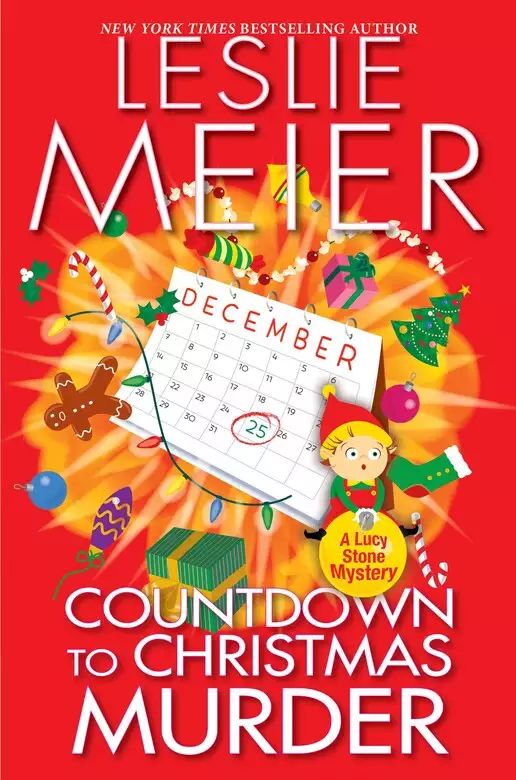
Christmas may be 63 days away, but as the Tinker’s Cove Chamber of Commerce gears up for an elaborate Dickens-themed Christmas event, reporter Lucy Stone is already feeling a bit Grinchy—until a possible murder requires her sleuthing skills in the latest Lucy Stone Mystery from bestselling author Leslie Meier.
With all four kids out of the house, Lucy Stone’s suddenly empty nest has put a damper on her usual zest for Christmas. She’s got plenty of article ideas to keep her busy though, including reports of vicious social media posts targeting several town residents. Plus, there’s the self-proclaimed “reputation changer” who promises he can clean up any negative press. It all seems a bit too convenient to Lucy, who decides an investigation is in order.
On top of all that, after agreeing to play Mrs. Cratchit in “A Dickens of a Christmas,” Lucy also decides to plan a pre-Thanksgiving family weekend. Despite her juggling, it’s not a success—the kids and their partners come but the mood is tense, and Lucy is relieved to see them off. Then comes shocking news: bank manager Bert Cosgrove, one of the victims of the slanderous media posts, has been found dead. The police are calling it a suicide.
No one, including Lucy, believes sweet, mild Bert would take his own life. While holiday preparations reach a feverish pitch, she’s determined to find his killer. And as she burrows into a surprising history of motives, longstanding secrets and family connections begin to stink like rotten plum pudding. Now, as Lucy gets closer to the truth, she finds herself in a life-threatening situation that would definitely spoil Christmas—permanently.
Release date:
September 29, 2026
Publisher:
Kensington Books
Print pages:
304
* BingeBooks earns revenue from qualifying purchases as an Amazon Associate as well as from other retail partners.
“Only sixty-three days ’til Christmas,” announced Phyllis Lindstrom, the receptionist at the Courier newspaper office in Tinker’s Cove, Maine. Phyllis was known for her seasonally inspired clothing, and today, October 23, was in Halloween mode, wearing a black sweatshirt with a glittery sequin jack-o’-lantern bouncing up and down on her ample bosom with every breath.
“Halloween’s still a week away,” replied Lucy Stone, the newspaper’s part-time reporter and feature writer. It was Wednesday, deadline day for the weekly paper, and she was busy wrapping up a story about shoulder-season tourism, which was an increasingly important part of the quaint coastal town’s economy. “Aren’t you rushing things a bit? Leaf peepers are still coming and buying pumpkins and maple syrup to take home.”
“Yeah, but the Christmas decorations are competing with the Halloween candy at the drugstore out on Route 1. And the chamber is already advertising their Christmas promo, A Merrie Olde Christmas. It’s Corney Clark’s biggest effort yet, and everyone in town is invited to take part. According to this press release, and I quote, ‘This will be a holiday experience like no other, with costumed characters from Dickens’s holiday classic, A Christmas Carol.’” Phyllis pushed her orange-and-black cheaters back up her nose, the better to read the copy. “It says here there will be vignettes, whatever those are, inspired by scenes from Dickens’s books, an old-fashioned Christmas bazaar at the Episcopalian Church, a greens sale at St. Brigid’s, and a cookie sale at the Baptist’s, plus the usual special discounts at local stores, which will also—brace yourself, Lucy—stay open evenings and Sundays.”
“Wow, that’s definitely a first,” observed Lucy, who knew the town shut down promptly at six, apart from the one or two restaurants that remained open year-round, but even they closed at eight. Only the roadhouse on Route 1 catered to night owls, allowed to drink until eleven when the bar closed, the lights went out, and the doors were locked.
“And,” continued Phyllis, “the grand finale of this whoop-de-do, is a plum pudding contest.”
“Corney must have lost her mind,” observed Lucy, who considered the Chamber’s executive director a longtime friend. “Plum pudding’s dangerous stuff. I remember one Christmas when I was a kid and the blazing pudding got out of control and singed my grandfather’s eyebrows.”
“That sounds awful.”
“It was. Those eyebrows were magnificent, you know, the way they grow out of control on some old guys,” offered Lucy, gesturing with her hand, fluttering her fingers in front of her eyes. “That wasn’t the worst part. My grandmother served the charred lump of pudding anyway, and we all had to pretend to eat it.” Lucy was struggling to write a caption for a photo of a pug dressed as a pumpkin. “The dog was sick from all the pudding we slipped to her under the table. Labs will eat anything.”
“It’s horrible stuff,” said Phyllis. “It’s made with suet, you know, and a lot of other mysterious lumps that you can’t identify.”
“Full of calories to get you through the long, lean winter, if you don’t die of a heart attack first,” said Lucy. “Which I guess is Corney’s plan. Not the heart attacks, of course, but to give our local businesses a chance to build up their bank accounts before the big freeze in January.”
“Well,” said Phyllis, putting the press release aside and moving on to the next, “I bet Ted is already salivating over the projected ad sales. There’ll be a special insert for sure.” Ted Stillings was the Courier’s owner, editor, and publisher, who considered himself a lone warrior fighting a valiant uphill battle against the economic and social forces that threatened small regional newspapers, and didn’t hesitate to remind everyone about his trials and tribulations as often as he could.
“We’ve still got to get through Halloween,” said Lucy, turning back to her keyboard, where she had moved on to a photo of a black cat sunning itself on a porch alongside a grinning jack-o’-lantern that needed a caption.
“And don’t forget Thanksgiving,” added Phyllis. “Pam made me a sweatshirt with a gorgeous patchwork turkey on it and I can’t wait to wear it. She’s so clever with a needle and thread.” Pam, married to Ted, was one of Lucy’s best friends and had recently taken up quilting.
“Who’s this clever person?” demanded Mallory Monaco, coming into the office and picking up the conversation. Mallory was the owner of Sweet Nothings, a chic lingerie shop located a few doors down from the Courier office on Main Street. From her rather confrontational tone of voice, Lucy thought Mallory was in a bit of a mood.
“Ted’s wife, Pam,” said Phyllis.
“She does beautiful quilts and patchwork,” added Lucy.
“Must be nice,” grumbled Mallory. “To have time for a hobby like that.”
“Yeah,” agreed Lucy, who didn’t have time for hobbies, either. “So what brings you here? You seem a bit out of sorts.”
“I’m actually furious,” declared Mallory, striding across the scuffed wood floor in the tall riding boots that she often wore, along with beige leggings and an oversize white shirt that offered a glimpse of the lacy black bra underneath. Today she’d added gold hoop earrings and thrown a fuzzy green-and-gold shawl over her shoulders. “I’ve been doxed!” she declared, tossing her fashionably long, wavy blond hair off her shoulders and shoving a cell phone in front of Lucy.
“Oh my! Is that you?” asked Lucy, her eyes widening as she studied a photo of a very curvaceous Mallory, pictured in the altogether, apart from a tiny black thong and a pair of very high stiletto shoes, with one leg wrapped around a pole. “No judgment,” she quickly added. “I mean, did you strip when you were in college or something? A lot of girls …”
“No, Lucy, not ever!” declared Mallory indignantly. “This is a complete fake! I was not and have never been a pole dancer, or a stripper, or any sort of sex worker.” She huffed. “I’ll have you know, I went to Miss Porter’s School in Connecticut …”
“You look real good,” observed Phyllis, who had hurried over and was peeking over Lucy’s shoulder.
“Thanks, but that’s not actually me. They just stuck my head on somebody else’s body.”
“You can’t really tell,” said Phyllis, turning her head to one side and then the other, studying the photo.
“That’s the problem,” growled Mallory, returning the phone to her bag, a roomy designer hobo.
“There’s a lot of fake stuff on the internet; nobody takes this stuff seriously,” said Lucy. “Probably best to ignore it.”
“I can’t afford to ignore it,” said Mallory, plopping herself down in the visitor’s chair next to Lucy’s desk while Phyllis made her way back to the reception area. “I’ve worked hard to make my shop a success and I’m proud of my reputation as a business owner, a professional. It’s not easy to get a retail business up and running these days, and I don’t want to be known as a former stripper. It cuts too close to the bone, if you know what I mean, because I’m selling lingerie. But my stuff is top quality, it’s tasteful. And I’ve recently added a line of cute flannel granny-style nighties.” She left that thought dangling and gave a little shudder. “I want this stopped, and I want whoever did it punished.”
“Then you should go to the police,” advised Lucy.
“I did! That was the first thing I did, and that’s why I’m here. They said there’s nothing they can do. You’re my last hope.”
Lucy sighed. She knew that Mallory’s success hadn’t come easily. She’d almost had to close her shop, Sweet Nothings, after her first season. It turned out that her vision of a high-end corsetiere offering personal fittings hadn’t gone over well with local women, who favored casual, comfortable clothes. She’d done a pivot, drawing on her previous experience working for a major department store chain, and made the difficult choice to recalibrate. She still offered to personally fit women with the correctly sized bra, but had added modest swimsuits and cover-ups for summer and cozy long underwear for winter. Out went the lacy French push-up bras, in came stretchy workout bras. “Okay, Mallory,” she said, “what do you want me to do?”
“Write a story! Let everyone know that this is phony.”
“I don’t think that’s a good idea …”
Mallory cut her off. “Newspapers are all about truth, right? And truth always wins.”
If only, thought Lucy. It seemed to her that these days the Courier and other newspapers were lonely voices crying in the wilderness, drowned out by the tidal wave of social media. While the newspapers strove to report factual information, and printed a correction when they made a mistake, anyone could say anything on social media, and the more outrageous it was, the more clicks it got.
“It’s not that easy,” said Lucy. “There’s the First Amendment …”
“I don’t think the First Amendment allows for lying,” countered Mallory. “If this is happening to me, it’s probably happening to others, and they’ll come forward, too. Then the police will have to act.”
“Unfortunately, it’s not actually illegal to lie. Besides, I don’t think the TCPD is equipped to handle cybercrime.”
“They can hardly handle a dog complaint,” offered Phyllis.
“These fake posts will wither when they’re exposed to the bright sunlight of truth!” declared Mallory.
“Absolutely!” declared Ted Stillings, the Courier’s editor, who’d arrived just in time to hear Mallory’s proclamation and sensed a big story on a favorite topic. “We’re in the truth business. Isn’t that right, Lucy?”
“We do our best,” said Lucy. “But Mallory’s been doxed, and maybe we don’t want to draw attention to something that’s offensive. Perhaps it would be better to let it die a natural death. People have short attention spans.”
In response, Mallory simply handed over her phone to Ted, whose eyebrows shot up as he studied the photo. “This won’t die of its own accord,” he said. “This is the definition of clickbait.”
“Ted,” began Lucy, “if we write about this, even more people will go looking for the photo. In effect, we’ll promote it.” She’d no sooner spoken than she realized that that was exactly what Ted wanted to do. He was perfectly willing to use Mallory’s fake photo to boost his readership. “We’re a family newspaper, Ted,” she reminded him.
“We can do this tastefully,” insisted Ted. “We could fuzz out the photo, or,” he added, growing excited, “black bars! We’ll put black bars over her …” Ted stopped in the nick of time, looking for a safer word choice. “Her eyes!” he declared triumphantly, “so no one will recognize …”
“Stop, Ted.” Lucy used her mother voice, a tone that her four children, now grown, had learned to ignore at their peril. “This is a family newspaper. We can’t run the photo.”
Ted looked at Mallory, who gave her head a little shake. “Okay,” he said, rolling his eyes. “You’re right. No photo, but we’re going to do the story.” He paused, considering his options. “It has to be you, Lucy. You have to write it. I can’t have Pete or one of the guys; that would be sexist.”
For once, Lucy would have gladly seen her rival in the paper’s Gideon office, Pete Popper, get the assignment. She wanted to point out that Ted was being sexist himself in even considering running the story, which was basically sensationalism. She didn’t want any part of it, but, she knew there was no changing Ted’s mind, and since he was determined to publish the story, she would do her best to handle it sensitively. Of course, she told herself, there was no guarantee that Ted wouldn’t edit out her best efforts to downplay the salacious aspects of the story.
“Well, I guess we’re all set here,” said Ted, slapping his hands together. “Say, Mallory, I’ve got an upcoming ad section I’d like to talk to you about. Why don’t we go over to Jake’s and grab some coffee?”
This was apparently too much, even for Mallory. “Oh, sorry, but I’ve really got to get back to my shop. It’s time to open up.”
“Understood,” said Ted. “I’ll catch you later.”
Mallory stood up, threw her shawl over her shoulders, and headed for the door. Pushing it open, she turned and smiled. “Thanks,” she said, and then she was gone with a little jangle of the bell.
“Get me that copy ASAP, Lucy, and I also want a big story about the Merrie Olde Christmas promo,” said Ted. “You’ve got Corney’s press release; use that as a base, but give her a call, too, and get some quotes. This Merrie Olde Christmas is going to be good for the whole town.” He turned to Phyllis. “That reminds me, we need to run an ad about the upcoming special insert.”
Phyllis and Ted put their heads together at Phyllis’s desk, on the other side of the office, while Lucy opened a new file and stared at the blank screen. Where to start? For the first time in a long time, she wondered if the job she used to love was really worth doing. The pay was paltry, the benefits nonexistent, and her husband, Bill, would be perfectly happy to have her at home, focusing on him. The kids were grown, his work as an esteemed restoration carpenter provided ample income; maybe it was time for her to explore this new phase of life as an older couple.
Raising four kids had been demanding, emotionally and economically. But now Elizabeth was happily settled in France with her partner, Chris, and was back at work as a concierge at the Cavendish Hotel after enjoying a generous maternity leave; adorable little baby Anais was cared for daily in the local government-sponsored crèche. Toby, their only son, was now established in Alaska with his wife, Molly, and their son, Patrick. Sara and her partner, Jodi, had recently moved in together in Quincy, and her youngest, Zoe, was now married and living in Westwood, Massachusetts, with her professional baseball player husband, Chad. All four were independent adults involved in making their own lives, apart from their parents. As much as she would like to fly off to France or Alaska every weekend, Lucy had to accept the fact that she and Bill were no longer leading characters in their children’s lives; they were now supporting actors and free to take on other roles.
But what part did she see herself playing now? That was what Lucy was beginning to wonder. She’d been a reporter for a long time, covering the little community she loved. But maybe it was time to make some changes. Bill had been talking about traveling more and had even suggested taking golf lessons as a couple, ploys she thought were really attempts to become once again the center of her attention. And truth be told, she thought guiltily, how long had it been since she’d made him his favorite dinner, or picked up a new shirt, or even socks for him? And what about romance? There certainly hadn’t been much of that lately, what with all the evening meetings she had to cover.
She thought of the commercials for river cruises that constantly popped up on TV, always showing an older couple gazing into each other’s eyes over glasses of wine. Wouldn’t that be nice? A relaxing cruise on a European river? Just the two of them …
Suddenly Ted’s voice broke into her reverie. “Uh, Earth One to Lucy,” he boomed. “It’s not a guideline, it’s a deadline.”
“I’m on it,” said Lucy, beginning to type.
54 days ’til Christmas
Lucy’s resentful and discontented mood didn’t improve over the following week. She continued to feel as if she were swimming upstream against a tide of overwhelming commitments that she had to fulfill even though she really had no interest in them. First and foremost on this list was the annual Hat and Mitten Fund Halloween Party for the town’s elementary school kids. Back in the day, when she was young and energetic and idealistic, she had gotten together with some friends and created the fund, which originally collected gently used winter clothing that they distributed to needy kids. The fund was a huge success, continuing its original mission but now also providing summer camp scholarships, Christmas toys, and the Halloween party.
When they first started holding the party it had been a lot of fun, but nowadays it felt to Lucy like a burden. A seasonal hurdle she had to get over, and this year was worse than ever. In a fit of madness she’d agreed to undertake the job of soliciting contributions from local businesses, and it had turned out to be more difficult and time-consuming than she expected. She knew she should never have agreed to take the job since she hated asking people for contributions, but nobody else had stepped forward, so she had taken a deep breath and plunged in. Much to her surprise, in the end she’d come up with everything they needed, and more. She’d paid a high price for that success, however, and it left her feeling drained and exhausted.
Now, on the morning of November 1, the party was history and she had to admit it had been a huge success. She even felt a sense of satisfaction remembering how cute the kids had looked, parading in their costumes to the tune of “The Monster Mash.” And the donated glow sticks and necklaces she’d begged from IGA owner Tony Marzetti were a huge hit with the kids and, more especially, with their parents, as they made it safer to go trick or treating. Now, as she parked the car on Main Street in front of Jake’s Donut Shack, she reminded herself that she could finally check one item—a big one—off her to-do list.
“Hi, Lucy!” called her friend Rachel Goodman when she entered the busy coffee shop. “We’re over here!”
Lucy couldn’t help smiling. She didn’t need to be shown where her friends were sitting; the three were seated at the same table they always chose, in the corner over by the window. Rachel was standing up, waving her arm; seated next to her was Sue Finch. Pam, Lucy’s boss Ted Stilling’s wife, was seated on Rachel’s other side. The group of four had been gathering religiously, usually on Thursday mornings, but occasionally switching to a different morning when their schedules demanded. Together, they had supported and advised one another through their kids’ difficult teenage years, as well as the challenges presented by menopause, illnesses, even husbands. Lucy took the empty seat they’d saved for her, and Norine, the waitress, immediately arrived and filled her cup with black coffee.
“I heard the kids’ party was terrific,” said Norine, circling the table and topping off the others’ mugs. That job done, she stood holding the coffeepot in one hand and cocking the other elbow, demanding, “Everybody having the usual?” Getting nods all around, she marched off to put in the order.
“Norine’s right,” said Pam. “Everyone says it was our best party ever.”
“That DJ was really loud,” said Sue with a grimace as she tucked a glossy lock of black hair behind one ear with a freshly manicured hand. Sue was the group’s fashionista, who never seemed to gain an ounce and always seemed to be wearing something new. “I can still hear The Addams Family theme song: ‘Dah dah dah dum, dah dah dah dum, dah dah dah dum.’”
“It was loud,” admitted Rachel, “but the kids had a ball. I always love the costume parade; it’s my favorite part, because those costumes give the kids a chance to exercise their imaginations. They really become a superhero, or a princess, in their own minds. You can see it in the way they move. Trying out different personalities is so good for their development, for their mental health.” Rachel had majored in psychology in college and, her friends agreed, had never gotten over it.
“And,” said Pam, who was of a more practical bent, “thanks to Lucy, we ended up in the black. We’ve actually got quite a healthy bank balance to take into the Christmas toy drive.”
“I’m amazed,” admitted Lucy, sensing danger and quickly holding up her hand in a stop signal. “But no. Don’t ask. I’m not going begging again; I can’t go back to the business folks who donated.” She shook her head. “It’s too soon, I’m still recovering.”
The others all laughed as Norine arrived with their orders: a sunshine muffin for Rachel, a yogurt parfait for Pam, hash and eggs for Lucy, and more black coffee for Sue. “You’re sure I can’t get you something?” she asked Sue, pleading.
Sue refused, of course, as she seemed to Lucy to exist on a steady diet of black coffee and white wine.
“I hate to say it, but it’s not too soon to start thinking about Christmas, though,” said Pam. “Ted’s really excited about the chamber’s new plan for a Merrie Olde Christmas.”
“Corney’s already contacted me,” said Rachel, who was active in the town’s Little Theatre and often worked closely with the executive director of the Chamber of Commerce. “She wants us to create scenes from Dickens’s A Christmas Carol throughout the town. It’s going to be a lot of fun; we’ve got a bunch of costumes we can use. And since the town’s so old, we’ve got some great settings. There’s the keeping room in Jacob Pratt House that can be Cratchit’s kitchen, the parlor in the Queen Vic is perfect for Scrooge’s nephew’s party, we can use a Sunday School classroom in the Community Church for young Scrooge’s school … I’ve got a ton of ideas.”
“We can all take parts,” enthused Sue, who loved to dress up. “Do you still have that wonderful dress with the hoop skirt from The King and I?”
“We do!” Rachel nodded.
“I get first dibs,” said Sue.
“Who’s going to be Scrooge?” inquired Pam, digging into her yogurt.
“How about Ted?” suggested Lucy, getting a raised eyebrow from Pam.
Sensing potential conflict, in case Pam decided to defend her husband’s parsimony, Rachel was quick on the draw. “We’ve just begun casting, but I hope everybody will take part, and that includes all of you. There’ll be carolers, strolling characters in costume, and all the shops are encouraged to put up old-timey decorations—holly and stuff like that. Candles. It’s going to be so pretty.”
“I hope we get a little dusting of snow,” said Sue. “Not a whole lot, just a frosting.”
“A blizzard would be better; then we could call the whole thing off,” grumbled Lucy, causing her friends to share concerned glances.
“Any idea what character you’d like to play, Lucy?” asked Rachel.
Lucy poked a toast triangle into an egg yolk and paused, considering her options. “Yeah,” she said, narrowing her eyes. “I could be Scrooge’s greedy housekeeper. You know, the one who strips the curtains from his bed while he’s still in it, dead, and tries to sell them.”
The others all laughed, a bit uncomfortably. “No, no,” said Rachel. “No housekeeper. I think you’d make a great Mrs. Cratchit.”
“I’d rather be the housekeeper,” insisted Lucy.
“Trust me,” countered Rachel, “we’re definitely not having that scene. You’ll be perfect as motherly Mrs. Cratchit. And we’ve got the cutest kid to play Tiny Tim.”
“Whatever.” Lucy sighed and bit into her eggy toast. While the others chatted about the upcoming celebration and their plans to gather with family and friends for the Thanksgiving and Christmas holidays, Lucy concentrated on her breakfast. It was a once-a-week splurge, hash with eggs was a favorite dish, but today it seemed a bit off, a bit flat. Maybe it was missing the salt, she thought. It definitely wasn’t as satisfying as she expected.
As she ate, she li. . .
We hope you are enjoying the book so far. To continue reading...

 Please log in to recommend or discuss...
