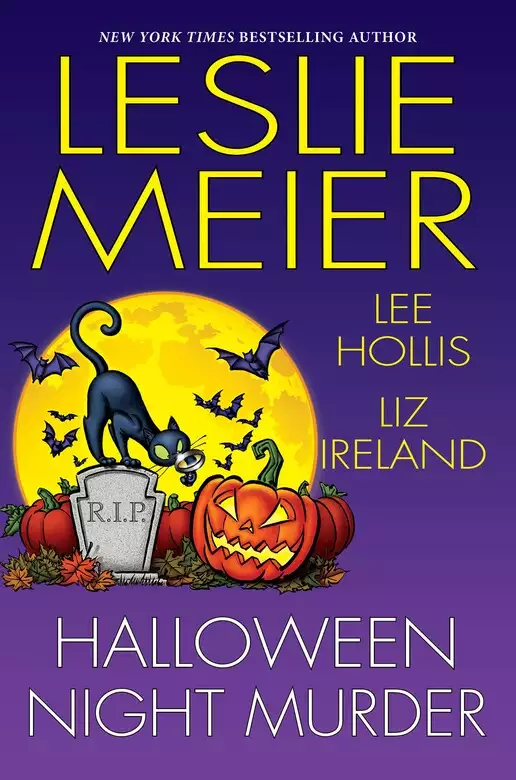
There’s usually a chill in the air when Halloween arrives—but in these three novellas by beloved cozy mystery authors Leslie Meier, Lee Hollis, and Liz Ireland, the crimes are even colder than the haunted climate . . .
HALLOWEEN NIGHT MURDER by LESLIE MEIER After a tiring but satisfying day of organizing Halloween festivities, Lucy Stone is surprised by a lone late-night trick-or-treater at her home in Tinker’s Cove, Maine. The next morning, she’s heartbroken to learn that the teenager died in a hit-and-run just minutes after she gave him the last of her candy supply. Haunted, she starts digging into his story—and discovers some dark secrets . . .
DEATH OF A HALLOWEEN NIGHT STALKER by LEE HOLLIS Bad weather has stranded restaurateur Hayley Powell and her friends in rural Maine—and the only shelter available is a spooky spot where they’re welcomed warmly by the lady of the house—but coldly by her suspicious, gun-toting son. They’re even more nervous after he scares them with his Halloween zombie costume—but the real fright is yet to come . . .
MRS. CLAUS AND THE WILY WITCH by LIZ IRELAND Disgraced elf Flake has returned from exile just in time for Halloween, but not everyone in Christmastown thinks he’s truly reformed. When Pumblechook the snowman suffers a mysterious fate, and a fellow elf is felled by Flake’s caramels, Mrs. Claus must determine whether the sticky-fingered Flake has become a hardened criminal—or if sorcery has invaded Santaland . . .
Release date:
August 26, 2025
Publisher:
Kensington Books
Print pages:
320
* BingeBooks earns revenue from qualifying purchases as an Amazon Associate as well as from other retail partners.
Lucy Stone was dead tired when her head finally hit the pillow, but even though she was physically exhausted, her mind was racing and she couldn’t fall asleep.
It had been the perfect Halloween, she thought, which might well serve as the lede for the story she would write tomorrow for the Courier, the weekly paper that delivered local news to the little coastal town of Tinker’s Cove, Maine. She’d long been a reporter and feature writer for the paper, which was owned by her friends Ted and Pam Stillings, and now had an online edition and had expanded coverage to serve the entire county.
Lucy’s focus had continued to remain the little town of Tinker’s Cove, where she and Pam, and two other friends, Sue Finch and Rachel Goodman, had teamed together to create the Hat and Mitten Fund. The fund was originally created to provide warm winter clothing for local kids, but had grown through the years and now also provided school supplies, Christmas gifts, summer camp scholarships, and an annual Halloween party.
That party was highly anticipated and the four friends, along with a faithful coterie of volunteers, had gotten to work early that morning to transform the elementary school gym into Spook Hollow. They’d hung decorations and strung lights, constructed a tent for fortune teller Madame Zostra (actually Rachel decked out in a turban and flowing robes), set up all sorts of games and craft tables, and loaded the tables with a variety of sugary treats. There were witches’ fingers, eyeball cupcakes, jack-o’-lantern cookies, marshmallow ghosts, and gallons of “poison” punch to wash it all down. When the doors opened, the kids poured in, requiring constant supervision as they played the various games and helped themselves to the treats. It was hectic and noisy, a DJ blasted out “Monster Mash” and other tunes, and it all ended with a costume parade when all the kids marched around the gym and prizes were awarded for the best costumes. The festivities ended at five o’clock, when the kids were dismissed and given goody bags containing healthful treats and toothbrushes to take home.
It had all gone off like clockwork, thought Lucy, rolling onto her other side and flipping her pillow over. This year, for the first time, the cash on hand had even allowed for the fund to hire the school’s custodial staff to do the cleanup. It couldn’t have gone better, she decided, remembering the sense of satisfaction she felt when the party was over and she’d stepped outside into the cool October night. As she made her way to her car she’d noticed the sky was clear, the moon was full, and a brisk breeze was tossing the dry, fallen leaves all around. As she drove through town she’d gone slowly, admiring the homes that were decorated for the holiday. Some simply put out a candlelit jack-o’-lantern, others set out huge inflatables and strung orange lights from their porches, and others even transformed their lawns into fake graveyards complete with tombstones and scattered bones. Ghosts were everywhere, a skeleton seated in a Hula-Hoop dangled from a branch, unfortunate witches had crashed into trees, numerous spiders had been busy covering bushes and hedges with their webs, while others hung suspended over doorways and crawled across roofs. Pumpkin people, harvest figures created from old clothes stuffed with rags and topped with pumpkin heads, lounged on porches. One fellow with droopy pants that revealed two plump pumpkin buttocks was bent under the hood of his car, attempting an engine repair. When she braked at the traffic light on Main Street, she saw a bird fly across the road. Not a bird, she realized—birds don’t fly at night. It was a bat! The absolutely perfect end to a perfect Halloween.
Lucy had been especially careful as she drove home, watching out for the groups of costumed trick-or-treaters who were going from door to door, collecting goodies. It was on nights like these, when the whole village came together, that Lucy felt especially lucky to live in a town like Tinker’s Cove. She and Bill had moved into their antique farmhouse on Red Top Road years ago, abandoning New York City so Bill could pursue his dream of becoming a restoration carpenter and to raise their family in a small town with trees and fresh air. Now they were empty nesters, their four kids had grown, but Lucy still enjoyed seeing this new crop of youngsters enjoying Halloween. Though, truth be told, the steadily dropping school enrollment figures indicated there were fewer students in this generation than in her kids’. Young families were priced out of towns like Tinker’s Cove, where even the humblest properties now went for sky-high prices.
When she’d got home, Bill reported that only a handful of youngsters had come to their house demanding treats, which had been the trend in recent years. Their house was some distance from town and stood alone, apart from a small development on nearby Prudence Path. “Renee came by with her little guys,” he told her, naming neighbor Frankie La Chance’s daughter, who now had twin boys. “They came as Tweedledum and Tweedledee, they’re cute little guys.”
“Anybody else?” she’d asked, eyeing the bowl of mini chocolate bars that stood ready by the door. If they didn’t give them away, she’d probably end up eating them and gaining five pounds in the process.
“A car pulled in the drive and a bunch of kids tumbled out, I didn’t know them, but they were real polite. They only took one piece each and even said thank you.” Bill was at the stove, stirring a pot of chili, which had become their Halloween tradition. “We’re so far from town, it’s not like we’re going to get a lot of walkers.”
“I know,” admitted Lucy, taking a bottle out of the fridge and pouring herself a glass of chilled chardonnay. “I do miss the days when the kids were little and they’d go out with their friends, roaming all over town.”
Bill nodded, checking on the corn bread that was warming in the oven. “Looks like we’re almost ready,” he said.
“Great! I’m starving,” said Lucy.
Nobody came to the door while they ate, sitting side by side at the round golden oak table where they now took most of their meals. The big table in the dining room was rarely used, except when the family reunited for holidays, something that generally required sensitive negotiations. Elizabeth, their oldest daughter, lived in Paris and only came home on alternate years; son, Toby, his wife, Molly, and son, Patrick lived in Alaska and only managed occasional visits due to job commitments and the high cost of travel. Sara, who lived in Boston with her partner, Jodi, and Zoe, who was now married to a Red Sox player and lived near Boston in suburban Westwood, were theoretically closer but had to balance visits with two sets of parents.
“Don’t forget, we’ve got to watch Rocky Horror,” Bill had said, noticing that Lucy had fallen silent, reminding her of a favorite Halloween tradition.
“Great Scott!” exclaimed Lucy, smiling. “But don’t forget,” she added, thinking of the time difference, “I want to Zoom with Patrick before we go to bed.”
When they’d finished eating, Bill went into the family room to set up the DVD player and Lucy cleared the table and loaded the dishwasher. She had wiped the counters and was ready to join him when there was a knock on the door. Lucy glanced at the clock; it was going on eight, which wasn’t all that late, and reached for the bowl of candy. Opening the door, she discovered a single trick-or-treater. He was pushing the age of what she considered the limit for trick-or-treating, probably well into his teens, but what did it matter? She had plenty of candy, and there hadn’t exactly been many others. His costume appeared to be a last-minute effort, merely a blue paper hospital mask and a man’s white shirt worn backward, along with a set of pink rubber gloves. “So you’re a doctor?” guessed Lucy.
“Yeah. Dr. Strangelove,” said the kid. “Trick or treat?”
“Sure,” said Lucy, dropping a handful of mini bars into the grubby pillowcase he was holding. Then, noticing his disappointed expression, added to the fact that he was awfully skinny, too skinny really, she emptied the bowl.
“Thanks, lady,” he said.
“You’re welcome,” she said, figuring that there weren’t going to be any more trick-or-treaters and she didn’t want the temptation of the leftover candy. “Happy Halloween,” she added, as he hopped down the porch steps.
So what was keeping her awake, she wondered, checking the clock and seeing it was almost midnight. It had been, all told, a perfect Halloween. The party had been a big success, Rocky Horror was fun, the Zoom with Patrick had gladdened her heart. Her grandson was growing up, but was still young enough to enjoy wearing a costume. He’d given his choice a lot of thought, he told them, but finally settled on Harry Potter. “I wish I could do magic like him,” he’d confided, reminding Lucy that Halloween was about more than simply putting on a costume. It was an opportunity for kids to explore a different identity, for one night anyway.
“Grandma, what kind of costume would you choose?” he’d asked. “If you weren’t too old to go trick-or-treating?”
Taken aback, Lucy had to give it some thought. “Nancy Drew,” she finally said.
“Miss Marple would be more appropriate,” teased Bill, getting a dirty look.
Reviewing the Zoom, even with Bill’s wisecrack, Lucy decided it was the best part of the day. She was smiling to herself as she rolled over once again and rearranged her pillow, then found her thoughts turning to that last trick-or-treater. Who was he? she wondered, thinking she should have asked for his name. Where did he live? And why was he out alone, so far from town? Did he live nearby? Certainly not on Prudence Path, where the houses were going for a million dollars nowadays, if those worn-out sneakers he was wearing were any indication. She had no answers to these questions, so she tucked them away in the back of her mind for further investigation. Tomorrow, maybe, she thought, wiggling closer to Bill, who was gently snoring and finally drifting off.
Next morning, she woke rather later than usual. Bill had gone, but the coffee pot was still hot when she went down to the kitchen, and her favorite mug was beside it. She filled the mug and was carrying it over to the table when there was a knock at the door. Peering through the glass window, she saw her friend Officer Barney Culpepper and waved him in. She was taking that first, crucial sip of coffee when he marched in, removing his cap.
“Help yourself to coffee,” said Lucy, who was focused on the reviving beverage.
“Thanks, but I’m all set.”
Lucy raised an eyebrow. “Really?”
“Yeah. Doc told me to cut back on the caffeine.”
“How’s that going?” asked Lucy, who couldn’t imagine starting her day without a big mug full of strong black coffee.
“I can drink some, I just can’t have it all day, like I used to.”
“Sit down, take a load off,” invited Lucy.
“Actually, I’m working,” he said, pulling out a chair and seating himself. “Interviewing folks in your neighborhood. Did you see or hear anything unusual last night?”
“No,” said Lucy. “Why?”
“There was a hit-and-run, right in front of your house. A kid, out trick-or-treating.”
Lucy suddenly felt sick. “Is he going to be okay?” she asked, picturing the scrawny kid who’d been at her door the night before.
“Uh, well, Lucy, I’m sorry to tell you this but he’s, um, passed.”
Lucy struggled to understand; how could this be? He’d been at her door, right in front of her, and now he was dead? “I can’t believe it! It must be the same kid, the one who was here, trick-or-treating. It was getting late, like eight, maybe. I gave him all my candy.”
“You didn’t hear anything?”
Lucy shook her head. “If I had, maybe we could’ve got him help.” She collapsed onto the table. “This is terrible. We were watching Rocky Horror Picture Show when that poor kid was . . .”
“I’m no expert, but I’ve seen a lot of accidents and it didn’t look to me like the kid had a chance, Lucy.” He let out a big sigh. “You couldn’t have done anything.”
Lucy shook her head. “This is awful, he was so young.” She saw him in her mind’s eye, in his makeshift costume, the grubby jeans, the worn-out sneakers. “Do you know who he is? Was?”
“No. Nobody recognized him. We’re investigating. There’s been rumors that squatters have moved into that old farm . . .”
“That abandoned place? The old chicken farm way back in the woods, just across the road?”
“Yeah, that’s the one.”
Lucy was incredulous. “People are living there?” In her mind, the derelict place was no longer fit for chickens, much less a family.
“Like I said, we’re investigating.” He cast a doleful eye at the coffeepot, which had just dinged, signaling it was turning off. “You haven’t seen any activity on the road?”
Lucy shook her head. “You want the last of the coffee?” she asked. “It’s going down the drain if you don’t drink it.”
“Thanks, old habits die hard,” he said, getting up, taking a mug out of the cabinet, and filling it. “Sugar?” he asked.
“On the counter.”
“Milk?”
“In the fridge.”
Barney fixed his coffee, then sat back down at the table. “I suppose if they’re squatters they wouldn’t exactly advertise their presence, you know?”
“The kid looked really poor,” she said. As a reporter, Lucy was well aware that there was an underclass in town of folks who struggled to survive. A lot of people were barely managing and it only took one bit of bad luck like a car breakdown, a cut in hours, or an illness to throw their lives into chaos. Suddenly homeless, they lived in their cars, built makeshift camps in the woods, or squatted in abandoned houses. There was a social safety net, but not all these folks were able to avail themselves of help due to red tape, addiction, mental health issues, or even a criminal record. She wondered what sort of life the kid had been living and thought of the clothes filling the upstairs closets that her kids had left behind, all the food stored in her pantry. “I hate to think of him lying there . . .”
“It was the candy,” said Barney, after taking a big slurp of coffee. “He was lying in the grass beside the road, pretty much hidden because it was still dark. It was Jim Peters, he’s on the road crew, you know, and was on his way to work. He says he saw a bunch of shiny candy wrappers, reflecting his headlights, you know, and stopped to clean them up. That’s when he found the kid.”
“What time was that?” she asked.
“About two hours ago.”
Now that the first shock had passed, Lucy was thinking like a reporter. This was a tragedy, but it was also news. “What actually killed him? The car? The impact?”
“Like I said, I’m no medical examiner, but it looked to me like the impact of the vehicle threw him into the side of the road where his head hit a rock. Bad luck.”
“I suppose there’ll be more information later,” she said, rising from her chair.
“For sure,” said Barney, draining his mug.
“Have you questioned the folks on Prudence Path?” asked Lucy.
“On my way now,” he said. “Don’t expect to get much, they’re even farther away from the accident than you.”
“Maybe one of them did it,” said Lucy. “I suppose they might not have realized, just felt a bump or something.”
“I’ll be checking their vehicles, that’s for sure.” Barney stood up and replaced his cap. “I’m getting too old for this sort of thing, tramping from door to door, asking questions, getting people to open up their garages.” He let out a big sigh. “Thanks for the coffee.”
“Sure thing,” said Lucy, who knew she also had a long day ahead of her. She put the mugs in the dishwasher and headed upstairs to get dressed.
Lucy’s spirits were low as she struggled on through the long day at the Courier office. This was the sort of thing that really got you, she thought. Tinker’s Cove was a small town where everyone knew everyone and people routinely left their homes and cars unlocked. Traffic was light and kids played ball in the street; drivers heeded the signs warning them to watch for children and drove slowly through the tree-lined streets. Of course, accidents happened, but rarely. She couldn’t remember the last time anyone had been hit by a car, much less a hit-and-run. Of course, the driver might have been unaware, or thought he hit a deer, which was especially common in the fall. Sometimes they weren’t seriously injured and just ran off into the woods.
The press release from the TCPD came just before quitting time, announcing that the hit-and-run victim was named Paul Mullen, age seventeen. That surprised Lucy, who wouldn’t have guessed he was that old. He was definitely undersized, possibly even malnourished. As Barney had suggested, Paul had been living at the old abandoned farmstead with his mother and three siblings in deplorable conditions. The mother, Chrissy Mullen, age thirty-five, was arrested and faced numerous charges including drug violations, child abuse, and neglect. And all this, she thought, was happening right across the road from her house. It was simply heartbreaking, she thought, writing up the scanty details as breaking news for the online edition.
She’d just finished when the little bell on the office door jangled and Officer Sally Kirwan came in. This was unusual because, even though Lucy and Sally were good friends, Sally rarely came to the newspaper office. Even more unusual was her request. “Lucy, I want to ask a big favor.”
That gave Lucy pause. It was more often Lucy who was asking Sally for favors, especially police department inside information. Now, it seemed, Sally was calling in her debt. “Of course,” said Lucy.
“It’s the Mullen kids, Lucy. I need a place for them just for the night.”
“You mean the kids who’ve been squatting at the farmstead?”
“Yeah, there’s three. Two boys and a girl. They’re cute,” added Sally, as if describing a litter of puppies.
Lucy doubted that, having seen the shape Paul was in. “What about social services?” she asked.
“Budget cuts, staffing problems, they’re in disarray. They’re working on it but need more time. It seems these kids have fallen through the social safety net, they’re not even enrolled in school. We don’t want to keep the kids in the lockup and I thought of you. You’ve raised a family so you’re experienced with kids and you’ve got that big house . . .”
Lucy thought guiltily of their big comfortable house, with heat and electricity and hot water, well stocked with provisions for emergencies like northeasters and blizzards, not to mention more than enough empty beds for three kids. “Just for one night?”
Sally nodded.
“Okay,” said Lucy.
“Great,” said Sally, with a big sigh of relief. “I’ll give you an hour or so to get ready and then I’ll bring them to the house.”
Lucy’s first thought was to call Bill, which she did as soon as she parked at the IGA to stock up on foods she thought the kids would prefer. She’d been planning baked salmon, couscous, and broccoli rabe for dinner and she doubted that was the sort of food they would like, or even eat. Pulling into the nearly empty lot at the store and parking, she waited for Bill to react to the news.
Much to her surprise, he was all in favor. “Three kids? It’ll be nice to have a full house again. Like it used to be, a hungry bunch at the dinner table.” He paused, then said, “I guess this means we’re not having the salmon.”
“Yeah, I don’t think the kids would like it.”
“Me neither,” said Bill. “So should I throw it away?” he asked, in a hopeful tone of voice.
“No!” Lucy had splurged on the expensive, wild-caught variety. “We’ll have it tomorrow. The kids are only staying for one night.”
“Too bad,” said Bill, who wasn’t a fan of salmon, or couscous or rabe. “So what are you going to give them?”
“Frozen pizza, mac ’n’ cheese . . .” began Lucy.
“I bet they’d like some Cocoa Puffs or Lucky Charms,” he suggested, naming two cereals that Lucy had stubbornly refused to buy for her family, despite frequent requests from not only the kids, but Bill, too.
“You’re a big baby,” she said.
“I’m just thinking of those poor kids,” claimed Bill, defending himself.
“Right. I gotta go,” said Lucy, ending the call and dashing into the store where she grabbed a cart and started zooming through the aisles, collecting the sugary cereals and processed foods she figured they would want, tossing in apples, bananas, and a gallon of milk as a way of sneaking in what she considered real nutrition.
Back in the car and heading home with the groceries, Lucy wondered if Bill really knew what they were in for when he’d suggested it would be fun to have a houseful of kids again. Lucy wasn’t sure what would happen, but she doubted it was going to be the fun-filled picnic Bill expected, especially since the kids were most likely traumatized by the death of their brother and the arrest of their mother.
She’d just gotten the groceries unloaded and Bill was down in the cellar, searching for some board games, when Sally arrived in a police cruiser with the kids. They were a ragtag group, thought Lucy, as Sally introduced them. Jack, the youngest, was five; then there was Rose, eight; and Jayson, eleven. All three were filthy and ill-clad, dressed for the most part in grubby T-shirts, jeans with torn knees, cheap sneakers, and, on Rose, whose little feet were blue from the cold, only a pair of cheap flip-flops. As much as she wanted to throw all three into the tub, she figured dinner was a more pressing issue. “Dessert first,” she announced, seating them at the kitchen table and opening up a bag of chocolate chip cookies.
Sally drew Lucy aside. “As you can see, they’re in tough shape. Don’t expect too much. They’re almost feral, they’ve been mistreated and they’re going to need a lot of support considering everything they’ve been through. You’re not going to be able to fix them in one night. Let them take the lead, okay? Don’t push ’em.”
Lucy had been planning on giving them all baths, providing them with pajamas and warm castoffs, and sending them on their way in the morning with their own freshly laundered clothes, but now wondered if that was a good idea and asked Sally what she thought.
“No. Hands off, and I mean that. Don’t even touch them unless they initiate contact. And don’t expect them to get undressed, that might be traumatic for them. We don’t know what kind of abuse they may have been subjected to.”
“Right,” said . . .
We hope you are enjoying the book so far. To continue reading...

 Please log in to recommend or discuss...
