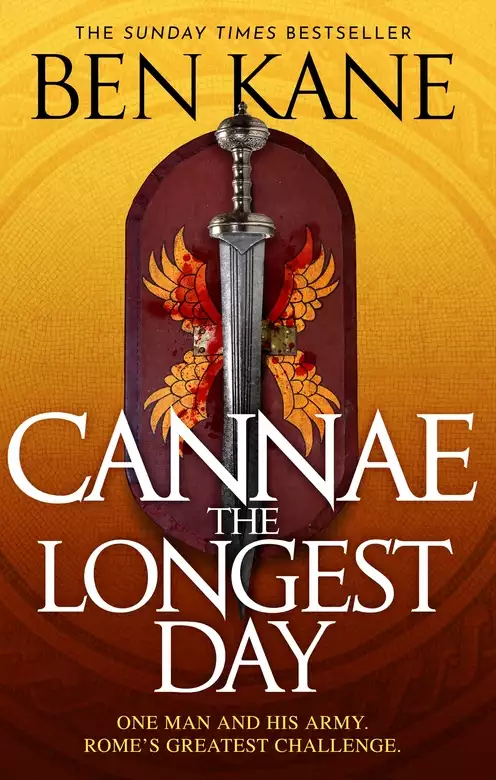
From the Sunday Times bestseller comes a gripping retelling of Hannibal's greatest trial - the battle of Cannae.
Cannae, 216 BC - Under a blisteringly hot sun, Hannibal Barca, perhaps the most skilful general in history, leads his army against the unstoppable might of Rome. His soldiers are outnumbered two to one.
The momentous battle will determine the Roman Republic's fate.
By the day's end, tens of thousands of men will be dead, the ground saturated in blood. Can Hannibal's army defeat the Roman legions, or will the challenge for the great general prove too much?
Recounted by soldiers on both sides, Ben Kane's historical epic Cannae brings the ancient battle to life as never before. Its cinematic, edge-of-the-seat action will drag readers into the midst of the fear, madness and brutality of Cannae, one of the bloodiest and most-studied battles in history.
Readers love Ben Kane: 'Powerful evocation of our history' ⭐⭐⭐⭐⭐ 'An engaging and exciting read' ⭐⭐⭐⭐⭐ 'Gripped me from start to finish' ⭐⭐⭐⭐⭐ 'Epic tales, gorgeous prose, non-stop action' ⭐⭐⭐⭐⭐ 'Rich in period detail and lively in narrative' ⭐⭐⭐⭐⭐
Publisher:
Orion
Print pages:
240
* BingeBooks earns revenue from qualifying purchases as an Amazon Associate as well as from other retail partners.
The origins of this book are worth explaining. A couple of years ago Paul Stark, head of Orion Audio, suggested that I write a fast-moving, radio-play-style audiobook. Inspired by his enthusiasm, I instantly thought of the battle of Cannae. The titanic contest featured in Hannibal: Fields of Blood, but the chance to repeat the process with an almost cinematic approach, told from multiple points of view, hugely appealed, and so the plan was hatched.
Less than a year after its audio release, Cannae: The Longest Day has entered the ‘normal’ publishing pattern, released in hardback and ebook, to be followed next year by a paperback.
I decided to leave out the fictional characters from my Hannibal books from the outset; their presence would complicate matters, I felt, and open up the possibility of errors.
Many readers will be unfamiliar with Hannibal’s struggle against Rome and the Punic Wars in general. To set the scene then: in the early third century BC, Carthage was a powerful city-state in modern-day Tunisia, and Rome was not an empire, but a republic. It controlled much of Italy, but not all, and had no foreign territories.
The first Punic War did not involve Hannibal, and lasted a staggering twenty-three years, from 264 to 241 BC. Describing that conflict is beyond the remit of this book, but a few details are useful. The war centred on Sicily, and in the waters around the island. Initially, Rome didn’t even possess a navy. Carthage by contrast had an enormous fleet, and controlled swathes of north Africa, southern Spain and Portugal as well as the islands of Sicily, Corsica and Sardinia. By the end of the war, against all expectation, Rome emerged victorious.
Underestimating the ability of Carthage to pay the reparations forced upon it in the aftermath of its defeat, the Roman Senate also failed to take note of Hamilcar Barca, a general who had fought in Sicily. Relocating to Spain with his young son Hannibal, Hamilcar carved out a vast personal kingdom in the years following, backed by an army which was loyal to him, not Carthage. This disparate force was to become the host Hannibal led to Italy.
The year 218 BC marked the ‘official’ beginning of the second Punic war. At the head of up to one hundred thousand men, Hannibal marched from Spain into France. Soon after crossing the River Rhône, a chance encounter with Roman forces caused him to take the fateful decision of entering Italy via the Alps rather than the easier coastal route. Savage autumn weather and hostile tribes saw his army suffer fifty per cent casualties during the crossing of the mountains. Replenishing his strength with Gauls, Hannibal bested the first force sent against him in December 218 BC.
The battle at the River Trebbia was not a conclusive victory, however, the legions punching a hole through the Carthaginian centre. A game of cat and mouse followed, two Roman armies attempting to track down and defeat Hannibal as he progressed down the peninsula. The Carthaginian general got the upper hand first, ambushing the legions in June 217 BC at Lake Trasimene in north-central Italy. Again some legionaries broke through Hannibal’s centre, but the defeat for the Romans this time was decisive. Many thousands of soldiers died, and a strong cavalry force sent to the legions’ aid was utterly destroyed.
This unexpected setback caused great consternation in Rome, and the man given subsequent command of its armies adopted a cautious policy of shadowing Hannibal, attacking his supply lines and only offering battle under favourable conditions. Despite his unflattering nickname of ‘the Delayer’, Quintus Fabius Maximus’ tactics gave the Republic breathing space to gather strength.
Shortly after Fabius had given up office, Gaius Terentius Varro and Lucius Aemilius Paullus were elected as consuls, the most senior Roman magistrates. Given joint command of eight legions (and a similar number of allied soldiers, socii), they went hunting for Hannibal, by now deep in southern Italy. Alternating command day by day, with Varro wanting battle and Paullus content to be more cautious, they closed in on the Carthaginian host. It is perhaps simplifying their relationship – yet still relevant – to state this: the consuls had been charged by the Senate to find and defeat Hannibal. A battle would have taken place, if not at Cannae, then somewhere else.
The Roman army reached Cannae, southwest of the modern-day Puglian town of Barletta, late in July 216 BC. Several days of indecisive skirmishing and manoeuvring followed, but as the sun rose on 2nd August, the stage was set for one of the most momentous battles in European history.
NIGHT2nd day of Mensis Sextilis, the year of Consulship of Varro and PaullusCannae, Apulia, SE Italia
Puer shifted position, unable to get comfortable. Sleep had been fitful. Indifferent summer weather had ensured a cool night, and he had no blanket, just his tunic and the bundle of warmth nestling against him that was Canis. Nonetheless, the task facing Puer meant he huddled down into the dirt, keeping his eyes closed, telling himself he had a little more time.
Desired-for sleep did not come. Images tumbled around his tired mind. Being caught by the savage Carthaginians and slain out of hand. Escaping death somehow, returning safely to the latifundium only for the vilicus to discover a number of sheep missing. He would whip Puer senseless. A second beating administered by their irritable mistress. She, waspish, ordering a favourite sting-in-the-tail, for Puer to be deprived of food also. One day was manageable, or two; he was used to it. Losing sheep merited a far weightier penalty, however. Four days or longer, it could be, with the mistress hawk-watching the kitchen slaves so no one took pity on Puer.
He had learned long since not to cry, but wanted to now. Ruthless, he stifled the emotion, and relived the previous day. After skirting around more legions than seemed possible to exist, he had been horrified to find Hannibal’s army encamped in one of his usual grazing spots. It had been a gods-sent blessing to avoid discovery, Puer going to ground in a hollow as the sun neared the horizon, with the nearest Carthaginian troops, unknowing, a mere ten spear-casts away. He had not dared to move the flock in the dark, instead lain scared and cold, hoping a new day would bring an opportunity to escape not just Hannibal’s men, but the enormous battle which threatened. This was his Herculean task.
No more pretending to rest, he thought, opening his eyes. He was grateful to see stars glittering overhead, and in the east, the sky was still dark. There was time to get moving, before the Carthaginians woke. His belly knotting, he stirred, and Canis was up on his feet. So was Macula, the second dog, who had been lying close by.
‘Quiet,’ Puer whispered, stroking the soft-as-down hair behind Canis’ ear, then doing the same to Macula. ‘Not a sound.’
They waited, patient, tongues lolling, and his heart calming, he petted them again.
Macula, old and reliable, had come with the shepherding job. Canis was the first dog Puer had ever trained himself, and he was good. By all that was sacred, he was good. It was as well neither his mistress nor the vilicus ever saw them working the sheep together, or Canis might have been sold. Money was always short on the latifundium, and a skilled dog was worth more than Puer was.
He was very fond of Macula, but he loved Canis more than anything or anybody living. It wasn’t heartless to be so. His parents were dead, and his siblings, all killed during a Roman attack on his Illyrian village five summers before. Amid the dark memories, he remembered his family had not called him Puer, ‘Boy’, but Glaukias. The name was long gone, though. Enslaved, he had been transported to Italia and bought off the block in Brundisium. Puer he had been dubbed then, and Puer he remained.
It wasn’t far to Brundisium, he thought, allowing the ember of hope in his heart to glow a little. Reach the port, and he could surely find passage back over the sea to his homeland. How much it would cost, Puer did not know. Remembering the few bronze asses in his possession, the ember dimmed. It would take years upon years to earn sufficient coin. Unless he stole from his mistress, said a little voice in his head. He shoved away the idea; there was already enough potential punishment in store.
Which brought him back to his present danger.
The sheep were getting to their feet, but a gesture from Puer had the dogs circle them, a reminder not to move a step. On hands and knees, he worked his way up the dewy grassed slope. At the top, he peered out of the hollow.
Watch-fires glimmered in the darkness, proof that the great Carthaginian host of the night before was still there. How Puer wished he had imagined it, but as his mother would have said, there was no point crying over spilt milk. He considered his options. Retracing his steps was pointless; the legions lay in that direction, and although they would not murder him, they would take his sheep. He closed his eyes, picturing the terrain to his left. The Carthaginians had not camped especially close to the river. Skirt along the bank without being spotted, and he would reach open ground, and be able to aim for the latifundium, a day’s walk away. The Romans – Hannibal’s focus – were to Puer’s right and rear, which meant the Carthaginians’ attention would all be concentrated there. So he hoped. So he prayed.
With Canis and Macula on the flanks, keeping himself at the rear, Puer got the sheep out of the hollow. Used to being herded, they moved slowly in the direction of the still-invisible river. But for the shush of their hooves on the short grass, they were silent; so were the pacing wraiths, Canis and Macula. Puer threw more thanks skyward.
They reached the bank, the water outlined as a deeper shade of black. It too moved without sound, there being no rocks or vegetation to speak of. A night bird called, and was answered by another. Puer, hope growing, began to walk along the river. With it on his left, his work, and the dogs’, was now easier. They just needed to reach the open ground. It was some distance, given the size of Hannibal’s army, but he hadn’t heard a voice yet, or the sound of anyone stirring.
All went well for a time.
Puer allowed himself to imagine a hot meal, sitting outside the farmhouse kitchen. Some bean stew and a hunk of leftover, not-too-stale bread, or if he was really lucky, a pork bone with some meat attached. His belly growled; he had not eaten since the previous morning, and that had not been much. Imagination running wild, he pictured the sweet pastries his mistress was fond of, the ones she got the cook to make for important visitors. He had tasted one once, when the cook had been in an especially good mood. Another of his favourites was the sausages at Saturnalia, when slaves ate as well as their masters.
Voices, straight ahead, speaking a guttural tongue alien to Puer. Frantic, for if the sheep kept on, they would surely walk into the midst of whoever it was, he risked a low whistle to the dogs. A quick gesture followed, and they loped in front of the flock, bringing it to a halt.
Puer stood, sweating, bladder twinging, unsure what to do, acutely aware he needed to do something. Over his shoulder, the eastern sky was paling. If he turned back, there was further to go, and it would soon be bright enough to be seen by a blind man. Stay where you are, he decided. Hopefully, the voices were just men going to the river for water. If so, he could proceed when they were gone.
The voices continued talking. One asked a question, two others answered in gruff tones. There was a chuckle and another question, and then a fourth voice, more commanding, silenced both.
Puer fought back panic. Let them be sentries, he thought, and the last man their officer, come to find out why the pair had strayed from their posts. He prayed to the sun god, mightiest of Illyrian deities. Let them walk away, he begged, and I shall creep past with no one the wiser.
A dozen heartbeats thudded by.
Puer tensed, preparing to give Canis and Macula the command to allow the sheep move forward again.
Three figures loomed out of the gloom to his right. Big men, spike-haired, bare-chested and in trousers, they carried hexagonal shields and spears.
These were no Carthaginians, light-brown-skinned and swarthy-complexioned. Puer had never seen the like, and briefly wondered if he had entered the underworld unknowing, to encounter demons.
The men grinned and laughed to see him and his sheep. Glances were exchanged. One demanded something of Puer.
What are you doing here? he intuited. ‘I am herding my master’s sheep,’ he answered in Latin, the language he’d learned as a slave.
The men, no demons but warriors, reacted with fury. More questions were barked. The next instant one ran his spear through Macula, who had strayed too close. The old dog went down without a sound, his blood soaking the grass crimson.
Puer cried out in anguish and terror. He would be next. A whistle brought Canis to him, and he prepared to run. It was doubtful they could both outdistance spears, but to stay was no choice at all.
A shouted order. The trio, arms drawn back ready to loose, froze.
The man who had spoken approached, his muscled breastplate and sword denoting him as an officer. He was more like the Carthaginians Puer had heard the vilicus talking about, sallow-skinned, black of hair. He snapped a few words at the warriors, who scowled but lowered their weapons. Looking at Puer with surprise, he said in accented but reasonable Latin, ‘What are you doing here, boy? Have you a death wish?’
‘I-no, Domine. I have to graze the sheep. I did not know Hannibal’s army would be here. I …’ Puer hung his head, aware his life yet hung in the balance.
‘Come now.’ The officer, who was middle-aged, and had a kindly face, came closer. ‘Those Gauls will not harm you.’
‘G-Gauls?’ Puer had never heard the word.
‘Fierce, aren’t they?’
‘Aye.’ Puer stared at Macula, and for the second time that morning, wanted to cry. ‘They killed my dog.’
‘Not the only thing they would have done had I not arrived.’
Puer watched the warriors, marking the one who had so casually ended Macula’s life. He had a bad scar on one forearm, a snaking, purple line.
‘A slave, eh?’
‘Yes, Domine.’
‘Do you like your owner?’
‘No, Domine! She is cruel. So is the vilicus.’
The officer smiled at his vehemence. ‘How would you like to serve me instead?’
Puer had little choice here, but as his father had been fond of saying, only a fool does not try to drive a better bargain. ‘As a slave, Domine, or free?’
A laugh. ‘Feisty! Luckily for you, I am in a good mood today. Serve me well, and you shall be freed in a year’s time. How does it sound?’
Puer could not believe his ears. ‘Fine, Domine.’ He stuck out his hand, solemn-faced.
The officer took the grip.
‘Do I have your word, Domine?’
‘You do.’
‘I will serve you loyally, Domine – I swear it by the sun god.’
The officer seemed not just satisfied, but pleased.
‘Shall I look after the sheep, Domine?’
‘Those creatures are for the pot, boy! Fifty thousand men need a lot of food each day. No, you will be my personal servant. My last one died after Trasimenus.’
‘Where, Domine?’
‘The lake where Hannibal massacred a Roman army last summer. You heard about it, surely?’
‘No, Domine.’
A rueful face. ‘I suppose it is far from here, and means little to a slave.’
Puer didn’t know what to say. ‘Will Hannibal win again today?’
‘I would wager my life on it.’
‘Good,’ said Puer, awful images filling his head.
‘You do not like the Romans.’
‘They butchered my family.’
‘That is reason enough for hate.’
Puer voiced the words for the first time: ‘I would kill them all.’
Shielded by cavalry, the legions would begin crossing the river, facing southwest towards Cannae. Varro, commanding, was to position himself on the left wing with the allied horse, the hill guarding his other flank. The legions were to form the centre. Paullus, leading the Roman cavalry on the right wing, would have the protection of the Aufidus river to his right.
Hannibal would respond to the challenge, sending skirmishers over the river first so the rest of his soldiers could cross in safety. These skirmishers rapidly came into contact with the Romans. As they did so, the main Carthaginian force moved into place, facing northeast towards the enemy with the Aufidus to their left and the hill of Cannae to their right. The left wing was formed of Iberian and Gaulish cavalry, the right of Hannibal’s fearsome Numidians. The centre’s shape was highly unusual, an inverted ‘U’, with the section closest to the Romans made up of Gaulish and Iberian warriors, and the long sections composed of Libyan heavy infantry. It’s thought the Libyans were invisible to the approaching Romans.
SUNRISEIn the Roman campHastati
Kill them all, thought Pulcher. It was his silent, monotonous refrain.
He had lain awake much of the night. He hadn’t been alone. Eight shared the stuffy leather tent. There had been restless shuffling, coughs, and smelly farts no one would own up to. Pulcher suspected nerves had prevented his inexperienced comrades from sleeping. It had been the same for him.
He had a second reason. Vengeance.
Three brothers, Pulcher had had. Now he had one, the youngest, living on the family farm near Alba. The older two had been at the bloody defeat of Trasimenus. Pulcher didn’t know if they had died fighting, drowned in the lake like so many, or been taken prisoner by the Guggas and executed afterwards. They were dead, whatever had happened.
Broken-hearted, his mother had gone into a decline, refusing to eat or drink, and passing into the next world not long after. Pulcher was greatly affected too. He had never wanted to be a legionary previously; farming was his world, but after his mother’s death, life became unbearable. Their father, hard-eyed, unshaven, drinking from sunrise to sunset; his youngest brother crying himself to sleep each night. One day Pulcher could take it no more. He headed for Roma and joined up as an hastatus. More than a year later, with little action yet seen, he was here to kill Guggas, Libyans, Numidians, Gauls, Iberians. It did not matter who. If they fought for Hannibal, they were to be wipe. . .
We hope you are enjoying the book so far. To continue reading...

 Please log in to recommend or discuss...
