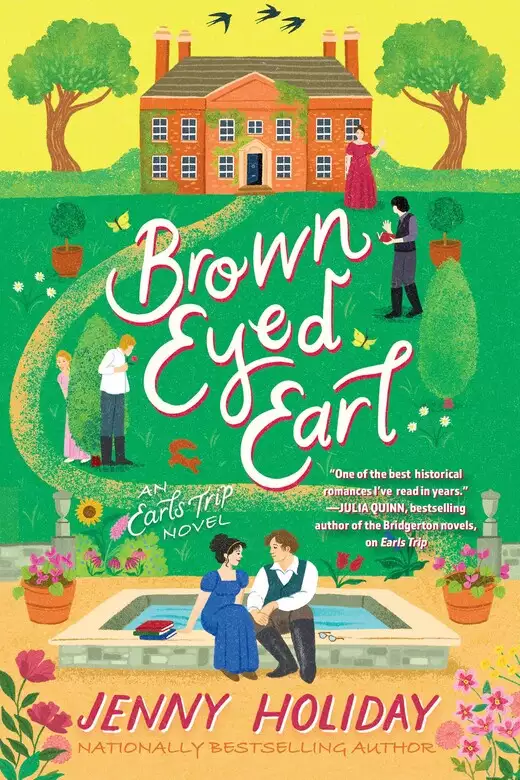
Ted Lasso meets Bridgerton in USA Today bestselling author Jenny Holiday’s laugh-out-loud bromantic comedy featuring three Regency-era Earls on their annual trip. These ride-or-die buddies offer one another unconditional support in everything from Lady problems to family woes, but this year, the country house retreat will be earls-plus-girls as our trio of heroes is joined by two beloved wives . . . and an exceedingly charming lady’s companion.
Simon Courteney isn’t like the other earls. He was never supposed to be the heir or the spare. Yet when his older brothers tragically died in an accident, he suddenly found himself a peer of the realm. Strait-laced and scholarly, Simon is resigned to a quiet life of work and service. The two bright spots in his calendar are the annual Earls Trip with his best friends, Effie and Archie, and his visits to Archie’s mother—where he trades books with her beguiling lady’s companion.
Miss Diantha Brown has long been settled into her role as Lady Harcourt’s companion. On the shelf and alone in the world, it’s a better life than Diantha ever imagined for herself. But her boring yet peaceful existence is upended when an old enemy returns, threatening blackmail and forced marriage.
Determined to escape her fate—and to protect Lady Harcourt—Diantha devises a shocking solution: her ruination. She needs just one thing: a kind, intelligent, brave man to help her . . .
Release date:
October 27, 2026
Publisher:
Kensington Books
Print pages:
304
* BingeBooks earns revenue from qualifying purchases as an Amazon Associate as well as from other retail partners.
Simon Courteney, the Earl of Marsden, put down his book, startled. He had merely intended to pass the time until Archie was due to collect him, but he felt as if he’d lived a lifetime in the quarter hour he’d been reading.
Novels: Who knew?
He shoved the book into his satchel, though he wasn’t sure why. He would be caught out, as he had been last year. He wouldn’t mind. He might even try to entice the boys to read this one. Perhaps it was time to incorporate a book club into Earls Trip.
“Good morning,” he said, standing as his friend, Archibald Fielding-Burton, the Earl of Harcourt, entered the library. “My apologies for having made you come inside. I intended to meet you out front as per usual.” Simon liked to think of himself as the sort of person who was at the ready when it was time to go. The sort of person who was prepared and therefore never surprised. He disliked surprises.
“It’s quite all right.” Archie looked around. “What is different here?” He squinted. “Perhaps nothing. I haven’t been inside your house for … nigh on a year? Can that be correct?”
It was. Simon rarely invited people over. He himself didn’t like being home, so why would he subject his friends to the place? He felt, though he knew he was being illogical, that it was better not to mix Archie and Effie with the ghosts of Number Seven Park Lane. He didn’t want the dead to taint the living. Well, he didn’t want the living to taint the living, but happily, there was no danger of that today. Mother was at Galecroft.
“I have taken down the family portraits that formerly hung in here,” he said in answer to Archie’s question.
“Ah, yes. Who was in here? Not your generation, I don’t think?”
“No. The library was home to my late-seventeenth- and early-eighteenth-century forebears.” He smirked. “Shall I recite their names for you?” He’d been made to memorize them as a boy. The former residents of this room were John, the third earl, and his wife, Agnes, pictured separately and in various configurations with their children, the eldest of whom was also John and who would go on to become the fourth earl at the age of twenty-four. John begat James begat another James. And so on and so forth.
“Oh, goodness, no,” Archie said cheerily. “No recitations on my account.”
“I decided to lighten up the place, given that I spend so much time here. I have censorious ancestors staring me down in the rest of the house. A man’s library should be his sanctuary.” And it was. The library was the only room in the house that felt like his. “The walls have been repapered, too.” He’d chosen a cream damask that stopped just short of being yellow. “You may recall that the walls used to be papered in a rather aggressive, dare I say lurid, violet floral. Which was fine, as far as these things go—I don’t care overmuch what is on my walls—but the spots where the paintings had been were dark and the rest was quite faded. It called to mind a pugilist with his front teeth knocked out.” He hadn’t been able to countenance the pattern made by the unfaded spots. It had, somehow, been considerably less symmetrical than his perception of such when the paintings had been up.
“It looks grand,” Archie said. “Are you ready to go?”
“I am.” Simon had never been more ready for an Earls Trip, in fact, even though he had also never been more trepidatious about an Earls Trip.
“That’s all you have?” Archie inquired outside as a footman hefted a valise into the coach. “No trunk of books? No trove of papers? No weight of the world?”
That last question gave Simon pause, but he merely said, “I have adopted a new packing philosophy.”
“Have you indeed?” Archie looked as if he were trying not to laugh.
“I haven’t brought any books. Well, I’ve brought novels, but no real books.”
Archie did laugh then. “Are novels not real books? Clementine would scold you for saying as much.”
So would Miss Brown.
“You know what I mean.” Simon climbed into the coach and settled himself against the squabs. “My reading this fortnight is to be refreshing. Absorbing in a way my usual material is not.”
Although he was treating his reading of late as a forensic enterprise. He considered the latest bookmark. He had thought of nothing else since he’d found it last night. What did it mean?
“I am not planning on doing any work at all over the next fortnight,” he declared, perhaps to convince himself as much as Archie.
“Who are you and what have you done with Simon?” Archie teased. “You can’t fool me: You are a lookalike impostor with a fondness for novels and an eye for interior decor.”
“Oh, I am still myself. I have made this decision, but I guarantee I shall fret about it. I shall feel the loss of my books and papers as a visceral thing, akin to going about in society hatless and coatless.” Simon could tell from Archie’s quizzically amused expression that for him, the notion of appearing sans coat and hat was not quite the scandal it would be for Simon. “I tell myself, though, with a certain degree of sternness, that Parliament has just adjourned. Surely I can take a holiday. Well, we always take a holiday this time of year. You understand what I mean. A true holiday.”
At least for the first week. Simon suspected the second week wasn’t going to be very … relaxing.
Archie’s quizzical expression turned fond, and it occurred to Simon that perhaps he ought to hang portraits of his friends in the library. They called themselves a found family, and in his experience, found families were loads better than the real thing.
“A winning strategy,” Archie said. “Your Parliamentary concerns will still be there in a fortnight. You may actually find them easier to wrangle for having had the holiday.”
“That’s what …”
Miss Brown said.
“I’ve been telling you as much for years,” Archie said. “A wonder you’ve finally listened.”
“My lord!” Simon’s housekeeper came running down the stairs just as the coach was pulling away. “You’ve forgotten your lemons!”
Oh no. Simon closed his eyes. How had he forgotten the lemons? And why had Mrs. Tavish not put them in a proper sack? When he opened his eyes again—he had learned the hard way that hiding from the truth achieved nothing—Mrs. Tavish was brandishing two dozen lemons in a string satchel, the plump yellow fruits rolling around almost lewdly for anyone to see.
“Yes, you’ve quite forgotten your lemons,” Archie remarked, not bothering to disguise his amusement as the bag was pressed into Simon’s possession. “Shall I inquire as to why you aren’t packing a pile of work this year but you are packing lemons?” Archie rapped on the ceiling of the coach, and they finally rumbled off.
“I wonder if we should bother making a wager about Effie this year.” Simon hoped the glaringly obvious change of subject would be tolerated.
It was. Archie said, “’Tis uncharted territory. On the one hand, he shan’t be in the garden composing a poem, or beset by unexpected suitors, or drowning in waistcoats he tried on and discarded before attending a ball the previous evening. So he’s less likely to have completely forgotten the trip.”
“On the other hand,” Simon supplied, “even without all the trappings, he remains Effie.”
“Indeed.”
“Still,” Simon said, “we ought to lay a wager for tradition’s sake. I say it will take us thirty minutes to extract him.”
“All right. I will counter with ten. Even if he’s not ready whatsoever, how long can it take to make himself so, given his current situation?”
“You may have a point, but as I said, he is still himself.”
This year, they were collecting Effie from his rooms on Grub Street rather than from his fine house on Hanover Square. Having upended his life to become a printer and poet, these days he had a much smaller home and a much smaller wardrobe, and nobody from polite society, excepting Simon and Archie, called on him.
They shook on the wager, and soon they were pulling up in front of the unassuming soot-covered building in which Effie, technically the Earl of Stonely, lived.
“Oh, look, he’s not outside waiting for us,” Simon said with a smirk. Simon and Archie always needled each other about the Effie wager. It was part of how Simon knew their annual holiday had truly begun. “We’d better go up.”
“Good morning,” Effie said as he opened the door for them. Unfortunately for Simon, he was wearing a coat and hat. “Give me two minutes.”
“Yes, but only two,” Archie said.
“You’re not even going to invite us in?” Simon asked. “What if we want to greet your wife?” He emphasized the two syllables as part of an ongoing jest. Effie and his wife, the magazine editor Julianna, had been married only eight months, and Effie had spent the earliest days and weeks of their marriage seizing every opportunity to utter the phrase my wife and its variations such as my lady, my bride, and even, once, until Julianna swatted his arm and told him to stop being so melodramatic, my helpmeet.
“I know what you’re doing, Simon,” Effie said. “You’ve made your usual wager, and you’re trying to make me dally. But how can I deny you the opportunity to greet my wife?”
He swung open the door and called, “Jules!”
She came from the far room, wiping inky hands on an apron. “Good morning to you, my lords.”
“How goes the magazine business?” Simon asked, and because they didn’t stand on ceremony with Julianna, though she sometimes still did with them—witness the my-lord–ing—added, “Have you any tea? Or perhaps something stronger?”
“We’ve port in the coach,” Archie said.
“Yes,” Simon said, “but a cup of tea here first would be the perfect aperitif.”
“Is this all your luggage?” Archie bent to pick up a small trunk just inside the doorway.
“It is, and I am fully packed,” Effie said. “You shall simply have to concede, Simon. I am a new man.”
Effie aimed one of his fond smiles at them, and Simon could feel his own lips curling upward. Effie was a changed man in some ways. His external circumstances had been altered dramatically. He’d effectively if not legally given up his earldom, shaking off the scandal that had ensued and leaving estate matters to his half brother in favor of making it in business with his wife. They published a magazine called A Lady’s Life, chapbooks of Effie’s poetry, and undertook printing jobs for others on the press they owned. The contraption was named Cordelia, and Simon sometimes thought Effie loved it as much as any child.
In other ways, though, in the ways that mattered, Effie was the same as he’d always been. The walls of his home were hung with paintings, the press was churning out magazines, and he was living a life full of love.
“All right,” Simon said, feigning annoyance as he threw up his hands. “Let us go.”
“Goodbye, my love,” Effie said, turning to Julianna and pressing both hands to his heart. “I shall count the days.”
“There you go again with the mawkishness,” Julianna said with exasperated fondness, shooting Simon a conspiratorial eye roll. “I shall see you all in a week’s time.”
“Yes!” Effie sounded cheered, as if this were news to him, though the change in plans for this year’s Earls Trip—namely, the addition of the ladies for its second half—had been discussed ad nauseam.
In the coach on the way out of town, Effie read aloud a sonnet he had recently finished. Archie delivered a monologue about having changed the planned orientation of the new plunge pool at his hunting box so bathers would have a vista of a nearby brook.
Simon sat back and let the voices of his friends wash over him. Every year, he embarked upon Earls Trip with a divided mind. He knew he needed these trips. A dose of his friends, and of quiet—even if his friends were very talkative, these trips conferred an elemental calm on his soul—always helped him recover from the preceding session of Parliament. But at the same time, some part of him resisted the trip.
He never wanted to leave his work behind. He struggled to disengage his mind. Work was important to Simon, and he made no apologies for that. This last session had achieved mixed success. Yes, he and his allies had passed a gaols act, but they were no closer to compelling the inspections required to actually effect meaningful change. He was anxious about what could reasonably be counted on next year.
It wasn’t only work. He worried about the London house in his absence. He was always happier when he and Mother were in different locales—he in London and she at Galecroft was generally how it went these days—but he didn’t like leaving the house empty of family. What if the servants forgot to latch the door at night?
He was fretting about Galecroft, too. A storm at the estate a few weeks ago had taken the roofs off two cottages, so in addition to the unexpected expense of replacing them ahead of schedule, he had two tenant families living in quarters that were too cramped.
And of course there was that other … matter.
His head was full of concerns.
But this year, he was trying something new.
He was simply going to, through sheer force of will, leave those concerns behind.
At least for the first week.
He pulled out his novel and, after a few pages, discovered one of Miss Brown’s markers.
A thrill fluttered through his chest. He sometimes thought he enjoyed finding these markers in the novels Miss Brown lent him as much as he enjoyed the novels themselves.
But perhaps not this one, which was a small piece of paper on which she’d written the words “I cannot think well of a man who sports with any woman’s feelings; and there may often be a great deal more suffered than a stander-by can judge of.”
The words were a lance to his chest.
He told himself not to be so vainglorious. Why on earth would he presume to think Miss Brown was thinking of him when she jotted down those words?
She was probably thinking of … the other fellow.
Anyway, from what she’d told him about her notes, this could be quite old. Years old.
The notion did not calm him.
Simon told himself the swirling in his stomach was due to the lurching of the coach, which had cleared the cobblestones of town in favor of rutted dirt roads.
Some people said novels were the devil’s work. He was not one of those people, but it was certainly the case that novel reading could be … destabilizing.
He set the book aside and cleared his throat, drawing the attention of the others. “Isn’t it about time for the rules?”
“I suppose it is,” Archie said, handing out glasses and sloshing a few fingers of ruby-red port in each of them. “This is the part where I would traditionally say, ‘Gentlemen. Welcome to Earls Trip 1823.’ But can we call it Earls Trip anymore?”
“Certainly we can,” Simon said.
“Half of it anyway,” Effie said. “Week one is Earls Trip, and week two is, what did Clementine and Olive call it, Earls-Plus-Girls Trip?”
“They did indeed. In fact, they’ve been talking of nothing else for the past few weeks.” Archie rolled his eyes, but affection for his wife and her sister was evident in his eyes. “But you are correct, Simon, just because this year is different doesn’t mean we bin the rules.”
“I should think not,” Effie said. “When a man upends his life utterly, he needs some tradition to hold on to.”
“I would suggest,” Simon said, “that the rules are more important than ever, given that ladies will be in attendance.” He wagged a finger at Archie. “You can’t be waving a gun around with ladies present. With your mother present.”
Archie’s mother, who was afflicted with a disease of the mind, was the chief inspiration for this year’s altered tradition. Archie hated to leave her, even in the capable hands of his wife and of Miss Brown, her longtime companion. Simon himself had suggested the new arrangement, noting that although Archie insisted he was fine to take the usual fortnight away, it was easy for them to change things round. The dowager aside, Archie and Effie were married men now. Things weren’t the same as in their bachelor days, so Simon had suggested they adapt.
As if Simon had ever been adaptable.
He was, though, when it came to his friends. Or at least he could learn to be.
The thing was, he had made this suggestion ages ago. Not that long after last year’s Earls Trip, in fact. Well before the … upheaval of the last month.
Before his … acquaintance with Miss Brown had deepened.
“I shan’t be waving a gun around,” Archie said, “but I do feel the need to remind you that we are bound for a property that has historically been a hunting box. It is therefore well-provisioned with guns. So the question you ought to be asking isn’t whether I’ve brought a gun—it’s whether the armory is safely locked.” He sniffed, but his eyes danced. “Which it is.”
“You know he hasn’t fired a gun since he almost shot me on Earls Trip 1818,” Effie said to Simon, and Simon had to smile at the cheerfulness with which Effie recalled his near demise. “And we all know that the rules are, at this point, merely notional.”
“Notional, perhaps, but important traditions nevertheless,” Simon said.
“You are, of course, correct,” Effie said. “And as I previously noted, I have a newfound devotion to the idea of tradition.”
Simon made a make-haste gesture. “Let us get on with it, then.”
“All right.” Archie lifted his glass and the others followed suit. “Gentlemen. Welcome to Earls Trip 1823. Allow me to remind you of the rules. Number one: Every time Marsden says the word ‘Parliament,’ he must down a dram of whisky.”
“Which I shan’t be doing, as I haven’t brought any work,” Simon said.
“I thank you not to interrupt,” Archie said with feigned annoyance.
“Number two: Stonely, formerly Featherfinch, is strictly prohibited from writing poems, unless they are naughty ones. And should you be harboring any concerns that I fancy myself above the law, we come round to number three: Harcourt is not permitted to shoot anything. And finally,” Archie continued with a flourish, “the most important rule of Earls Trip …”
They spoke in unison. “What happens on Earls Trip stays on Earls Trip.”
“Is that true anymore, though?” Simon asked.
“No, indeed,” Effie said. “The happenings of the last two Earls Trips spilled so far over into regular life that both you and I are married, Archie.”
“And welcoming the resultant gate-crashers this year,” Simon added.
“Hush,” Archie said. “We just agreed the rules are traditional, if notional.”
“Goodness!” Effie exclaimed. “We are going to be quite outnumbered.” He began counting on his fingers. My wife will be joining me. Archie has a veritable harem joining him: Clementine, Olive, his mother.” He stopped and eyed Simon. “I am sorry that Earls-Plus-Girls has left you … girl-less, Simon.”
“You forgot Miss Brown,” Simon said, though of course Miss Brown, while a member of Archie’s household, did not belong to anyone, least of all Simon.
“I did, didn’t I?”
“You did.” Though Simon couldn’t fathom how anyone could ever forget Miss Brown.
Four weeks earlier
August 11, 1823
Twenty-eight days before Earls Trip
Diantha Brown was in the music room when her life fell to pieces, scattering as surely as the playing cards she dropped when Mrs. Saunders swept in and announced that she had a caller and that his name was Mr. Hill.
“A caller?” A weak echo was all Diantha could manage as she tried and failed to stand, her legs having ceased to function properly.
A spark of hope: Perhaps her ears were similarly afflicted. Perhaps she had misheard. “I beg your pardon. What did you say the caller’s name was?”
The housekeeper frowned at the cards strewn across the gleaming parquet. Diantha followed her gaze and made eye contact with the king of hearts.
Diantha had always thought irony an overrated literary device.
“Mr. Hill,” Mrs. Saunders said.
Diantha had not misheard.
Everyone always thought she didn’t have any family, but that wasn’t true.
Well, it was partly true. She had no family by blood, but she did have one relation by marriage.
Get up, she ordered herself.
“I’ve put him in the small parlor.” Mrs. Saunders paused. “He seemed …”
He seemed as if he didn’t belong in the large drawing room in which Mrs. Saunders typically installed guests. Mrs. Saunders, who was very good at her job, had chosen correctly. If Diantha had to speak to Mr. Hill, it was better done in a small, out-of-the-way room at the back of the house.
Get up.
“Is Mr. Hill alone?” she inquired, though she wasn’t sure whom she was imagining might have accompanied him. It certainly wasn’t going to be Amalthea.
“He is.” Mrs. Saunders glanced at the dowager, who was happy this morning, absorbed in her painting. “I’ll sit with her ladyship while you receive him.”
Get up.
Diantha got up.
She always did.
Enoch Hill looked exactly the same as when Diantha last saw him, seven years ago at her sister’s wake. It was an accomplishment, in a way, considering his fondness for the drink and for stuffing his face with the cheese and butter he always said did not agree with him.
Diantha’s own countenance was vastly changed from the nineteen-year-old she had been when he’d shipped her here. But she supposed the gulf between nineteen and twenty-eight was far greater than that between forty-four and fifty-three.
“Mr. Hill.” She bobbed a stuttering curtsy—her legs were still not entirely obeying her will. “What a surprise.”
“My wife died.”
“Oh.” That set her back on her heels. “I’m so sorry.” Diantha had never met Enoch’s second wife, but she knew her to have been young.
“She died in childbirth.” He paused. “As did the child.” Another pause. “A boy.”
“Oh, Mr. Hill.” Diantha had no love for this man, but she wouldn’t wish such a tragedy on anyone. “Did you and your late wife have other children?” They’d been married six and a half years, Enoch having remarried so soon after Thea’s death it would have raised eyebrows had they been moving in polite society, so it seemed possible, even likely, there were other children.
“No. We’d been trying since our wedding night, and she never quickened until this time. It seems my curse is to wed barren, or near-barren, women. Four years with Amalthea and nearly seven with Anne, and each marriage yielded only one ill-fated pregnancy.”
Something in Diantha bristled to hear him refer to Thea as barren, though she could not argue with the fact that marriage had not produced children for her sister and Enoch.
And given that Enoch’s second marriage had taken six and a half years to do so, she was tempted to ask if perhaps the impediment was his.
She checked herself. That had been an unnecessarily cruel impulse. Enoch had wanted a son so badly. Diantha remembered many things about Enoch. Most she wished she could forget, but one happy remembrance was the day Thea told Diantha she was with child. Perhaps it will be a fresh start, Di, Thea had said. Diantha had been skeptical, but she’d kept her reservations to herself. They’d worked together to prepare Enoch’s favorite meal and, when he’d come home from the pub that night, surprised him with the news. He had smiled so widely that Diantha realized he was missing one of his front teeth. She had lived in his household for a year by that point and hadn’t known.
Diantha was always having to remind herself to be kind. She wished it were a quality that came naturally, but, alas, she had to work as hard at it today as when she was young. Happily, unlike the old days, she didn’t live under the same roof as someone who was constantly poking the bear that hibernated inside her.
Having successfully tamped down that flare of anger, sorrow rushed in to fill the void. She missed her sister so terribly, even after all these years. She couldn’t help but wonder if Amalthea would still be around if it weren’t for Enoch. It was a nonsensical thought, of course. Enoch hadn’t given Thea scarlet fever; it had come from a neighbor’s child. But if Thea hadn’t been married to Enoch, she wouldn’t have had that particular neighbor. If Thea had been full of ire and bile like Diantha, instead of empathy and the milk of human kindness, she wouldn’t have found it necessary to visit that sick child and her family.
Diantha shook her head to chase away the memories. There was no point in relitigating the past. Especially not when the present was so concerning.
Although perhaps she was being overly wary. Perhaps Enoch had found some keepsake of Thea’s as he was clearing out his second wife’s things and had thought to deliver it to Diantha, though that would have been uncharacteristically thoughtful of him.
“I’m very sorry to hear of your misfortune, Mr. Hill.” She pasted on a small smile she hoped wasn’t too welcoming. “To what do I owe the pleasure of this visit?”
“I’m here to discuss the future.”
“I see.” She paused. “I can’t think what advice you could want from me on the matter.” Although perhaps she sold herself short. Thea always used to say that M. . .
We hope you are enjoying the book so far. To continue reading...

 Please log in to recommend or discuss...
