
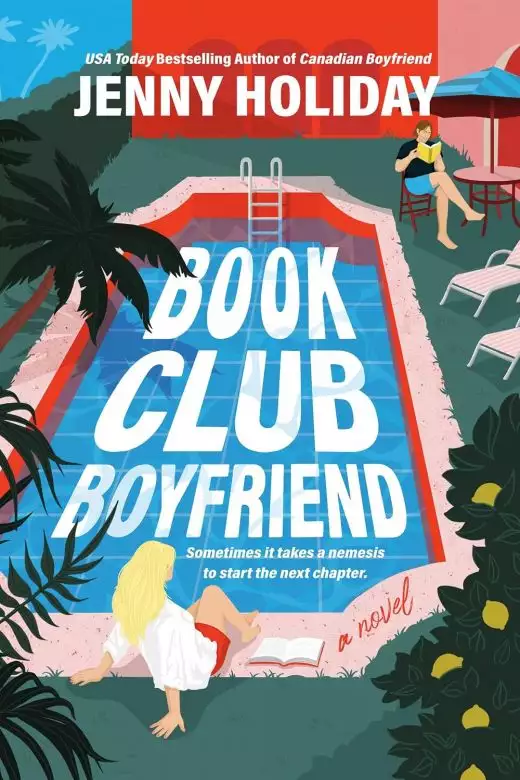
Book Club Boyfriend
- eBook
- Paperback
- Audiobook
- Book info
- Sample
- Media
- Author updates
- Lists
Synopsis
In this simmering enemies-to-lovers romance, a divorced actress invites the surly writer who rejected her to live in her pool house when they both find themselves at a crossroads.
Producer Blair Kellermoon is having a rough time of it. She’s newly divorced, her youngest kid is off to college, and the movie project of her heart has just fallen apart. Oh, and she’s still stinging from being publicly humiliated by literary novelist Jack Branksome, who declined her offer to feature his debut novel in her popular “Books with Blair” book club. Blair was Hollywood’s rom-com queen in her acting days, but she’s having trouble navigating this phase of life. She needs a win. And some company—she’s not too proud to admit that she’s lonely.
Jack Branksome doesn’t mind being called a jerk. If having standards makes you a jerk these days, he’ll wear it as a badge of honor. What Jack’s not used to is writing to deadlines. After the runaway success of his first novel, all eyes are on him, and he’s genuinely afraid he won’t be able to deliver. But when he has to apologize to Blair for yet another gaffe and they begin texting, she surprisingly becomes the only person he can confide in about his fears. When she impulsively invites him to finish his book while living in her pool house, the idea should be everything he hates: sunny California skies and an even sunnier California hostess. But maybe some of her annoyingly chipper, can-do attitude will rub off on him. Or maybe some time spent reading and writing with Blair will change everything.
Release date: July 14, 2026
Publisher: Grand Central Publishing
Print pages: 352
* BingeBooks earns revenue from qualifying purchases as an Amazon Associate as well as from other retail partners.
Reader buzz
 Please log in to recommend or discuss...
Author updates
Book Club Boyfriend
Jenny Holiday
The New Yorker, September 9, 2024
Jack Branksome wants to know when the pound sign became a hashtag. For him, the answer is right now. I start our lunch unsure if his claim—that he truly didn’t know what a hashtag was before this moment—is genuine.
“Ash’s daughter frequently says things like ‘Hashtag who cares.’ I put it down to teen lingo I wouldn’t presume to try to understand,” he says as he tucks into a bowl of mussels in garlic white wine broth at a cozy Minneapolis bistro he insists I not name as a condition of our interview. “I don’t want it to be overrun. I want to be able to come back here.”
Ash is Ashwin Bajwa, fellow novelist, fellow tech-avoidant literary savant—both men were longlisted for the National Book Award last year—who is in town leading a weeklong fiction master class residency at the University of Minnesota, and the pair is having a reunion. Unlike the relentlessly single Branksome, who declares romantic entanglements “distractions that weaken the constitution,” Bajwa is married and in possession of a hashtag-using, Instagram-scrolling teenage daughter.
When I try to explain that a hashtag organizes content online, Branksome’s expression goes from confused to contemptuous.
“A person can choose to have a rich interior life. If a person makes such a choice, a person might find himself called to protect that choice.”
“I think what he’s saying,” the genial Bajwa interjects, “is that the infinite scroll afforded by social media is the enemy of creativity.”
“No, what I’m saying,” Branksome says, “is that authenticity, which I believe we are called toward as humans, sometimes comes at a cost.”
When I tell Branksome I might have an inkling of how Blair Kellermoon felt when he rebuffed her invitation to feature his debut novel in her Books with Blair reading club, he takes his time prying a mussel from its shell, chews slowly, and only when satisfied that mastication is complete says, “Ms. Kellermoon has a lot of little projects on the go. I’m sure she’s forgotten all about me.”
Jack Branksome looked up from his computer screen at the clock on the wall in his office. The minute hand had not moved since he’d last checked on it. The little red second hand—this was a vintage analog clock of the sort that used to hang in the classrooms of Jack’s elementary school—had not even made a full revolution.
It was too early to go down for the mail.
As the second hand approached twelve, he stared at the minute hand, sensing more than hearing the click when the long black blade that had been taunting him all day made its tiny stutter forward. Twelve fifty-five.
“It’s too early to go down for the mail,” he said into the room that was empty except for a desk, an overpriced ergonomic chair that was not doing what it was supposed to do, and the clock of doom, as if saying the words aloud would make them more true than when they had been only a thought in his head.
He turned back to the screen. Checked the word count in the lower left corner of his document. It had not moved. Just like the minute hand of a minute ago.
That was what happened when you stared at a screen without doing anything.
He sighed. He was downtrodden.
An hour later, Jack, not a fan of adverbs, had to conclude that not only was he downtrodden but he was exceedingly downtrodden. It was almost two o’clock, though, and therefore no longer impossible that the mail should have come.
He pushed himself out of his chair, and something in his back protested. It was a fucking Aeron chair. It had cost a small fortune back when he thought he had one of those to spare.
His wrists hurt, too, which was ridiculous given that he hadn’t written a God damn word for three days.
It was probably psychic pain manifesting in his body. “How can one be well,” Tolstoy asks, “when one suffers morally?”
Jack had a dinner at seven that he was dreading. If he started writing at two, he could get four hours in by the time he had to stop to shower and make himself presentable.
He checked the clock: 1:56.
It wouldn’t take him more than a couple of minutes to go get the mail. It would be good to stretch his legs, get the blood moving.
When the elevator arrived at his floor, there was someone in it, so he pretended he’d forgotten something in his condo. The second try deposited him in the lobby, but the mail had not yet arrived.
He looked at his watch: 2:04.
If he started writing at two thirty, he could get three and a half hours in before he had to stop.
Coffee.
He would go out for coffee, and by the time he got home, the mail would be here. It would be two thirty, and he would be caffeinated, in receipt of the mail, and ready to write.
It was a beautiful September afternoon, the first hint of autumn in the air. Not decay yet, but a kind of precursor to it, a ripeness that was aware of its own impending demise.
The door at Maud’s jingled. There were only a few tables occupied, it being too late for lunch, at least for Midwesterners, and too early for dinner.
“Jack.” An unsmiling but not unfriendly man lifted a palm from behind the bar at the back of the small bistro. It was Oliver, Maud’s proprietor—and son of the real-life Maud, whose landscape paintings hung on the restaurant’s exposed brick walls. “Americano?” he asked as Jack approached. “Barolo?”
“Too early for wine. I’ve got to write yet today.”
“Americano it is. To go, I assume, if you’re working?”
Jack glanced at his watch: 2:17.
He pulled out a stool. “Make it a cortado, and I’ll drink it here.” If he drank quickly, he could be back at his desk and writing by three o’clock.
Maud’s didn’t really do coffee. Well, clearly it did, as evidenced by the whirring of the espresso machine behind the bar. But it wasn’t a coffee destination.
Oliver set the miniature cup and saucer in front of Jack. “How goes the struggle?”
Jack sighed and took a sip.
“That bad?”
“I have to go to a Friends of the Library dinner tonight.”
Oliver wrinkled his nose. “Libraries. Friends. Dinners. All known bummers.”
Jack rolled his eyes, but something in him loosened a notch, like an overtightened screw being eased.
Jack was aware of his reputation, and he didn’t mind it. Being known as a curmudgeon came in handy. But the truth was, he liked talking to people. Well, he liked talking to specific people in specific circumstances. It didn’t have to be a real friend, or a deep conversation. In fact, it was better if it wasn’t. Jack’s ideal conversation partner was intelligent and quick-witted. Someone who knew him, but not too well. Someone with whom he could skip the small talk but also not be on the hook for any kind of deep, lasting connection.
Oliver was one of those people. He reached under the bar and produced a dish of cashews, and Jack’s innards relaxed another notch. Regular retail interactions were exactly Jack’s speed. Sometimes he thought back to his teaching days and wondered how he had survived. So many people. So much talking.
The day he’d presented the principal with his resignation letter had been the best day of his life.
And the day he had to slink back and ask to be rehired was going to be the worst.
It was almost three thirty by the time Jack was done with his coffee.
The mail consisted of two bills—internet and gym. He couldn’t live without the internet—alas—but it might be time to cancel his membership at the very expensive gym he’d joined when his first book took off and it seemed like he was going to be the subject of a lot of media attention. It wasn’t as if anyone could see his biceps under his clothing—he’d been posing for pictures in Newsweek, not Men’s Fitness—but it had been the principle of the thing. He’d wanted to look his best. Look the part. An intellectual, but not your father’s intellectual. Not his father’s intellectual, not to put too fine a point on it.
The gym in his building was decent. He could survive with—Oh. The New Yorker was here. The New Yorker usually arrived on Thursdays, and today was only Wednesday. Well, he hoped today was Wednesday. If not, he was not going to have any friends left at the library.
He took himself back up to his place—3:43—and flipped open the magazine, but not before trying and failing to parse the cover image, which was an abstract jumble of dark blues and blacks with a fuzzy green dot off to one side.
Jack would have liked to be the kind of person who didn’t read press about himself. His dad always said that reviews were for readers and professed not to read his own. Maybe that attitude came with time, with the accumulation of an august backlist that was taught in college literature classes. For now, Jack was the kind of person who—secretly—read his reviews.
Not that this was a review.
There was nothing to review at the moment, his first book having come out more than a year and a half ago. Those reviews had been stellar, beyond his wildest dreams.
Jack’s second book didn’t exist yet, because he’d had to ask for an extension on his deadline. He was originally supposed to turn it in this coming January 1. When he’d fessed up to his agent that he wasn’t sure if he was going to make it, a new date had been agreed on: March 15. Beware the ides of March, he’d thought jauntily, because at that point, March 15 had seemed doable.
At the rate he was going, there would be nothing to review again, ever.
Hence the “Talk of the Town” profile in The New Yorker, arranged by his publisher. By his chipper but, he had to admit, competent and well-connected publicist.
He read it.
He read it again.
Well. If he’d had a heart, it might have sunk.
He called Lyn, the aforementioned competent and well-connected publicist.
“Have you seen The New Yorker?”
He realized belatedly that he should have announced himself. He wasn’t Lyn’s only author. But she probably didn’t have more than one author in the current issue of The New Yorker. That sounded like self-flattery, but it was just a fact.
“I have seen it. It’s great.”
“Is it?”
“Is it not?”
“Do I come off as a jerk?”
The pause before she spoke answered his question. “Does it matter? ‘Jerk’ works for your brand.”
“I have a brand?”
“No, no,” she said soothingly, probably because she understood that he was the sort of jerk who would hate the idea of having a brand.
“But I already had that… thing with Blair Kellermoon. And now that line about her ‘little projects.’” Why had he taken the bait when that journalist asked about her? “I didn’t mean that as snidely as it reads.”
“You’re overthinking this. The piece is great. You show some personality. It will keep people interested until the next book.” Another pause. “How is it coming?” Pause. “You don’t have to answer that. I’m not editorial.”
She wasn’t, and he wasn’t going to tell her anything.
She must have taken his silence—he didn’t do platitudes—for the dismissal it was, for she eventually said, “Well, I can’t wait to read it!”
Jack couldn’t wait to read it, either.
Three fifty-two.
His phone rang at three fifty-five.
“You didn’t tell me you were going to be in The New Yorker.”
“Dad, hi.”
“Good piece.”
“You think?” Jack asked, and immediately regretted it. He didn’t need his father’s approval.
“You made the right choice turning down that Hollywood person.”
“Mm,” he said vaguely, refraining from pointing out that he hadn’t asked for an opinion on the Books with Blair offer, then or now.
“That’s not what we do,” his dad said.
“That’s not what you do, and it’s not what I do.” Which was subtly but importantly different from That’s not what we do. “Dad, I have to go. I’m doing a Friends of the Library dinner tonight, and I’m trying to get some work in beforehand.” I’m trying to get some staring at the screen in beforehand.
“So it’s dinner with rich assholes.”
“It’s dinner with rich assholes,” he said, both because it was the path of least resistance and because it was probably true. “Sometimes you have to have dinner with rich assholes.”
“But do you? If those rich assholes don’t have anything you want, do you?”
“Apparently some rich assholes give their money to the library.” And apparently Jack hadn’t become a complete cynic.
“Well,” his dad said, “don’t let it distract you from your purpose. You can’t ask for another extension.”
He was aware. He was also aware that his father had never missed a deadline.
“Bye, Dad.”
Three fifty-seven.
He googled Blair Kellermoon.
“Blair Kellermoon and Reginald Johnston confirm split; actress and producer will divvy up real estate portfolio, pets”
People, August 26, 2024
Actress-producer Blair Kellermoon and megaproducer Reginald Johnston are divorcing after twenty years of marriage. Documents filed Tuesday indicate the divorce is uncontested.
Johnston, a former Paramount executive who left the studio in 2017 to form his own production company, is the force behind the blockbuster “Inkery” series, though he has credited Kellermoon with introducing him to the books that are its source.
Known for her starring turns in such iconic rom-coms as I Found You and Hidden Gems, Kellermoon has of late tried her hand at producing, with her shingle, Moonpics, behind such streaming hits as The Girl Behind the Door and The Swallows. More recently, Green Light, a young adult Great Gatsby retelling that Kellermoon has called her passion project, fell apart after the departure of writer-producer Gerhard Tolhart; this on the heels of Kellermoon being famously rebuffed by novelist Jack Branksome when she tried to secure his smash-hit debut novel for her book club.
Having been tapped by Disney to direct an as-yet-untitled stand-alone installment in the “Star Wars” universe, Tolhart cited scheduling conflicts and wished Kellermoon well, though rumors abound of personality conflicts between the auteur and the actress-turned-producer. Tolhart’s departure is the latest in a series of mishaps for the project, based on a novel by the late Angela Laredo.
Kellermoon, 39, and Johnston, 43, married in her hometown of Savannah, Georgia, and share two children, Calvin, 21, and Esme, 18. Kellermoon and Johnston are terminating their rights to spousal support.
The formerly globe-trotting couple have sold their New York apartment and Park City, Utah, chalet. Sources close to Kellermoon tell People that she will retain a Hollywood Hills three-bedroom Tudor built in 1929 that she has owned for two decades, and that Johnston, a vintage car aficionado, will remain in the $27 million Calabasas estate the couple has called home, which features 10 bedrooms and an eight-car garage.
Blair was trying to be the kind of person who didn’t jump every time her phone dinged, but it didn’t take much these days. Her mother would have said she was a bundle of nerves. Martha, her old shrink, would have said she had an anxiety disorder.
It was a text from a number she didn’t recognize. She leaned over—she was trying this thing where she put her phone out of reach while she ate—and read the notification without putting down her fork.
I’m sorry for what I said about you in The New Yorker.
Huh?
Blair tried to think of who might talk to The New Yorker about her. Reggie, even though she suspected him of being “sources close to Kellermoon”—why else all the stuff in that People article from a couple of weeks ago about how many fucking bedrooms everyone had? He had ten in his McMansion/used car lot, and poor Blair only had three—didn’t have those kinds of connections. Anyway, Blair wasn’t New Yorker material. They reviewed her movies and TV shows sometimes, but that was the extent of it. She entertained a momentary hope that perhaps some critic or other was writing a twenty-thousand-word manifesto about Hollywood’s inability to make something not based on existing IP and/or starring a grown man in a superhero outfit, but what good would that do her at this point? Green Light was dead as a doornail.
She blew out a breath. It was still hard to admit that. And she wasn’t, not publicly, anyway. Her official stance was that she was letting the project rest.
This is Jack Branksome, by the way.
Well. Goodness. Gracious. Blair had had her assistant pass her number on to Jack after that ill-fated Zoom call, in case he changed his mind about Books with Blair.
She stopped pretending she wasn’t a slave to her phone and picked it up. Her hands were shaking.
Blair wasn’t the kind of person who let herself be intimidated. They—and by they she meant men—tried. She was petite and blond. She had a Southern accent. She’d made her name starring in rom-coms. She was aware that all that added up to some people dismissing her as unserious. She even understood. She was operating in a town that prized a certain kind of intelligence, a certain kind of persuasiveness, a certain kind of leadership. Not to mention a certain kind of story. She and Tiffany had started their company with an agreement that they would calmly sidestep the sort of men who made those assumptions. They would make opportunities for themselves and in turn make opportunities for other creatives, many of them women. They would tell the stories they wanted to tell.
More to the point, Blair was no longer a teenager who could be shamed by anyone, not the men of Hollywood, not her mother, not Pastor Glen.
So she wasn’t sure why she had let—and was continuing to let, judging by her shaky hands and the pit that had opened in her stomach—Jack Branksome get to her.
Blair: What did you say about me in The New Yorker?
There. Cool. Mildly but not overly interested. Not betraying the fact that she was, even now, heading outside to see if the mail had arrived.
Jack: I made an observation that sounded reasonable when it came out of my mouth but when committed to paper and stripped of context sounded less than ideal.
No mail. Blair went back to the kitchen island to consider her next move. She was pretty sure the reason she was letting Jack Branksome get to her was that she respected him, or at least she had before that Zoom call. When studio dudes and billionaire tech bros in search of vanity producing credits dismissed her, she dismissed them and moved on. When they tried to humiliate her, she didn’t let them. Humiliation, she’d told Cal once when he was eleven and in a nail-polish phase, was not something inflicted upon you. It was a state of mind. An attitude. Blair didn’t allow herself to be humiliated these days.
Usually.
There was a first time for everything.
She considered why she was giving Jack Branksome the power to humiliate her. She considered the pit that had opened in her stomach just now.
The other thing that had opened a pit in Blair’s stomach was Jack’s book. She hadn’t been blowing smoke, or exaggerating, when she’d told Jack’s editor what a fan she was of In Time. The book was, on the surface of things, about three generations of a family embarking on a holiday at an unnamed seashore in order to celebrate the sixtieth anniversary of the patriarch and matriarch. But it was really about how our attempts to control each other can backfire. Or how they can succeed, but at a cost. It was about a family coming undone.
Blair loved reading. Had since she was a kid perched in the sycamore tree on the far corner of her family’s estate. A book was a way to pass a summer afternoon, or, tucked into a Bible, a long Sunday morning at church. A book was a way to get out of your own head, and Blair could admit—to herself, anyway—that she needed that, more than ever these days.
And sometimes, a book was a window to the world. It could make you think about stuff. It could make you rethink stuff.
Even less often, like once every couple of years if you were lucky, a book could brush up against a truth you didn’t know was inside you. It could open a pit in your stomach, turn your guts out into the sunshine in a way that was painful but somehow, also, overdue.
That kind of stomach pit wasn’t bad, exactly. It was unsettling but also galvanizing. It had the potential to change who you were.
Jack’s book had done that. Opened that kind of pit.
And then Jack had layered a humiliation on top, dug the hole inside her a little deeper, opened the bad kind of stomach pit using a different tool, a sharper one.
She eyed his text. She wanted the last word, but she knew such a wanting was futile, with Jack Branksome at least. To say that Jack had a way with words was an understatement. Blair wasn’t a writer. She had been told that in exactly those words by her college creative writing professor (I believe literary criticism is more your forte) and by screenwriting legend Seth Sider (Stick to acting), and while the feedback had stung at the time, she was grateful for it in retrospect. She wouldn’t have become a producer otherwise.
Blair: Well, lucky for you I don’t read The New Yorker.
It wasn’t even a lie. She subscribed to The New Yorker, but that didn’t mean she read The New Yorker. She would need to clone herself for that to happen.
Jack: You don’t read The New Yorker?
Blair: I’m not the kind of person who reads The New Yorker.
Jack: What does that mean?
Blair: I’m a college dropout from Savannah.
Blair knew exactly what she was doing: Saying what Jack Branksome was thinking. Saying it before he could. Getting ahead of the humiliation. Was it even humiliation if you said it yourself?
Jack: Flannery O’Connor was from Savannah.
Blair: What is your point?
The bubbles that indicated he was typing floated and floated and floated. Finally, a fully formed paragraph appeared.
Jack: I accept that perhaps you do not read The New Yorker. But I do not accept that you’re not the kind of person who reads The New Yorker. You’re more the kind of person who falls behind in her New Yorker reading and gets stressed when too many issues accumulate and finally calls off a brunch date and dedicates a weekend morning to scanning the tables of contents, resigning herself to being relentless in her triage, and bookmarks a few articles in each issue and settles in for a marathon day of reading.
That was exactly right—though the calling-off-brunch part was not that remarkable. These days she called off brunch for a lot less than a day of reading.
Somehow curmudgeonly, misanthropic Jack Branksome knew people. He had to, or he couldn’t have written a book like In Time, which was full of compelling, nuanced characters of all ages and backgrounds who knew exactly how to wound each other.
Jack: You’re too well-read to be “Not the kind of person who reads The New Yorker.”
She was flattered, though she probably shouldn’t be. There was bound to be a catch.
Blair: How do you know I’m well-read?
Blair: Do you think because I read your book that equals “well-read”?
Jack: No, I watched The Swallows.
The Swallows was a limited series Blair had produced, based on the novel of the same name. She was exceedingly proud of it.
Blair did not know what to say.
Jack: That was a tough book, and even tougher, I’d imagine, to adapt. All that interior monologue, and you did it without any voice-over.
Maybe there wasn’t a catch. Maybe Jack wasn’t a jerk so much as he was socially awkward. In her experience, many writers were.
She thought back to that terrible Zoom. Nah, he was a jerk. A preternaturally talented jerk, but a jerk nonetheless.
Blair: My grandmother once told me that life is finite and that therefore a person can either read magazines—mind you, this was ages ago when magazines were more of a going concern—or books, but not both. You have to choose your horse, she said.
Jack: So you’re a book person.
Blair: I try to keep up with magazines, but yes, books win.
Jack: I will accept that as a reason that you don’t read The New Yorker.
Blair: Didn’t know I needed your permission to not read The New Yorker, but thanks.
Jack: My pleasure. Anyway, you can’t believe everything you read.
Didn’t she know it? She thought back to that People article implying that she, the “actress-turned-producer,” and not Gerhard, the “auteur,” had been the problem with Green Light.
Blair didn’t know how to end this conversation, but since Esme was always telling her—and demonstrating to her in real time—that a person didn’t have to formally close off a text conversation, she left it alone.
She should have felt vindicated after that exchange.
Instead, the cyclone was starting up. Some people got a feeling in their bones when literal storms were coming. Blair’s bones told her when figurative storms were coming. Panic attacks, she was pretty sure, given that they were heralded by a racing heart, sweating, chest pain, and a weird sense that she could hear her own blood pumping through her veins.
But it always started with this amorphous “feeling in her bones.” A tingly sensation—but not the good kind of tingly.
“The cyclone.” She wasn’t sure why she used the definite article—the the. Maybe because the storms all felt like they came from the same place, the same source, as if the ingredients for them were always there, hovering in the background, an amorphous soup that could spill over at any moment. And unlike in The Wizard of Oz, where she was pretty sure she’d gotten the concept of a cyclone—didn’t most people call them tornadoes these days?—she wasn’t going to wake up in a land of color and whimsy when the storm was over. She was just going to be in her same life, her neck hurting from pulling her head down to her chest, which was something she did by instinct. Protecting her head, covering her ears: it wasn’t logical, but it felt like it helped get her through the storm. But she sometimes did it so vehemently, and for so long, that her neck ached afterward.
She breathed in and counted to three. Sometimes, if she caught the tingly-bones feeling soon enough, she could head things off.
There was no reason to go buy a New Yorker, she told herself while she breathed out to a count of four. Her copy would come. Maybe even later today. She inhaled for five. Whatever Jack Branksome had said about her wasn’t going to change anything about her life. She exhaled for six. Whatever he’d said about her would still be there for her to read later today, or tomorrow.
The breathing wasn’t working. The cyclone was stronger than her ability to defend against it. All she could do was sit down, protect her head, and tell herself she wasn’t dying. That there was no need to call 911 for a panic attack.
She would survive. She always did.
The first time Reggie had come over unannounced, Blair invited him in for a drink.
She was lonely.
At least she was self-aware about it. She liked to believe that self-awareness had an inoculating effect.
It wasn’t as if she didn’t have friends. Tiff would. . .
We hope you are enjoying the book so far. To continue reading...
