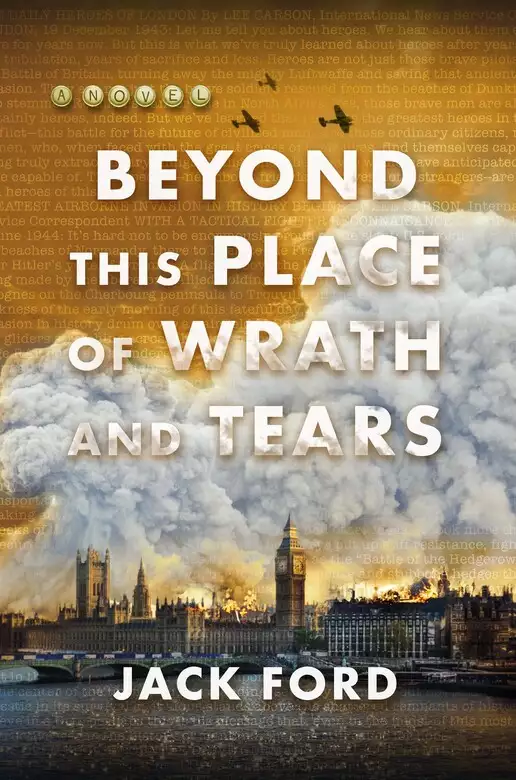
From award-winning journalist Jack Ford, a riveting and colorful dual timeline novel of Lee Carson, the heroic yet elusive female journalist who defied convention and danger to report from the front lines of WWII, combining breathtaking wartime narrative with a compelling Cold War espionage tale for fans of Christine Mangan, Pam Jenoff, Erika Robuck, and Kate Quinn.
Washington, DC, April 1954: Lee Carson, former war correspondent, is frustrated that her journalism career has been relegated to society events and fashion stories. But when she receives a tip about a Russian spy in a high-ranking government position at the height of the Cold War, she feels the thrill of a story that she hasn’t felt since she was on the front lines of the European theater . . .
London, December 1943: As war rages on across Europe, twenty-two-year-old Lee Carson is waging a private battle of her own. An American-born correspondent for the International News Service, Lee is determined to cover the war from the field. But no woman, certainly not an attractive young woman with no military experience, will be allowed near the front lines.
Lee is not easily dissuaded. And as the Allied forces prepare to take the fight to the enemy, her gift for boosting public morale is seen as a valuable weapon. Assigned to cover the build-up to the invasion of Nazi-held Europe, she constantly wrangles with authorities to get to the heart of the action. From talking herself onto a bomber and flying over the beaches of Normandy at the start of D-Day to other feats of daring, she witnesses and reports on the war’s most pivotal moments.
Told in dual timelines, Beyond this Place of Wrath and Tears is inspired by the story of an incredible woman who has largely been forgotten by history, and who, like many women in WWII, broke barriers in wartime only to find that upon the return home, she had to continue to fight for relevance in an entirely different way . . .
Release date:
May 27, 2025
Publisher:
Kensington Books
Print pages:
352
* BingeBooks earns revenue from qualifying purchases as an Amazon Associate as well as from other retail partners.
The ballroom of the venerable Willard Hotel—a palace-like expanse of white marble columns, dark velvet curtains, and ornate ceiling panels, just a stone’s throw from the White House—was ablaze with light and alive with sound. Nearly two hundred people from the highest echelon of Washington society—political figures, business leaders, military brass, journalists, and socialites—were gathered at the invitation of the U.S. Secretary of State to honor the arrival of a new foreign ambassador. An orchestra, fronted by a singer in a low-cut, form-clutching black sequined gown, was onstage performing a string of Johnny Mercer tunes, while the guests strolled from one dining station to another, chatting, laughing, and drinking champagne.
In a corner near one of several bars scattered about the room, an animated conversation was taking place among a group of five guests. A three-star army general was holding forth as the others—a navy admiral and three noted Washington journalists—listened intently, champagne flutes in hand.
“Mark my words,” the general barked in a deep Southern drawl, “Ol’ Georgie Patton—God rest his soul—was right when he pushed Ike to go after the Russians and drive ’em out of Europe when the Nazis fell. Should’ve done it right then and there when we had the manpower and the momentum. Now,” he said, waving his glass for emphasis, drops of golden liquid ricocheting out into the air around him, “just like Georgie warned, we’re probably gonna have to fight ’em sooner rather than later. Especially since this Khrushchev fella took over. Another Joe Stalin who doesn’t care how many of his folks die, as long as he gets what he wants. And right now, he wants the whole damn world.”
“But, General,” one of the journalists interrupted gently, the eyes of the others turning respectfully to the only woman of the group, “do you really think the U.S.—and the world, for that matter—had the stomach back then to continue the war? With everyone, after finally beating the Nazis, then having to fight the Soviets? For what probably would have been who knows how many more years?”
The general looked at her carefully, not bothering to hide his apparent attraction to her obvious allure. Lee Carson was a correspondent for the International News Service and a well-known reporter on the Beltway beat. She was a striking presence, slightly taller than average, in her midthirties, with shoulder-length, wavy, mahogany-red hair that framed an oval, classically beautiful face, marked by pale skin, sparkling green eyes under arched eyebrows, and a broad mouth. Dressed in a dark emerald cocktail dress, she drew jealous looks from many of the other women and covetous stares from just about every man in the room when she strolled into the reception earlier. Indeed, she had only recently been voted the “most attractive reporter in Washington” by Newsweek magazine. A celebrated combat correspondent in the European theater following the Allied invasion of occupied Europe until the German surrender, she had been assigned to Washington since the end of the war.
“Miss Carson,” the general began, a bit sternly, “you, of all people, should know about those cutthroat Russkies. You were right there on the front lines, in the foxholes, surviving the Battle of the Bulge, meeting up with the Russians at the Elbe River. You saw what they did to people—even their own people—on their way to Berlin. Brutes and animals, that’s what they were. And the officers, well, they were as bad as their troops. Slaughtering anybody that got in their way. These people will stop at nothing to get what they want. And now, what they want is us. So we’re gonna have to stop ’em. And if it wasn’t for them damn lily-livered politicians back then . . .” He paused and glared at the group. “We’re, of course, off the record here, right!” he warned. All three reporters nodded.
“If it wasn’t for the damn politicians,” the general said, continuing his diatribe, “we could have fought it out right then and there. Pushed ’em all the way back to Russia. So, here’s what I’m betting’s gonna happen. . . .”
Just then, Carson felt a tap on her shoulder and turned to see a waiter in white livery holding a tray of champagne flutes in one hand and a note in the other.
“Miss Carson?” he asked quietly.
“Yes?” she answered.
“Sorry to interrupt, but a woman asked if I would deliver this to you,” he said, nodding in the direction of the main doorway.
Carson looked over the waiter’s shoulder and saw a woman standing by herself just inside the entrance to the ballroom. She was small, with dark hair and glasses, dressed in a black dress and shawl. The woman caught her eye and offered a barely perceptible nod.
Carson took the note from him, opened it and read:
Carson looked up quickly. But the woman was gone.
The Jefferson Memorial is situated in West Potomac Park, flanked by the Potomac River and the Tidal Basin. The memorial, completed in 1943, is composed of circular marble steps, a portico, a circular colonnade of Ionic columns, and a grand dome under which an enormous statue of Jefferson dwells.
Lee Carson arrived fifteen minutes before noon and found a seat on a bench on the Potomac River side of the building, under a string of cherry trees that were bursting into vast, pillowy clouds of pink blossoms. Following its completion, the memorial had very quickly become a tourist favorite, and today was no exception. Throngs of visitors wandered inside the serene, hallowed marble structure and meandered along the surrounding pathways, enjoying the early spring sunshine and snapping photographs with their Kodak Brownie cameras.
At first, Carson was uncertain about the note and whether she should follow the instructions. Once she returned to her apartment after the diplomatic reception, she considered whether the note might have been some type of prank. But her reporter’s curiosity was piqued, and her instincts told her that, given the level of intrigue and Russia-phobia that had descended upon the nation’s capital since the launching of the Cold War—and exponentially exacerbated by the anti-Soviet crusade of Senator Joe McCarthy and his followers—she should show up. And, she thought, if it was, in fact, just a prank or the woman turned out to be some kind of kook, well, at least it was a lovely day to visit the memorial. So, here she was, waiting.
As the minutes passed with no appearance yet by the mystery woman from last night, she gazed out over the National Mall in the direction of the White House. Warmed by the sun, she found herself, once again, musing over what she was doing there—not just at this moment and in this city, but at this point in her life. She had returned from the war as a renowned and respected combat correspondent—along with a small handful of other women, all pioneers in the journalism of war. While she was jumping into knee-deep-in-mud foxholes, ducking artillery bombardments, and racing in jeeps from the beaches of Normandy to the gates of Berlin, all the while sending back stories of the heroes and victims of the greatest conflagration the world had ever seen, she had surprisingly become a celebrity, both on the front lines and back home. Not only had her byline—“Lee Carson, INS Correspondent, reporting from somewhere in France”—become required near-daily newspaper reading, but the “beautiful girl reporter,” as some newspapers described her, had also unexpectedly found her way into the society and gossip reports, with her reporting adventures appearing occasionally in the likes of Walter Winchell’s On the Town columns.
But just as the war had changed her life dramatically, so too the end of the war had also changed her life. Also dramatically. When she returned to the States after the German surrender, she had expected, given her successes on the front lines, that her journalism career would continue on its upward trajectory. But what she soon discovered, as did so many other women who had contributed mightily to the war effort, was that the good jobs—the big jobs—were going to the returning men, while the women were expected to go back to their prewar, more traditional roles. A football analogy often came to mind—she had been a fan since childhood, regularly attending college games with her father. Once the “starters” returned from the war, the “subs” were sent to the sidelines.
She looked at her watch. Nearly forty-five minutes had passed, and no one had appeared. With a sigh, she stood and prepared to head back to her office, disappointed that nothing had come of last night’s moment of intrigue. As she began to walk away, a slight figure, not much more than five feet tall, wearing a long overcoat, large round sunglasses, and a slouch hat, suddenly arrived at her side.
“Come,” the woman said in a clipped, hushed voice. “Walk with me.”
Carson fell in step with the mystery woman and they walked in silence, circling the structure in the direction of the Tidal Basin.
“So,” Carson said after a few wordless minutes had passed, “can you tell me your name?”
“No,” the woman answered, peering quickly over her shoulder. “Not just yet.”
“Well, then, your note said you have information about a Soviet spy ring. Can you tell me more about that?”
The woman was silent again for a moment.
“Here’s what I can tell you right now. Perhaps more later. There is a Russian spy working in the State Department. High up. With access to very sensitive information.”
“Respectfully,” Carson said skeptically, “those allegations have been floating around for a while now. Joe McCarthy’s been making a living off of them. So . . . you have anything specific?”
“I do.”
“And?” Carson asked.
“Not yet,” the woman answered.
“When?” Carson asked, a tone of exasperation creeping into her voice.
“When I’m sure you’re the right one to talk to.”
“And how will you know that? How do I convince you?”
“I’ll know.”
“And how do I know that I should be talking to you? That you actually have real information for me?” Carson asked.
The woman abruptly stopped walking and faced Carson.
“Because I’m a Russian spy.”
Lee Carson stared at the mysterious woman, trying in vain to pierce the opaque blackness of her sunglasses shield, to somehow seek out any sign of truth in her eyes.
“You’re . . . ?” Carson began.
“A spy. Yes,” the woman answered softly.
“A Russian spy?”
“Yes.”
“But then why—”
Once again, the woman interrupted with her answer. “Why would I admit it to you? Because I need you to believe what I have to tell you.”
“Keep walking,” the woman demanded, winding her arm through Carson’s and propelling her forward, as if they were two old friends enjoying a springtime stroll.
“So, let me be clear here. You’re a Russian spy . . . and you want to give up another Russian spy?” Carson asked.
“Correct.”
“Why?”
“I need to be sure about you before I answer that question.”
“And just how do I make you sure about me?” Carson asked. “And why me, anyway?” she added.
For the first time, the woman’s stoicism cracked slightly, offering a shadow of a smile as she spoke.
“Because I know about you. About the war. Your war. About you fighting to follow a story. Despite all the hurdles they threw up at you. And risking your life back then if you had to. To tell the story.” She paused and checked behind her yet again. “I need to tell this story to someone who’ll follow it wherever it takes them. Even if it means risking their life.
“And,” she continued after a beat, “I get the feeling that you’re anxious to break a big story like this. That you feel you’ve been ignored since the war, that your talents have been somehow forgotten. That’s why I believe you may be the right person.” She stopped walking and turned to Carson. “Am I wrong?”
Now it was Carson’s turn to remain silent, turning all of this over in her mind. No, this woman, whoever she was, was not wrong. Not at all. But Carson still felt uncomfortable about confirming all of that, her disappointments and frustrations, to a total stranger. Especially one as puzzling as this woman.
Finally, Carson spoke. “So, let’s say you’re right. And I’m interested in your story. Where do we go from here?”
The woman slipped her glasses off and looked hard at Carson. She had a round face, not unattractive but nondescript and quite unremarkable. And empty, almost lifeless eyes. A face that was so bland and common that it would be nearly invisible. Good qualities for a spy, Carson thought. Not necessarily a face you would remember.
After just a brief moment, the woman seemed to come to a decision.
“We move forward now,” she said forcefully. “I believe you’re the one I should tell my story to. I believe you will do whatever is necessary to find this spy. To break this story.”
Carson nodded her agreement.
“So, this is what we’ll do. We’ve been together too long out here in public,” she said, glancing backward once again. “We’ll meet again tomorrow. There’s a bar about a block from your apartment. Called Jake’s Tavern.”
“You know where I live?” Carson asked, a bit harshly.
“I’m a spy,” the woman said. “Of course I know where you live.”
“Okay,” Carson said. “Jake’s Tavern.”
“Tomorrow at four p.m. There’s a booth all the way in the back. I’ll be waiting. And I’ll tell you everything then.”
“I’ll be there,” Carson said.
The woman began to walk away and then stopped abruptly.
“And, Miss Carson . . . not a word to anyone. Anyone at all. Or our deal is off.” With that, she scurried away, swiftly blending into the flock of wandering tourists.
Lee Carson opened the door to Jake’s Tavern and stepped inside. The space was narrow, dark, and dingy, much more a shot-and-a-beer dive bar than a tavern. As she squinted, allowing her eyes to adjust to the darkness, she spotted the mystery woman seated at a booth in the rear, next to a door. She had her back to the wall, giving her an unobstructed view of the entire bar. Through the gloom, Carson spotted a bartender seated on a stool reading a newspaper and just one other person, a patron hunched over a drink in the middle of the bar. The woman nodded to her. Good spy craft, Carson thought, walking toward her, back to the wall, view of the entrance, and a nearby door for a quick getaway.
The woman gestured to the seat across from her and Carson sat.
“So,” the woman said, her eyes darting from Carson to the front door, “did anyone see you coming in here?”
“No,” Carson said. “I was careful.”
“Good. Let’s get started,” she said abruptly. “What do you want to know?”
“Well, let’s start with who you are.”
“My name is Elizabeth Bradley.”
“And?” Carson prompted.
“I was born and raised in Pennsylvania. Graduated from Vassar with degrees in English, Italian, and French. Did my graduate work at Columbia and the University of Florence,” she said, her eyes flashing rapidly between the front door, the bar, and Carson, like the 360-degree rotating, flickering eyes of a chameleon.
“Doesn’t sound like what I’d expect for a spy’s background,” Carson said.
“Your mistake is thinking that there’s a ‘typical’ spy background,” she said. “Fact is, the only thing that’s ‘typical’ is that there’s nothing ‘typical.’ That’s important to the recruiters—the people who find you and groom you. The more average you are, the less you stand out, the more attractive you are to them.”
“So how did the Russians find you?” Carson asked in a hushed tone, leaning across the table.
“Long story,” she answered. “My first flirtation with anti-fascism happened when I started an affair with my faculty adviser at Columbia. He was passionate about the dangers of fascism. I started going with him to meetings of the American League Against War and Fascism. Boring meetings but some interesting people. After a while I found out that most of the really interesting ones were members of the U.S. Communist Party. So I joined, too.”
“Why?” asked Carson. “What attracted you?”
“I don’t know,” Bradley mused. “At first, I think I was just curious. Looking for something meaningful to connect with. But soon, I was drawn into the sense of community, the feeling that we were doing something important. That the people of the U.S.—of the world—needed something better than capitalism, better than the notion of the rich getting richer and the poor being left out. Deserved something better.”
“A lot of people back then—especially young people in college—got attracted to the idea of communism. But not many of them became spies for the Soviet Union,” Carson said.
“True,” Bradley answered. “For many, the novelty wore off. For some, it was just a phase they went through, like joining a social club. Something different—maybe even a little exciting—for them to explore from the comfort of their dorm rooms.”
“But you were different?” Carson asked.
“I believed. Truly believed,” she answered, for the first time looking directly into Carson’s eyes. “My family wasn’t poor, but I’d seen poverty—especially the coal miners in Pennsylvania where I grew up. The owners of the coal mines were wealthy and had everything they wanted, while the miners barely scraped by, often dying of lung disease. The vision of communism—the idea of providing fairly for everyone—just started to make so much more sense to me.”
“So, how did the Russians find you?” asked Carson.
“In 1935, I was offered a job at the Italian Library of Information in New York City. It acted as the fascist Italian government’s propaganda bureau in the U.S. The Communist Party was interested in anything I could discover, since the Communists and Fascists were sworn enemies, so I took the job and reported back to them about anything of interest. About a year later, I was approached by a man who said he was an officer with the Soviet intelligence service, the NKVD. He said my information could be helpful in their battle against fascism. Against the Nazis and the Italians.” She shrugged. “So I agreed to provide anything I found to him. He became my controller. And after a while we became . . . involved.”
“Involved?” Carson asked.
“An affair.” She shrugged again. “We were spending a lot of time together. The secrecy was exciting—even a little dangerous. We worked together for two years. One thing led to another. You know how it goes. Then the Justice Department got suspicious of him and required him to register as an agent of the Soviet government. That made it impossible for him to continue his work since they were now watching him. He was ordered back to Moscow. . . .” Her voice trailed off.
“Who was he?” Carson asked.
“His name was Jacob Golos. At least, that’s what he called himself. Never actually found out his real name. Haven’t heard anything from him since he left. Don’t even know if he’s still alive,” she added wistfully, the first hint of emotion she’d shown.
“What happened then?”
“The head of the U.S. Communist Party suggested that I take his place. The agents who’d been working for him would now report to me. And I’d forward the information to Moscow.”
“How?”
“I got a new handler. Another NKVD agent who was attached to the Soviet Embassy here in D.C. I’d pass on anything I received to him.”
“His name?”
“Itzak Akmerov. Again, I never knew if that was his real name.” She paused a moment. “At this point,” she continued, “I realized that I wasn’t just passing on information to the American Communists—I was now actually working for the Soviets. I even got a code name—Umnitsa. It means ‘Clever Girl.’ So,” she said with a sigh, “I was now a full-fledged Soviet spy.”
“Were you bothered at all? About what you were doing?” Carson asked.
“No,” Bradley said, seeming almost surprised by the question. “I didn’t view myself as someone who was doing anything to hurt America. I was just trying to help the country—the system—that I believed in. And in the beginning, during the war, we were allies, so I didn’t see it as a problem at all. I was just helping the Soviets keep track of what their partner in the war was doing. But perhaps not sharing with them. And I must admit,” she added, “there was something a little bit intoxicating about spying.”
“But now,” Carson interrupted, a flicker of anger creeping into her voice, “since the Cold War started, clearly we’re no longer allies. We’re now sworn enemies. Khrushchev’s declared that the Soviet Union will ‘bury us.’ So now you are working for our enemy. Against America.”
Bradley nodded slowly, as if she was digesting the depth of her betrayal for the first time.
“You’re right,” she said, nodding slowly. “Things have changed.”. . .
We hope you are enjoying the book so far. To continue reading...

 Please log in to recommend or discuss...
