- Book info
- Sample
- Media
- Author updates
- Lists
Synopsis
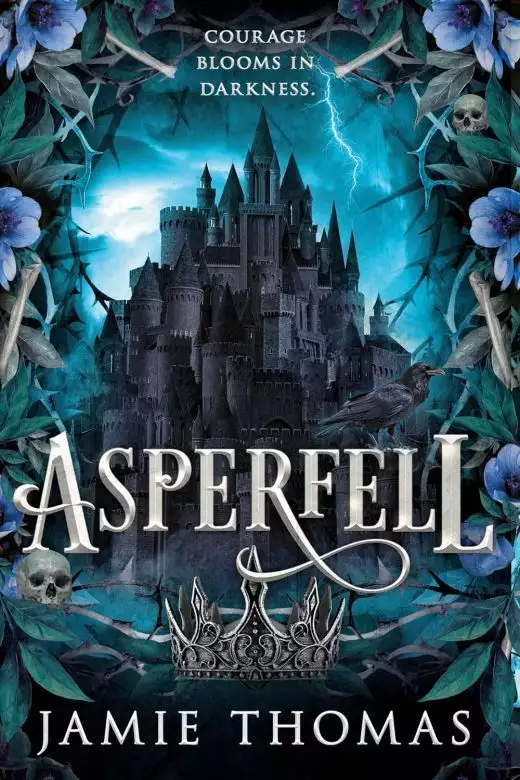
A daring and romantic story awaits you within the pages of Asperfell…
Even as an old maid of twenty, Briony has no interest in the rituals of the court, especially when her kingdom’s ruler has an obsession with brutally eliminating anyone who can use magic from the land. When Briony is arrested for showing signs of magic, she evades a death sentence by jumping through the gate to Asperfell, an enchanted prison built to hold the darkest and most dangerous of Mages.
Trapped amongst the hopeless, the violent, the deranged, Briony does her best to stay alive while also desperately trying to understand her new powers. The only way to get back home is to rescue the true heir to the throne, the Mage prince Elyan who’d been wrongly accused of murdering his father. When she finally finds him, he’s nothing like the regal, courageous prince he once was: Elyan’s time in Asperfell has made him cynical and jaded.
As they journey together, trying and failing to resist the undeniable attraction between them while fighting incredible terrors, they’ll regain the hope of saving their kingdom and come together to fight a tyrant who would destroy all the magic in their world.
Release date: June 23, 2026
Publisher: Orbit
Print pages: 450
* BingeBooks earns revenue from qualifying purchases as an Amazon Associate as well as from other retail partners.
Reader buzz
 Please log in to recommend or discuss...
Author updates
Asperfell
Jamie Thomas
I was only eight years old at the time and cared not at all for life beyond my own nose, but some things can never be forgotten.
I was pulled from the deep, satisfying sleep of one who had spent the day climbing the rafters in the west turret to avoid their odious tutor by my older sister, Livia. She smothered my groan of displeasure with her hand, and in the stillness of the room I stared at her wide eyes and disheveled curls as she raised a finger to her lips, then slowly removed her hand from my mouth. Livia was the very soul of decorum. Her reasons for waking me in such a state must’ve been very urgent indeed.
“There are men below,” Livia told me in a breathless whisper, as I struggled to free myself from the bedsheets tangled around my skinny legs. “Men from the Citadel.”
“What time is it?” The sky outside the window told me nothing with its darkness. I could’ve just fallen asleep an hour ago or it might have been near morning. The late autumn night guarded her secrets carefully.
“Just after midnight.”
With a grunt, I turned my back on her and flopped down into my pillows, my hand groping for the blankets. “Go away.”
Livia shook my shoulder, her fingers gripping me so tightly that I yelped. “Get up, Briony,” she hissed into my ear. “I think it’s bad.”
“Men from the Citadel come all the time.” My voice was muffled by the pillow, and I shrugged my shoulder in an effort to be rid of her. She only dug her fingers deeper into my skin.
“Mother and Uncle Geordan are below with Lord Falstone,” Livia said. “And there are guards.”
At this, I perked up. “Guards?”
“Yes.” Livia pulled my blankets off me, and I gasped at the sudden shock of the cold air of my bedchamber. The little fire that usually burned so merrily in my grate was a dull smudge of blackened coals with very little living inside to stoke.
“Come on,” I whispered to her, suddenly eager. “We can listen at the top of the stairs.”
We walked down the darkened corridor, our bare, cold feet padding silently on the rich, dark wood floors until we reached the landing that overlooked the grand foyer of our Iluvien townhouse. We crouched together, Livia and I, in our long white nightgowns, and pressed our faces as close as we could to the ornately carved railing.
There were six people clustered in the foyer. I immediately recognized the broad, stalwart figure of my Uncle Geordan, and my mother beside him, still wearing the russet gown she’d had on at dinner, which meant she had not gone to bed. The tall man with a sallow face and hair the color of metal was Lord Falstone, whom I disliked. He was as stern as his countenance and, when it came to children, a traditionalist. He only marginally tolerated my sister Livia because she was twelve and had learned the intricacies of interacting with adults. Which was to say, she sat demurely with her fine white hands in her lap and said nothing at all. Me, he did not care for. I was, as my father affectionately referred to me, a whirlwind.
There were two palace guards, one on either side of the door to the courtyard, resplendent in black-and-silver livery and utterly still.
The sixth person I did not know at all. He was an unremarkable man; he was neither short nor tall, broad nor thin, and his face was quite ordinary. It was the sort of face one would forget entirely without frequent exposure. He looked to be in his middle years, younger than my father, but not by much. He hung back from the others, but his eyes were watchful.
“Who is with him now?” My mother’s voice, usually melodic and rich, was hushed and pitched low.
Lord Falstone replied, quieter even than she had been, and I could only make out two names of the several he listed: Aeneas and Magnus. The first was one of the king’s Mages. The second was my father.
“And the traitor?” my uncle demanded.
“In the Tower,” was Lord Falstone’s response. “The Guard is with him, and four Mages.”
“Has he said anything?”
“Nothing at all.”
My uncle snorted in disgust, the sound echoing in the vast open space. Mother laid her hand on his arm. “The girls are abed.”
My uncle ignored her. “Tell Magnus to send another detachment to the Tower. The filth killed his own father.”
I gasped out loud.
The unremarkable man, who had until this point remained utterly still and silent, turned his gaze to the railing where we crouched, and Livia gripped my arm. He must’ve seen us; we were hardly concealed in the shadow of the railing. But if he did see us, he said nothing.
“We should go back to bed,” Livia whispered to me, her hand on my arm. “I don’t think this is something we should hear.”
I shook her off. “You go back to bed, then.”
My father, a great friend and councilor to the king, was often at court and shared absolutely nothing about what he did there with Livia or myself. Had the news delivered to our home that night by Lord Falstone been of the mundane sort, I still would’ve been mad to hear it, mad enough to risk a sound whipping should I be discovered. But my uncle had just pronounced King Gavreth dead, and at the hand of his own son. No power in all of Tiralaen could’ve sent me back to my cold bedroom. I would hear it, never mind what it cost me.
“The bells have not rung,” my mother said below. “The news has not spread beyond the palace, then. How long can they possibly contain it?”
Lord Falstone frowned. “Not long, I’m afraid. The court was gathering as I left.”
“Will there be a trial?”
“It would be unprecedented if there were not.”
My uncle made a vicious gesture with his hand. “A waste,” he spat. “He was found with the body, Sabine. The king was killed by magic, and we all know his wretched son is a proficient.”
Livia’s wide eyes met mine, and in the dim light of the hall I could see her face was as pale as I imagined my own to be. To cause another human being harm by magical means was sacrilege.
“He is also only sixteen years old—not even a man,” my mother reminded him.
“He is man enough to use his magic to kill,” my uncle replied sourly.
“It troubles me greatly,” Lord Falstone agreed. “Prince Elyan is arrogant, and he has a sharp tongue besides. But to kill his own father? He has nothing to gain from it. The throne was already his birthright.”
“No doubt the old man wasn’t aging fast enough for his liking.” My uncle’s tone held none of the doubt in my mother’s voice, or even in Lord Falstone’s. “He’ll go through the Gate for this, though I would rather see him hanged.”
At this, the sixth man stepped forward and placed his hand firmly on Uncle Geordan’s arm. “I fear your conversation is no longer your own,” he said, and he tilted his gaze up to the upper floor where we crouched.
Livia shrank back into the shadows, likely terrified that our clandestine eavesdropping would anger and disappoint our mother. I did not. I gripped the bars of the railing in my small hands and met the faces below with a child’s brash confidence.
In the distance, the bells began to toll.
It was still dark when I woke to the sound of the hinges on my door creaking in soft protest. A thin shaft of light fell across my bed, and I sat up, fully intending to tell my sister to leave me alone, when I saw it was not Livia’s hand that held the lantern aloft: it was my father’s.
I said nothing as his tall, broad form crossed the room and set the lantern on my bedside table—had it only been a few hours since Livia had done the same?—and the wood of my bedframe creaked as he lowered himself onto it. In the lantern light, I could make out the proud, handsome planes of his face, the auburn curls shot with gray that spilled onto his forehead. I had inherited the color of his hair but very little else from him. My brown eyes were my mother’s, and far too big for my face. I was a tiny thing like her. Livia was almost as tall as Mother, even at twelve, and bonny like my father. She had already begun her bleeding and was filling out her dresses while mine hung off me like sacks.
“Is the king really dead?” I whispered into the darkness between us.
My father sighed heavily, inclined his head toward me. “I am afraid so.”
“Uncle Geordan said the prince killed him.”
Beneath his beard, the ghost of a smile tugged at my father’s lips. “Told you that, did he?”
“No.” I swallowed. “Livia and I were listening.” Then, because I could not discern if he was angry or not: “I’m sorry.”
“It would’ve come to you eventually.” My father’s voice was so very sad, and I reached out impulsively and grasped his giant hand with my much smaller one.
“Is it true?”
He took so long to answer that I wondered if he’d forgotten me there. “Yes.”
When my mother and uncle had spoken of it, it seemed too shocking to be believed, a story that had come from an overactive imagination in the palace kitchens, a fantastical distortion of an event that would eventually turn out to be quite ordinary. Hearing my father confirm it now, it became horribly real.
“But why,” I said, aghast. “Why would he kill his own father?”
My father’s eyes met mine in the dim lantern light. “Murder has many motivators, none of which are meant to be understood by a child.” He sighed deeply and looked down at our clasped hands. “Whatever his reasons, the king is dead, and the prince…”
My uncle had said the prince would go through the Gate for his crime. All children in Tiralaen knew what the Gate was and knew what lay beyond it: the ancient fortress of Asperfell, a prison created to hold Mages.
Magic was said to have been given to humankind by the goddess Thala, and the taking of a life in which the gift resided was considered the deepest blasphemy. The trouble was, there was not a prison in Tiralaen that could hold the Mages, their power was so great. Many fools had tried and failed spectacularly, and so an alternative was sought: a bargain between death and freedom. The Gate was this grand compromise, and it had done its job for five hundred years. No living being had ever crossed the threshold and returned.
“Will he go through the Gate, Father?” I asked in the silence that stretched between us. “To Asperfell?”
“Undoubtedly.” He lifted his head and looked at me. “Briony, I must ask something of you. Something of great importance.”
I sat up straighter, eager to show that whatever it was that he wanted, I could be trusted to do it.
“Our family is about to see a great change.” The way he said it made me feel as though this change was not something he took any pleasure in. “And I fear there may be difficult times ahead.”
I nodded, though I had little idea what he meant. Difficult times for a child of privilege meant no pudding at supper, or an early bedtime.
“You have always been a strong-willed child.” My father chucked me under the chin, and I smiled at him sheepishly. “With a certain, shall we say…proclivity for shirking the rules.”
I believe if he had seen me that morning in the rafters, he wouldn’t have put it quite so delicately. “I don’t mean to be a burden,” I said.
“I know you don’t.” He smiled ruefully. “And I have always loved this about you, my little whirlwind. But where we are going, the life we will live, you must try your hardest to behave. To play the lady.”
I squeezed his fingers in the dark. “I promise to be better, Father.”
“Just so.” He nodded and helped me snuggle back into my blankets, tucking them around me. “Briony, there is one more thing you must promise me.”
“Anything,” I said. My eyelids were growing heavy.
“Have courage. And no matter how dark the world seems and how much you’d like to darken with it, find whatever light you can wherever you can, and help it grow.”
“I will,” I murmured.
“Help it grow,” he repeated. Against the sweet pull of sleep, his voice sounded very far away. “For that is the only way we can defeat the darkness.”
In the end, it was decided that Livia and I should be permitted to attend the administering of the prince’s punishment. My mother protested, believing we were far too young to witness something so somber, but my father prevailed. He was adamant that we begin to learn the intricacies of court life, even those as ghastly as this.
The sentence was carried out on a frigid morning five days after the king’s death.
Livia and I were trussed up into our finest gowns, our cheeks rosy and pink after a thorough scrubbing from Augusta, the maid we shared between the two of us. Her deft hands braided our hair into coronets atop our heads and fastened our fur-lined cloaks under our chins and sent us out into the blustery gray to meet our mother and uncle.
I was used to seeing my uncle in his court attire; he did not often change between the palace and our townhouse when he came to call. But the sight of my mother draped in rich silk and dripping with jewels was a rare one indeed. If the gravity of what we were about to witness had not set in for me before, it certainly did then.
We rode in silence to the palace. Bored and uneasy, I sat on my knees on the carriage seat and pressed my face to the glass, watching the grand stone residences of the city’s wealthy and influential gradually give way to rows of neatly kept terrace houses and shops in the bustling heart of the city and, farther still, the ramshackle tenements where the poorest lived. I wrinkled my nose at the sudden onslaught of smells, a pungent intermingling of roasted meats, wood smoke, and feces, both horse and human. It was not a smell I cared for.
For those who worshiped the new god, today was a holy day, and crowds of people swarmed the gleaming temples, seeking the promise of salvation. Their prayers were sung with reverence, but they were not beautiful; always mingled with the holiness was fear, and fear and love were not easy company.
The places where the Old Gods were venerated were far more ancient, and to worship them was to worship the moon and the sun, the stars, the earth, the water. To worship them was to worship magic, for it was from the Old Gods that magic had first come to humans.
The Father is Coleum, who rules the heavens, and the Great Mother is Sator, whose realm is the world itself. Between them they bore three children. Bellus, who loves discord and strife, is jealous of humanity and petty; thus, we are tormented by his spirits, though such abominations have not been seen for centuries. Mor, whom we simply call Death, cares little for anything living at all.
It is Thala, born of water and stars, who loved the poor creatures her parents had made, and in her love had blown softly against the skin of the first people and woken the light within them, stirred the magic in their blood. Her temple by the sea was said to be made of white stone shot through with silver that gleamed when the sun rose over the sea and bathed it in light. I’d never seen it; only Mages were permitted within its sacred walls.
Like his father before him, King Gavreth honored both the old religion and the new, believing them capable of living side by side, and so families worshiped as they chose, anathema to the lands to the north and east where the religion of the people was determined by the religion of the crown. There, the monotheistic teachings of the new religion reigned.
Iluviel, the Shining City, capital of Tiralaen, known for progress and enlightenment and culture and learning, had gradually come to embrace the new god as they might a new fashion, but outside of the city the Old Gods still held sway, even amidst he wealthy, where shrines to Coleum, Sator, and Thala could be found on the grounds of most country estates.
Still, there was an uneasy truce between the Old Gods and the fashionable new, though the former thought the latter prudish and insufferably smug and the latter found the former strange and wild and savage.
My own parents had taken their vows of marriage before the Old Gods in the Temple Sol Eternum, but they did not practice the way some families did, particularly families with Mages. They observed only the two most important of the sacred holidays, Serus in the winter and Solarium in the summer, and only occasionally placed offerings at the foot of a statue of Sator in our garden, bunches of herbs and bowls of milk for the faery folk that were her pages and handmaidens.
They did not keep the long vigils, did not know the old stories and songs, did not make pilgrimages to the shores of the Lucet Sea.
“Why do Mother and Father never take us to the temples?” I asked Uncle Geordan above the rattling of our carriage wheels on the cobblestones.
He smiled. “Perhaps they are waiting until you are grown, so that you may better understand the choice you make when you worship the Old Gods. Or the new, for that matter.”
“Which do you worship?”
Uncle Geordan snorted. “I have love for neither, really, but if forced, I would throw in my lot with the Old Gods. This new sort has far too many rules for my taste.”
In the distance, the spires of the Citadel rose in the dull morning fog like fingers pointing toward the heavens. Beyond it, I could just make out the Tower Maer. An ancient fortress, the Tower was the original seat of the royal family before the Citadel and the sprawling palace within its walls were built as a gift from a king to his Yalanese bride, who had lived in an exquisite palace by the sea and wept upon seeing her new home. The Tower Maer was now a prison, and a place of execution and banishment.
The poor and wretched, whose crimes were those of desperation and passion, were not kept in the Tower Maer. They were either condemned to hard labor in the east or sent to Vraith off the coast of Cyr, where they died quickly and were forgotten. If their crime was particularly heinous, or they had some notoriety amongst the rabble, they were executed in Iluviel’s main square, but this practice had fallen out of fashion with the rule of King Gavreth and his father before him.
No, it was men and women of wealth and influence who lived out their days within the small rooms of the Maer or were executed within its walls, along with Mages waiting to be banished beyond the Gate to Asperfell.
I had never been to the Tower before, and my eyes drank in the imposing slabs of stone that rose into the sky as we passed under a portico. The outer vestibule of the Tower was a gloomy business, made gloomier by the grim presence of Lord Falstone, who had been sent to collect us in my father’s place. He said nothing as we stepped down from the carriage but gave my mother a stiff bow and offered her his arm.
Uncle Geordan did the same for Livia and me, and I was grateful for his solid, warm presence as he guided us through an archway where two palace guards stood unmoving. We passed into a long corridor lined with ornate sconces holding glass spheres full of Magefire. The effect was quite breathtaking, and I could not help but gasp in delight at the sight of it.
“Are we almost there?” Livia asked Uncle Geordan, her small voice echoing around us.
So enraptured was I by the magic before me that I did not see his smile, but I heard it in his voice. “Very nearly.”
“Will they have pies?” I asked, as my stomach rumbled loudly in protest. “The cook’s boy said they have pies at executions, and cider.”
Livia looked horrified, but my uncle chuckled indulgently. “There are food and drink carts at the executions of commoners in the streets, Briony, but not here. Not at the Tower. Executions here are a serious affair.” His smile faded. “And today’s most serious of all.”
I was highly disappointed by this turn of events. I’d purposefully eaten only half a sweet bun at breakfast in anticipation of the bounty I was falsely promised.
I shielded my eyes from the sharp, cold morning sunlight as we emerged from the passage into the inner courtyard. My first impression of the place where Tiralaen’s most noble criminals were executed or exiled through the Gate was that it was much smaller than I had imagined. I could not help but stare open-mouthed at the walls of the Tower, punctured here and there by uneven windows with filthy, warped glass, or by clumps of green growing stubbornly in the fissures in the stones. I began to count the windows, if only to figure out how many floors high the Tower was, but I stopped when I realized there were faces staring out at me. They could’ve been male or female, young or old, for all I could see of their features. They floated in the panes, smudges of white with sunken eyes, and I shivered at the hopelessness I saw within their depths.
There was a wooden scaffolding in the center of the green, and surrounding it on three sides were benches three rows deep, each raised higher than the one preceding it. Though the benches could’ve held at least a hundred spectators, I counted only a few dozen men and women, all members of the king’s court, hunched in their cloaks against the chill. I could see no children among them. On the fourth side of the scaffolding, there was a dais that held two thrones, one larger and one smaller. Two palace guards flanked the thrones, and I realized that must be where the new king would sit to watch his brother’s eternal banishment.
As my uncle guided us onto the bench beside our mother, I tugged on his sleeve. “I don’t see the Gate. Where is it?”
“The king’s Mages will open it when it is time. You cannot expect that they would leave it open with such impish girls running around, now can you?”
I stuck my tongue out at him. “We can’t cross through the Gate. We’re not Mages.”
He meant to abate my worry, I was sure of it, but I honestly had no idea what to expect. My childish mind could not conceive of a gate that could appear and disappear at will, as this one must’ve done, for I simply could see no evidence of a gate anywhere.
“Look!” Livia whispered. “There’s Father!”
Sure enough, our father had emerged across the courtyard with two men familiar to my eyes though I could not name them. They each bore the gilded chains of members of the king’s privy council, and behind them strode a youth close in age with my sister. Behind them were three very somber men indeed, Mages wearing sweeping robes, and last of all came a constituent of palace guards in black-and-silver livery emblazoned with the sigil of House Acheron: a raven and a branch of thorns. A murmur rippled through the small crowd at their appearance, and I understood this meant that the dreadful thing we had all come to witness was soon to begin.
As the Mages ascended the scaffolding, Uncle Geordan whispered to me, “The young man with the fair hair is the king’s cousin, Macon Eleutheris. He has been a ward of Gavreth’s for some time, but now I imagine he will return to his family’s estate in the south. The other two men with your father are members of Gavreth’s privy council.”
“Will they serve the new king now?”
“It would be terribly unwise of them not to.”
“Where is the queen?” I craned my neck, hoping to catch a glimpse of her. I’d seen her twice before, on Solarium of this year and last, when my father had finally relented and allowed me to attend the palace festivities, however briefly. She was the most beautiful woman I had ever seen—tall and lithe, with a perfect oval face and hair as dark as a crow’s wing—and she had the loveliest laugh, like the tinkling of bells. I did not imagine I would hear that laugh today.
“She will accompany the king,” Uncle Geordan said.
I couldn’t quite remember the faces of Keric, now king of Tiralaen, or his brother, now condemned. I’d caught only glimpses of them at Solarium during the feast, before my father had sent Livia and me home in a carriage, determined that we should not see the court descend into what he described as the “less-than-savory activities that typically follow a night of drink and revels.”
He’d smiled at me, the younger of Gavreth’s sons, when our family approached the throne to wish the royal family health and happiness for the season and to present our gift: a magnificent hand-painted globe my father had commissioned from an artist in Minn, awash in gold filigree. Likely he thought me quaint in my best dress and pinned curls, a court lady in miniature. I know King Gavreth certainly had; his booming laugh and pleasant voice had made me blush.
I remembered very little about the king’s eldest son and heir, other than that he was tall and had dark hair and a sharp expression. He’d spoken little and smiled not at all.
Once my father and the king’s cousin were standing on the dais, the small crowd on the benches rose to welcome the new king and his mother. Both Livia and I were far too short to see them, so my uncle let us stand on the bench. Beside Livia, my mother pursed her lips in disapproval but said nothing.
“Oh,” Livia exclaimed quietly. “He is very handsome, isn’t he?”
The young king of Tiralaen, resplendent in his fine black velvet trimmed in silver, was indeed a handsome boy with the rich brown hair of his late father and a pair of fine eyes that looked as though they often sparkled in merriment. At only fourteen, he was a strapping lad and would likely grow finer still. Beside me, Livia gazed at him enraptured.
On his arm, his mother was weeping. If I had not known her to be made of flesh and blood, I might’ve thought her a statue of the finest porcelain. Her face was deathly pale, and she was shrouded in black veils that billowed around her face.
As the king and his mother approached the empty thrones, the court bowed as one, deep and low. Of course, I had no idea I was supposed to do this, and Livia had to shove my head down.
Once we were seated again, I pinched her leg.
King Keric saw his mother seated in the smaller throne before he took his own. Then he nodded at his Mages.
We did not rise for the prisoner.
Like all of those unfortunate souls condemned to death or banishment through the Gate, he wore no ornaments, only the simplest garments of pale gray: the color of the lost. He bore no chains but walked freely between two members of the king’s personal guard and mounted the scaffolding alone. He was a tall, thin rail of a boy with skin so pale it was almost translucent and a shock of overgrown black curls that fell over his forehead. I did not care overmuch for the sharp angles of his face, but he had the most extraordinary pair of eyes I had ever seen: the palest shade of blue, so pale they were nearly clear, the color of summer rain, and of ice.
Those extraordinary eyes slowly swept the court and finally landed on his brother. His expression held nothing but cold contempt, and even from where I sat, I could see the muscles of his jaw tighten.
This was the boy who had murdered his father in cold blood with magic? Even though he was twice my age, he seemed so impossibly young. The anger that thrummed through his taut form was the helpless rage of a child, a throaty scream, hot, furious tears. I could not believe this boy, no matter how proficient a Mage, could take a life.
I knew from my Uncle Geordan that his trial had been swift and attended only by a handful of people at court. He must’ve had the chance to defend himself then, or at least someone should’ve done, but I wondered why he said nothing now as he stood in front of us all, facing his terrible fate.
As if he’d understood my distress, Uncle Geordan whispered into my ear: “He’ll have been spelled into silence. It would be unwise for the king to allow one smack of perceived martyrdom.”
I did not know what martyrdom was, but two of the three Mages were moving toward the young prince, and Uncle Geordan’s words fell away as the Mages raised their hands and touched the tips of their outstretched fingers to one another’s. I had seen magic worked before, of course—everyone in Tiralaen had—but the spells had been simple. Nothing like what I was now witnessing on the scaffolding. Very slowly, the Mages drew their hands apart, and between them blossomed a glittering circle of silvery light, as if the sky had been cut open to reveal it. The farther they moved away from one another, the more the circle grew until it was the height and width of a person.
It became clear at last. “The Gate,” I whispered.
“Elyan, son of Gavreth of House Acheron,” the third Mage intoned. “You have been found guilty of the murder of your father, the king, by magic and sentenced to eternity through the Gate in the prison of Asperfell, never again to walk this world. May you find solace in the Old Gods, and may they grant you mercy.”
Prince Elyan’s piercing gaze had not left his brother as the Mage pronounced his fate. Now, he spared a brief glance for his mother. Tears were streaming down the queen’s pale cheeks, dripping freely onto her hands, and she made no effort to wipe them away.
“Oh, Briony,” Livia whispered, her voice quivering. “To lose her husband must hurt beyond all imagining. But to lose him to her son, and to lose that son as well…”
I glanced up at her and was shocked to see her eyes rimmed with red, the streaks of moisture on her cheeks already drying in the cold wind. Perhaps it was her words, or the distress in her distraught face, but I felt the hot sting of tears in my own eyes. Ducking my head to hide my face in the hood of my cloak, I dashed them away quickly.
Beside his despondent mother, King Keric’s
We hope you are enjoying the book so far. To continue reading...