“With its unflinching excavation of our dark past, American Nightmare is a page turner with a message.”—Tayari Jones, New York Times bestselling author of Kin
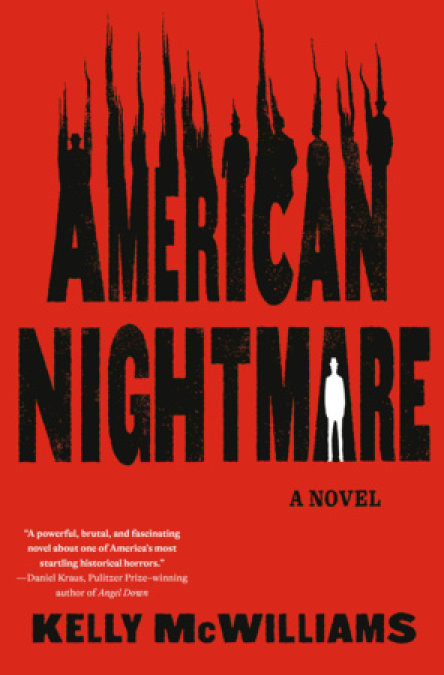
In this haunting historical novel, a light-skinned Black man goes undercover to investigate lynchings in the South, only to be confronted by the very evil that has pursued him since childhood...
Clark Wendell White first encountered the Nightmare as a child during the Atlanta Race Riot of 1906, when he and his father stood guard over their family home. In the eyes of the mob surging through his neighborhood, Clark sensed this malevolent presence. It was then that the Nightmare took shape, burrowing deep into his mind and feeding on his fear.
Years later, the same evil presence drives Clark to the NAACP’s headquarters in New York City, where he answers an ad seeking light-skinned Black men for dangerous undercover work. As a spy for the NAACP, Clark investigates lynchings, impersonating the very Nightmare that once tormented him.
As Clark descends deeper into this double life, another force rises: a new chapter of the Ku Klux Klan, finding a foothold in the storied streets of New York City. Among its eager recruits is Sam Cahill—the one man who can see past his disguise. Now Clark must outwit both the living and the dead, as he confronts a past that refuses to stay buried and a future where the act of passing exacts a soul-deep price.
Inspired by the life of civil rights activist Walter White, who passed as a white man to expose the brutality of lynchings from the South to the Midwest, American Nightmare is a gripping historical thriller that reveals the most terrifying monsters aren’t those that go bump in the night but those that walk among us.
Release date:
September 15, 2026
Publisher:
Crown
Print pages:
304
* BingeBooks earns revenue from qualifying purchases as an Amazon Associate as well as from other retail partners.
Across a metal table from his interviewers—one graceful woman and one exceedingly famous man—Clark nods.
“You came up from Atlanta?”
“Rode the rails for thirty-six hours just to meet you, Mr. Johnson. May I say it’s an honor, an absolute—”
“Easy, Mr. White.” James Weldon Johnson holds up a long, elegant hand. “No need for flattery. Just answer the question.”
Clark swallows.
The room is plain, dull as a mailbox—not what he expected from the offices of the National Association for the Advancement of Colored People. Then again, he suspects this isn’t headquarters but only some Fifth Avenue limbo set apart from the rest of the men: the NAACP’s real, battle-hardened soldiers.
A hot ache builds behind his eyes—his yearning to stand among them.
After two days on his feet, clinging to train stanchions in colored cars, Clark reeks of sweat and the hardscrabble South. Johnson, meanwhile, looks like he stepped out of an oil painting, mustache crisp and collar neat. Gloria—he never did catch her last name—is dressed to the nines. Stunning white pearls adorn her long neck, and her ebony suit’s cut with military precision, the kind of tailoring Clark has only seen in magazines. But it’s her eyes that snag him. Though velvet, they’re merciless.
Clark fidgets in his best suit, like a traveling salesman who done lost his way.
Johnson softens. “You understand why we’re in such a hurry. What position we seek to fill—and why?”
Clark’s got himself a darn good guess. In the pocket of his trousers is a flyer given to him by his boss, Eugene Rivers.
On the lurching train, he memorized every word.
To the LIGHT-SKINNED Negroes of Atlanta! The NAACP is ACTIVELY recruiting WHITE PASSING MEN for a SPECIAL ASSIGNMENT in New York! RESPOND, TRUSTED SOUL, FOR YOUR HELP IS SORELY NEEDED!
“My boss, Mr. Rivers, says—”
“Good ol’ Eugene!” Johnson smiles wide. “The way he tells it, you’ve scammed white folks from Georgia to Texarkana at great risk to yourself.”
“Sure.” Clark plays it cool. “I’ve sold death insurance in a few rough places. Never know what might happen out in those bayous.”
“And most of your customers—they’re white?”
“Poor whites along the river roads . . . that’s my core market.”
Scowling, Gloria slashes her pen across a notepad.
Clark flinches.
Not everyone appreciates a white-passing man. Not everyone sees the value.
Ah, well. He’s used to it.
“And most of those ‘poor whites,’ as you put it”—Johnson’s steady gaze is like bottled lightning—“don’t take kindly to outsiders. Let alone Negroes.”
“No, sir.”
“And you really are a Negro, ain’t you?” Johnson smiles apologetically. “See, I got to ask.”
A lank of blond hair falls over Clark’s eye. “I’m a Negro,” he says stiffly. “My parents walked off the same plantation as children.”
“It happens, don’t it?” Johnson winks, making amends.
“Yes, sir.”
“So tell me, Clark. This passing thing you do. How do you pull it off?”
Gloria looks up, pen hovering. This answer is what they’re really after—these spymasters in search of a spy.
“On the road, everyone picks up a trick or two.” Clark clears his throat. “But I reckon accents—and voices—those are mine.”
“And just how good are you?”
I’m alive, ain’t I? “Any drawl a body can name, I can mimic it.”
Johnson swaps a look with Gloria.
Laconically, she murmurs, “Might we request a demonstration?”
“Well.” Clark thumbs his nose, preparing. “Y’all already know what we sound like down in Negro Atlanta—somethin’ just like this. And can you catch how that’s different from slow, curlicued Savannah white?”
Clark slips into the accent like a fine-spun coat. Women usually love it. Gloria doesn’t even crack a smile.
“There’s more where that came from.” He squares his jaw; he wants this job more than air. “Memphis riverboat? Flows right outta me. Panhandle twang? Slice of pie. Alabama drip? No skin off my knees.”
Johnson thunders, “Oh, bravo! Bravo, son! That’s just delightful!”
Clark stares, momentarily lost in the wonder of his presence. Just last week, Clark read his speech on the rise in Southern violence, delivered to a Chicago crowd.
We work night and day at the association, Johnson said. But the hard truth is that nothing we do matters a whit if we can’t stop these lynchings!
So long as they kill us like beasts, what does desegregation matter, or even the vote? So long as any one of us is just waiting to die, how can we make any progress at all?
Clark had shivered, reading the words. So long as any one of us is just waiting to die. That’s how it felt, living in the South.
Johnson leans forward. “You ever been caught?”
“No, sir.”
He grins, wolfish. “And how many trips would you say you’ve made back and forth? As a white man, I mean?”
“Dozens,” he admits. “Two dozen at least.”
“Hot damn!” He slaps the table, rings flashing. “A record like that speaks for itself. Don’t it, Gloria?”
“Jim,” she warns. “He’s pale as a tablecloth. Could be luck.”
Clark frowns; she crooks an eyebrow. A tiny mole hovers over her upper lip—unfairly lovely. If she wasn’t so unpleasant, she’d be distractingly pretty.
“It ain’t luck that’s kept me alive, ma’am,” Clark starts. “It’s—” The Nightmare, he nearly says, like a child. “What I’ve seen. What I know.”
He never intended to pass for a living, but when Standard Life Insurance was in danger of going under, Mr. Rivers asked for a special kind of help. Clark agreed to do it.
And he excelled.
On the road, Clark always knew just when to knock, when to leave a door alone—and when to run. Up and down the Mississippi, he howdied along with the best of them, turning a pretty penny as a white-passing man.
But it sure was lonely with all those white folks looking at him like a mirror—finding only themselves—and Negroes ducking their heads as they passed by.
He’d started to break apart, not feeling quite real.
He’d interviewed at all the Negro businesses he could think of—looking for work, any work that didn’t involve a scythe or a wheelbarrow or a lie. But colored businesses had been shuttering in the decade since the riot, and half of those that remained were helmed by bosses who took a frank dislike to Clark on account of his skin.
A colored mechanic in Buford even told him to go on and be white if he wanted work so bad.
You could be a white bellhop for the hotel . . . or a white bank teller at Southern . . . hell, be a white motherf*** of a cop for all I care. He chewed dip. Spat it, wet, on the ground. All I know is my wife’ll kill me if I hire a white boy like you to do a colored man’s job.
But Clark didn’t want to make a buck for a white man’s wallet.
With the Nightmare swirling all around them—and picking up steam, the nasty, evil thing—and better men fighting overseas, he hungered to be just what he was.
Only lately he’d started to wonder if what he was was cursed.
Then Eugene Rivers passed him the flyer.
“Any Negro with brains is gettin’ the hell out of the South,” he said, kind eyes gone hard. “You make a fine salesman, but . . . it’s time you moved on.”
On the train north, Clark rode the tide of hope, growing taller with each stop because he was ready. He’d been ready for years.
Then, in the lobby, he’d shaken hands with the only other applicant for the job of a white-passing spy: a pomaded Northerner the color of caramel, clutching a handkerchief to a bloody nose.
“I’m Mr. Paul Benjamin, Esquire, of Pennsylvania,” he’d said sniffily. “Pleased to meet you.”
Then coughed, long and wet.
It’d be a cold day in hell before Mr. Benjamin could pass for white.
And that meant, by God, that Clark had a chance.
We hope you are enjoying the book so far. To continue reading...

 Please log in to recommend or discuss...
