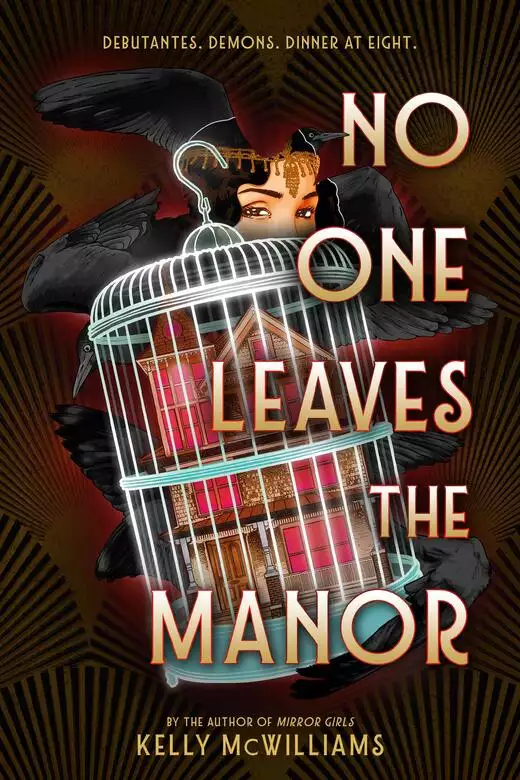
A deliciously twisted, fast-paced YA horror, where debutante dreams become bloody nightmares—perfect for fans of House of Hollow and Their Vicious Games.
It’s 1921, and Mrs. Caroline Reginald Kane, the last surviving descendant of a family of oil barons, has invited four young debutantes to visit her at Greystone Manor. There, they'll compete for the ultimate prize: to become heir to her unspeakably vast fortune.
But only one girl can win.
And the manor is watching.
Dorothea is a thief, and the best liar in the American Northeast. Her mother vanished at Greystone years ago, and she’s determined to find out why—so long as no one uncovers her secrets first.
Vaughn isn’t crazy. She was born for this life—and she won’t let anyone come between her and the fortune she deserves.
Birdie doesn’t know why she’s been invited, but she believes everything happens for a reason…and that reason just might be divine.
Elspeth is called “pretty as a peach, dim as a doorknob.” But she sees things that the others can't: whispering birds, shifting doors, and a language that should never be spoken.
And there’s something else hidden behind these walls. Something sinister.
It doesn’t plan to let them leave alive.
Release date:
July 14, 2026
Publisher:
Little, Brown Books for Young Readers
Print pages:
320
* BingeBooks earns revenue from qualifying purchases as an Amazon Associate as well as from other retail partners.
“IT’S SO ODD THAT I’VE NEVER SEEN YOU before,” says the boy—so unwise—who let Dorothea Williams into his mother’s powder room the night of the Du Pont family’s New Year’s Eve party, where she’s currently rummaging through his mother’s jewelry case, smiling at her great good fortune: pearls, lapis lazuli, and a diamond ring.
Dorothea stuffs them all down the front of her brassiere, moving quick and clean, like Chester taught her. The boy isn’t particularly bright, but his parents could stumble upstairs any moment, and Dorothea’s not eager to see the inside of the McKinley Women’s Reformatory for Coloreds ever again.
“I mean,” the Du Pont boy slurs, voice muffled through the door, “I thought I knew every pretty girl in Boston. But you’re something else. Something special.”
With a fistful of gold watch chain, Dor rolls her eyes. Rich boys.
Brunette or blond—or, rarely, redheaded—these sons of bankers, financiers, and stock market traders are always, somehow, exactly the same. It’s almost too easy to smile at them winningly, convincing them she’s very much interested in a handsy kiss in a closet. Convincing them she belongs—which she certainly does not.
Though it would shock Thomas Du Pont III (or was it the IV?) to know it, Dorothea Williams hasn’t been invited to this sumptuous party inside a millionaire’s townhome. She knows no one here because she isn’t a debutante—she’s a thief. And that’s how she prefers it. There’s nothing she despises more than a pampered, helpless deb.
Brassiere fully stuffed, Dor slips a bangle over her wrist. Thomas is so drunk, she doubts he’ll notice.
In her heart, an invisible watch ticks: Hurry, little rabbit. Time’s running out.
Oh, but on her right is Mrs. Du Pont’s glorious closet, stuffed with furs. Dor’s always wanted a glamorous fur—something with a bright satin lining. And wouldn’t it only be prudent to snatch one while she has the chance? With the right clothes, a person can walk through any door. Be anything.
Quickly (but clean, Dor, keep it clean!), she darts into the closet and lifts a silver fox fur from its hanger. It’s impossible to hide the elegant thing, but everyone is terribly drunk, Prohibition be hanged. This old coat won’t sink her.
She throws it over her shoulders and returns to the mirror, admiring herself by the light of the candelabra.
Why yes, monsieur, I’m worth a cool million, at least. She crooks an eyebrow. I wear only the finest diamonds, and wouldn’t you know it—my checks always clear!
“Jane?” her mark whines, jiggling the doorknob and finding it locked. “It’s almost midnight. Haven’t you finished powdering your nose yet?”
He’s eager for his New Year’s kiss, that boy—whining with the false name she’s given him.
In the mirror, Dorothea sees “Jane” reflected: a white-looking girl with dimples and golden skin, her face framed by red-brown curls she’s pressed into submission. Her nails are polished down to the cuticles, her hair stiff with cream. She looks like any other Beacon Hill debutante on break from some vaunted finishing school—but it’s all an act.
Dor comes from another part of Boston entirely. And her people are decidedly not “finishing school” people.
Hurry, little rabbit. Time to go.
“Jane?”
“Hold your horses, Thomas! I’ll be right out!”
She whips open the door just in time to see the tuxedoed scion kick a small black cat.
Her smile burns off.
“Sorry.” He smirks. “My sister dumped Cleopatra on me before she left for Sweden. The whelp scratches.”
The terrified cat scrambles down the marble staircase, all slipping, panicked claws. The crowd below pays no attention. Ostrich-feathered flappers click across parquet, exposing ivory throats as they flirt and laugh. Al Jolson croons on the radio, and the New Year’s countdown has just begun, and Dor really hates these callous, thoughtless people, who’ve known nothing but comfort all their lives and can’t be bothered to lift a finger for anyone else—not even a helpless, pampered cat.
Ten! they chant. Nine!
“Wait a minute.” Thomas squints. “Is that my mother’s fur?”
Hang it.
“What did you say your name was again?” Beneath his shiny flop of hair, the Du Pont heir no longer looks quite so drunk.
Eight! Seven!
“Jane,” she says sweetly.
“No.” He snaps his fingers. “Your surname. Who even invited you?”
Now she whips out her sharpest smile—double-edged, like the pin in her hair. Why not? She’s been made. It doesn’t happen often, but when it does, it’s always a thrill.
And Dorothea loves a thrill.
Six! Five!
“No one invited me,” she purrs, walking two fingers through the air like legs in heels. “I just waltzed. Right. In.”
Shock slackens Thomas’s face. She slams his mother’s door in it. Before he has a chance to recover, she wedges a bergère chair beneath the knob, barricading herself inside.
Four!
Three!
Two!
ONE!
HAPPY NEW YEAR!
Below, the crowd erupts. It’s officially 1921 in America, and for the champagne set, at least, it promises to be a very good year.
“Jane? Open this door!”
Petulant. Why are rich boys always so petulant? They’re like eternal children in tuxedos!
She hurries to the window she cased yesterday. It overlooks a rose garden and the mansion’s curved porte cochere—what poor folks call a driveway. She shakes her matchbook from her purse (The Catfish Club, its silver letters read) and strikes one alight.
A sleek Rolls-Royce flashes its headlamps once. Twice.
Dor grins.
Thomas Du Pont batters at the door. She hears loud voices—he’s called for help. Probably the cross-eyed butler—big enough to hold her down. Now a stronger, more urgent thrill piano-jangles up her spine, because she really could go down tonight. In less than the second required to strike a match, she could plunge into the abyss, taking what’s left of her family down with her.
And yet, forcing the window open, Dorothea feels wonderfully, fearfully alive.
“We’re coming in!” the butler shouts. “Stand back! I’m armed!”
“So long, Thomas,” she sings—and clambers out the third-floor window.
Between the sill and the drainpipe: half a foot of air.
Dor leaps, clutching at empty space… and finally at an ice-cold pipe, which she rides like a firefighter under the fear-brightened stars, whooping for glee.
The Royce growls in the driveway: Chester’s worried.
Though he first taught her to steal, her brother’s never liked it. For years now, he’s been trying to talk her out of gambits like this one, claiming it’s only a matter of time before they’re caught—but Dor disagrees.
Though she’s a Negro, she’s light enough to pass for white—and Chester’s clever enough to break them out of Fort Knox. Together, they’re the best team in Boston.
Her feet strike the cobblestones just as the bedroom window crashes open.
“STOP! THIEF!”
Like a lighthouse in a storm, Chester’s headlamps pierce the night. Dor grips the collar of her fur and runs, sprinting for her brother’s car, now perfectly angled to peel out of the driveway just as fast as the engine can fire.
Commotion in the town house behind her—doors opening, voices rising—and they have but a second to make their getaway, quick and clean, as they planned. Against her chest, the Du Pont woman’s jewelry feels awfully cold. It’ll pay their mortgage for the rest of the year, not to mention the lease on the Royce. How lovely to start the new year off on the right foot!
She’s reaching for the car door, which Chester has helpfully swung open, when out of the corner of her eye—
A black streak.
A furry black streak.
Dor pivots.
Chester honks, incredulous.
Too late. She’s already scooped the cat—Cleopatra—into her arms.
Thomas was right about one thing: The whelp does scratch.
But Dor isn’t about to abandon her here, surrounded by people too addled by riches to ever truly love her. Dor might be a thief, but she’s not a monster. She knows what it’s like to be left behind by the one person who was supposed to love you most.
She knows what it feels like when that person disappears.
Partygoers pour out of the town house. Soon they’ll have the Royce surrounded, but Dor’s back on her game. She launches herself and the yowling cat into the back seat.
Chester stares in disbelief.
He’s wearing his best disguise: a chauffeur’s trim cap. Between that and his skin—far darker than hers—none of these people ever look at him twice. Just somebody’s driver, they think. Surely no Negro in Boston owns a Rolls-Royce.
“Is that a cat?”
Cleopatra hisses.
“Drive, Chester!” Dor shouts. “By golly, just drive!”
The Royce lurches forward, tires squealing over cobblestone.
Thomas and his friends shout in the distance, waving their arms.
Fireworks explode over Beacon Hill, red, white, and blue.
Forty horses fast, they vanish into the night.
WHIPPING THROUGH BOSTON’S ALLEYS AS if his life depends on it, Chester can’t believe he’s still pulling nonsense like this—even now, at the ripe old age of nineteen.
It was all very different when they were younger.
With Mama gone, he and Dor had no choice but to case these glorious houses and filch what scraps they could. Now they have resources. He’s leased the Rolls; he could easily go straight. Drive for the same rich people he’s used to fleecing. If he put his mind to it, Chester wouldn’t have to spend his New Year’s Eve on the verge of a heart attack, watching his sister slide down a gutter pipe in a stolen fur coat.
The problem, as always, is Dor.
Stretched across the back seat, she’s laughing, cuddling the cat she stole (one with a collar! And a little bell!) while it tries its best to murder her.
He never could say no to his sister—so maybe the problem is actually Chester himself.
Maybe he’s been too soft on her.
In Copley Square, he eases his foot off the gas.
“I’m stopping this car,” he says. “Then you’re gonna put that thing out. You hear?”
To Chester’s dismay, Dor snorts. “This thing is a cat, and this cat has a name.”
“I don’t care.”
“It’s Cleopatra, evidently. We’ll call her Cleo, instead.”
“We are not keeping her, Dor, and you should’ve left her where she was. White people are nuts about their pets. Everybody knows that. And—just look at her!”
In an attempted evisceration, the cat is digging into the belly of Dor’s coat with sharp, pearlescent claws.
“Now, Cleo, don’t fight me,” Dor coos. “I promise—” She begins to sing, channeling Marion Harris: “I’ll be the greatest pal you’ve ever had.”
The cat freezes, gazing up at her—and so does Chester.
When was the last time he heard his little sister sing?
The cat blinks once, slow as a nod, and—as if she’s been waiting all her life for that very song—curls against Dorothea’s chest, starting to purr.
“See that, Chester? She heard me! She loves me!” It breaks his heart, how delighted his sister is. “Isn’t she gorgeous?”
Restarting the car, Chester shoots a glance at the black fluff ball—and finds it scowling right back at him, smug as a bug.
It’s not, in fact, a particularly attractive cat.
Her green eyes glitter with predatory malice. Her face smooshes inward like unformed dough. Tufts of fur already mar his ivory seats. Whoever tagged her with a leather collar and bell probably thought she was some precious princess once. But Chester knows a killer when he sees one, no matter how small.
“I love her to pieces, Chester.” Dor rubs her face against Cleo’s small one. “She’s got spunk. And I’ve always wanted a pet.”
Chester’s heart softens.
Dor lost her mother when she was only six. He still remembers the look in her eyes when he told her Mama wasn’t coming home. A dazed, wandering look, as if the world had tilted on its axis. He’d hugged her tight, waiting for her to cry.
But she hadn’t shed a tear.
Chester thinks she still hasn’t. The place where natural grief lives inside her was stunned that day—shocked silent.
It scares him to think, sometimes, of what might’ve grown in its place.
An hour later, Dor’s fallen asleep in the back of the Royce, buried under her stolen fur. Her body rising and falling in slow, even waves.
Curled in her lap, the cat’s sleeping, too.
Turning into their hardscrabble district, Chester switches off the headlamps. Everyone recognizes the sleek black Rolls, which he’s nicknamed Liza, after Eliza Doolittle. Jokingly, his friends call her the love of his life.
Outside their garden-level apartment, Chester parks, peels off his cap, and studies his sister. When she sleeps, she looks like a perfect angel—but it’s smoke and mirrors. Beneath the filched coat, her cocktail dress is also stolen goods… stolen goods, light-fingered from the whites-only department store. Even as a kid, Dor loved waltzing into segregated places, using her pale skin and pretty smile to get exactly whatever she wanted from people who’d spit on her if they knew the truth.
Chester’s never been able to pass as she does: not with his skin, his hair.
Wherever he goes, Chester’s always a Negro.
And that, ladies and germs, is why I’m stuck driving getaway, while my baby sis sticks out her neck.
Thinking about that feels like biting a glass apple.
Of course, his job’s risky, too. He sells the stolen jewelry and launders the cash. He pays their bills, keeps his daredevil sister from hitting the same targets twice, and discourages the neighborhood brothers from asking her out. (And if she ever caught a whiff of that, she’d kill him dead.) But most of all, Chester worries. He worries about traceable money and police showing up at their door. He worries about their apartment foreclosing, and the two of them winding up, once again, on the street. He worries about influenza coming back. He worries about America falling into another war.
And he worries, endlessly, about Dorothea.
“Wake up,” Chester says to her now. “We’re home.”
“Already?” She stretches, yawning. The black cat mirrors her, flashing teeth.
“Yeah. But listen.” He tries for casual. “I’ve made a decision.”
“What decision?”
He shrugs as if it’s nothing, as if he hasn’t been rehearsing the line in his head all night. “Call it a New Year’s resolution. This is the year we go straight. Put the bad life behind us. For good.”
Dorothea blinks once—then laughs in his face.
“I mean it,” Chester says, wounded. “I passed my livery exam. There’s plenty of work for chauffeurs. I’ve leased Liza for the rest of the year, and I’m sure I can cover the mortgage. If you get a job—maybe at the laundry—we can—”
“The laundry?!” Draped in fur, Dor’s the picture of haughtiness. “You want me to work at the laundry?”
She’s been spending far too much time around white folks.
“It’s just an example. You can have any job you want, long as it’s legal.”
“Horsefeathers, Chester, we can’t quit now. We’re still having fun! Aren’t we?”
I’ve coddled her.
Now watch it bite my ass.
“Life isn’t all about fun,” he says. “Not for us.”
“You mean Negroes.”
“Negroes, immigrants, poor whites—whoever’s got themselves some real problems. Rich folks can play all day, but we’ve got to grow up, Dor. And fast.”
The cat arches her back, exploring the plush seat as if it were always meant to be hers.
“What if I’m not ready to quit?” Dor tips up her chin. “You don’t know what it’s like inside these houses. How filthy rich they are. What we’re doing isn’t a game. It’s how we get justice. It’s how we get ours.”
Chester groans.
“I mean it!” Dor flares with fresh heat. “Why should these people get everything, while we settle for scraps? Don’t you remember sleeping outside the opera house? How ladies stepped over us like we weren’t even there? People like that deserve every bad thing coming to them. Why shouldn’t that bad thing be little old me?”
“Because I want you to live a long, happy life, for one thing,” Chester says. “How you gonna feel if they put you in a cage?”
“I’ve done time before.”
“As a child, Dor. Next time they cage you, it might be forever.”
“I’ll take my chances.”
“Not on my watch.” He’s angry now. “And I’m not risking my freedom, either. Not anymore.”
“You’re just the getaway driver, Chester! It’s easy as pie!”
“Easy as pie?” His laugh kicks out. “Do you have any idea how many nice girls won’t touch me because I’m a known crook? How many good, upstanding daddies have chased me off their front porch?”
Dor laughs. “I almost forgot about Mr. Johnson. Poor Ella was mad for you.”
Ella was, indeed, mad for him—pretty, too. But Mr. Johnson made his feelings clear—and girls like Ella mind their fathers.
Chester grinds his teeth.
“I’m telling you I’m done!” He doesn’t mean to raise his voice. “That was my last job, Dor. If you want to keep going, it’s a free country—but you’ll have to find another driver. And I don’t like your chances of staying out of prison.”
Two pairs of eyes stare him down: Dorothea’s copper browns, and the cat’s emerald greens.
“Message received.” She’s steely.
Not good. “Come on.”
“I read you loud and clear, brother mine. From here on out, I work alone.”
He rubs his eyes, wondering if everything would be different if he’d only made her go to bed on time, back when she was small.
Now, cradling her stolen cat, Dor slides out of the Royce and slams the door behind her.
At the front door of the apartment, she turns. “Well? You coming or what?”
Chester pinches the bridge of his nose with one hand, the other patting Liza’s perfect dash. Clean lines, tight gauges, every dial in its place. He breathes once, steadying himself. Their talk didn’t go as planned, but he’s no quitter. He gets out, locks the Royce, and follows Dor down the rickety stairs into their apartment. He relishes the familiar sounds of homecoming: the clatter of his keys hitting the table, the shush of their shoes slipping off.
Modest as it is, he’s proud of the home he’s provided. The neighborhood is solidly working-class. The colored tenants don’t have much in the way of money, but they make up for it in dignity. Grown folks work hard while kids play double Dutch. Most of the time, they fall asleep with bellies full of meat and potatoes and garden greens. It’s a good neighborhood—but Chester can’t help worrying they got here too late.
He’s heading into the kitchen to put the kettle on when Dor pauses at the mail table. She flips through a handful of envelopes, then inhales sharply.
Chester spins around. “What’s wrong?”
“It’s an invitation,” she breathes. “To Greystone Manor.”
His stomach swerves. “No,” he says. “Absolutely not.”
But she doesn’t look at him. She stares at the invitation as if it contains every secret in the known universe. Every other piece of mail—the circulars, the bills—falls at her feet.
“Dor, listen to me.” He tries to pull her focus. “This is one con we absolutely cannot pull. Not under any circumstances.” He’s sweating, just thinking of it. “We are not doing this.”
The look she levels at him is that of a heartbroken child—and it guts him.
“But, Chester,” she whispers. “It’s Mom.”
Against all he knows is coming next, Chester shuts his weary eyes.
ON THE ROTARY PHONE AT HER THIRD FINishing school in as many years, Elspeth Taylor clutches her invitation to Greystone Manor, fighting gulping tears of panic.
It’s very important that she not cry now, while everyone’s watching.
She’s seated inside the glass booth where the school keeps its precious automatic telephone, and there’s a sinuous line of other young ladies (that’s what the school prefers to call them; Elspeth has witnessed too much cruelty to think of them that way herself) tapping gold watches and pulling impatient faces, trying to bully her out of the fifteen minutes she booked on the sign-up sheet.
Fifteen minutes is all they’re allowed on the phone, but the girls behind her think they can gain a few more precious seconds if only she’d shove off early.
And everyone is just so certain that Elspeth will shove off, because here, at the Broadmoor School for Young Ladies, Elspeth Taylor languishes at the bottom of the pecking order, all because she had the nerve to show up in last season’s dresses, signaling to one and all that she couldn’t afford a fresh wardrobe. Her very presence triggered the investigations of a great many bored debutantes, aided and abetted by their meddling mothers. Calls were placed. Letters were written. And, ev. . .
We hope you are enjoying the book so far. To continue reading...

 Please log in to recommend or discuss...
