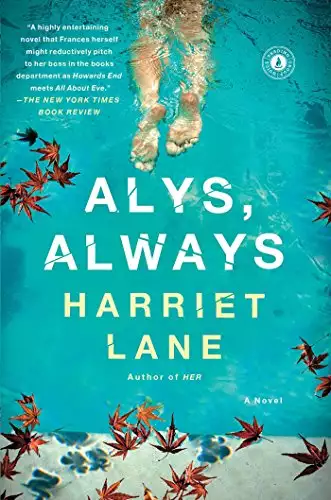
Frances is a thirty-something sub-editor, an invisible production, drone on the books pages of the Questioner. Her routine and colourless existence is disrupted one winter evening when she happens upon the aftermath of a car crash and hears the last words of the driver, Alys Kyte.
When Alys's family makes contact in an attempt to find closure, Frances is given a tantalising glimpse of a very different world: one of privilege and possibility. The relationships she builds with the Kytes will have an impact on her own life, both professionally and personally, as Frances dares to wonder whether she might now become a player in her own right...
Read by Clare Corbett
Release date:
June 12, 2012
Publisher:
Scribner
Print pages:
224
* BingeBooks earns revenue from qualifying purchases as an Amazon Associate as well as from other retail partners.
It’s shortly after six o’clock on a Sunday evening. I’m sure of the time because I’ve just listened to the headlines on the radio.
Sleet spatters the windscreen. I’m driving through low countryside, following the occasional fingerpost toward the A road and London. My headlights rake the drizzle, passing their silver glow over gates and barns and hedgerows, the CLOSED signs hung in village shop windows, the blank, muffled look of houses cloistered against the winter evening. Few cars are out. Everyone is at home, watching TV, making supper, doing the last bits of homework before school tomorrow.
I’ve taken the right fork out of Imberly, past the white rectory with the stile. The road opens up briefly between wide, exposed fields before it enters the forest. In summer, I always like this part of the drive: the sudden, almost aquatic chill of the green tunnel, the sense of shade and stillness. It makes me think of Milton’s water nymph, combing her hair beneath the glassy, cool, translucent wave. But at this time of year, at this time of day, it’s just another sort of darkness. Tree trunks flash by monotonously.
The road slides a little under my tyres so I cut my speed right back, glancing down to check on the instrument panel, the bright red and green and gold dials that tell me everything’s fine; and then I look back up and I see it, just for a second, caught in the moving cone of light.
It’s nothing, but it’s something. A shape through the trees, a sort of strange illumination up ahead on the left, a little way off the road.
I understand immediately that it’s not right. It’s pure instinct: like the certainty that someone, somewhere out of immediate eyeshot, is watching you.
The impulse is so strong that before I’ve even really felt a prickle of anxiety, I’ve braked. I run the car into the muddy, rutted margin of the road, up against a verge, trying to angle the headlights in the appropriate direction. Opening the car door, I pause and lean back in to switch off the radio. The music stops. All I can hear is the wind soughing in the trees, the irregular drip of water onto the bonnet, the steady metronome of the hazard flashers. I shut the door behind me and start to walk, quite quickly, along the track of my headlights, through the damp snag of undergrowth, into the wood. My shadow dances up ahead through the trees, growing bigger, wilder, with every step. My breath blooms in front of me, a hot, white cloud. I’m not really thinking of anything at this moment. I’m not even really scared.
It’s a car, a big, dark car, and it’s on its side, at an angle, as if it is nudging its way into the cold earth, burrowing into it. The funny shape I saw from the road was the light from its one working headlamp projecting over a rearing wall of brown bracken and broken saplings. In the next few seconds, as I come close to the car, I notice various things: the gloss of the paintwork bubbled with raindrops, the pale leather interior, the windscreen that hasn’t fallen out but is so fractured that it has misted over, become opaque. Am I thinking about the person, or people, inside? At this moment, I’m not sure I am. The spectacle is so alien and so compelling that there’s not really any space to think about anything else.
And then I hear a voice, coming from within the car. It’s someone talking, quite a low, conversational tone. A sort of muttering. I can’t hear what is being said, but I know it’s a woman.
“Hey—are you all right?” I call, moving around the car, passing from the glare of the headlight into blackness, trying to find her. “Are you okay?” I bend to look down into windows, but the dark is too thick for me to see in. As well as her voice—which murmurs and pauses and then starts again, without acknowledging my question—I can hear the engine ticking down, as if it’s relaxing. For a moment I wonder whether the car is about to burst into flames, as happens in films, but I can’t smell any petrol. God, of course: I have to call for an ambulance, the police.
I pat my pockets in a panic, find my mobile, and make the call, stabbing at the buttons so clumsily that I have to redial. The operator’s answer comes as an overwhelming, almost physical relief. I give her my name and telephone number and then, as she leads me through the protocol of questions, I tell her everything I know, trying hard to sound calm and steady, a useful person in a crisis. “There’s been an accident. One car. It looks like it came off the road and turned over. There’s a woman in there, she’s conscious; there might be other people, I don’t know, I can’t see inside. Wistleborough Wood, just outside Imberly, about half a mile past the Forestry Commission sign—up on the left, you’ll see my car on the road, it’s a red Fiat.”
She tells me help is on its way and I hang up. There’s quiet again: the trees creaking, the wind, the engine cooling. I crouch down. Now my eyes have adjusted, I can just make out an arm, thrown up against the side window, but the light is so dim that I can’t see any texture on the sleeve. Then she starts to speak to me, as if she has woken up, processed my presence.
“Are you there?” she’s asking. She sounds quite different now. There’s fear in her voice. “I don’t want to be on my own. Who’s there? Don’t go.”
I kneel down hurriedly and say, “Yes. I’m here.”
“I thought so,” she says. “You won’t leave me, will you?”
“No,” I say. “I won’t leave you. There’s an ambulance on its way. Just stay calm. Try not to move.”
“You’re very kind,” she says. The expensive, cultured voice goes with the Audi, and I know—hearing that voice making that remark—that she makes that comment dozens of times a day, without even thinking about it, when people have shown her courtesy or deference at the farm shop or the butcher’s.
“I’ve got myself into a bit of a mess,” she says, trying to laugh. The arm moves, fractionally, as if she is testing it out, then lies still again. “My husband is going to be so cross. He had the car cleaned on Friday.”
“I’m sure he’ll understand,” I say. “He’ll just want to know you’re okay. Are you hurt?”
“I don’t really know. I don’t think so. I think I knocked my head, and I don’t think my legs are too good,” she says. “It’s a nuisance. I suppose I was going too fast, and I must have hit some ice. . . . I thought I saw a fox on the road. Oh, well.”
We wait in silence for a moment. My thighs are starting to ache and the knees of my jeans, pressed into damp bracken, are stiff with cold and water. I adjust my position and wonder how long it will take the ambulance to get here from Fulbury Norton. Ten minutes? Twenty? She doesn’t sound terribly hurt. I know it’s not a good idea to interfere in a car accident, but maybe I should try to help her out somehow. But then again, if she has a broken leg . . . and anyway, I have no way of opening the car door, which is crumpled and pleated between us, like a piece of cardboard.
I cup my hands and blow on them. I wonder how cold she is.
“What’s your name?” she asks.
“Frances,” I say. “What’s yours?”
“Alice,” she says. I might be imagining it, but I think her voice is sounding a little fainter. Then she asks, “Do you live around here?”
“Not anymore. I live in London. I’ve been visiting my parents. They live about twenty minutes away—near Frynborough.”
“Lovely part of the world. We’ve got a place in Biddenbrooke. Oh, dear, he will be wondering where on earth I’ve got to. I said I’d call when I got in.”
I’m not sure what she means and I’m suddenly frightened she’s going to ask me to ring her husband. Where’s the ambulance? Where are the police? How long does it take, for God’s sake? “Are you cold?” I ask, shoving my hands into my jacket pockets. “I wish I could do more to help make you comfortable. But I don’t think I should try to move you.”
“No, let’s wait,” she agrees lightly, as if we’re at a bus stop, only mildly inconvenienced, as if it’s just one of those things. “I’m sure they’re on their way.” Then she makes a sound that frightens me, a sharp inhalation, a tiny gasp or cry, and then she stops talking, and when I say, “Alice? Alice?” she doesn’t answer, but makes the noise again, and it’s such a small sort of noise, so hopeless somehow; and I know when I hear it that this is serious after all.
I feel terribly alone then, and redundant: alone in the dark wood with the rain and the crying. And I look back over my shoulder, towards my car, the dazzle of its headlamps, and behind it I can see only darkness, and I keep looking and looking, and talking—though she’s no longer responding—and eventually I see lights, blue and white flashing lights, and I say, “Alice, they’re here, they’re coming, I can see them, it’s going to be fine, just hold on. They’re coming.”
We hope you are enjoying the book so far. To continue reading...

 Please log in to recommend or discuss...
