- Book info
- Sample
- Media
- Author updates
- Lists
Synopsis
London had Sherlock Holmes. The dark alleys of Edinburgh had Inspector McLevy.
Known as the father of forensics and a likely influence on Sir Arthur Conan Doyle, real-life police inspector James McLevy is here reinvented by David Ashton in a thrilling mystery—the third in a series—set in dark, violent Victorian Edinburgh.
Halloween 1881, Edinburgh, and the dead are restless. In respectable Edinburgh society, beautiful young American spiritualist Sophia Adler is causing a furor with her dramatic séances. But the ghosts of the past seem hell-bent on retribution.
Inspector James McLevy finds his investigations distracted by more earthly concerns when Muriel Grierson, an outwardly genteel widow, is robbed at home. Her knight in shining armour—one Arthur Conan Doyle, recently graduated from medical school—is keen to learn from such a master of detection as the renowned inspector, but McLevy is less sure that he requires a new acolyte.
A vicious murder occurs with evidence of supernatural strength and violence. Treachery revenged from a battle long ago. All roads lead to Sophia Adler, and the inspector becomes involved with one of the most dangerous women he has ever encountered.
Release date: May 5, 2016
Publisher: Two Roads
Print pages: 349
* BingeBooks earns revenue from qualifying purchases as an Amazon Associate as well as from other retail partners.
Reader buzz
 Please log in to recommend or discuss...
Author updates
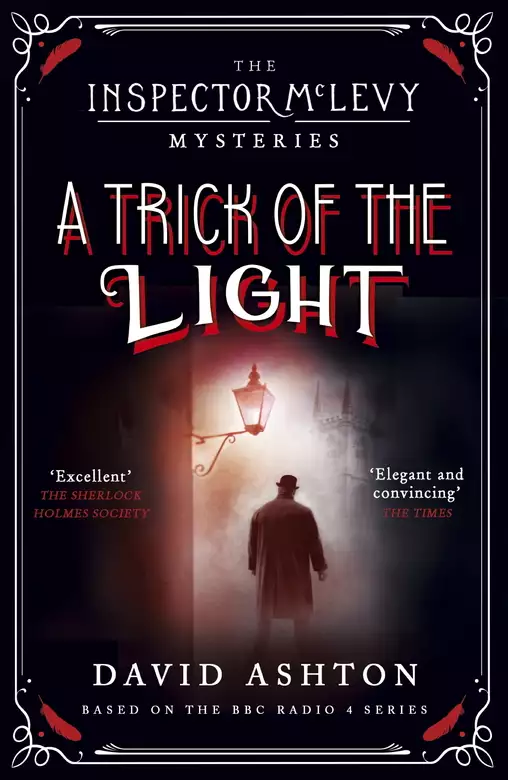
A Trick of the Light
David Ashton
Rousseau to James Boswell
A deathly hush had fallen on Leith Harbour as a horde of white faces stared up into the dripping sombre sky. The drops had smeared and caused the chalked make-up of the young men to run, giving them the appearance of distorted circus clowns, the dark rings round their eyes sliding like black tears as they held a collective breath.
The object of their scrutiny was a slender cane projecting like a stray moonbeam towards the top of a stately ship’s mast. In fact an official vessel of Her Majesty’s Revenue Service, but for this moment trembling on the edge of being the recipient of an equally stately corset that dangled from the tip of the cane.
The underwear swayed as if shying away from the jutting masculine naval staff and then coyly wreathed itself in fond embrace to surrender her charms, helped by an impatient prod from the conductor’s baton.
But would she stay the course?
The stick removed itself, the wind fluttered straps and buckles but the corset held steadfast, gleaming pale as streaks of water ran down old satin in the dark night.
‘She has found her hero!’
A disembodied voice rang out in the damp air, and the crowd below burst into wild cheers to hail the slight figure who shinned nimbly down the mast, mission accomplished.
As the shape landed awkwardly on the deck and hopped to the harbour flagstones, it was now obvious that the cane was no affectation – one leg lagged crablike behind the other – but despite this, the young man executed an agile caper as he accepted the adulation.
His name was Daniel Drummond, also white-faced but with jet-black hair, long and swept-back, that framed the alabaster visage in a dramatic casing.
A medical student with exams successfully passed, Daniel was soon to be qualified like the rest of his fellows; and also qualified as leader of the White Devils, who at this moment vied with the Scarlet Runners, deadly rivals in derring-do and anarchic acts aimed at creating havoc in the public domain.
Three days of mayhem were the city’s reward for the begetting and nurturing of these young bloods who would, in time, become respectable and frown upon the antics in which they now revelled.
A solid chunky figure led the congratulatory throng, Alan Grant. Drummond’s best friend, he played, with some relief, Sancho Panza to the other’s Quixote.
‘Corsets on the topmast – a beautiful sight!’ Daniel announced with gusto amidst much cheerful bedlam as the two friends embraced.
‘I hope your mother doesn’t miss them,’ was the more deliberated response.
‘She has such fripperies in abundance!’
Alan shook his head as he gazed up whence his comrade had newly descended.
‘You are truly mad, Daniel. On such a night to climb so high.’
‘Too cautious, my friend. How are we to win else?’
A refrain of agreement from the rest of the students milling around them brought a smile to Alan’s face.
In truth both young men were to some extent acting a part, as were most gathered here, but whereas Alan possessed a ballast of sorts, the prudent inheritance from generations of a cooperage-owning family, Daniel had a reckless streak. His eyes glittered like the silvery cane he twirled in triumph.
Alan nodded judiciously.
‘The Scarlets will be hard pressed to match such an exploit,’ he admitted.
‘And the White Devils will triumph –’
A hail of wet dungy clods, sky-propelled but now earth-bound, contradicted this bold assertion as they landed with smelly spattering impact on the gathering.
This was accompanied by a chorus of catcalls from a crowd of equally garishly attired young men who had emerged from one of the taverns, their tribal marking a livid scarlet, which covered the face and glowed diabolically in the dark like a satanic challenge.
A howl went up from the white ranks and as the scarlet horde whooped their jubilant way towards the narrow wynds that spread off the harbour, the corset-worshippers set forth in hot pursuit.
Daniel paused once more to admire his handiwork atop the mast and Alan loyally kept company. The crippled leg would not allow his friend to keep up with the whirling limbs of their companions and these two would perforce follow at a more measured pace.
If there was any acknowledgement of his disability, it certainly did not show in the eyes of the slender figure as he bowed solemnly to Alan and they prepared to go where the noise of the fracas would lead them.
Then a cracked voice from the shadows stopped them in their tracks.
‘I saw ye.’
A momentary fear showed in Daniel’s eyes, as if some deep unrest had been provoked by a force of conscience but then some movement from the darkness revealed an old woman who stepped forward, clutching her large handbag like a shield.
A thin face, cheekbones sucked tight in rectitude, the small figure quivered with indignation as she confronted the two miscreants.
This was Agnes Carnegie, as the youths would find out at a later juncture, much to their regret.
‘I saw ye,’ she repeated. ‘Profane a woman’s undergarments, ye sinful godless creatures.’
Daniel threw out a riposte, though Alan was already trying to edge them away from further entanglement.
‘I merely moved them to another location,’ he replied.
‘Ye have no shame!’
As Agnes spat out this verdict, some virtuous saliva joined forces with the rain falling alike on the blameless and culpable.
Nature has no favourites.
While Alan tugged at his elbow, Daniel peered with some humour into the accusing mouth.
‘No shame indeed, but yet I have my own teeth.’
The tiny form shook angrily.
‘A godless sinner!’
‘He does lack a certain pious inclination, madam. You are correct in that observation,’ said Alan earnestly, though a gleam in his eye betokened an inherent comicality to the situation.
Agnes’s hat was saturated and had folded itself around the small pointed pate like a dismal pancake. She wrenched her head right and left to scatter the seeping raindrops, and moved forward to remonstrate further.
‘Decent folk cannot walk the streets these nights without a student rabble making their life a misery.’
‘I would imagine yours to be a misery in any case, madam,’ Daniel responded ungallantly. Then, with aplomb, he limped forward and offered with outstretched hand what he thought to be a placatory gift.
It was a crudely formed rosette of white – the emblem of his faction, and indeed one of the same rested cosily in the bosom of the billowing corset above.
‘You may have one of our favours, madam. White. For purity of purpose.’
She snatched the rosette and with a vicious tweak of her clawed fingers, tore the fragile fabric in two.
Christians have never hesitated to proclaim their virtue by indiscriminate cruelty and Agnes held true to her belief; indeed the action released a further vein of moral invective sown in the Old Testament and reaped by Calvinism.
‘Ye dare insult your elders,’ she observed with tight-lipped relish. ‘Look at you. A deformed soul. See God’s punishment for your wickedness.’
Daniel’s face flushed and his hand gripped tight to the cane. ‘Go to hell,’ he muttered and allowed himself to be moved away by Alan’s restraining hand.
But Agnes had more to convey, clutching at the light grey sleeve of Daniel’s suit, a colour he wore to distinguish himself from the common herd.
‘You will wait till I have ended!’ she shrieked.
‘Take your hands from me –’
‘You will wait my pleasure –’
Alan had by now walked some paces on, thinking to be followed, but now looked back to see the struggling pair.
‘Daniel, come on with you,’ he called somewhat desperately. What had been an amusing entanglement now appeared to have a vicious aspect.
‘Let me go!’
The young man wrenched away and Agnes fell onto her backside in a puddle with an unholy splash.
‘See how I am treated, God help me!’ she cried as both youths disappeared into the darkness.
For a moment Alan looked concerned, but Daniel hauled the larger man onwards, shooting back a vindictive glance, and then all that was left was the sound of the rain.
A distant howl indicated a faraway melee as the rival students joined battle.
Agnes sat, feeling the noxious damp spread around her nether regions. It seemed an eternity passed before she gathered the strength to lever her bony form upright.
She once more clutched her handbag and muttering a deal of possibly uncharitable imprecations, moved slowly off into the darkness.
Mistress Agnes Carnegie had lodgings in Salamander Street, where the slaughterhouse welcomed most dumb animals to its bloody bosom; every night she walked the length of Leith Harbour safe in the arms of the Saviour, but this evening the inner conversation was informed with a certain malicious righteousness. Despite her damp posterior she considered she had won the joust with the crippled reprobate – had he not fled the battle? Scuttled away like a dirty wee rat?
Agnes laughed aloud in the silence. But what was better was her discovery from an earlier time – an open book had revealed the dark secret that would give her power to use or withhold, depending upon her Christian conscience.
Oh, the pleasure to be found as fearful haunted eyes begged silently for mercy and her avoiding gaze twisted the sin deeper, like a nail in the flesh.
Then a wetness where her fleshly tissue had rarely if ever known such brought her wandering thoughts back to present circumstance.
Daniel, the other had called him. A fell disgrace for such a holy name –
The rain had stopped for a moment and something fluttered at her feet. It was the favour she had previously torn, now lying on the moist flagstones.
Agnes looked swiftly around but saw nothing save darkness and shadow. Then a chirruping whistle sounded from behind her and she turned to see a slim figure emerge from one of the wynds that spread like wormy fissures from the body of the harbour.
Her eyesight was poor but she could see that he held a cane and skipped with an odd halting gait towards her.
Had the old woman not been so wrapped up in her vengeful musings, she might have observed this strange being to have dogged her footsteps for some time.
She peered as he whistled once more like a discordant meadowlark. His face was chalk white, his suit a pale colour, hair plastered flat, eyes dark and hidden as his countenance was averted at an angle from her sight.
He pranced up merrily like a March hare, struck an attitude with one dainty foot to the fore, then flipped back the tip of his cane to land on the shoulder and smiled, the teeth a little yellow against the white mask of his face.
Then he deliberately allowed himself to become still and presented his appearance close towards her, as if in invitation.
Finally, her jaw dropped in recognition.
‘You –’ she began as the cane whipped across and took her full in the throat, crushing the windpipe to stanch the flow of air.
Words need air.
As her head lurched forward, the cane cut viciously down in two blows to the sides of her unprotected neck and then welted down upon her pathetic, pious hat to penetrate her cranium.
She fell like a stone and the blows rained down with hideous accuracy and no little brio as the figure danced around the broken-backed doll that had once been a woman of some upright quality.
With her dying breath Agnes tried to form a word to name what she had recognised, but a swordsmanlike hit cut precisely between her eyes like a sabre and – as it were – she gave up the ghost.
A dying spasm finally loosened her grip on the bag and amongst its contents, now spilled out onto the slippery stone, was a heavy bible, solemn with usage, but the spine loose and flapping like a duck’s wing.
The figure riffled through the pages till, coming upon a suitable passage he ripped free the leaf. Having perused then marked a line in it with a thumbnail, he wrapped the white favour within this holy covering and stuffed the whole inside the old woman’s mouth as if she were a Christmas turkey. He then jammed the jaw shut.
So, like a jack-a-dandy, bible in hand, he danced off into the night, leaving his erstwhile partner a numb, lifeless wallflower.
The rain began to fall again, diluting the trickle of dark blood coming from the ears of the corpse.
A seagull high above let out a screech.
To signal a soul departing, or was it just a bird on the wing?
I’ve seen sae mony changefu’ years,
On earth I am a stranger grown:
I wander in the ways of men,
Alike unknowing and unknown.
Robert Burns, Lament for James, Earl of Glencairn
James McLevy regarded himself in the rust-flaked mirror and came to the conclusion that he resembled a ruined castle.
The cheekbones still held their place but above and below were a scene of near desolation.
Where was the wolf these days?
He leant forward and peered into the slate grey eyes almost concealed in the folds of lidded flesh; a yellow light might still burn in them somewhere but damned if he could see it.
This revelation caused the nostrils to flare in the broad pitted nose. What teeth remained were like tombstone stubs hidden behind the thick, curiously ripe lips.
It aye puzzled the inspector why his lips might appear so lush with promised joy and perhaps to disguise this, he had recently grown a bushy moustache, which was flecked with some grey and an indeterminate colour like charred ashes that gave him the appearance of, in the opinion of Constable Mulholland, ‘a walrus with the mange’.
Beneath the dimpled, or in more manly terms, cleft chin was where the real trouble lay.
The heart.
Some years before, the inspector, after laying low a brute of a killer by dint of shooting the bugger on top of a roof while receiving a simultaneous battering, had commenced to experience various shafts of pain in the chest and innards. These shafts were sharp and took the breath away.
After suffering for many years as a man is apt to do with what he does not wish to acknowledge, this thorn in his flesh became more insistent and harder to disguise from such as Mulholland and Lieutenant Roach at the station.
McLevy began to suspect that Roach, not a man noted for his perception of other’s woes, was giving him the odd little sideways look, so the inspector decided enough was enough and went to see the doctor.
A doctor in Glasgow of course; Edinburgh was a village for gossip and there’s nothing the Scots enjoy more than the cataloguing of other folk’s ailments.
Alexander Pettigrew was the reconnoitred specialist: an attenuated yet boisterous fellow whose false teeth flew in and out of his mouth with alarming rapidity.
The inspector had grudgingly bared his upper body to be poked and prodded, suffered an interrogation as regards his dietary habits, and even at one point been cross-examined on the subject of sexual activity.
Pettigrew clacked his teeth happily at the baleful glare this question produced – nothing irritates the male Caledonian more than enquiries into the activity of nether regions.
The doctor finally sat down at his desk while McLevy donned his shirt and jacket, then put his medical fingers together to form a barricade and then beamed.
‘Your heart,’ he pronounced, ‘is like an old carthorse that has been hauling a heavy load up too many braes, its poor hooves striking sparks from the cobblestones, the beast frothing at the mouth, badly fed and worse treated.’
This created a vivid picture in McLevy’s mind except that it was himself he envisaged, lugging a scaffie cart up Coal Hill while the criminal classes of Leith jeered and threw big dods of mud at his suffering carcass.
But who was driving the vehicle? When he looked back, he saw a bulky figure silhouetted against the dull sky – the man was wearing a low brimmed bowler and brandishing a whip.
Pettigrew at the desk bore a fixed smile on his face as if it were cemented; in fact the only time the doctor had frowned in any way was when McLevy had described his plethora of tavern provender augmented by many mugs of coffee, each furnished with four to six large sugars, that he gulped during the day and especially at night.
Having exhausted his carthorse simile, the physician moved in for the kill.
‘Mend your ways,’ he declared with a hint of the Old Testament, ‘or the Grim Reaper will mend them for you.’
His patient seemed unimpressed. Pettigrew clarified.
‘Death. Will strike you down.’
‘I deal wi’ death every day,’ muttered McLevy.
‘You are an undertaker by occupation?’
‘Of a kind.’
McLevy had volunteered nothing in terms of his job. ‘It causes you a measure of strain?’
‘More like mortal trepidation – from time to time.’
The healer shook his head in cheerful sorrow. ‘Then you must give up the profession!’
The atmosphere in the consulting room changed suddenly as if an icy ghost had slid in, and the doctor found himself pinned back by the bleak menace in the opposite eyes.
‘My profession is my life.’
The flat statement lay on the desk between them like a fallen angel, until Pettigrew leapt to his feet and pointed an accusing finger from his tall lanky frame.
‘Do you sleep?’ he demanded.
‘Whit?’
‘With such caffeine ingestion – do you sleep?’
The inspector considered this.
‘But rarely,’ he replied.
The doctor waved his arms in triumph as if he had diagnosed the disease.
‘Then worry no more about your aforesaid life. Either change your ways my dear sir, or you will attain the longest sleep known to man. An everlasting quiescence. Oblivion!’
On that dramatic note, a sour-faced McLevy had paid the Messenger of Doom, quit the scene and travelled back to Edinburgh as fast as the train could take his newly maligned shell of humanity.
The present incumbent of this cracked and fissured carapace left a grumpy face plus Glasgow memories in the mirror and crossed to a recessed cupboard, there to unlock the door panel with the gravity of a parish priest about to delve into the sacraments.
Here he kept mementoes of past cases all related for the most part to homicidal intent; either accomplished or abandoned depending on which way the hangman’s rope had swung.
In pride of place was a narrow red ledger, itself a product of the relatively innocuous crime of embezzlement though it did involve a respectable suicide; this he carefully removed to lay upon the scratched surface of his battered old table-cum-writing desk.
Above the table was a large window that looked down from a height over the gleaming, mysterious city – this was his family, his keeping and his fate. Auld Reekie.
He sat, pursed his lips solemnly, slugged back some cold coffee from a mug, dipped his pen and began.
Diary of James McLevy.
7th May, 1887.
It has been some years since I ceased to write in this book and my motives for stopping are as puzzling to me now as the reason why I recommence.
The past wreaks vengeance on the present.
These words have been running in my head all day. If I set them down on paper, perhaps they may let me be.
They are accompanied by a dull feeling of dread, nothing you could pin with a finger but lurking as though perceived by someone else who has deposited the pending catastrophe with me for safe keeping.
Lurking.
And another thing.
Why is it that iniquity reveals nothing in the visage?
Here’s me, a bastion of law and order looking like a demolished edifice compared wi’ Jean Brash who keeps the most notorious bawdy-hoose in Edinburgh, revels in all levels of corruption and yet has the appearance of a milkmaid at dawn. Well, nearly.
Is there some toothless old harpy in the Just Land to whom she transfers the marks of sin? Who sits sookin’, plook ridden, at some crumbly sugar biscuit in the darkness of the cellar? I must take scrutiny, next time I visit.
Jean Brash. The woman is untouched. Like a picture in a frame.
But I bear the scars of every murderous crime I have set my seal across. They sear me. Old yapping ghosts.
Scars of body and soul.
A curious innocence in my heart yearns for redemption.
There is a wild energy prowling in the city. Young. Dangerous. A roving, vagabond energy. The devil is on the loose and who knows what flavours he will throw in the pot?
As usual I am in the middle but I feel the ground shaky as if the centre lacks cohesion.
Oh to be young again. What a foolish thought.
McLevy carefully blotted this guddle of half-baked insights and closed the book.
A noise from the streets below brought him to the window and he looked from his attic room over the black slates drenched by the slant rain of May, down at the torches flickering in the distance by the harbour.
A youthful reckless energy. Hazardous to itself and other folk or was that just the opinion of an old man whose voice echoed in the fumbling darkness?
Ach tae hell with it. He defiantly poured some tarry dregs from his fire-scorched coffee pot into the mug and let the humid tincture trickle through tombstone teeth as the enamel rim brushed annoyingly against the stalwart bristle of his moustache.
But there was scant doubt. Heart or no heart, pain or no pain – the devil had come to town.
What mask was he wearing?
One of my cousins, long ago,
A little thing, the mirror said,
Was carried to a couch to show,
Whether a man was really dead.
JAMES THOMSON, ‘In the Room’
Leith Docks, Edinburgh, 1864
The man had been running for his life. A shaft of light from one of the creaking ships moored in the harbour caught his face like a lover’s hand and tilted it to the side as he came to a juddering halt in one of the narrow wynds; the stone passages that spread like broken veins from the main artery of the Old Docks.
Breath jagged in his throat, heart jumping as he listened. Nothing. Good. He had lost them.
The face was almost petulant, a drooping full lower lip somewhat redeemed by the bony hooked nose and flecked hazel eyes. He had lost his hat in the chase and his golden hair glinted treacherously like a beacon in the stray beam of light. It flopped over one eye in a manner some might describe as affectation but his wife thought most becoming. Like a true plantation owner. A shadow in the sugar cane.
A bitter smile crossed the man’s face. His name was Jonathen Sinclair. He was an officer in the Confederate Army and a measure out of his depth as a clandestine agent beyond the battlefield.
And his wife? She was far away. Lost in a dream.
The silence was profound; just the soft hissing of the rain, hardly audible, a saturating, insidious blanket of moisture that seeped into his very bones.
Melissa. Sweet Melissa. They had married with the approaching Civil War as best man. Since then, only snatched moments of marital bliss where the grim spread of death and blood did not stain her pretty dress nor lessen the desire that her husband must acquit himself a hero.
Her passion gripped and ringed him round … A wilful heat, a passionate certainty. The South must triumph.
But that was before Cemetery Ridge, and before the Alabama was sunk in Cherbourg breakwater with thousands howling on the shore as the ship went down. How many men swam under the sea that day? How many brave sailor boys? What songs were they singing?
Jonathen Sinclair realised – approaching midnight in the Leith docks, in a foreign land, in a damp, dank climate where the sun seemed to grudge each moment in the sky – that he was not a hero. Not by a long travail. He was capable of heroic deeds most certainly, but he could not hammer through the long pain. A real hero endures.
And when he dies, angels lead him to heaven where a white house stands upon the hill with a woman looking out the window. A farmer’s girl. Her face always the same. Loving and full of welcome. Waiting for him.
He almost burst out in a reflex of laughter but that small moment of release was strangled by a sound somewhere in the dark empty space that unrolled in all directions before him; one of which was out past the nudging ships and into the blank pitiless ocean.
Footsteps. Certain in pursuit. The fixed betrothed, coming for her ravaged bridegroom.
A sudden shriek on high and he clapped his hand over his own mouth to forestall startled response.
As if he had divided into two parts; one the grim guardian who had watched his own men, under the merciless hail of Union artillery, splinter into the sky, grey uniforms spouting red. And the other?
A young officer stands looking at himself in the mirror, slouch hat firmly upon his head, cord with acorn tassels stitched in place, travelling cape over his shoulders. A handsome dandy.
It was a seagull. No more. Damned bird. Screeching like a lost soul in the black sky above.
And the footsteps had stopped. Perhaps they had never existed. A figment of his guilty conscience.
Sinclair removed a hand from lips that had tasted forbidden fruits and puffed out a short breath.
He had learned the value of stillness, waiting in the reeds by the river to surprise a Union munitions column; arms so badly needed that they might justify the inglorious action about to be taken. Early morning, the sun new-risen, clouds like cotton, as if the world has just been born.
‘When I was young I us’d to wait
On Massa and hand him up his plate;
Pass down the bottle when he got dry,
And brush away de blue-tailed fly.’
Abe Lincoln’s favourite song they said. A minstrel song. A slave’s song. Of revenge.
A large horsefly with a blue-black belly had landed on the back of his hand where he gripped the revolver. It was searching out blood and stung through just as the ragged volley of shots rang out and the dark uniformed Union soldiers fell from their horses into the yellow waters.
His own soldier boys whooped and screamed as they waded out, bayonets fixed, knives in hand, to finish off the few survivors. The blade driven deep, cut and drown rather than waste a bullet, savages in threadbare Confederate grey; the war had turned them all into barbarians.
As they hauled the plunging horses with their precious cargo back towards the riverbank one of the floating bodies suddenly sprang to life and a terrified young Union soldier ran towards what he hoped might yet be safety amongst the long rushes, not seeing in his blind panic the still figure of the officer standing there.
Then he did. Halted. His mouth opened as if to say something in explanation before the back of his head exploded and he toppled to lie in the shallow water, fragments of bone and blood swirling forlornly around Sinclair’s muddy boots.
Corporal John Findhorn, who had fired the shot and would die of his wounds on the long retreat to Virginia after, like Sinclair, surviving the slaughter of Gettysburg, looked down at the corpse and shook his head. ‘That man should have stayed dead,’ he pronounced.
Findhorn, a Baptist from Arkansas, tended to the laconic. Sinclair found him a great relief. Most people, including himself, talked too damned much.
He sucked the back of his hand where the insect had drawn blood and spat it out to join the rusty streaks in the yellow water.
He and the corporal looked across and read death in the other’s eyes. Then Sinclair gazed up to where the sun burned with fierce indignation above in the powder blue sky.
The South had no base from which to build. Their only ironclad, the CSS Virginia, had been scuttled to prevent capture. No ships or guns; the Confederates could only steal or buy and the Union naval blockade was strangling them like an anaconda.
The blockade must be broken.
A sound jerked him back to the present. In front of his retreat, ships creaked quietly in the harbour like docile beasts of burden. Behind though. Surely he had not been outflanked? He turned slowly, hand sliding into the folds of a thick coat where his revolver had its resting place.
He had but three bullets remaining.
His eye caught a flicker of movement in the darkness. Low down. A crouched shape. Too small for a man, too large for an outcast dog.
Sinclair lunged with his free hand, the other gripped to his gun, and his clawed fingers found purchase on hair. Human hair. He hauled up, backwards to the faint light and looked into the feral, terrified face of a young boy.
‘Don’t mark me, sir,’ the captive whimpered, face crunched up in pain. ‘I’m no’ harmful.’
‘What are you doing here, eh?’ Sinclair spoke softly and dragged the boy close by to muffle the exchange, only too aware that more dangerous foes might lurk in the shadows.
‘Where I sleep,’ replied the other with muted indignation. ‘A’ right for some.’
This pallid show of gumption brought a brief smile to Sinclair’s lips.
He chose his words carefully. The Scots valued consonants more than vowels at times and he had mitigated his accent accordingly.
Light and clear. Keep it so.
‘What is your name?’
‘Samuel Grant.’
‘Not Ulysses S.?’ he asked with a bitter smile, reminded of the Union General who was a thorn in the flesh of the South and had driven the Johnny Rebs from Tennessee to open a route through Atlanta into the heart of the Confederacy.
‘Ulysses?’The other screwed up his face at the unfamiliar name. ‘That’s foreign.’
Sinclair laughed softly and a glint of animal cunning showed in the boy’s eyes as if he thought there might be some advantage to be taken.
‘I’ve seen you, sir,’ he whispered.
‘Where?’
‘At the Happy Land.’
The man’s own eyes hardened. Lie down with dogs, you get up with fleas. It was indeed true that after dark t
We hope you are enjoying the book so far. To continue reading...