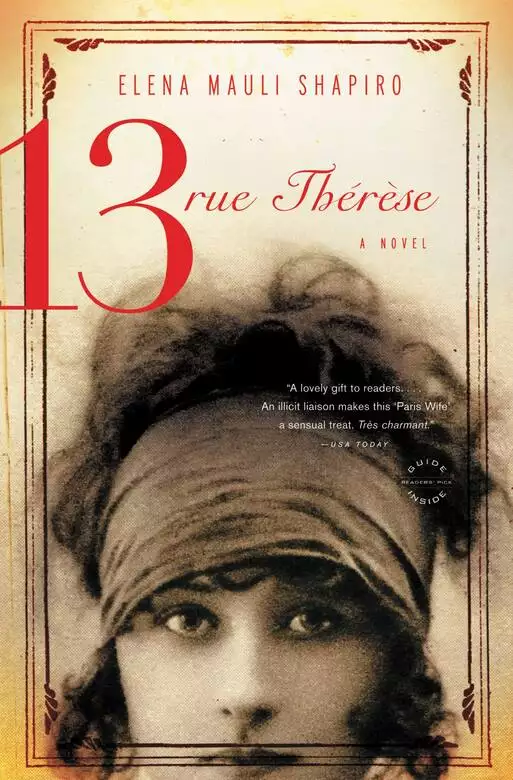
French-born author Elena Mauli Shapiro vividly recreates Paris during World War I in this captivating novel. 13 rue ThErEse follows Trevor Stratton, an American academic working in Paris who discovers a keepsake box dated back to the Great War. The box, Trevor discovers, belonged to a piano teacher named Louise Brunet. Inside it are mementos that give Trevor clues to Louise’s life, including the love she lost in the war and her affair with a neighbor. Mesmerized, Trevor begins to imagine what life was like for the mysterious Frenchwoman.
Release date:
February 2, 2011
Publisher:
Recorded Books
Print pages:
304
* BingeBooks earns revenue from qualifying purchases as an Amazon Associate as well as from other retail partners.
Josianne’s gift is a simple square box, its sides about as long as her forearm. It is about as deep as her hand is wide. The white plastic
lid has a quaint red crosshatch pattern on it, like the sort you might see on a tablecloth in a small family-owned restaurant.
The box is nothing extraordinary, though its contents have been known to induce fevers. At least, that is one of the effects
it had on Josianne when it first came to her—perhaps she decided to pass on her gift as much from a need to get it away from
herself as to share it with another. At least, the box let her think she decided.
The first was a Russian physicist, whose face she had liked best when flipping through the files of foreign professors. His
photograph called to her. She decided to hide the box in his office for him to find when he arrived and explored his new working
space. The box had an odd effect on him, too—or maybe the effect was partially due to her easy laugh, her smooth, deeply red
hair, her hazel eyes that changed color so strangely with the light, that had something a touch hazardous in them like a faint
electric crackle. The next year, there was a Swiss historian. (The gift always chose to return to her.) Then there was a year
when none of the scholars appealed to her, and she left the gift fallow.
At first Josianne thought this year would be the same; she’d taken no special notice of him. He was a foreign professor like
all the others in her stack: a piece of paper she would have to enter into a database, assign an office space to, order a
library card for. When he wrote to ask her questions about his sojourn in France, he was crisply polite—surprisingly formal
for an American. When she entered his curriculum vitae into the system, she typed the words without really seeing them—a scholar
in nineteenth-century French literature from a California university. It was only when her automatic fingers copied in one
of his side projects—translating the poems of Paul Valéry—that something registered with her. She stopped and looked back
up at the top of the page to check the name she had entered, truly reading it for the first time: Trevor Stratton.
A translator, caught in the space between two tongues. Such people tend to come a little bit unglued from the task of trying
to convey meaning from one code to the other. The transfer is never safe, the meaning changes in the channel—becomes tinted,
adulterated, absurd, stronger. Translating Valéry especially is a peculiar choice: his meaning is quite unstable even in the
original French. That Trevor Stratton must be a little strange. Well, at least Josianne hoped so.
Now that she has received the photograph he sent her for his library card—the red one that will grant him access to special
collections and original manuscripts—her mind is made up. She likes his face. His eyes are slightly widened in the picture,
as if he is startled to find himself captured there. She is convinced that she sees the necessary gleam of yearning in those
eyes; she thinks she can help this yearning. She is already fond of the graceful sweeps of gray arcing over each of his ears,
contrasting sharply with his otherwise starkly black hair, and his mouth caught in something like the beginning of a smile—whether sheepish or mischievous she isn’t
quite sure. It must be he is ripe for her gift.
She will give him the office with the tall, useless empty file cabinet in the corner. He will probably not think to open all
the drawers and look in them his first day on the premises. But he will, eventually, discover a box tucked all the way into
the darkness at the back of the bottom drawer, innocent-looking yet unexpected. How could one see such a thing and then not
take a little peek inside?
She wonders what effect it will have on him.
This is the lid on the box:
Would you like to open it?
Paris
January 12th
Dear Sir,
Quite by accident, I have found the most fascinating record. I will be sending you scraps of my findings as I extract them—thus
you must forgive me if the documentation does not yet make much sense to you. I will send all to you in the order in which
I find it, and once I have all the data there is for me to excavate, I will attempt to collate everything into something more
cogent. The letters are not in any order. Neither are the photographs. Neither are the coins, the gloves, the cards, nor anything
else. It is all quite pell-mell, quite a puzzle.
It has snowed here in Paris, a good fall that layers everything in a lovely sheen of glimmering white. The poor French are
utterly routed by this development: it seldom snows here. Traffic is gridlocked; people are stuck places. It is rather funny.
I am told that when it snows, generally it is in tiny flakes that melt as soon as they hit the ground. This snow has stuck,
and no one knows what to do.
So I am scanning the pieces of the record as I come upon them, and sending copies of the scans to you, should some ill luck
befall my notes. Included with this missive are my first findings:
a letter asking for a girl’s hand in marriage, dated 22 November 1915 (accompanied by my clumsy translation).
two photographs of the same man, taken approximately fifty years apart. (These are the largest photographs—they rested on top of all the artifacts. They are approximately six by nine inches, and quite beautifully preserved. The first
is dated 26 January 1943. The second is undated, and likely taken in the last decade of the nineteenth century, from the looks
and clothes of the fellow in the picture.)
a postcard from a father to his daughter from the front lines, dated 12 October 1918.
a rosary.
a tiny diary with a drawing of roses on the cover, which calls itself “Little Memento Calendar for 1928.” (The thing fits
in the palm of the hand. I have scanned the cover and a few of the pages.)
two calling cards: one for M. & Mme Henri Brunet, and one for Madame Henri Brunet alone. (I have not yet found a photograph
of the woman herself. Perhaps I will, but I’m not sure—perhaps she is not much for pictures of herself? Her Christian name
is Louise.)
That is all I have to show you for now, but there will be more. I cannot tell you when for sure. I am constantly being sidetracked
by other projects. Also, by absurd administrative rigmaroles: the French appear to have a fondness for that! Especially the
pretty red-haired secretary, who loves to stamp things, and have me fill them out in triplicate, and make me take them places
to be stamped again, and bring them back. On some days this tickles me. On other days, it makes me want to press the palms
of both my hands against my ears to keep my brains from spilling out of them.
I am well these days, Sir. As a matter of fact, surprisingly well, considering that all my colleagues appear to be dropping
like flies of various flu-like ailments.
I have told no one yet of this record I have found. Surely, someone would then try to steal it from me. Certainly, the French
would insist on sending it to Preservation, and I would have to get a thousand things filled out and stamped before I could
look at it again. What a nuisance. For now, I exercise my absolute right to be a secretive and quiet researcher—it is delicious
and sweet, like hard fruit candy in the mouth.
Well, I will leave you to your work, Sir, before I get too fanciful with my language again. My greetings to you and yours.
Sincerely,
Trevor Stratton
[NB: The envelope is missing from this particular letter, which is a bother—I am not even sure of the name of the addressee.
It is one sheet of paper folded in half, to make a small folio. It is so delicate, splitting along its center fold. You can
see that the writer was hardly more than a schoolboy; his endearing clumsiness of feeling and his orthographic errors are
a testament to this, as is the fact that he has traced lines on the paper in pencil so that he could write neatly, straight
across the page, and then attempted to erase them after the ink from his nib dried on the paper.]
*
At the armies, the 22-11-15—20:30
My Dear Uncle,1
For a long time now, I have had something to tell you and today I finally dare announce it. It is a bit of a secret. This
started last year, when I left for the regiment in Algeria in the month of September. Then, I had designs upon a young girl,
and in our correspondence since then, the friendship that we shared in the beginning became love, so that when I left for
the front I had a heavy heart. But one must be resigned to such things, so I carried on. Since I have been at the front I
have not stopped corresponding regularly with her. When I was on leave, seeing her made me crazy with joy but we had to part
once again. I saw you, my Dear Uncle, when leaving for the second time for the front, but I did not have the time to speak
to you of this development. Today I count on being granted leave for new year’s, and this is why I write you, because in the
month of January I would take great pleasure to call my fiancée the one that I hope to make happy as my wife. This young girl
is Louisette, and, my Dear Uncle, today I ask for her hand upon my return from this carnage, where I will have changed enormously
since war makes the character of a man. My Dear Uncle, you will forgive me if my request is brief, but I do not know how to
make a fuss. I have to tell you that Louisette knows nothing of this as I have never properly told her what I have just told you. But I believe that if my request is accepted, she would only be happy. I have labored at the
front with this happiness in mind. I hoped to redeem my faults by being at the regiment and I believe I have done so. I hope,
My Dear Uncle, that you will accept this request and share it with Louisette. I have learned from her that she has left Malakoff
for a spell and that she is now at my aunt Eugénie’s. I hope she will be happy at my Aunt’s as she is so good. I am still
at rest and my health maintains itself. I do not have much left to tell you other than that reading your reply will grant
me a great new burst of courage.
I finish by embracing you.2
Your nephew who loves you and thinks of you, Camille
THIS MAN HERE, HE has to be a collaborator. Look at that mustache. Does it remind you of anyone? This is a mustache that he would not have
worn after 1945. You know he doesn’t make it that far, yet you do not know how you know he never sees a free France again.
He dies of a massive heart attack just a year after this picture is taken. You see him stricken, breaking a sudden sweat, clutching his left arm with his right hand. Moments before, his face had been
so placid as he read his newspaper. Look at the face from moments before and try to read the cause of his body’s failure—
If you were a romantic, you would say: he died of a broken heart. He was, after all, a widower. His wife died when his daughter
was born—in 1896. It must have been a very, very slow broken heart. Maybe it took so long because it kept getting half-mended
by the young women he hired to tend to his children.
Or he died of a broken heart because his country was in bondage—though he survived the invasion by nearly four years. Really,
morally, he was quite flexible. The situation was not ideal. He didn’t necessarily enjoy it, but he never fought it. He was
too old. It was no longer any of his business.
He was seventy-three years old. It was just his time. His last name was Victor. His first name is yet to be found in the documentation.
AFTER THE TROOPS MARCH into Paris in June of 1940, he spends an entire month completely drunk. His daughter is concerned. Her husband says: “Leave
him alone. This is how he mourns our country.”
This condition is unusual for him. He always had an even temperament. He was always a moderate person. Despite his constant
state of inebriation, he isn’t loud or sloppily emotional. He doesn’t say anything that might get him shot. He hardly says
anything at all.
The men who used to work with him say his pathetic drunkenness is caused by his recent retirement—he simply doesn’t know what to do with himself.
He never explains to anyone the reason for his sudden excess. In July he comes back to himself. He lives a quiet life. He
doesn’t belligerently look into the German soldier’s eyes when he gets asked for his papers on the street, a mere three steps
away from the front door of his apartment building. He doesn’t belligerently refuse to meet the German soldier’s eyes when
the soldier looks into his face, scrutinizing him for signs of subversive tendencies. He respects the curfew.
He buys meat on the black market. On the black market, he also buys a delicate pair of sheer stockings with a black seam up
the back: a gift for his daughter. She thanks him but doesn’t wear them. She says she will save them for a special occasion.
HE KNOWS HIS VISION up close is failing. His work becomes more difficult. Soon he’ll have to retire. This frightens him. He would like to be
able to work all the time—it would make it easier for him to ignore the rising rumblings of the forthcoming war.
HIS DAUGHTER HAS BEEN trying for years to have a son. She has not been successful in begetting any child, not even a daughter. She cries to him:
“I am too old now, I never will. Why didn’t I? Am I not a real woman?”
He holds her febrile body against him. He feels her hot face against his neck, moist with tears. “My dear,” he says, “be glad
you don’t have a son. Look at the shape this world is in. Be glad you don’t have a son.”
Still, he would have wished a son for his daughter, just to make her happy—even though he knows that the grief of losing a
child is much keener than the grief of never having him.
HE LOVES HIS WORK, its tiny precise nature. He can get lost in it for hours. He has been doing this work for so many years that his hearing
has lost sensitivity to the sound of the drills and sanders. It hardly even registers anymore. When he was young, the noise
echoed in his head for hours after he got home. He could hear it as he went to sleep—even when he made love to his wife, so
long ago.
THE GREAT WAR IS receding; it is a new decade, and his daughter seems to be taking well to married life. It doesn’t escape his notice that
the fellow she married looks strikingly like him. The resemblance makes him smile. It isn’t uncommon for good girls to marry
their fathers.
She babbles joyfully about having a son. She cannot wait to cut up her wedding dress to make baptismal robes for the plump
pink baby boy she will push forth from herself, in blood and pain and happiness.
He looks at his daughter’s sweet oval face, at the young hope in her dark eyes, and is reminded of his wife. Louise is the
only thing he has left.
HE GETS A GREAT price on fifty-seven eight-millimeter pearls from one of his suppliers. Their color is beautiful: a uniform cream that can flatter any complexion. They are also almost perfectly round. Their smooth weight in his hands is a joy to him.
He has one of the women in the shop string them on white silk thread: though his hands are skilled in so many ways, he has
never been good with knots. He is a man for metal and stone, for welding and cutting and polishing—a man for intricate patterns
in chains of gold and glinting facets on diamonds.
He makes the clasp himself, from white gold. He encrusts it with tiny round diamonds. It is truly a labor of love. He will
give his daughter the necklace on her wedding day. She is marrying a fellow that he approves of, who works under him at the
shop. The fellow’s name is Henri Brunet. He should train him to take over, after he is gone.
HIS ELDEST CHILD, HIS only son, dies swiftly of the Spanish influenza in December 1918, after surviving the Great War. His life is a disaster.
If it weren’t for his daughter, he would take the rifle he went to war with, wedge it tightly under his chin, and blow the
back of his head off.
HE SERVES IN THE Great War. He is too old for this. This is ridiculous. He is too old for shells and shrapnel and falling men with bloody
gore splattering from their shattered skulls—these men who fall and stay there, rotting and dissolving into the noxious earth.
There is an explosion behind him. He ducks from the shower of poisonous mud, covers his head with his arms. Something flies
into the back of his neck. . .
We hope you are enjoying the book so far. To continue reading...

 Please log in to recommend or discuss...
