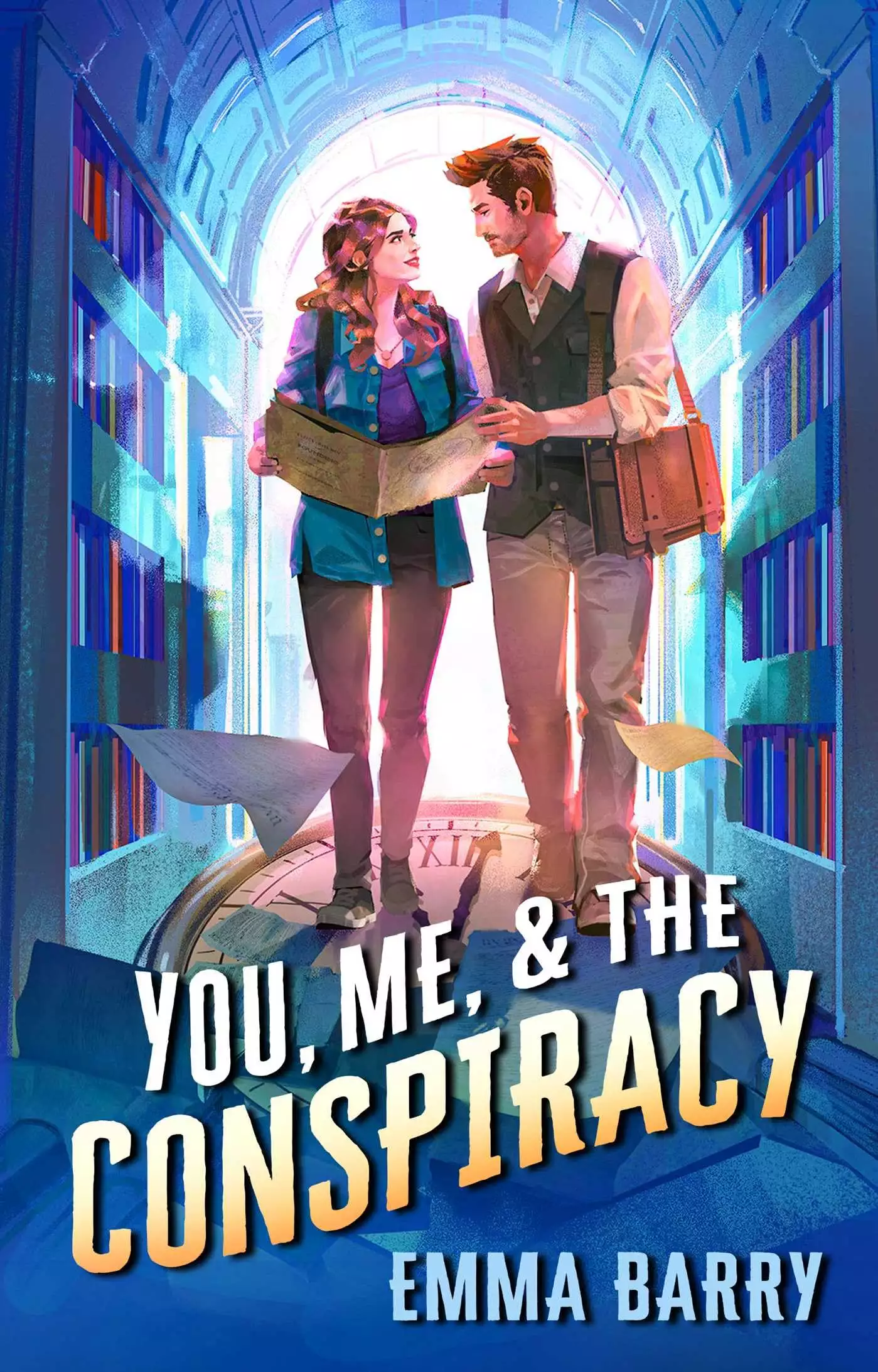
Perfect for fans of Jo Segura, You, Me, & the Conspiracy is an academic adventure romance that finds two history professors trying to unmask a deadly secret society.
After a bruising book rejection, tenure-track history professor Jessica Wilson is scrambling for something new to publish to secure her spot at the top of the academic food chain. While researching in the archives, she discovers a coded message written by one of the founding fathers with the power to change her—and the world’s—understanding of American history forever. But first, she’s got to prove it’s real.
Desperate for answers, Jess searches out Calloway Morgan, a Harvard PhD student turned adjunct professor. Cal was forced to leave graduate school after presenting theories about a shadowy revolutionary organization. Jess heard his conference presentation and thought his findings were absurd, but now, she believes he was on something.
With their fates intertwined by their discoveries, the two begin to work together, but danger lurks around every corner. The clandestine fraternity that they’ve uncovered still exists and is ready to kill. With it hot on their heels, the embers of Jess and Cal’s attraction grow. But unless they can make their findings public, they’ll soon become the conspiracy’s latest victims...
Release date:
November 10, 2026
Publisher:
Atria Books
Print pages:
288
* BingeBooks earns revenue from qualifying purchases as an Amazon Associate as well as from other retail partners.
Chapter 1 CHAPTER 1 Studying history should make you hopeful. Jessica Wilson trudged into the Massachusetts Historical Society with her father’s text echoing in her head, as sharp and loud as the ratatat of her heels on the mahogany floor.
Easy words for a man who’d had tenure by the time he was thirty-six. But easy had vanished from academics sometime during the last century.
At the deserted reference desk, Jess called, “Um, hello?”
“Just a sec,” came the answer from an open doorway to the left.
A second, a year, what was the difference? Jess wasn’t going to find anything in the archives today that could save her career. She’d given everything to academics, and all she had to show for it was a job she wasn’t going to be able to keep and a pile of grading she’d never get through.
Jess imagined writing an honest response to her father: No one under forty knows what hope is. But he wouldn’t understand.
A portrait of the Marquis de Lafayette hung on the wall. His face, rendered in crackling oil paint, was a strange mix of youth and old age. His pink cheeks and mouth were almost elfin, while troubled eyes sunk deep under high, bowed brows.
It was a face that had seen some stuff.
“How’d you get through Valley Forge?” Jess muttered, leaning closer, trying to make out the medals glittering on his chest. According to the label, one was for his service in the French Revolution, one for the American Revolution, and one for something called the Society of the Cincinnati—
“Hey, you!” Adina Felman emerged from the doorway with a friendly smile.
She’d been a student of Jess’s at Penn, but when Adina had come to her for advice about grad school, Jess had gently steered her toward archival work. Adina loved old books, and she’d wanted to be able to pay her rent, and a history PhD guaranteed you neither.
Too bad no one had been around to give Jess the same good advice fifteen years ago.
“I was hoping you’d be working today.”
“You here to see the Phelps papers again?”
Jess had spent grad school researching the women involved in Shays’ Rebellion. Her dissertation was supposed to become a book, the book, that she would ride triumphantly to tenure.
Everything had been going according to plan when, during her first year as an assistant professor at Boston College, she’d gotten a revise and resubmit from a publisher.
Cool. Jess could do that.
Outside the time she spent teaching, rewriting her dissertation consumed everything else in Jess’s life for twelve months. Long nights in the library, hunched over her laptop, ignoring her friends and family, insisting to herself that her promotion would be worth it.
And it would’ve been. Until the reviewer who’d read Jess’s R&R had told the press to reject her manuscript.
“Have you seen the latest catalogue from NYU Press?” Adina asked, blissfully ignorant about what had happened. “There’s another book on Shays’ coming out, and I wondered—”
“I’m aware.” Let that be enough to end this conversation. Jess desperately didn’t want to explain how she’d failed, because then she’d have to watch Adina, one of her all-time best and favorite students, realize that Jess was a fraud whose career was slipping away from her.
Alas, Adina digested Jess’s tone and put the story together because she was bright as hell.
“Ten books on Lincoln are published every year—surely there’s room for yours too.”
In Adina’s voice, there wasn’t an ounce of pity or any indication that she’d lost respect for Jess—and thank God for that. Jess might have lost it otherwise.
“Sadly not.” Jess tried to make that light, but she failed. Failing was all she did these days. “My R&R ended in rejection, and I’d bet you a quarter that Andrew Vickers”—the author of the other book—“was reviewer number two.”
These things were supposed to be blind, but in a field as small as early American history, they never were. He’d known who Jess was when he’d mauled her book, and she’d known who he was when she’d read his feedback. His potentially career-ending feedback.
“I’m so sorry.”
Jess was sorry too, sorry about her work apparently being awful, about her lack of a backup plan, and about the fact that she couldn’t talk about the rejection without wanting to sob.
But sorry didn’t change a thing.
“What are you going to do?” Adina asked.
Sylvie, Jess’s best friend from grad school and the most rabidly pragmatic person she knew, would say, Get over it and start writing something else.
That was probably why Sylvie had requested—and sailed through—her pre-tenure review a full year early, while Jess was standing in the archives looking for a paddle mere weeks before her materials were due.
“Well, I’m going to find something amazing that changes how we understand the course of American history. Obviously.”
Jess’s words were dry like burnt toast. As kind as Adina was being and as right as Sylvie would be, the only person Jess wanted to discuss her situation with was her grad-school adviser Professor Sheridan—never Isla—who had an uncanny ability to see Jess. Not her accomplishments or her ambitions, but Jess herself.
And today, Professor Sheridan would see that Jess was profoundly fucked.
The only thing Jess had going for her was that she had never given up, not once in her life. Not when she’d gotten mono as an undergrad, not when the prof she’d been TAing for had turned out to be a raging alcoholic, not when one of her seminars had been full of students who honestly believed Helen Keller had been a fraud.
Ergo, Jess couldn’t stop now. She was going to get up off the dirt and write a brilliant article, and then, then, she would be able to face her friends again. To face herself again.
Jess set her driver’s license on the desk. “I should be on the schedule.”
Adina clicked a few things on the computer. “The Hancock family papers? I pulled them this morning. I’ll have these right out.”
“Thanks.”
Jess went to find a free seat—and there were plenty to choose from. It was a regular, workaday Thursday a month into the fall semester. Most visiting scholars came over the summer, not in early October. These folks were local, or they were lucky enough to be on sabbatical.
She didn’t know if she wanted months off to research and write, but Jess knew she should want that. It was the ultimate academic privilege and bragging right. Which meant she would shoot for it someday.
And look, despite her career-induced angst, Jess’s heart still went pitter-pat for the historical society’s main reading room. The rows of gleaming oak tables, the skinny brass lamps, the dark beam-and-plaster ceiling, and the eighteenth- and nineteenth-century paintings were… perfect. It was like something out of a movie where everyone wore a lot of tweed and bantered about scansion.
Put Jess in a place like this with some old books and manuscripts, and even with the fraying self-confidence and the constant fears that she’d lose her job tomorrow, she couldn’t remember to be cynical.
Across town, a failing student sat in Calloway Morgan’s office.
“I do the reading.” Linzi’s glare was insistent, and her posture was tight. She wanted her US history professor to believe her—and she was certain he wouldn’t.
Cal knew many of his colleagues wouldn’t listen to Linzi or allow her to retake her midterm. He’d seen the articles on Inside Higher Ed, the ones arguing that the pandemic was over and so flexibility for students should be. A return to standards and all that bullshit.
But after five years of teaching at Bunker Hill Community College, Cal could shake all the teachers who seemed to hate teaching, the ones whose students graduated convinced that they were “bad” at history, “bad” at school altogether.
And he loathed his own professors who hadn’t bothered to prepare Cal to teach history, only to do it. Maybe they simply couldn’t imagine students like Linzi. Safe in their ivory towers, where no one worked the graveyard shift at the Stop & Shop and where everyone took for granted the value of the liberal arts, they never had to worry about helping someone like Linzi make sense of primary sources. You didn’t have to account for Linzi at all.
“Tell me about Benedict Arnold,” Cal prompted.
“But I don’t—”
“You do.”
After a pause, Linzi said, “He was a traitor. Well”—she screwed up her face and rewound the story—“at first he was, like… a star.”
Good. “What did he do to become a star?”
“He slowed the British down.”
“At Fort Ticonderoga,” Cal added for her. “What else?”
“He led a battle charge at Saratoga.”
“Ah, so you do know about him?”
Linzi rolled her eyes. She was getting her feet under her, getting back to herself. “But only because you talked about it in class.”
“That still counts. The reading is important, but it’s not the only way to learn things. What happened next?”
“He romanced a loyalist.” Linzi said this with barely concealed excitement. She liked this part of the story, probably because it had the zing of a Shonda Rhimes script.
“Yup. And what happened when he married Peggy Shippen?”
“The British asked him to become a double agent.”
“And why did he agree?”
“He thought he’d been, like, passed over. Plus, he was injured, and his wife was a traitor.”
That hadn’t been how Peggy Shippen saw it, but whatever, Cal and Linzi didn’t have to get into everything. “It sounds to me as if you have three things to include when you work on a new answer to the missing essay question.”
Linzi rubbed her foot over the rug, a wine-red thing covered with flowers that Cal had found at a garage sale for three dollars. It classed up his shared office, even if he couldn’t do anything about the battered gray filing cabinet or the awful tube lighting.
“But I can’t write it,” she finally said.
“So don’t write it. Do the podcast or the video option. Just tell me what you know. Make a claim, break it down, and provide the evidence. You can obviously handle that.”
Linzi watched him levelly. She didn’t trust that Cal wasn’t laying some trap for her to stumble into and get caught.
Goddamn, but Cal really hated whoever had made her believe that.
“Really?” she asked.
“Absolutely. Some people like essays, and that’s fine. But all I care about is that you demonstrate what you know about American history.”
“Sweet.” If Linzi didn’t quite sound enthused, she was at least going to give it a try.
For the moment, Cal would take it.
“What are you doing here, anyway?” Linzi asked as she packed her stuff up. “Why aren’t you at, like, Harvard?”
Cal was not the kind of asshole who hung his diploma in his office, but despite his best efforts, the bad news got out anyhow. “It’s way better here. Trust me.”
“I bet their heat works in the winter.”
You’d be surprised. “I left” was all he said. “And I wouldn’t go back.”
It would be more precise to say he couldn’t go back. Hell, it would be more accurate to admit that he’d been asked to leave after giving a talk at the Organization of American Historians conference on… well, either it had been complete bullshit or it was the kind of thing that belonged next to Area 51 on r/conspiracy.
Even years later, Cal still had no idea which it was. He was done with that stuff, and he wasn’t going to let it ruin whatever life he’d been able to salvage.
“Life runs in one direction, Linzi. You can’t fight the flow.”
Struggling against the current didn’t get you anywhere. Cal would know.
“Here you go.” Adina carefully transferred an archive box and a book cradle onto Jess’s table. “What are you looking for?”
“Something to do with gender and business.”
That was what her department chair, Patrick, had suggested, anyhow. So Jess was going to take another look at the Silas Deane affair. She had read through the microfilm of these papers a few years ago, but she hoped that seeing the originals would shake something loose in her brain.
“Holler if you need anything. I’m usually the last person to leave on Thursday and the first one in on Friday.”
“Good to know. I’m sure I’ll be back.”
Jess extracted the finder’s guide from the box and gave it a quick skim. She’d already read it online, but she was as committed to her process as baseball players were to their walk-up music.
In front of her was a letter book of Hancock family and business correspondence, mostly written by John’s uncle, Thomas, and his brother, Ebenezer.
John Hancock wasn’t as sexy as the founders who’d gone on to be president or who had been more instrumental in writing the American state papers. Besides, Hancock was gross: He’d been nakedly involved with grift masquerading as business. He’d basically invented pay-to-play. It was almost as if the country had started the way it meant to go on.
But if this was what it took to get tenure, so be it.
Jess removed the letter book from the box and set it on the book cradle before opening a blank Word document on her laptop for notes. Over the next few hours, she examined:
A customs certificate.
A letter about hurricane damage to a ship.
A property deed.
An account of work on a house.
A shipping manifest.
And receipts. So many receipts.
Nothing was out of the ordinary, and nothing spoke to masculinity or the philosophy of business or the intersection of the personal and the political, or any of the things Jess had hoped to write about.
She blew out a long breath. This had probably been a terrible idea. Maybe there was no way to snatch victory from the jaws of defeat, and Jess was going to have to find a way to tell her department chair, her mother, her father, her grandmother, and, oh God, her grandfather that she wasn’t going to be able to hack it as a professor.
But when she turned another page, Jess discovered a piece of scrap paper covered with gibberish characters.
It wasn’t as if a chill went down her spine. There was no golden light or angel choirs. Nothing changed in the room at all.
But something changed in Jess. It was like pushing your hand through the back of the wardrobe and feeling snow.
Interesting.
Jess carefully rotated the paper. Some of the letters were at 90-degree angles, others at 180 degrees, to the rest. It looked—intentional. Not like lettering practice or scribbles. She lifted the paper up to the light, and the pattern of the mold it had been handmade on glowed. Laid paper.
After considering the scrap from every angle, every side down, Jess turned it over, and on the back, in faint pencil, were the words Ortu Solis.
Jess’s father would’ve rather walked into Nantucket Sound, pockets brimming with rocks, than allow Jess to be illiterate in Latin. Ortu Solis meant Rising Sun.
With the translation still ringing in her chest, she took in the handwriting. The letters slanted to the right, almost climbing off the page, and she knew this penmanship.
Knew who had prepared this cipher.
Jess’s back collided with her chair. Okay, the angel choir had started to warm up.
The only reason she recognized this handwriting was because of a musical, or at least because of the book that had inspired the musical.
Alexander Hamilton wrote this.
Jess clenched her fingers on the edge of the table to stop herself from pumping her fists in the air. She’d wanted a breakthrough, and this could be the start of one.
Alexander Hamilton and Benjamin Tallmadge had managed a network of spies and informants for Washington. That was the stuff of a zillion bad History Channel specials. And as Washington’s aide-de-camp, Hamilton had sent letters to Hancock. Those things were known.
But the fact that Hamilton had sent a coded message to John Hancock after the war was new. Surely it was good enough for the beginnings of an article.
Jess glanced around, feeling foolish. No one was paying the smallest amount of attention to her.
Trying to move nonchalantly, she grabbed her camera and carefully photographed the cipher, front and back. She changed the camera’s settings to document and took a second set of pictures. Then she carefully replaced the paper where she had found it and continued flipping through the book.
She wasn’t absorbing anything, though. The words and letters streamed past her eyeballs while she kept turning the words Ortu Solis around, like balls in a bingo cage.
What could the rising sun mean to Hamilton?
A few clicks on her laptop, and Jess found a couple psalms and a dramatic bit from Joshua about the rising sun. Shakespeare had written about a dozen sonnets with sun imagery. There were lyrics to some folk songs she’d have to nail down real dates for and a John Donne poem. George Washington’s chair at the Constitutional Convention had a sun carved on it.
God, Washington and the sun reminded Jess of the weirdest academic conference presentation she’d ever seen. Weird, but memorable, mostly because the speaker had been magnetic. When he’d looked at Jess, she’d felt like the only person in the room, the only person at the conference.
Okay, fine, he’d also been hot. Add in the charisma and the lack of a wedding ring, and she’d been interested… until she’d realized what he was saying.
The guy had given an alternative history of the Conway Cabal and the Newburgh Conspiracy, serious challenges to Washington and the federal government in the 1770s and ’80s. He’d argued that Washington’s position had been far more tenuous than most historians thought and that he’d found and decoded some of the group’s correspondence.
That was it: the Rising Sun. He’d said the conspiracy was called the Rising Sun.
For this theory, the guy had been, almost literally, laughed out of the room. It was a given that the people involved in Newburgh were patriots who were only upset about potentially not being paid for their service in the war.
But even more importantly, everyone knew Washington had almost been made king. How could a near king have been anyone’s puppet?
So Jess hadn’t sought the guy out afterward. She hadn’t even let herself think about him again. She wasn’t going to change her policy now.
“Nope,” Jess whispered out loud into the near silence of the reading room. She couldn’t let herself think along those lines. Not even for a second.
She needed a real discovery, a breakthrough that Patrick could use to handwave away the gaps in her CV. Conspiracy nonsense didn’t fit the bill. Cranks didn’t get tenure.
She carefully closed the letter book and returned it to the box. But before she carried it over to Adina, she took another look at the finder’s guide. It was ancient, typed on the yellowing tissue paper favored by mid-century librarians who had to file everything in triplicate.
All it said was Hancock Family Papers III, Hancock Family Account Book. A coolly declarative description, without any reference to the Hamilton cipher.
Almost as if it didn’t exist.
We hope you are enjoying the book so far. To continue reading...

 Please log in to recommend or discuss...
