A compelling call for compassion and resilience in the maw of social dissolution from literary legend James Sallis, master of many genres and Nebula, Edgar, and Shamus–nominated author of Drive
All I wanted was for my life, when you picked it up in your hands, to have some weight to it.
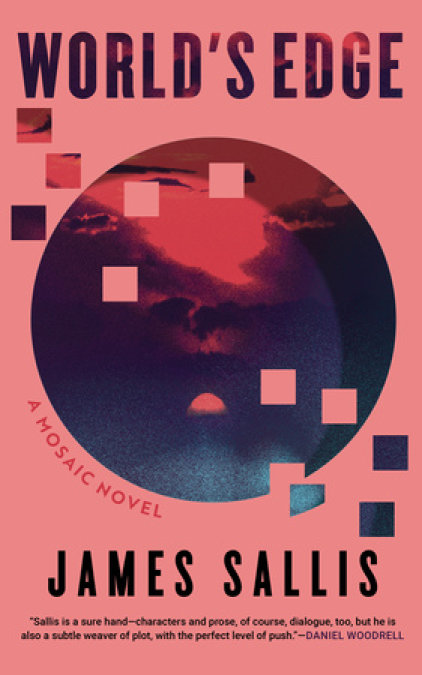
In a not-so-distant future the United States has fragmented, balkanizing into unstable provinces often at war with one another, and Americans, their great promise not so much lost as forfeited, are encountering the terrors and devastation so much of the world daily lives with. Throughout a land littered with refugees, ruins, orphaned children, soldiers, militia, and fugitives, people go on about their daily lives as best they can.
The five linked stories of World’s Edge track the false starts and stall-outs of a nation and civilization trying to rise again, to rebuild, and of individuals caught up in that rebirthing. As ever, the only true history lies in the story of individual lives, in the old rag and bone shop of our hearts.
Release date:
February 10, 2026
Publisher:
Soho Press
Print pages:
240
* BingeBooks earns revenue from qualifying purchases as an Amazon Associate as well as from other retail partners.
1. At 10:36 as I’m listening to accounts on the radio of a plane lost over the Arctic Sea, the noise from within the trunk gets to be so annoying that I stop the car, open up and whack the guy with the cut-down baseball bat I stowed under the front seat. The ride’s a lot better after that. They never find the plane.
Where I’ve pulled off is this little rise from which you can see the highway rolling on for miles in both directions, my very own wee grassy knoll. The trees off the road are at that half-and-half stage, leaves gone brown closer to the ground, those above stubbornly hanging on. Because of Union Day there’s little traffic, two semis, a couple of vans and a pickup during the time I’m there, which is the only reason I’m risking everything to be out here and on the road taking care of one last piece of business. Even the government’s mostly on hold.
What they never understood, I’m thinking as I get back in the car, what it took me so long to understand, is that after rehab I became a different person. Not as in some idiotic this-changed-my-life blather, or that last two minutes of screen drama with light shining in the guy’s eyes and throbs of music. Everything changed. How the sky looks in early morning, the taste of foods, longings you can’t put a name to. Time itself, the way it comes and goes. Learning all over how to do the most basic things, walk, hold onto a glass, open doors, brush teeth, tie shoes, put your belt on from the right direction—all this reconfigures the world around you. A new person settles in. You introduce yourself to the new guy and start getting acquainted. It can take a while.
An hour later I make the delivery and go about my business, not that there is any. They’d got too close this time and I’d gone deeper to ground, pretty much as deep as one can burrow. The gig was a hold-over from before, timing rendered it possible, so I took the chance. Messages left in various dropboxes now would grow up orphans.
I was staying on the raw inner edge of the city, a gaza strip where old parts of town hang on by their fingernails to the new, in a house with rooms the size of shipping crates. Tattoo-and-piercing parlor nearby, four boarded-up houses like ghosts of mine, an art gallery through whose windows you can see paintings heavy on huge red lips, portions of iridescent automobiles and imaginary animals.
Nostalgia, dreamland, history in a nutshell.
The house owner supposedly (this gleaned from old correspondence and visa applications) was away “hunting down his ancestry,” driven by the belief that once he knows about his great-great-grandfather, his own blurry life will drift into focus. So here I am, with every item on the successful lurker’s shopping list in place: semi-abandoned neighborhood, evidence of high turnover, no one on the streets, irregular or nonexistent patrols, no deliveries, few signs of curiosity idle or otherwise.
A week or so in, it occurred to me that the neighborhood had this fairy tale thing going. Grumpy old man half a block south, bighead ogre seen peering out windows of the house covered with vines, guy with cornrows who resided at the covered bus stop and could pass for a genie, even a little girl who lived down the lane.
Look at the same frame sideways, of course, and it goes immediately dark: poverty, political pandering, ineptitude, dispossession. Where you watch from, and how you look, dictates what you see.
A cascade of strokes, they told me. Infarctions. Areas of tissue death brought on by interruptions in blood supply and oxygen deprivation—like half a dozen heart attacks moved far north. No problem, they said. We’ll go in and fix this.
So they did.
*
They came for me at 4 a.m. No traffic or other sounds outside; the curfews were in place. And nothing more than a promise of light in the sky. The third step of the second landing creaked. I made sure of that with a bit of creative carpentry when I moved in.
Four of them. I counted the creaks. Then was out the window and down, gone truly to ground, by the time the last one hit the landing.
We wait to be gathered, my uncle always said. Tribally, commercially, virtually, finally. Uncle Carl disappeared when I was eight, in one of the myriad foreign lands where we indulged what were then called police actions. Hard upon that, his footprints and afterimage began to leak away, public records, photographs, rosters. Within a matter of weeks he no longer existed.
Nothing in this old part of town had been planned. The alleyway in which I found myself was no exception; it simply came into being as buildings grew around it. Doorways, jury-rigged gates and doglegged side paths could lead nowhere. But exits abounded. I took one at random, looking back to where their cars (always two of them, it seemed, always dark gray) sat at curbside, still and featureless as skulls.
We wait to be gathered.
That day, days before, the wind blew hard, tunneling down through the streets of the city bearing tides of refuse. Drink containers, bits of printout, feather and bone, scraps of clothing. Birds, mostly hawks, stayed put on building tops, electing not to launch themselves into the fray as, overhead, clouds collided and the large ate the small. I was on one of those building tops too, looking down at protestors who had gathered outside People’s Hall, protestors largely in their late teens or early twenties, with a sampling from the next generation up sprinkled among them. Just over a hundred, I’d say, though news reports doubled that figure.
The police had military-issue equipment: weapons, body armor, full automatics, electrics. They waded into the kids, stunned a number of them, gassed the rest, now had them face down on the ground roughly in squares.
There are no right angles in nature.
We’re never too far from the ground. My uncle again.
Watching events below so closely, I had failed to notice the drone hovering nearby, took note of it only when one of the hawks launched from a rooftop. The hawk hit hard. Its talons scrabbled for a hold but, finding no purchase, it flew on. Unable to right itself, the drone crashed into the side of a building. Though not before it had scanned me and dialed it in.
*
Tulips.
In seventeenth century Holland, Uncle Carl told me, a single bulb of the rare Semper Augustus sold for the price of a good house. The tulip craze geared up in November 1636, ran its course, and burned itself out by February of the next year, forever a lesson on inflated markets, fabricated desire and greed of a sort not so much unlearned as endlessly learned and forgotten.
I was seven. This was a year or so before he was supposed to come back for a visit, for shore leave. Before he disappeared. Before he got gathered.
I had no idea what he was talking about, but I did have memories of earlier stories, stories that would adhere over time to experiences of my own, form a latticework upon which hung notions of life untempered by slogans, manipulation and misdirection.
*
I took breakfast at a Quick’n’Easy, street name Queasy, directly across from the fast rail’s inner loop, watching passengers flow onto the platform then drain into the maw of the cars or out onto the streets.
An abandoned building nearby, once a pharmacy, bore an arc of spray-painted letters on its front: reborn. Another farther along, faded red and yellow colors suggesting it had once been a bodega, read believe. Christians come into the neighborhood at night and leave their mark, evaporate like dew.
I’d barely settled in at a window seat on the 6:56 Express when the aisle seat beside me filled. We picked up speed; station, sky and buildings outside ran together in a single blurred banner. The light on the camera at the front of the car blinked steadily. I kept my face averted as though looking out the window. Not that this would help all that much, should they engage recognition software.
“Sorry to keep you waiting,” I said without turning to my seat mate.
“Two hours, a smidge less. About as I expected. This was your most likely egress.”
“You ran a sim?”
“No need. The dogs were closing in, I knew where, I had absolute confidence they’d fail. There was a time we thought alike.”
“You might easily have called in the dogs yourself. Primed the pump.”
“Ah, but that would lack subtlety. Not to mention it would leave my size ten footprints scattered about digitally. Still, there it was. And when was I likely ever to have another chance to find you?”
Security came through the car randomly checking, a young woman shiny with purpose, uniform pants pressed blade-sharp, and we stopped talking. Outwardly calm, within I was anything but. Flee if possible, fight if not. But she passed us by. Moments later the train slowed almost to a stop as we drew abreast of the war memorial. Passengers went about their business, chatting to companions, working or browsing on links. One woman’s eyes never left the wall. She could not see the name, but she knew it was there. Husband? Sibling? Child? As the last row of names crawled by, the train regained speed. At the border between municipalities, guards waved us through.
We went down, temporarily, at West End Station. Sniffers had flagged probable contraband—illicit drugs or explosives, usually—so trains were held and passengers offloaded to the platform. We’d scarcely lined up behind the sensor gates when a young man near the end broke and ran, only to stop moments later as though he’d run into an invisible wall—the first time I’d seen the new electrics in action. Guards unsheathed a wafer-thin stretcher, rolled him bonelessly onto it and bore him away. Soon we were on the move again.
Warren waited till a teenaged Asian passenger, belt and backpack straps studded with what looked to be ancient revolver casings, passed.
“Here.”
I took what he held out, a shape and weight familiar to my hand. Its cover creased and worn though it had to be new.
“A new name, history, vitals, the data manipulated just enough that scans won’t flag it, but it’s basically you. Most anywhere in the city and surround, these will suffice. You’ll want to stay away from admin buildings, information centers.” He turned to the window. “This would be your stop.”
The announcement came then over the speakers. All our grand technology, and station calls still sound like hamsters gargling.
“Use the papers if you wish. If not, dispose of them. On the chance that you use them, Frances looks forward to seeing you.”
I turned back and motioned for him to follow.
We hope you are enjoying the book so far. To continue reading...

 Please log in to recommend or discuss...
