
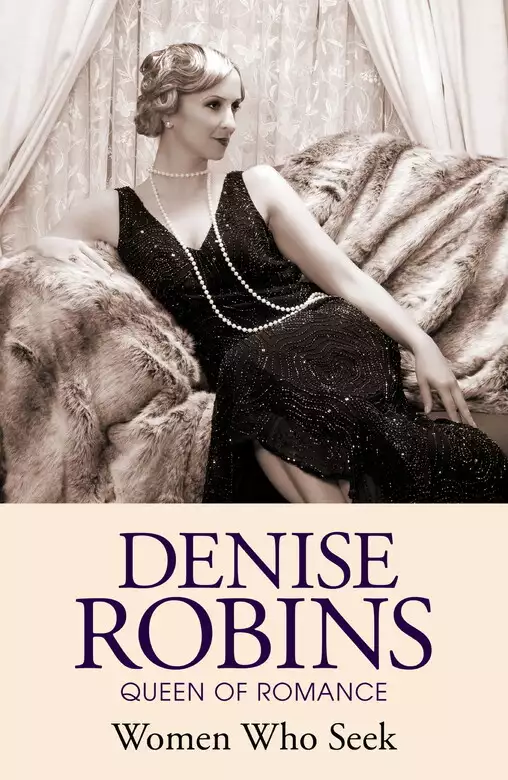
Women Who Seek
- eBook
- Book info
- Sample
- Media
- Author updates
- Lists
Synopsis
Women are seekers after love. The Eve of this book is no exception, but when she finds she is only passing amusement to the man she loves, she marries a young Doctor on the rebound. Boredom follows. Then comes the gay tempestuous Nicholas, and Eve falls in love for the last time, but her love walks hand in hand with tragedy.
Release date: April 24, 2014
Publisher: Hodder & Stoughton
Print pages: 400
* BingeBooks earns revenue from qualifying purchases as an Amazon Associate as well as from other retail partners.
Reader buzz
 Please log in to recommend or discuss...
Author updates
Women Who Seek
Denise Robins
Suddenly, from a narrow alley leading out of the main thoroughfare, four young people emerged, hanging on to each other’s arms, laughing and talking. The policeman on the opposite side of the road stood watching the little crowd with indifference. He knew where they came from. One of London’s most select, recherché night-clubs was tucked away in that narrow alley – the Pompadour. It had been raided twice.
The four young people who had just come out of the club walked down Regent Street toward Piccadilly Circus in a row, arms linked. They were all in excellent spirits. The two men were in evening-clothes and wore Burberrys. The girls picked their way along the wet pavements daintily on high-heeled silver shoes. One wore an evening cloak of Chinese-blue with a skunk collar; the other a black velvet coat.
The girl with the dark hair and Chinese-blue cloak was not strictly sober, although she could not strictly be called drunk. But she had had enough. She was a very pretty girl, not more than twenty-one, with eyes as blue as her cloak, and a round baby face. She clung to the arm of the younger of the two men – a boy fresh from Cambridge, whom the party addressed as “Bobby.”
He was a moon-faced youth with horn-rimmed spectacles, limpid eyes with girlishly-long lashes and a slim graceful body. He was never out of temper, danced the Charleston like an expert, lisped slightly, and used the word “marvellous” in every other sentence. He had no father, a mother who had spoiled him all his life, and enough money to waste. He had no ambitions. His life at the ’Varsity had meant pleasure and not work. Just now he was at the stage when nicely-brought-up girls bored him, so he sought the companionship of actresses, or girls like Poppy Crawford, who had been nicely brought up, but did everything she could to disguise the fact. Poppy was without intellect; she was merely intelligent where men, money, or dress were concerned; she was amusing, and she openly declared war on the morals of the older generation.
Bobby had organised this little party to-night. Originally he had intended to take Poppy out to dine; then to a theatre and the Pompadour, à deux. But Poppy had telephoned to the flat wherein he lived with his mother, at Knightsbridge, to say that she was bringing a friend with her – a girl who lived near Haywards Heath, where Poppy also resided – and had asked him to find another man to make up the fourth.
Bobby had found Lawrence Hammond. Lawrence was a member of Bobby’s club – thirty-one, travelled, amusing in a rather dry, cynical fashion. He had the thin dark face of a satyr; a face browned by tropic suns and lined by experience. He was of medium height, and moved extraordinarily well. He played excellent bridge, told witty stories with the air and ease of a born actor, and was altogether good company.
Bobby – ten years his junior – admired him. He did not know much about Hammond’s private life. He had only known him since the summer, when Hammond had returned to England from Malma. He seemed to have no relations and few friends, and lived in rooms in Half Moon Street. It was apparent that he had very small means, and was going back to a job of some kind in Malma, just before Christmas. He was not at all communicative about his affairs, and to Bobby he was something of a mystery – but all the more interesting for that.
Lawrence Hammond found the boy a bore, but tolerated him good-humouredly. All men liked Hammond. They called him a “good fellow.” Women were intrigued by his satyr-like face and shrewd tongue, and the charm of manner which he could exert when he chose. But no woman had ever held Lawrence Hammond for longer than an hour or a day. He had no desire to get married. Sex was not so much part of his existence as cards or wine. Freedom meant more to him than anything. His main trouble was extreme indolence. He could never have worked in England. Even the work he did, perforce, on a rubber estate in Malaya bored him, but he found life out there preferable to an existence in some dreary office over here.
He had not particularly wanted to come out with young Richards this evening. Dancing at the Pompadour on a few square inches of floor seemed to Lawrence a poor amusement.
He knew Poppy Crawford. He had met her with Bobby before to-night. And he had met her type in every part of the world, round which he had travelled thrice. Ultra-modern; rather deplorable. Hard as nails under the frills. All right to pass an hour with.
The other girl he had not met until to-night. Her name was Eve Walton-Evans, and she lived near Haywards Heath. According to Poppy the Walton-Evans had recently bought an estate there, and Mrs. Walton-Evans had called on the Crawfords, thereby establishing a friendship between the girls.
“Eve is an absolute duck, but her parents are fearfully old-fashioned and trying to make life a curse for her,” Poppy had informed the men. “I’m trying to cheer her up.”
Hammond found himself slightly interested in Poppy’s friend. He had no use for extreme youth and innocence; and less use for blatant corruption. But the complex was always entertaining, and Eve Walton-Evans was a mass of complexity.
He had watched her during the evening, and amused himself by dissecting her in his cold, blasé fashion. Here was a girl – a mere child of nineteen – with all her natural instincts warring against the conventionalities and creeds of her upbringing. The very name “Walton-Evans” suggested to Hammond a nice, respectable, middle-class British family.
But Eve was bored at home. She was mentally struggling against the bars of convention which caged her family. At any moment, Hammond reflected, she would slip straight through those bars and spread her wings. She was consumed with curiosity to see the world outside the cage. She had only a vague idea of what life had in store – ideas culled mostly from books which she read, or from people whom she met and studied.
She was not like her parents, and they could not make her like them. She read too much and thought too deeply to settle down into the narrow, mindless groove in which her mother was firmly lodged. She absorbed the ideas and views of every fresh-comer she met. She was determined not to stagnate. She was enthusiastic and ardent about life. She wanted to go ahead. Despite the lamentations of her family she copied the dress of the ultra-modern woman; she wore her skirts extremely short, used a lipstick, learned to Charleston, and smoked with enthusiasm; although, to her own regret, she could not learn to drink. It did not agree with her.
Hammond saw in her an echo of Poppy Crawford – even to the use of Poppy’s slang and the adoption of Poppy’s free-and-easy manner. But under it all she was not a Poppy Crawford. She was something much more intelligent and sincere. Poppy, by instinct, was bad. Eve Walton-Evans, by instinct, was good, but she tried to be bad because she thought it smart and up-to-date. Hammond, watching her keenly through the evening, saw her frown and flush when Poppy made some particularly flagrant remark.
Hammond thought it rather a shame that Eve should be under the influence of a girl like Poppy. In the right hands she could become something much finer. She had charming traits. And she was charming to look at, with her well-shaped brown head, rather pale fine skin, and small straight nose. Her eyes were set wide apart – hazel-green; quite beautiful between thick brown lashes. When she was talking and laughing animatedly Eve’s eyes were almost like those of an impudent boy – honest, challenging, gay. In repose they were what Hammond called “triste.” They looked as though she wanted something badly, but knew not what she wanted.
“They are undeniably attractive eyes,” Hammond told himself. “They might be the eyes of a great saint or a great sinner. The child has possibilities. She is a little stubborn – one can see that from her strong chin – but I doubt if she is very strong-willed on the whole. I think there is weakness in the mouth.”
Certainly the child had depths in her … and very passionate depths, too. He wondered how far a man could go with Eve; how far she would let her own impulses and passions master her. She had been flirting desperately with him the whole evening. But would she do more than flirt? He wondered, a little stirred by his own thoughts, but more coldly interested in the dissection of the girl’s character than in the actual sex-thrill of it.
She was by no means a woman of the world yet. She was very young and inexperienced. Her flashes of coquetry were gauche. She had not learned to be subtle. But if she had shown subtlety Hammond would have fled from her. He was terrified of subtle women.
He doubted if she had ever been kissed with passion by any man. Quite possibly she wanted the experience. Lawrence Hammond asked himself if he wished to teach her. It might be quite interesting to watch the play of her emotions. She was not a hard little devil like Poppy Crawford. She was sensitive and receptive under the mask of devil-may-care which she adopted in order to appear modern and smart.
“Complexes are always entertaining,” Hammond soliloquised, as he walked with Eve to the garage where Bobby had left his car. “I wonder what this child will be like in ten years’ time. Either she’ll marry early and settle down to domestic bliss, or she’ll throw in her hand and do something foolish; or perhaps she’ll sow her wild oats after marriage. One wonders.”
Eve was not indulging in any psychological studies like the man at her side. She was just enjoying life. She thought it “rather a thrill” to be out so late with this merry party. She pictured her mother and father, fast asleep in the quiet house down in Sussex, and grimaced. They did not approve of her conduct. They had tried to dissuade her from coming up to town this morning with Poppy. Eve’s mother, in particular, disapproved of Poppy Crawford, and regretted that Eve had ever started the friendship. And both the Poor Parents, as Eve called them, considered it unwise and “bad form” for her to career round town at night with Poppy, a boy like Bobby whom they had met once, whose type they deplored, and a man whom they did not know at all. They had all argued about it during breakfast this morning. The argument had ended like most of them did nowadays. Mr. Walton-Evans threatened to stop Eve’s allowance, and Mrs. Walton-Evans dissolved into tears. But Eve did as she wanted to.
For a whole year Eve had tried to settle down to the type of existence her mother led, and to interest herself in the local inhabitants. But she had failed dismally. She had found herself growing restive, bad-tempered, moody. And then Poppy Crawford had come on the scene just in time to give Eve the push which she needed.
In her heart of hearts, Eve did not admire Poppy, could not respect her. But Poppy was an amusing friend, knew her way about the world, and was quite willing to teach Eve a few things. Poppy had a very good time. Her mother had died years ago. Her father – a stockbroker, living in Haywards Heath – was a weak-minded, foolish man, completely under the thumb of his pretty and inconsequent daughter. She had a two-seater car of her own. She went out when she wanted and where she wanted. Haywards Heath saw little of Miss Crawford. Her present craze was to get on the films. Failing success in this, she wished to ensnare an American millionaire.
Poppy had had heaps of love-affairs. At least, she called them love-affairs. But they were rapid, flashing episodes without deep sentiment or sincerity, and she maintained that she could never remain in love with any man for longer than a fortnight.
Eve had had no love-affairs. But she was fundamentally a sentimentalist, and her ideas about love and marriage were touched with idealism. She tried to be cynical. But in her heart she was utterly without cynicism. At nineteen she was still in a stage of adolescence which was very disturbing to her. She was not sure of herself. She was afraid that she was rather fickle in her affections. She hoped that some man would come along ultimately to inspire a deathless and noble passion in her. She had no desire to become what Poppy was by nature – promiscuous.
To-night marked a new epoch in her career. She had enjoyed herself, not only because she always found a theatre, town, and a night-club exciting, but because Lawrence Hammond had been one of the party. For Bobby Richards she had very little use, except as a useful friend. But Hammond struck her seriously as being one of the most attractive men she had ever met.
Of his defects she knew nothing. But she found his brown, saturnine face and rather cool, tolerant manner most intriguing. Here was a man not easy to conquer, and in this girl the “eternal Eve” was strongly developed – woman seeking the thrill of conquest. And the greatest thrill of all, naturally, is conquest when the running is difficult. That fact applies to either sex.
Eve was intrigued with the idea of making this cold, superior man madly in love with her. It would be a victory. She possessed the optimism and vanity of extreme youth which has not yet met with defeat. She knew that she was very pretty, and that she was not a fool. Poppy encouraged in her the belief that she could “get any man she wanted.” Why not Lawrence Hammond, therefore? He was witty, and he had travelled. The fact that he lived in the Far East attracted Eve, like it attracts so many girls who have never been abroad, and for whom the East possesses an irresistible glamour.
He was much older than she was. She was at the age to find a man of thirty more attractive than a boy of her own years; and his polished manners and air of worldly wisdom appealed to her.
She had set herself out to be charming to Mr. Hammond, but now, at two in the morning, when the evening was over, she was uncertain of the impression she had made. He had been very nice; very attentive; but in no way had he responded to her attempts at flirtation. Eve brooded over this as she entered the garage with him.
His sleek head, his graceful, well-proportioned body held her attention. She watched him start up the engine of the big, luxurious Packard which Bobby’s idolising mother had recently given him. Then he got into the vehicle and held open the door for her.
She sat down beside him, drawing her black velvet coat about her closely. She felt suddenly cold and tired. The early morning wind cut through the thin sheath of the dark red georgette dress she was wearing. She shivered.
“Have you got a car?” she asked curiously.
“No,” he said. “I can’t afford to run one.”
The man of her dreams had unlimited means; could afford to shower her with expensive gifts and place her in a most luxurious home. She was slightly disappointed to find that this attractive man with his satyr-like face and cold, critical eyes should be poor. But somehow it did not lessen his attraction.
Hammond said: “Enjoyed your evening, Eve?”
“Enormously,” she said with enthusiasm.
“Life’s pretty dull for you at home, I suppose.”
“Ghastly,” she said. “Nothing to do. My father is crazy about roses and shooting – a funny combination –” She laughed. “But he spends all the summer in the garden and all the winter at his shoot, chasing partridges and pheasants. I’m afraid I don’t care for gardening and I can’t shoot. My mother leads the regular county existence, and that bores me.”
“What interests you then?” asked Hammond, as he swung the great Packard adroitly out of the narrow mews into Regent Street.
“Life,” she said childishly.
He drew the big car up at the curb on which Poppy and Bobby were performing a Charleston, under the forbidding eye of the solitary constable who still surveyed them from the other side of the road. Poppy was in very high spirits. Her Chinese-blue cloak was open, showing a glittering white sequin dress. Her straight black hair was disordered. Eve looked at her, then at Bobby’s round, stupid face, and felt suddenly resentful of them. She wished they were not here.
Hammond got out of the car.
“Oh, I say!” exclaimed Bobby. “I promised to drive the girls back to Haywards Heath, but I did think you’d come too. It’ll be frightfully dull driving back alone – over an hour of it.”
Eve, who had stepped out of the car and was standing on the pavement beside Poppy, looked at Hammond. Her heart began to beat very quickly. She said:
“Yes, do come down, Lawrence.”
He glanced at her. The street-lamp above her lit up her charming face and revealed the invitation in her eyes. She wanted him to drive down to Haywards Heath. He was not at all disposed to the long drive at this early hour. It meant they would not be down there till four o’clock … and back in town at six. All very well for the young and enthusiastic. But Lawrence Hammond, after years of the East and a lifetime of being an egoist, yearned for his comfortable bed. Besides, that look in the eyes of the Walton-Evans child disturbed him. If he went down with her … they would sit in the back of the car … it would mean a little love-making. He really had no desire to be food for Eve’s experience. He knew that his own passions were fierce and short-lived; and he could do no good to her, and it would only land him in one of those sentimental difficulties which he spent his life in avoiding, because they were too much trouble.
“I’ll come if you like,” he said briefly.
Eve sat in the luxurious tonneau of the car beside Hammond. She was snug and warm under a fur-lined rug, and she was happy. Hammond was holding her hand. He held it under the rug. She felt his fingers, very hard and lean, over her soft ones. She was extraordinarily thrilled that he had consented to accompany her.
Bobby drove swiftly along the wet, deserted streets, through the meaner thoroughfares of the suburbs, and out of town on to the London-Brighton road. They met practically no traffic. But the road was greasy, and Hammond at intervals cautioned the boy to keep down the pace.
Bobby and Poppy, in the front seats, talked and laughed tirelessly. But Hammond said little, and Eve did not talk because she was so happy holding Hammond’s hand under the rug, and she feared if she spoke or moved that he would take it away.
“I believe I’m falling in love,” she told herself, half-fearfully. “I wonder what he is feeling.”
Eve stole a glance at Hammond’s profile. He was looking ahead of him. She felt a sudden contraction of the heart. The drive would be over in another twenty minutes. And he had done nothing but hold her hand. She felt rather ashamed of herself for wanting him to kiss her … but she did. She was so afraid that when he said good-bye to her to-night she would never see him again.
She began to shiver from sheer nerves, and he felt her trembling. He bit his lip. He knew perfectly well th. . .
We hope you are enjoying the book so far. To continue reading...
