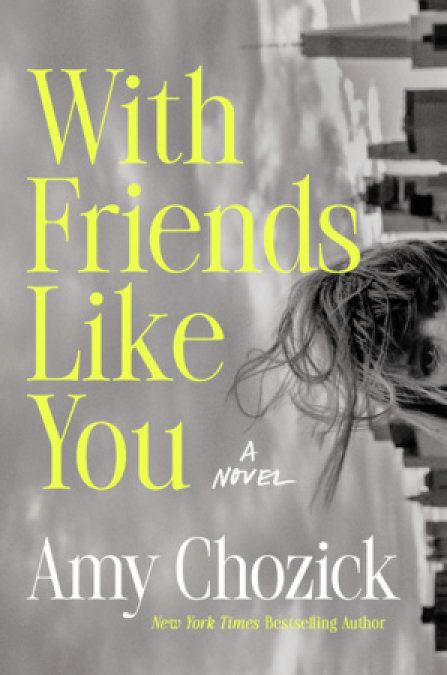
A feverish search for a long-lost friend threatens to upend a young woman’s life in this darkly funny, gripping thrill ride of a novel that defies all expectations, from New York Times bestselling author Amy Chozick.
Emily is unmoored as a new mother in Manhattan—exhausted, broke, and slipping away from her well-meaning husband. She becomes fixated on finding the one person who ever truly understood her: her college roommate, Daisy. Cool, poetry-reading Daisy, who vanished years ago, after she took a job dancing at a strip club off campus.
In her desperate search, Emily tumbles from new-mom message boards into a world of sex work, secrets, and a high-end escort service for global billionaires, hitting one dead end after another. Until the unthinkable happens: Daisy suddenly reappears.
Daisy infuses Emily’s life with newfound purpose and community as the two launch a new mothers’ group in a vacant luxury skyscraper (matcha on tap, vibrators on offer). But the joy of their reunion soon fades, revealing deep, unsettling cracks in their relationship. Is Daisy the key to Emily’s happiness, or is she unraveling her world? And where has Daisy really been all these years?
With Friends Like You is a story of feverish obsession, new motherhood, and a fractious friendship pushed to the edge.
Release date:
July 21, 2026
Publisher:
Dutton
Print pages:
336
* BingeBooks earns revenue from qualifying purchases as an Amazon Associate as well as from other retail partners.
CAUTION: This email originated from outside of Penguin Random House. Please be extra cautious when opening file attachments or clicking on links.
Chapter One
I could describe Daisy a lot of ways, but I guess the simplest way is to say that she was my first love. Not in the romantic sense but in the even more fleeting type that only happens among a certain type of adolescent girls-one magnetic, the other malleable. Even now, so many years later, married, and definitely not a poet, I've never felt more spiritually, and instantly, platonically connected to another person than I did to Daisy. At least, that's the way I remembered the year we shared a dorm room.
We were both eighteen, assigned, by chance, to share two hundred square feet. My mom unpacked a couple of IKEA bags full of plastic hangers and battled with a fitted sheet before declaring that I was an adult. I'd have to handle my own bedding. And the smell of a Hickory Hot Pot coming from the adjoining dorm room was giving her a gag reflex. I walked to the vending machine to get a Diet Coke, and when I got back Daisy was there, spreading a Laura Ashley comforter over the bed by the window.
"Hi. I'm Daisy. I grabbed this one, but if you want the window, we can switch. I have SAD . . ." I looked at her. "Oh, seasonal affective disorder. So I need a lot of sunlight."
Fifteen years later, and I kept thinking about that sentence: "I have sad."
She unpacked an electric teakettle, a white brick of a clock radio without an iPhone hookup or anything, quartz crystals and scented candles, and one of those Waterford ring holders. She pulled a Tiffany table lamp that looked straight out of a Hollywood prop department out of styrofoam popcorn and plugged it in on the bedside table between our twin beds. "Is this okay? One for you"-she flipped on the lightbulb on the right-"and one for me," she said, flipping on the bulb on the left.
"Yeah," I said, stuffing my twelve-dollar-and-ninety-nine-cent Skärhamn desk lamp back into a bag.
Daisy's grandma, whom she called Queenie, an elegant woman who looked like she got her hair freshly set each week, hung a print of Kandinsky's Circle in a Circle on the wall. Daisy hardly glanced at the abstract work. "It's upside down," she said.
It was August; Daisy found a scorpion under her bed. We both signed up for American Satire and Elizabethan Poetry. There were so many parties in those first weeks of college and we didn't get invited to any of them, and we wouldn't have gone even if we'd been invited. Daisy drank hot tea and watched French New Wave films, while everyone else was doing keg stands. She had her Paris Review subscription forwarded to the dorm and knew how to drape a scarf, even in college.
We decorated our dorm room with Daisy's Rothko-esque paintings, a Brontë sisters box set, a framed poster of Manhattan, twinkle lights. Daisy put an oriental rug that looked like it belonged to the Romanovs over the scratchy apricot carpet. We hung Cot's The Storm on the ceiling, the fairylike teenagers, Daphnis and Chloe, running for shelter in a rainstorm, staring down at us. We hardly ever turned on the lights. Daisy said fluorescents killed everything. Instead, we used candles and the Tiffany light, which washed everything in muted stained-glass colors. Daisy said that streaming murdered art movies and had a sizable collection of DVDs-Hitchcock movies, Who's Afraid of Virginia Woolf?, Kubrick. She had Mike Nichols and Elaine May on vinyl. I didn't even know how to play a record, but Daisy said she just liked having Nichols and May around.
After a required Intro to Calc class that we both struggled in, the teacher's aide-a grad student from Bogotá-started to walk with us after class. He asked me for coffee, offered to tutor me. It didn't take long for me to realize that he was talking to me to get closer to Daisy. She had no interest in him, and he soon lost interest in talking to me, too. She'd been so cool and blasé about it, brushing off this engineer who played soccer and came from a wealthy family and carried himself like he'd stepped out of a cologne ad. I couldn't decide if I loved Daisy or if I wanted to be her-or both. But I knew pretty early on that being around her made me feel more like myself than I'd ever felt before.
Daisy and I ate at the sushi place followed by the frozen yogurt place downstairs almost every night, because we couldn't stand the girls in the cafeteria, all bike shorts and pep. We both dreamed of leaving Texas for an ivy-washed school "up east"-a Seven Sisters college, maybe. Or no college at all. It's too boring and whiny to explain why we both ended up at a land-grant party school in Central Texas, best known for its football team and a fraternity's bonfire ritual that killed twelve students in 1999. If you didn't grow up like we did, it's impossible to understand how hard it was to leave. How big and encompassing Texas is. A larger landmass than France. Twelve years of Texas history. Even if you had the grades and ambition and means to go out of state, all anyone asked was "Why would you ever leave Texas?" I'm Texas born and Texas bred, and when I die, I'm Texas dead, engraved on my grandpa's tombstone. I know, I know, everyone loves Austin, but we were eighty-seven miles from Austin, and even Austin wasn't ideal when all you wanted to do was host dinner parties and be Sylvia Plath.
We acted like orphans who had only each other. I called my mom once a week, and every couple of months she'd take me out to dinner with her newest boyfriend. The last one took Daisy and me to Benihana. I watched the chef sharpen his knife, the drizzle of oil, the culinary acrobatics of shrimp and rib-eye, thinking it was all so tacky and ostentatious and who would finish all this food, definitely not my anorexic mother. And what was Daisy thinking?
That night Daisy told me her stepdad hit her mom. He'd accused her of cheating. She'd threatened to leave, and then-wham-right in her face with a closed fist. I didn't know how to react. I asked what he was like toward Daisy. "Fine," she said. "I think he wants to fuck me," and she took a string cheese out of the mini-fridge.
It was Daisy who asked me the things my own mother should've asked. How was your day? How did the exam go? Did you make any friends? Did you meet any boys? It was Daisy who told me to stop torturing my hair with blow-dryers and flat irons and to wear it curly. She bought me drugstore mousse, blew it into a cloud in her hand, scrunched it into my wet locks. "There. Naturally pretty," she said.
The days and nights rolled together in one string of conversation and chamomile tea. Daisy would lie on her floral comforter, wet hair wrapped in a towel. Me, in a hotel robe and boxer shorts. We stayed up late talking. No, we weren't "talking"-that isn't quite right. We were slicing our insides open, knotting our intestines into bows, becoming a conjoined organism. Soulmates, she called us. Daisy was an artist. I was a poet. We'd go to Paris. After graduation, we'd move to New York. We'd be broke and free and get our noses pierced. Daisy would turn on Chopin. I'd lie back on my faded duvet, listening, closing my eyes, Daisy's words and the music rolling over me-Cooper Union School of Art, open mics at the Nuyorican Poets Café-until I fell asleep. She'd turn off the Tiffany light between us. Only the twinkle lights sparkled above.
I didn't sleep well in my mom's house, too much anxiety about how I would become someone else. But when I was with Daisy, I slept ten, eleven hours straight. Deep, dreamless sleep through my alarm, through the cafeteria breakfast and Intro to Humanities, those nights when we shared a dorm room.
I was supposed to go home for spring break, but my mom went to Hawaii with the new husband. Daisy and I decided to drive to New Orleans. I proposed Café Du Monde, and she said not to be silly. We'd go to William Faulkner's bookstore first. We wandered into a curio shop, dusty and velvety red and filled with voodoo dolls and Wiccan trinkets. Both of us, at the same time, on opposite sides of the store, strapped butterfly wings to our backs. We bought a bottle of Stoli at the supermarket and took long swigs, two girls in butterfly wings passing a bottle in a brown paper bag between us on a sidewalk in the French Quarter. I rested my head on Daisy's shoulder, and we stayed like that for a long time, until everything went fuzzy and we felt the humid air on our thighs and somebody tossed us purple and gold beads even though it wasn't Mardi Gras. We wandered the streets, past the neon bars and the Creole town houses, floating over cobblestone, pretending we could fly. We ran away from our own stories, flew toward our futures, leaving anyone who wanted to trap us behind, a tiny, tiny dot in the distance. We were witches, wild and drunk and together and so, so alive.
At school, I was back at a desk staring at a calculus exam. I tried to find Daisy, but she'd already dropped the class, wiggling out, in her way, of anything that got between her and her art. If only she'd been there, maybe I would've had the answers.
By our second semester, for reasons I didn’t fully understand at the time, Daisy’s stepdad stopped paying her tuition. There was a fight on the phone. Tears. She wanted to stay in school, but her campus job at the student union coffee shop didn’t pay nearly enough to cover room and board and tuition. She turned to her grandparents, but they were essentially broke. Wealthy in name and real estate only. So Daisy got a job as a cocktail waitress at a triple-X strip club by the airport called the Landing Strip. It didn’t take long to realize the real money was on the pole. Three weeks later, Daisy was giving lap dances for twenty dollars a pop. She was still a virgin.
And then everything went dark.
We stopped talking. Daisy would skip class, sleep all day, her Laura Ashley comforter pulled over her head. I'd bring her fruit and muffins from the cafeteria until it all began to rot, flies circling. She made new friends, women who wore frosted lipstick and had names like Krystal and Amber. They had toddlers and clit piercings and were generous with advice about body-hair removal and what type of handgun to buy. I went to watch Daisy dance a couple of times. She did this slow number to Nine Inch Nails. I understood why men went nuts. She had skin like a blank page. Thick, dark hair down to her mid back. Wide eyes. A teeny elfin frame. And she could dance. Maybe it's because she was an artist and everything, even the platinum pole and the air that smelled like chicken wings and menthols were like a canvas. I sat on the edge of the chair, wondering if upholstery could transmit gonorrhea. I didn't like being there. Not because I was a prude, though I definitely was that. Or because I was grossed out watching a teenager turn on middle-aged men. That was obvious. I couldn't stand seeing how much Daisy was enjoying it all. Who was this girl? The way she ran a finger over a mustache, grabbed a paisley necktie, waved her butterfly wings and bare ass over an orthodontist's erect lap, as if all those childhood ballet classes had prepared her for this. I knew, watching her onstage, that I had lost her. That there would be no going back to Comp Lit 101. No trips to Paris. No Cooper Union.
The final month of our freshman year, I came back from the library to find that Daisy’s side of the room had been cleaned out. The next day, a well-endowed, bubbly girl named Justine, a transfer from SMU, was hanging a Katy Perry poster above the bed.
The man who owned the Landing Strip had seen that Daisy was special. Stripping became sex work. She dropped out. Moved in with Krystal, then Amber, then who knows . . . In a matter of months, Daisy had disappeared into a world I didn't understand. She called me a couple of times. She asked for money. She asked if I wanted to buy heroin. She showed up at my twentieth birthday party strung out. Took her Wet Seal halter top off. Gave my boyfriend a lap dance. I was too young, too impossibly young, to know what to do. I tried to get her help. I took her to an NA meeting. I called her stepdad, her mom, busy on yet another marriage. I called Grandma Queenie, who'd helped raise Daisy, but whose WASP delusions meant she couldn't fully grasp the world in which her beloved granddaughter had landed, much less rescue her from that black hole.
I didn't hear from Daisy for a couple of months, and then, on New Year's Eve, she showed up, banging on the door of my off-campus apartment. She said she'd kill herself if I didn't give her money. Kill herself if I didn't buy her heroin. I double-locked the doors, turned off the lights, cried listening to her yell from outside that it would be "all your fault!" if she wound up dead. For months, I'd hoped that our friendship could survive the strain of addiction and mental illness, but that night, when I turned off the lights, I knew it had irrevocably broken.
We lost touch. I heard she moved to California to make adult art-house films. I blamed myself. If anyone should've understood, been able to talk her back, had patience and empathy, it was me. I tried to find her a couple of times over the years, through family, friends, but nobody knew anything. Late nights, I'd stay awake scouring the internet, but whenever I thought I'd finally caught a glimpse of Daisy on some sick corner of the web, I'd click and it'd be gone. She'd be gone.
I graduated early and moved to New York. I did open mic nights. I got a ridiculous nose ring that got infected and lasted a month. I was broke and free and mostly happy. Sometimes, on my way home to the East Village apartment that I shared with Paul and his boyfriend, Tyrone, I would walk past the Cooper Union School of Art, stare at the students leaving with their portfolios and acrylic-stained Dickies, and imagine Daisy and me happy and sharing a cigarette at the big black cube at Astor Place on a warm Thursday night. I'd blink and the image would be gone.
We hope you are enjoying the book so far. To continue reading...

 Please log in to recommend or discuss...
