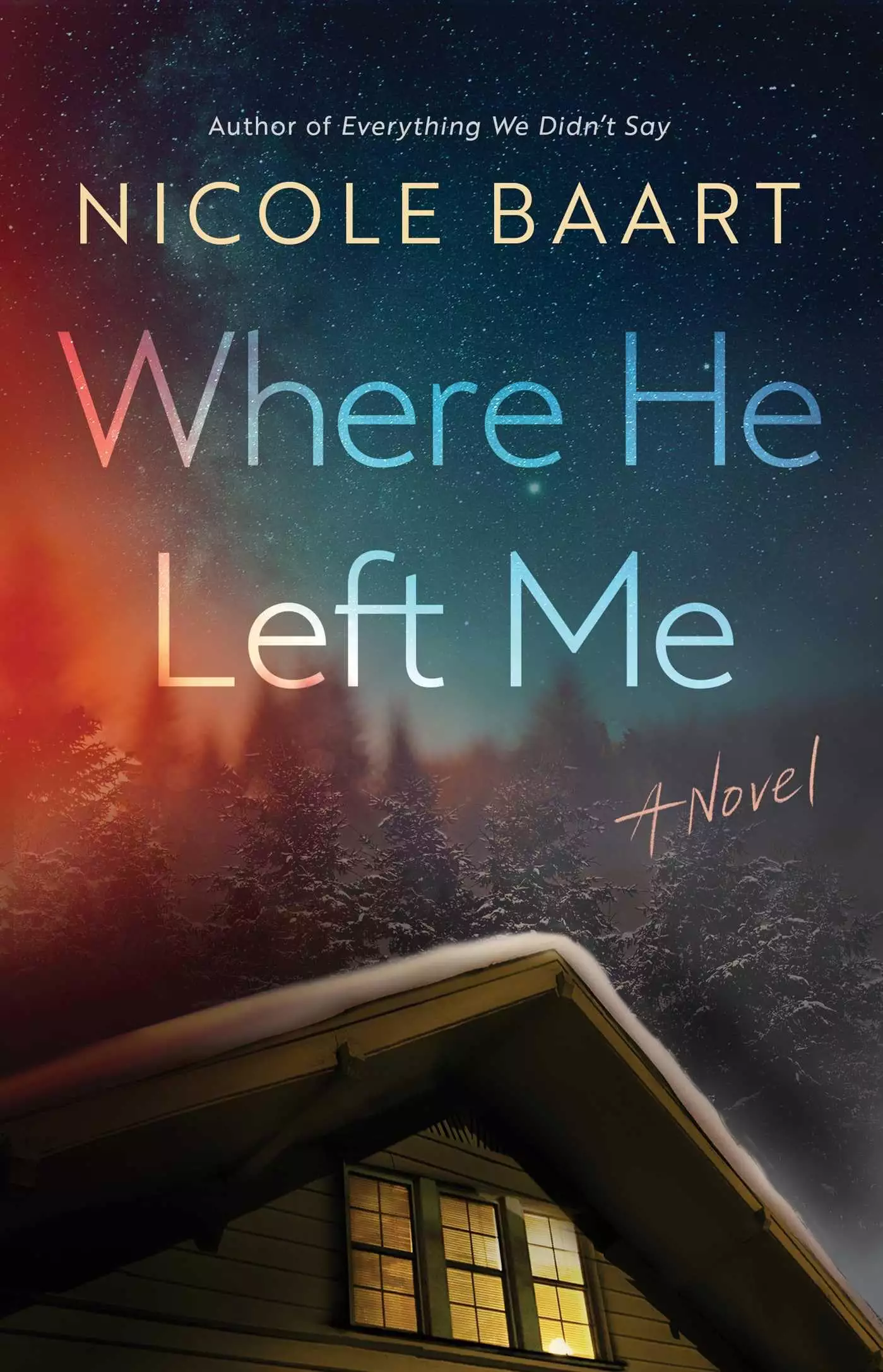
From Nicole Baart, the bestselling author of Everything We Didn’t Say, comes a twisty, atmospheric suspense novel about a newlywed whose husband disappears, leaving her isolated in Washington’s North Cascades.
College professors Sadie Sheridan and Felix Graham are on sabbatical at Hemlock House, located on a remote mountain homestead established years ago by Felix’s family. When Felix leaves on a work trip but doesn’t return, effectively stranding Sadie on the mountain, her world collapses.
Alone at Hemlock House, frantic Sadie struggles to make sense of what her missing astronomer husband left behind. Forced to confront two mysterious trespassers just as a powerful storm bears down, Sadie and the strangers have no choice but to ride it out together. As conditions worsen and shocking secrets are revealed, Sadie must face whether or not she ever knew the man she married and decide: is she fighting only for her own survival now—or still for the man who promised her the stars?
Where He Left Me is another compelling, emotional thriller from an author who“writes with a poet’s eye for language and a storyteller’s gift for suspense” (William Kent Krueger, New York Times bestselling author).
Release date:
November 4, 2025
Publisher:
Atria Books
Print pages:
384
* BingeBooks earns revenue from qualifying purchases as an Amazon Associate as well as from other retail partners.
NEW MOON / TAURIDS METEOR SHOWER / URANUS AT OPPOSITION
Later, after the feel of his fingertips against the line of her jaw was nothing but a fading memory, Sadie told herself that she’d imagined it all.
The whole thing was reckless, a last-minute lapse in judgment that made her pocket her car keys and turn away from the parking lot of the humanities building toward the dark north entrance and the quad. It was November in Iowa, a night so cold and dark, the first prick of brittle late-autumn air was keen as a freshly honed blade. She almost turned around. But Sadie had been in Newcastle for over two months, and still working past ten on an ordinary Monday night. She was lonely, just gathering the courage to admit it, and the flyer tacked crooked on the bulletin board in the English Department pod felt like an invitation.
The heels of her sensible flats tapped a rhythm on the flagstones of the courtyard as she hurried, then jogged, between the science building and the campus commons toward the football field. Of all places. But there was a certain exhilaration in having somewhere to be that wasn’t her office, a classroom, or the condo she rented on the outskirts of town. Sadie wound the scarf tighter around her neck and bunched her fists beneath the long cuffs of her wool coat. She told herself the spontaneity of it was thrilling.
The poster had promised “Stargazing on Steroids,” with a couple of the science department’s portable telescopes set up for viewing both a meteor shower (Sadie had already forgotten the name) and something to do with Uranus—which would’ve sent the middle schoolers she used to teach into hysterics. The poster had crackled with energy, a guileless enthusiasm that made the crisp night air feel clean and fresh as newly fallen snow. Full of possibilities.
The Brantford Memorial Stadium (Go Newcastle Knights!) was cloaked in darkness, the streetlights extinguished for what she could only imagine was an attempt to cut down light pollution for the stargazers. But Sadie wasn’t afraid as she hustled beneath the brick arch to the knot of people gathered at the fifty-yard line. Her eyes had adjusted to the ink-black world, and Newcastle was safe. Like, leave your keys in the ignition, don’t lock your front door safe. Though she still did both, and carried a personal alarm clipped onto the strap of her purse—a relic from her days teaching eighth-grade English in downtown Milwaukee. The only thing Sadie had to fear tonight was putting herself out there, a directive her mother had barked at her only a few hours before: Don’t be such a mouse. Put yourself out there! Wouldn’t she be surprised when Sadie told her she’d done exactly that. If she remembered the conversation at all.
Twenty or so people were clustered in a semicircle around a man who stood between a pair of telescopes mounted on silver tripods. No one glanced up when Sadie folded herself in at the edge of the crowd, grateful for the cloak of the deep, moonless night. She was also—she hoped—indistinguishable in the small crowd of students, perhaps a faculty member or two. Her light hair was pulled back in a low ponytail, navy peacoat belted tight. Maybe no one had to know that the newest member of the English Department had made her first social appearance since arriving on campus in late August.
But anonymity wasn’t the point of this outing at all. Maybe there had already been introductions and she had missed her chance to share that she was Dr. Sadie Sheridan, assistant professor of creative writing (though her degree was in English lit, but beggars couldn’t be choosers), recent transplant from Wisconsin, French cuisine aficionado, so pleased to meet you. She began to back away.
“I want you to take your shoes off,” the man between the telescopes instructed, cutting straight through Sadie’s distraction. She was so surprised by the strange direction, she froze mid-getaway. “Grounding has some incredible health benefits,” he continued. “Research suggests that the negative charge of the earth’s surface can neutralize free radicals, regulate our nervous system, and synchronize our circadian rhythms.”
“It’s cold, Dr. Graham!” someone complained, but it was good-natured, and more than a few of the students laughed.
“Well, we could talk about the benefits of cold therapy, Landon, or you could trust me on this. Stargazing isn’t just a fun hobby, it’s an art. A way to ground yourself in time and space as you contemplate the infinitude of the cosmos. To connect with both the world around you and the baffling beyond. I find it helps to feel the earth beneath me before I turn my attention to the stars.”
“Dude’s a wannabe poet,” a student muttered, but everyone bent to remove their shoes.
Sadie couldn’t see Dr. Graham, not well, yet something about the way he spoke made her toe off one camel flat and lower her bare foot gingerly onto the clipped grass of the football field. It was definitely cold, and a bit damp, but it also felt like green growing things and summertime and childhood. It made Sadie smile because she couldn’t remember the last time she’d stood barefoot on grass, so she quickly slid off the other shoe, wiggling her toes in the carefully maintained turf.
“I’m going to pass out binoculars and star charts,” Dr. Graham said. “I want you to spread out on the field and find a place to lie down. There are blankets if you want them. Once your eyes have adjusted to the dark, you can watch for the so-called falling stars of the Taurids meteor shower, or see if you can find Cepheus, Cassiopeia, or Pisces.”
“I’m here for the Starlink satellite train!” This brought a gale of laughter, and as the crowd filed forward to accept a pair of binoculars and a star chart, Sadie could just make out the flash of white teeth as Dr. Graham smiled.
“I’d keep my eyes on Taurus if I were you,” he said. “The meteors will radiate from the center of the constellation.”
A girl passed Sadie a pair of binoculars and a laminated star chart over her shoulder. Sadie wanted a blanket, too, but Dr. Graham was already talking about the telescopes and Uranus at opposition, so she just stepped back into her shoes and wandered off to find a spot that wasn’t already claimed by prone bodies curled close together.
Looking around, she had no doubt there were more than a few couples in the crowd. Young love and all that. Was stargazing the perfect first date, or hopelessly cheesy? And was it pathetic that she was here, among them?
When Sadie finally lay down, the vast expanse of sky made her dizzy, like she was falling and flying at once. She dug her fingers into the grass and tried to concentrate on Dr. Graham’s calm directions, his nearly whispered guidance for locating the Andromeda galaxy by star-hopping from the W-shaped valleys of Cassiopeia to the great spiral solar system itself—the most distant object visible with the naked eye, he claimed.
Sadie had no idea what she was doing, but his voice became the quiet soundtrack to her exploration, and as the sky became darker still and the stars and planets and far-flung galaxies poured across the velvet scroll of forever, she lost herself. There were whole universes contained in each pinprick of golden light, and she was so very, very small. A single heartbeat. A whisper.
“Did you want to look through the telescope before I pack it up?” Suddenly, Dr. Graham was standing over her, his face in shadows, hand outstretched.
Sadie propped herself up on her elbows and glanced around, confused. She felt lightheaded, almost drunk, and she realized that the field was emptying, the stargazers wandering back to dorm rooms, the all-night diner, or perhaps Joe’s, the one seedy but welcoming bar in Newcastle.
Embarrassment coursed through her, and she fumbled for the discarded star chart, the binoculars that she had abandoned long ago. The wonder of it all spilled out of her, a tipped cup. She regretted coming.
But if Dr. Graham thought her a fool, he didn’t let on. “It’s magical, isn’t it?” He loved it, Sadie realized. The sky, the stars, the limitless possibilities of the great beyond.
“Yes,” she said belatedly. It was magical, and she had been utterly transported, but now she felt stiff and cold. Ashamed that she had let herself get so lost in space. Literally. Sadie curled her feet beneath her and tried to stand, but her thigh-length coat was making it tricky, and she ended up dipping sideways.
“Here,” Dr. Graham said. He leaned down, slipped an arm around her, and helped Sadie to her feet in one swift movement. “Did you know that some physicists believe there are more universes than the human mind can comprehend? It makes me believe in, well, everything.”
“Everything?” Sadie parroted as his hand fell away. She was freezing, her body trembling, protesting the time she had spent in the grass. She wrapped her arms around herself to both ward off the cold and hide the fact that she was shaking.
“Maybe anything is a better word.” Dr. Graham ran one hand through his black hair. It was thick, wavy, and just a little too long to be respectable. “It’s hard not to believe in anything and everything when our understanding is so rudimentary.”
Her eyes had grown so used to the dark she could see that he had a dimple when his mouth pulled into a half smile. Closed lips, but his expression was warm and sincere. She couldn’t help but smile back.
“?‘There are more things in heaven and earth, Horatio, than are dreamt of in your philosophy.’?” Sadie was mortified the second the line popped out of her mouth.
“Sadly, the name’s not Horatio.” Again, the crooked smile. The dimple. “It’s Felix Graham. Science Department. But I’m guessing you already knew that. You must be the new assistant professor. I’m sorry we haven’t crossed paths.”
Sadie’s chest burned when he stretched out his hand, and she was grateful that he couldn’t see her pinked cheeks. “Dr. Sadie Sheridan,” she managed. “English Department.”
“Thus the Hamlet quote.”
“I’m just a walking cliché.” She didn’t realize her fingers had turned to ice until Felix wrapped both of his warm ones around them.
“Shakespeare is always applicable. But I’m truly sorry for the hypothermia I’ve clearly caused tonight.” He gave her hand a light squeeze, and when he let go, she tingled all over.
“It’s fine. I’m fine. I saw your flyer as I was leaving tonight and decided to stop by. Kind of a last-minute thing.” Tucking her aching hands deep into her pockets, Sadie surprised herself again by continuing, “You know your Shakespeare.”
“I took an English lit class as an undergrad and the prof was obsessed with Hamlet. If you had quoted Macbeth, I would’ve been clueless.”
He had a very slight accent, or maybe a lisp. A softening of his consonants, vowels rounded as if he savored each word like something sweet on his tongue. Sadie found herself squinting at him, grateful for the cover of night as she tried to discern more than just dark hair, dark eyes. Felix was taller than her by a few inches, wearing nothing but a thick sweater, though the night was becoming almost unbearably cold. “Can I—” she began at the exact moment he blurted: “Would you like to see Uranus at opposition?”
Sadie almost giggled at that, the punch line of a bad junior high joke, and Felix must have caught the glint in her eye because he grinned. “My astronomy students have a new one every day. Uranus jokes will always be funny.”
“Will they?” Sadie raised one eyebrow.
“You’re right,” Felix conceded, shaking his head. “Only funny to twelve-year-olds and lovers of planetary science.”
“Yes.” Sadie dismissed the bite of the November night, along with her self-consciousness. “I’d love to.”
There was something easygoing and authentic about Dr. Graham. Sadie had finished her doctorate just a year ago, a few weeks after her forty-first birthday, and breaking into higher ed at her age was a lesson in humility. It was why she’d accepted a position at a relatively unknown small college over five hundred miles from home. From the quaint assisted living facility where her septuagenarian mother—her only family—lived. Sadie had left everything behind for Newcastle, and so far she wasn’t convinced it had been worth it. Her course load was intense, her lectures packed. She didn’t have time to make friends.
But Felix acted as if this moonlight meeting was as normal as bumping into each other after faculty assembly. “Once a year, Uranus comes into opposition,” he said, leading Sadie to the single telescope left standing.
Everything else had been packed away into cardboard boxes. How had she missed that?
“The Earth and Uranus pair up on this side of the sun—only two point eight billion kilometers apart.”
“Practically touching,” she said, and felt like an idiot. But she was rewarded with a light chuckle.
“Next-door neighbors,” Felix agreed. “It’s a piece of cake to spot it with binoculars, but you can see the planet’s distinct blue-green marbling with this telescope. Did you spot it earlier?”
She could’ve lied, but Sadie shook her head and admitted, “I got distracted.”
“Totally understandable. Here, let’s start with these and work our way up.” He handed over the binoculars he’d rescued from one of the boxes, and pointed at the night sky, telling her where to find Uranus in relation to the Great Square of Pegasus. Sadie had no idea what he was talking about, but gave it her best shot, squinting into the smudged lenses until Felix stepped behind her. “May I?” he asked, and before she could answer, he touched her.
It was nothing really, just a fingertip or two on her jaw, lifting her chin a few degrees. “You have to look up a bit more, Sadie.”
Her name on his lips was an unlocking. In a single moment, Sadie’s whole heart fell loose and open.
“It looks just like a star,” Felix said, oblivious, “but it’s not. The diameter of Uranus is four times that of Earth, and it possesses the coldest atmosphere in the solar system.”
But Sadie wasn’t listening anymore. Her skin flamed where he had touched her. She felt naked and exposed. “Thank you,” she choked out, shoving the binoculars in his direction. Could he tell? Did he know how he affected her? Sadie knew she had made an absolute spectacle of herself. Coming to this stargazing event, whispering under a moonless sky with a colleague like she was a flirty teenager instead of an academic—a professor!—in her forties.
“In the telescope you can—”
“Thank you,” she said again, interrupting. “I’m afraid I have to go. Maybe I can see it another time.”
Of course, there wouldn’t be another time. Once a year, he had said. A special event. Something unique and disruptive and extraordinary. As uncommon as Sadie Sheridan doing something impetuous.
“This was… informative,” she said, gathering herself and trying to force the wayward pieces back into place. Midnight stargazing with strangers was the most un-Sadie-like thing she could have possibly done, and the impulsivity of it felt rash and uncomfortable. “It was nice to meet you, Dr. Graham.”
“Felix,” he said, but she had already turned away. “You can call me Felix.”
Sadie wanted to tell him that he was the most interesting person she had ever met. That she believed she could spend the entire night looking at the sky with him and never once get bored. But the lightness in her chest, that uninhibited exhale that made her tingle all over, was ridiculous.
Sadie knew herself. She liked her life safe and predictable, her two feet firmly planted on the ground. A thoughtful plan outlined. Don’t forget the cost/risk analysis and a foolproof exit strategy.
She simply wasn’t built to be untethered.
We hope you are enjoying the book so far. To continue reading...

 Please log in to recommend or discuss...
