
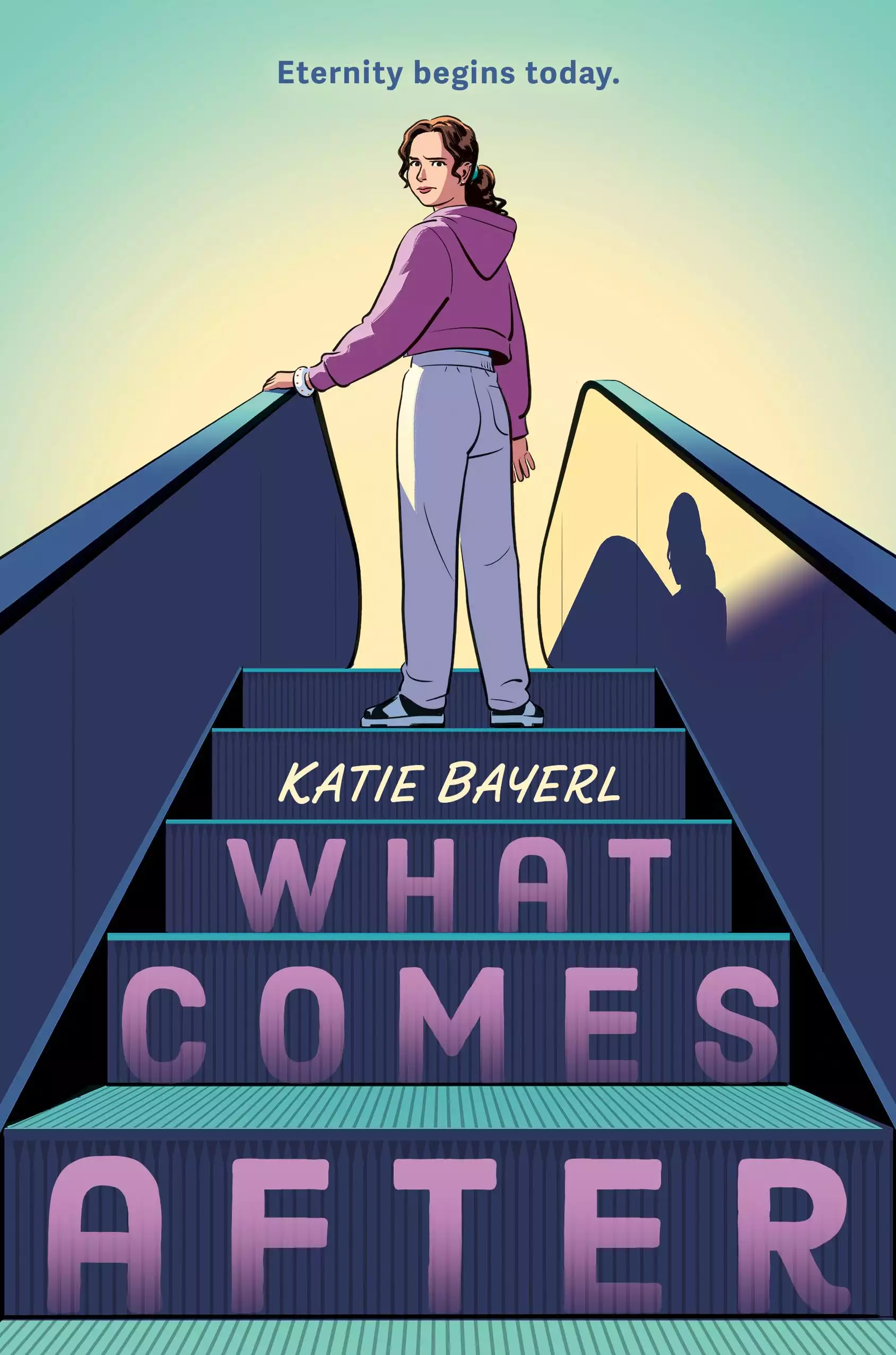
What Comes After
- eBook
- Audiobook
- Hardcover
- Book info
- Sample
- Media
- Author updates
- Lists
Synopsis
Mari never gave much thought to the afterlife before her untimely demise, but she certainly didn't think it would be an experimental wellness enclave called Paradise Gate—a place where the newly dead go to sort out the unfinished business of their lives. She also didn't think the biggest problem to plague her in life would follow her into the great beyond: her also recently deceased mother, Faye. Mari quickly realizes Faye is her unfinished business, and in order to move on to whatever's next, she'll have to find a way to forgive her dysfunctional mother for being no mother at all. But there's so much to forgive: never holding down a steady job, never having a stable home, and abandoning Mari in the end.
It's a lot to sort through, but faced with the possibility of being turned out into the abyss, Mari gets to work. She enrolls in the prescribed self- actualization classes (think: journaling, positive self-talk, and lots of Youga™). It all seems pretty hokey, but still, the assignments force Mari to confront difficult truths about her past.
When a shocking revelation about Mari's death captures the attention of the afterlife media, Mari is suddenly in the spotlight, her messy history being judged by the whole realm. She finds escape in an equally troubled boy, who takes Mari to an obscure part of Paradise Gate and introduces her to rebels who show Mari that this “wellness center” is not all it pretends to be. With classmates disappearing and an afterlife revolution brewing, Mari must decide whether to play it safe or break the rules. At stake? Her eternal fate. Literally.
Release date: April 29, 2025
Publisher: Nancy Paulsen Books
Print pages: 416
* BingeBooks earns revenue from qualifying purchases as an Amazon Associate as well as from other retail partners.
Reader buzz
 Please log in to recommend or discuss...
Author updates
What Comes After
Katie Bayerl
After
I died on a Saturday in early October, four weeks before my seventeenth birthday, thirteen minutes after I was scheduled to begin the SATs.
Cause of death: trauma to the head.
Further details: unknown.
I’ve been told that some memory loss is normal. I’ve also been told that, contrary to what I’d always understood (perhaps even hoped), death does not equal The End.
The last thing I remember clearly was sitting in my guidance counselor’s office—a full sixteen hours before I bit the dust, according to the sequence of events I’ve been given. I can still see the soft twist of Ms. Crawford’s mouth as she told me there was nothing more she could do. I remember, too, the sinking sense that despite months of valiant effort, I’d hit a dead end. (No pun intended.) As I left the guidance suite and traced my way through Brookline High School’s empty hallways to its inner courtyard’s crush and clamor, I felt more alone than I’d ever been. More helpless. For once, I saw no path out.
I didn’t kill myself, if that’s what you’re thinking. They’ve assured me my wounds—most notably, a massive blow to the back of the head—weren’t self-inflicted. It was most likely an accident. Possibly, an attack.
The rest—the how, the why now, the why me of it—is a bit of a black hole.
I do recall one bit, though. I’m not sure what you’d call it. A memory? Feeling? There’s no sense of time or location. Just a rush of adrenaline, the itch of a shout. Then, a stampede of emotions. First, shock. Then, terror. Now, disappointment, confusion, rage, regret. And finally, joy.
Yup. The last one surprised me too. I thought dying was supposed to be the saddest thing imaginable, but in my final moment—if that’s what this was—I felt all my burdens lift, and for a tiny sliver of a second, I was the happiest human alive.
Or, you know, dead. As it were.
The feeling was extremely fleeting. I opened my eyes and discovered: A ceiling. Spotless, white. Not regulation hospital tile, but far from heavenly. The mattress I lay on was decidedly thin. I blinked a bit, trying to make sense of it. Where was I?
Then, I saw her.
My mother looked like she did the last time I’d seen her, six months ago, April, but makeup-less and more subdued. Her blue eyes widened, setting off an unpleasant stirring in my limbs. (One, two, three, four. Yes, all four still intact.)
“Mari.” Two pale hands reached for me, and the machine beside me let out an unsubtle screech.
Fun fact: Faye Novak, aka “my mother,” kicked the bucket six weeks before me. Walked out in front of a bus, no explanation. I got the news on a swamp-thick morning in late August. My aunt Jenny delivered her ashes a few days later, then sat on the tiny sofa in my one-room apartment, waiting politely for me to cry. She was too late for that. I took the box, tucked it in a dark corner below the sink, offered to make us some coffee.
My mother was gone. Life carried on. For a while anyway.
Except now here she was, my dead mother, sitting on a simple chair pulled tight against my bed, machines bleeping all around, those baby-doll eyes brimming with regret. I felt a sudden, urgent need to flee.
At this point I became aware of the others. Their cries rose from the beds around us, some squeaky, confused, others low with anguish. Faye, meanwhile, just sat there, staring at me, expecting me to do
something, say something. When her heart-shaped lips began to quiver, I understood: I might be dead, but my troubles weren’t over, not even close.
“Where the hell are we?” I finally found the courage to ask. “Is this…?”
“No.” She shook her head.
She quickly brought me up to speed on a few details about death that had surprised her too. “Death isn’t the end of things like we thought, baby. It’s not exactly upstairs-downstairs, either, like other folks believed. Or maybe it is for them.” The majority of souls have gone elsewhere, she explained, or perhaps to multiple elsewheres, sorted according to their deeds and beliefs, leaving the rest of us—the nonbelievers and agnostics, the spiritually muddled and decisively secular, plus all those who (like me) never once took seriously the concept of an after—in this in-between place. For us, this next phase is where the real work begins.
“It’s our last chance to get things right,” Faye said, “here, in Paradise Gate.”
An Extremely Brief History of Paradise GateImagine it: A small-time bureaucrat, a self-help guru, and a tech developer pass over the threshold into the vast, eternal abyss. It’s an ugly place. Gray. Profoundly lonely.
After a brief eternity[*1] of wandering a realm that many describe as ennui made concrete, the three drift into a common orbit and immediately begin to gripe.
This is awful!
This is miserable!
It’s meaningless and depressing!
How can any soul escape a despair such as this?
By then, they’d heard rumors of a lucky few who—poof!—had mysteriously released their anguish and gone on to a much better place. Such successes, however, were rare and the process murky. While the three knew instinctively that their goal should be to move on—transcend the eternal soup—they didn’t yet know how.
What if there was a more transparent process? they mused.
“Something more efficient,” proposed the bureaucrat.
“…and
psycho-spiritually uplifting,” envisioned the guru.
“…with some truly kick-ass tech,” offered their code-savvy friend.
And because they had an eternity to work out the details, they did.
Cut to today: approximately eighty cycles[*2] into the future. The trio’s dream: realized. The Powers That Be, as they now call themselves, have designed a functioning colony for secular souls, which, as far as anyone knows, remains the only such refuge in the vast misery known as the In Between.
Welcome, friends, to Paradise Gate. We wish you an efficient stay.
*1. Ten days? Ten eons? Unclear. To a soul adrift, time is slippery.
*2 That’s twenty years for those new to our system. One cycle = three months; or, ninety days.
After
Day 0
Murmurs build and groans erupt as, one by one, my dead peers take stock of our new situation. Their shocked expressions cause my own anxiety to kick in, a scream caught high in my throat.
Is this real? Is it a prank? A punishment?
Whispers fill the room.
What are all those machines? What are they planning to do with us? (To us?)
Dozens of beds line the bright, windowless ward. In them, bodies. Some old, many older. A few teens like me. All shapes, colors, and genders. No kids. We’re in some sort of processing center for the newly dead, all of us outfitted in loose white pajamas (tunic, bottoms), and hooked to a tangle of sleek monitors. A few, like me, are accompanied by visitors—predeceased family and friends dressed in more normal clothes. No one appears ill exactly, or injured, though the navy-robed attendants keep assuring us that we have all definitely bit the dust. They smile pleasantly as they pause at bedsides to scan our screens.
“Yes, sir, you’re dead. Yes, ma’am, you still have a body. A replica. No, we have not made a mistake.”
It’s a lot to take in.
A youngish attendant sweeps toward me, smiling blandly as he prepares to clamp a device onto my wrist. I look at Faye in alarm. “To keep track of your vibes,” she says matter-of-factly.
“My wha— Ow!”
The device’s light turns a bright crimson, which, from the attendant’s frown, I gather isn’t good.
Faye’s been explaining the mechanics of everything (or what she understands, anyway; she’s never been one for details)—how our souls left our bodies and passed over a threshold when we died. How, in the past, that was the end of it: Unaffiliated souls like ours might wander the expanse for an eternity, unable to shake free of their unprocessed angst. (“Which is terribly unfair, don’t you think? Baby, did you know that a third of all Americans identify as nonreligious? And more than a billion people globally? We deserve decent afterlife opportunities too, right? Thank goodness for the Powers That Be!”) I murmur something noncommittal because, really, I’m not sure I should be thanking anyone for what happened next. Apparently, the Powers erected a giant soul-scooping net that drags newly deceased souls out of the void and onto a dock where they are hooked into their grid, scanned briefly, and, if deemed salvageable (by whom? and by what measure?), uploaded into a giant shared simulation.
“It’s like virtual reality, except not a game,” I overhear a visitor tell her companion. “A place where we can clean up our act and play out our unfinished business.”
My groaning neighbors go quiet as the visitor describes what we’ll find outside the ward—a highly organized community, well-equipped homes, plentiful opportunities to learn and grow and maybe even get a massage from time to time. “If you earn it!” he says with a cheerful finger wag. “But more importantly, at the end of the ninety-day cycle, if you’ve done the work and resolved your angst, you’ll be invited to ascend.”
“Ascend where?” someone asks.
“The Ever After.”
Everyone goes quiet, chewing on this for a moment. From their gauzy expressions, I assume that my neighbors are drawing on the usual stock imagery (clouds, harps, etc.). Personally, I still want to hear more about the gray drifting place. Because the idea of spending ninety days in whatever this place is with, of all people, my mother isn’t something I can consider. Especially after Faye mentions that her bungalow sprouted a second bedroom this morning. “Can you believe it? We’re getting another shot, baby! The Novak girls, reunited!”
Oh, hell nope. I throw back the sheets, ready to start a riot when I hear that.
Faye hops to her feet a split second after I do, her smile sucked away as she glances nervously at the attendants and a security camera winking down from above. Her pale face grows paler, fingers fluttery. She waves at me to lie back down, begs me to give her a chance—“Just wait, sweetie. Things will be better this time. I promise.”
I crumple back onto the bed. I’m too dead for this. Too over it. Promises. Uff. I fold myself neatly between the sheets and tell Faye to calm herself, sit.
She follows my order like an obedient pup.
“You’re sure you don’t know how you died?” Faye whispers a few minutes later. “How you hurt your head?”
I shake the head in question.
“Do you think someone hit you? Were you feeling okay before it happened?”
“I said I don’t know.” I add extra bite so she’ll drop it. I literally woke from the dead less than an hour ago. A case of mild amnesia seems like the least of my problems.
When a navy robe hurries over to check a machine that’s begun bleeping behind me, I take a deep breath and smile bravely. “Excuse me? Ma’am?” I ask. Maybe if I ask politely, she’ll double-check my numbers or give me a test (I’m excellent at tests) and send me to a different afterlife. Maybe she’ll realize this is all a mistake, that I don’t belong here, with my mother, that this whole situation is just a little bit insane.
But the attendant swivels, her attention caught by a clatter across the room.
A middle-aged white woman stands atop her bed, ripping at her tunic. “I don’t belong here! I’m telling you, I did everything right! I meditated daily! I was on the board of three local charities! Why won’t anyone listen?”
An attendant speaks in low tones, to no effect.
“No, no, no! The service here is unacceptable! I want to speak with God. Immediately. Not a manager. God.”
“But, ma’am, we don’t…more importantly, you don’t— It says right here you didn’t believe in any deities?” The room has gone hushed, all of us listening as the attendant points to his tablet. “Could this be an error?"
The woman’s eyes turn to slits. “You know who I mean. The Big Boss. You must have one. Take me to her. Now.”
The attendant smiles generously, pausing to press something on his screen while simultaneously attempting to explain the situation (i.e., no gods here, no “bosses” either, not in that sense, just a bunch of souls creating the best afterlife they can under a rather complex administrative structure), but the woman only grows more agitated the more he talks. Soon she is shrieking, hurling pillows. A siren blares, and a pair of guards crash into the room, making a beeline for her bed. Swift flip and the guards have her sideways. They carry her from the room plank-style as her shouts escalate into howls.
The doors slide closed, and the ward goes still, silent but for the machines’ steady bleats. My neighbors exchange trembling glances. Only the attendants appear unaffected. The one nearest me leans in to check my monitor. She frowns at something, typing. “You had a question, miss?”
I shake my head, clear a frog from my throat. “Nope. I’m good. I’m fine. Everything’s…fine.”
The attendant smiles. “That’s the right attitude. Keep thinking positive, dear.”
A buzz sounds overhead. The initial assessment period has concluded. We’re hurried from our beds, herded into a line at the far end of the ward. Faye, clinging to me, is whining something about second chances. I swat her away so I can peer through the crack in the doorway, but there’s no sign of the guards or their yowling prisoner.
Another buzz and the lights blink. For a moment, the whole ward seems to wobble. “Just a glitch,” an attendant says cheerily. “Nothing to worry about.”
More unanswered glances.
Faye and the other visitors must take their leave now. Faye makes another play for my hand. “Baby, listen to everything they tell you, okay? Just…do what they say. Promise?”
I push back her touch, then momentarily regret it (where are they taking us, exactly? when will I see her again?), but before I figure out how I want to handle Faye or any of this, we’re being whisked down the hallway and my doll-faced mother is gone.
• • •In a large room with faux-wood paneling, we’re told to find a pillow and sit. A few older folks balk before discovering with delighted murmurs that their joints move more freely than they have in years.
I find a cushion in a middle row, near an exit door. More groups file in from
other doorways, until there are at least a hundred of us, possibly more, huddled and waiting for whatever comes next.
Eventually, the front wall breaks open, revealing two figures on what appears to be a live two-way screen. They smile broadly, introducing themselves as the co-chairs and founders of Paradise Gate, aka the Powers That Be.
“Wherever you’ve been, whatever your burdens, we assure you that you’re in good hands now,” says a portly man in a collarless button-down. Screen name: Chairman Ted.
The woman—willowy, white-haired, unironic genie pants (screen name: Lady Lu)—pipes in. “Yes! Yes! We’re here to help you find your best eternity! Join us and together we will manifest our brightest inner selves.”
Oh boy. I side-eye my neighbors to see if they’re hearing the same thing I am. These are the folks responsible for our eternal outcomes? But around me, the others lean forward on their pillows, listening intently. A few actually smile as the Chairman guy goes on a meandering monologue about his own past (boring) and the slightly more interesting story of how he, Lady Lu, and a third guy conceived Paradise Gate.
“Our mission from day one has been to provide secular souls with a clear path to redemption or, as we prefer to call it, actualization. In developing our program, we scoured the metaphysical theory and borrowed several helpful concepts from more traditional spiritual systems—”
“And self-help!” cries Lady Lu. “Don’t forget self-help.”
“Yes. Hmm. That too.” Chairman Ted smiles broadly into the screen. “The short version of this long story, friends, is we’ve designed a unique, streamlined system for healing the past and achieving inner tranquility, and we’re pleased to inform you that we’ve been wildly successful. Our settlement, still technically in a pilot phase, currently serves approximately seventy-five thousand souls per cycle and boasts impressive ascension rates. A majority who enter our program graduate within the prescribed ninety-day term.”
“Excuse me?” Someone in the front raises a nervous hand. “Where do the others go? The ones who don’t graduate?”
Chairman Ted pauses
pauses, squinting into the room. “Ah, well, we don’t want to frighten you on your first day, do we?” He taps his belly. “No, let’s focus on the positive for now. According to our research, success is twenty percent aspiration and sixty percent perspiration, which means, if you follow our program, we’re eighty percent certain you’ll succeed!” The Chairman chuckles while the rest of us remain silent.
“Our model isn’t for everyone,” offers Lady Lu more solemnly. “We don’t accept pedophiles, sociopaths, or neo-Nazis, for starters—”
“Because!” interrupts the Chairman. “Because the truth is, we can only help those willing to work. We provide the tools and…” He glances significantly at Lady Lu.
“And the results are up to you!” she chirps.
“The clock is ticking now, friends. Think of this as the push you’ve always needed.”
“Your last chance to become your best you!” coos Lady Lu.
By now, my dead stomach has sunk all the way to the floor. I need to go back. Start over. Fix whatever error in the script landed me here, dead at sixteen, in what feels like a terrible infomercial.
The Chairman stands taller. “Whatever reservations you may be experiencing, set them aside, right this second. Your job from here forward is to trust in the process.”
A bell chimes and Lady Lu raises her hands, encouraging us to do the same. “Trust in the power of you.”
Before
September (1 month earlier)
Looking back, there were likely signs that my life would unravel. Choices, turning points, forks in the path. Take this route, and your life will turn out okay. This one, and you will wind up desperate, then dead, mere months before high school graduation with a wall of regret so high you can’t even remember what’s on the other side.
But here’s the thing: Who had time to worry about signs and what-ifs when the present was so consuming? Not me. I preferred to follow my nonnie’s advice—chin up, eyes ahead. With my view fixed on the horizon, I still had a shot at survival.
Chin up, Bunny. That’s what Nonnie said when I, as a fifth grader, became obsessed with melting ice caps, noxious gases, and crumbling democracies, with cows crushed in factories, rampant disease, one in five children living in poverty (in America!). Big concerns for a child, yes, but I liked to keep an eye on things. Nonnie said it was one thing to know, another to let knowledge consume you. When she caught me spiraling, muttering about starving orcas, a planet on the brink, she’d pull me close, chuck me gently beneath the chin. Come now, Bunny, you know what to do.
And I’d take a deep, slow breath and stretch to my fullest height.
Chin up, eyes ahead, we’d say together.
And, as if by magic, the world became more bearable.
It’s a motto that served me well, long after Nonnie’s passing. It was still doing the trick on that quiet August evening when, at age sixteen, I tucked my mother’s ashes into a corner beneath the sink and sent an apologetic Aunt Jenny on her way.
“I’ll be fine,” I insisted when Jenny explained (again) why I couldn’t come live with her. (Pending divorce, property dispute, extremely messy living situation, etc., etc.) I lifted my gaze as Nonnie’d taught me and told Jenny that I understood. It was no problem. I’d done fine on my own these past four months. No need to change anything on account of my dead mother.
“I’m okay,” I insisted. “Really. I promise.”
I blinked back a small burst of worries—what would we tell my caseworker? would the state cut off funds if they discovered our ruse?—squashed all the questions down where they belonged. After all, I’d been through worse, hadn’t I? Nights in shelters, that stint in a group home I’d rather forget. I’d weathered bigger losses too. (Yes, bigger than a dead mother.) With Faye gone for good, I told myself I’d be better off. It was all in my control now, order within reach. If I planned carefully, budgeted diligently, there was no reason I couldn’t be happy.
If it all sounds a bit cold, calculating, perhaps it was. But I’d chosen a path and I intended to stick to it.
Of course, I didn’t say all of that to Jenny. I gave my aunt just enough info to settle the worry line on her brow and get her back out the door.
Faye was harder to get rid of. She’d pop up, corner of my eye, over there by the radio. Now she wavered by the door. I’d glimpse her at the far end of the grocery aisle, that unmistakable sciatic hobble, or just beyond reach on a tightly packed train. Blink and her soft lines melted into someone else.
Was it a ghost? My mind playing tricks? Likely the latter. I was tired. I hadn’t been sleeping right. The landlady’s cat wasn’t helping. Yowling half the night, scratching at my door. Once, I awoke to find him perched by my head, watching.
I cursed Faye. She was the one who’d insisted on feeding him, who’d always had a thing
for strays. Oscar isn’t a stray, I’d reminded her. Look how fat he is! He has his own human. A human who gorged him some days and forgot about him the rest, it’s true. And okay, yes, sometimes I worried about Oscar too, but as Nonnie used to say, We can’t solve the whole world’s problems. A wise woman, my grandmother. Unfortunately, her wisdom had left no imprint on her elder daughter. Faye had coddled that old tabby, crooned to him, and now, in her absence, Oscar expected me to do the same. He spun around my pillow, kneading, seeking. Another spin, and his puckered bumhole appeared by my mouth.
Nope. Uh-uh. I jumped up, swatted Oscar toward the door, cursing loud enough to wake the dead. In the shadows, I swore I heard Faye laugh.
• • •The first week of my junior year arrived just in time. I’d enrolled in six classes (two APs), plus I had community service and my job at the grocery store. Homework filled all remaining gaps. After a full day, I’d come home late, hit the books for as long as my eyes could stand it, spend five hours tossing and turning. Then: early alarm, lightning-quick shower, and I was off for another round.
My guidance counselor, Ms. Crawford, caught the yawn that slipped one morning.
“Everything okay at home, Mari?”
Her gentle eyes probed, but I stopped them short.
“I’m fine,” I said. “I promise.”
And I was.
The hardest part, it turned out, was money. I was bringing in $342 a week, plus a monthly stipend from the state that went straight to rent. I kept a small cash reserve under the sink for food, train fare, and school fees. Brookline High was public, but most of my peers were wealthy, and everything—from lavish field trips to non-optional prom fees—seemed designed for them. For someone in my situation, that didn’t leave a lot of wiggle room. So when my landlady showed up late one night, whining about the water bill, I began to sweat. Technically, it was an illegal sublet, no formal lease, so she could demand anything she wanted. Old Mrs. MacAfee was a little unhinged, if you ask me. Or maybe it was age that made her chant the same questions, over and over. Did you shut the faucets properly? Do you think there could be a leak? That night, I managed to convince her that the water issue wasn’t in my unit, and got myself into bed.
The next morning, I stepped outside, toast wedged between my lips, and a sharp rap sent me skyward. Several heartbeats later, I found the old
lady peering owlishly from an upper window, knuckles pulled back from the glass to mime a faucet. I mimed one back. Yes, I’d turned it off.
“Batty old witch,” I muttered, giving her the finger beneath my sleeve.
Oscar, as if agreeing, pressed hard against my leg, purring hopefully. “You little fucker,” I said more softly, dropping him a bite of my toast.
I made it to the train stop, belly rumbling and out of sorts. The street-level platform was empty—a train had recently departed—so it was just me and a transient girl who perched on the platform each morning, singsonging: Hello? So sorry. Can you help me? Can you spare any change? Today her cup was empty.
It really pissed me off how few of these rich Brookline commuters stopped to help her. I didn’t have much, never did. You can’t solve the whole world’s problems, Nonnie said. Still, the principle of it. I reached in my pocket for my lunch money. As I did, I caught another wisp of Faye on the breeze.
The girl looked at me quizzically with her strange amber-toned eyes.
“Are you okay?” she asked. Like those eyes could see straight into my head.
I shoved a dollar in her cup. “I’m great!”
Jesus. Why did everyone keep asking me that? “I’m totally freaking fine!” I told her, more harshly than necessary, before moving myself to the far end of the platform to wait for the incoming train. ...
We hope you are enjoying the book so far. To continue reading...
