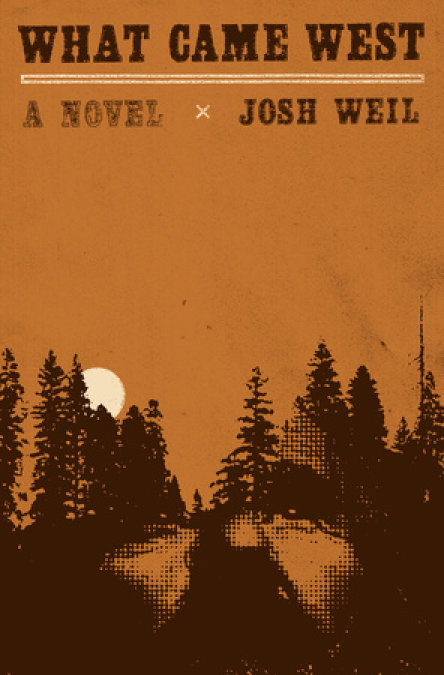
A gripping tale of murder and pursuit set against the shifting Sierra Nevada during the Gold Rush, where ambition, violence, and destiny collide.
“What Came West is astonishing. Unraveling the mythology of the Western with a genius for insight and description, Weil tells the story anew: a beautiful, ruminative, bloody, terrifying and brilliant book about a chapter in the life of one man and in the life of our country. Unmissable.” —Andrew Sean Greer, Pulitzer Prize-winning author of Less
Sierra Nevada, 1840s, just before the Gold Rush ignites. Silas Hall has never belonged anywhere except the wild. Bullied as a child and uneasy even within his own family, he finds brief solace in love and fatherhood before the pull of the frontier overwhelms him. One day he heads west, chasing a life that might finally make sense.
What follows is a swift, pulse-pounding journey into the mountains, where Silas becomes one of the first white settlers to cross into the Sierra Nevada. He forges a precarious peace with the Indigenous people who live there—until the Gold Rush crashes in with violent force. As thousands flood the region, the balance shatters, and Silas commits murder, a desperate act that alters the course of every life around him, including his own.
Taut and propulsive, What Came West is told in two parallel voices—one a tense, third-person account of Silas on the run, and the other a confessional letter from Silas to the son he left behind—and confronts many different forms of American inheritance, in all its danger, emotional voltage, and mythic momentum. Weil’s masterpiece is a fierce, heart-driven portrait of an outsider racing toward belonging and barreling headlong into consequence.
Release date:
June 2, 2026
Publisher:
Doubleday
Print pages:
512
* BingeBooks earns revenue from qualifying purchases as an Amazon Associate as well as from other retail partners.
You will want to know why. Even if you do not think so. Even if you have tried to cut loose. From me. And done it. Still one day you will want to. I know cause I have tried to cut loose too. From you. Your mother. She used to call you Shash. We used to. Yes cut loose & done it & still I am here 12 yrs later in these last hrs I will have in this place that has become my reason why for everything for all of it has become me. Your father. And still here I am now writing to you. It is temsampauto. Season of small trees freezing. Octbr 49 maybe novbr. Cold outside enough to snow. But in here warm with the fire. Fire & smoke & so they will find me. Outside I have set the traps. 20some springloaded spiked steel jaws waiting in the woods round me. For whoever comes.
The nisenan say when you die your heart stays. A few days longer. Goes round to all the spots you knew in life. Now as your ghost. To do again all of the things you did bfore you died. I have been thinking on it. Is it for the spirit? Or for the living who are left? The living do not know the ghost is there & if they did they cld not see it. The spirit knows the living are near but cannot allow itself to see them either. If it so much as looks at someone the one who it lays eyes on will die too. So it has got to redo its life all over in a kind of blindness. Of its own making. A kind of dance. Reenacting memories longside those who also lived them. But now alone. Here is what I think. I think it is for both. To give time to the living & the dead to let them make them force them to feel. I think that is why they cannot see each other. So they will look into themselves instead. And grieve. Maybe then when the heart at last goes west to rise off of the earth it can leave bhind its regret. Its sorrow. Which wld make this that I am writing now really for myself. Except if somehow I can get it to you. Then I will have got round the rules. Let you see me.
Your father. Back when I was a boy of three or four. Bent low and moving slowly through shadows of branches and leaves. My earliest memory. An afternoon in must have been 08 or 9. My mother brother sister. The four of us gathering walnuts in the grove just outside town. When from somewhere byond the trees there came a murmur. Low. Like a breeze in the canopy. But rising too suddenly building too steadily already become too loud.
I was crouched down filling my sack. Lost in the rhythm of reaching for each windfall nut each hard green shell nearly too big for my small hands. When I looked up. Around me leaf shadows stirred gently as before. Above the branches seemed undisturbed. But beside me Hinton had stood up strangely straight his half filled sack swinging from his sudden rise and beside him Adnah reaching to still it. Both my siblings turning to find our mother.
She was a few trees away. Staring behind her across the field toward the closest windbreak. The farther glints of roofs marking the start of town. The two steeples spiked white against the sky’s low edge gone strangely dark. Less like some stormcloud coming than a strip of night that had simply refused to leave. Now bent on returning.
We watched it widen. The darkness climbing off the horizon over the steeples’ tips. The quickness with which it filled the sky catching my breath. Its sound by then had swelled past anything like wind. Become something more akin to thunder. A ceaseless rolling clap that kept on coming. Loud enough to clear all else out of my ears by the time I realized it was birds. Passenger pigeons. A flock so huge it blackened the sky, blocked the sun, cast the land below into a sudden dusk sweeping fast across the field toward us.
Around me I could feel the others fleeing, my brother and sister running for the cover of the thicker canopy, my mother turning as if to follow, then seeing me and pausing. By then she had learned to keep me separate from my siblings, to place herself between me and their playing, had come to know the way that sudden shifts in my surroundings could set me off, and in the sweeping shadow of the onrushing birds her face betrayed her worry. But I was calm. Beneath the bird storm I stood completely still—my two fists gripping two walnut husks, my face turned up—the roiling blast blowing away all other movement, blotting out all other sounds, encasing me.
The beauty of those flashing feathers. Slate-blue and copper, snippets of greens, streaks of tarnished silver. The movement of the flock surging, swooping, swerving, so that the sky itself appeared to lift and dip.
I do not know how long it lasted. Only recall the overwhelming peace. The blur of birds above. The sense their passing would never end. And then the falter, a snag in the flow, and out of the flock the first one falling. Another. Some were still flapping, some plummeting, some careening wildly out of the rest, the sound even louder. Nearly enough to smother the shots.
They had come running by the scores. Townsfolk clambering over fences, leaping off carts, women with dressfronts wet from washing, men calling back at wives to bring their guns. Already nearly a hundred were following the flock, firing upwards with pistols in both hands, reloading muskets on the run, flinging nets into the air or climbing roofs to hack with scythes and rakes, the rest just grabbing whatever was at hand and hurling it into the birds.
My own siblings were throwing walnuts, flinging the rock-hard husks and stooping and throwing the heavy shells again, breaking the slate-blue wings, snapping the copper-colored necks, bringing down body after flailing body to lie whapping at the ground. Then I was throwing too. Whipping the stone-heavy nuts hard as I could at my sister and brother. They were a few years older—Hinton seven or eight, Adnah nearer ten—and on their faces there was a second of stunned shock. Quickly replaced by fear. Their frantic screams, the quaking of our mother’s voice—Sy!—shouting my name—Sy!—as she came running.
To me? To them? I have no memory. Nothing between then and when—a few breaths later, or half an hour, or half a day?—I must at last have come back to the world. A flock that vast might have taken all afternoon to pass over the trees, out of hearing and sight, to finally leave me a boy of maybe four sitting in the fallen leaves amid the bodies of fallen birds beneath a canopy turned white. Branches pale as the grass beneath. As if it all had been dusted in ash. I took in my own white legs, felt the coating on my arms, in my caked hair, smeared face, and knew that it was scat. And it was comforting. To my eyes, my mind. As if the frenzy of everything always around me had been subdued.
Until a whimpering. A movement catching my eye: a body rocking, rocking. No: three. Huddled away from me. My mother, sister, brother. She was holding them. Shushing, rocking. Only then did I realize that I was rocking too. And stopped. And, in the sudden stillness, saw my father’s cart coming across the field, the horses driven at a trot. Before it had quit clattering, he had leapt off. I remember his trousers growing gray with smears, his suit jacket streaked, hat tumbling to its ruin in the guanoed grass. I remember Hinton, stripped to his waist, covered in bruises, an eye swelled shut. Adnah’s hair stuck to her cheek, her bloodied ear. I remember not understanding why, inside my mind no hint of what had happened between my first few throws and this. An emptiness that slowly filled with the terror of knowing that whatever violence had come upon my brother, sister, mother, had come from inside of me.
Would again and again. It could be something simple as a scent: bread rising on an afternoon of baking with my mother, and my father barging in reeking of his veterinary work, lighting a pipe, smothering the small back kitchen. Or I might be waxing boots, lost in the whisk of cloth on leather, only to hear my mother’s humming break through my peace and feel it coming. Already by four or five I’d grown to recognize the flare-up at its first flicker and, seized by a terror that those around me would see it too, I’d grasp for any way to make it abate, keep it inside. Might force myself to join my mother in her humming, my brow bunching under the strain, struggling to keep the small vibrations from becoming tremors in my face. Taking the rising dough into the farthest corner, I’d lift the cloth over my head, bend my face so low inside the bowl’s buffer I’d feel the yeast’s warmth on my eyes, my desperation increasing with its heat, till, rearing up, I’d find myself hurling the bowl toward my startled father, the ceramic smashing, my mother’s humming ceasing beneath a screaming I would not even remember making.
Tantrums, my parents called them. Fits. Words that, as I turned five and six and the episodes only increased, fell away in their inadequacy. Replaced simply by it or one—he had another one; it happened again—my father pleading with the pastor for his guidance, my mother whispering to friends who brought their children over while the women worked together: Had they experienced anything similar? Seen it in another? The other woman speaking then of Susquehannock mothers she’d witnessed swaddle children as old as three, or how a high-strung daughter benefitted from hot baths, a son from bee balm tinctures, teas made from catmint leaves. None of which seemed to my mother to touch on what was wrong with me, what she might do to help her six-year-old sitting in the corner, knotting bits of discarded wool into an ever-longer strand, hidden behind the spinning wheel, its spokes like bars between him and the other kids. Beside my mother, the other woman saying something about some cousin, the way he’d flap his hands, or set to moaning, or rock when he was riled like your son. How he’d become so overrun with what was wrong inside they’d had to keep him on a rope, ready to restrain him, till at last they’d found relief in dosing him with laudanum. And all the while my mother trying to keep the conversation from my ears—muffled beneath the whirring wheel or clacks of chopping—her glances flicking to the other woman’s daughter or son drawing ever closer to me. Long as she could, my mother would resist intervening, give me a chance to change, before, seeing me break, she would rush over. Sometimes, distracted by her visitor, she arrived too late. Sometimes the other mother got to me first. Though by the time that I was five most of her friends had learned to leave their children home when visiting. By the time that I turned six most found it best simply to stay away.
And who could blame her then if there were times she came undone herself? If her shouts would overpower mine, her prayers to God for help give way to curses against the devil in me. If, slamming out of the house, she’d simply flee me the way that I fled everyone else. If, one day, as another mother carried her own child—hand bitten hard enough my teeth had hit the bone—out of our home, my own had hauled me before our parlor mirror, held me in place. Despite what she knew it would do to me to clamp my bucking back against her chest, trap my flailing arms inside her clasp, restrain my struggling body with her own. I can still feel her bruising grip as she snapped Silas! Look at yourself! Words she would repeat till they would be subsumed by her own sobs.
My father by then had come to accept that he would never hold me, never wrestle me the way he did my brother or seat me before him in the saddle the way he’d taught my sister to ride. At first, he tried to fix me. In his work he’d seen animals altered by things they ate—poisons that traumatized the mind, sullied the spirit—knew cattle to get soft-brained from hollow horn, had himself sawed off the tips to pour in vinegar and salt, and he would pry his instruments into my ears, put me on his examination table, probe my belly, underarms, spine. But as the years passed, he set all that aside. Instead, simply observed me, the same sharp eye and alert senses that had brought him renown as an animal doctor now brought to bear on his son.
The way my rocking would increase with each new person entering a room, abate as they withdrew. Seeing the way I’d stiffen at a still-distant sound—my sister chatting to a friend as they ascended porch steps, my brother playing with other boys out in a field—he’d set down his work, observe me tightening my body against the coming burst, till, breaking, I’d slam out the kitchen door. And, crossing to the window, he’d watch me run for the woods, my limbs loosening with each step taking me farther from them. My family. Though with anyone else it was worse. The mere clatter of an approaching cart enough to send me fleeing, a visit from my grandparents consigning me to a far room. From which I would refuse to emerge till they had left.
And if my grandmother were to speak to me through the shut door, my father would know, soon as the thudding started, that I was trying to knock her voice out of my head, would whisper to her to leave it be. Though sometimes, in the rare moments of peace that could descend upon us—me crouched beside a rivulet of ants, handing them torn flower petals; or, standing motionless, my arms outstretched, as butterflies alighted on my body—he would forget himself, let his hand rest on my head, feel me shrink away.
But I could sit for half an hour picking ticks out of our collie’s coat, fingers roaming so gently they would send her to sleep. Might stay atop a horse all day, give it the reins, lie resting on its withers as it grazed, its shifting drift beneath my chest working on me much the same way. I could even set my hand down in the path of the ant colony, let them climb up my arm, trickle across my skin, the feeling unhinging nothing in me but the smile spreading over my face. Till, feeling my father’s stare, I might turn in time to see him look away.
Sometimes, watching him fight the urge to meet my eyes, it seemed he must have been looking less at me than into me, through to whatever inside me kept me away from my own kind. But then he would give in, glance back, and I would see in his eyes the weight of his failure to find it. The barrier in me that I could not escape, found simply by looking back into his face. Or at my mother’s. Or anytime I tried to feel in me what I saw on my sister’s, brother’s.
Oh, I could catch the glow in Adnah’s face as she returned from riding with my father, the pleasure in his as he helped her off her horse. Could know it was borne of their experience together. Could hear my brother’s laughter as he rounded the house chasing a friend, recognize the peace inside my mother came from the happiness she saw in him. Could even feel it in myself, for them. In them, for me.
But in between us always, the barrier of me combined with anybody. In the schoolhouse, there were a score of children packed in the single room. At seven, I was among the youngest. Not that age mattered: the press of their small bodies hit me the same. I could feel it even before I entered, a density to the air in there that pushed out through the walls, so that, as I drew near, the morning’s crispness would recede, the cheery call of a towhee disappear, my own slowing footsteps smothered by the voices coming from inside. Even the dawn’s last chill burned away in their leaked heat.
There was their scent—the unwashed staleness of kids my age, the riper stench of older boys, the stink of slops and excrement from morning chores—and their noise: banter, laughter, boot-thumps. The way their breath got in my lungs. But none of it would have undone me if it hadn’t been evidence of them. Their presence. I could feel it. Clear as if they’d somehow crammed the mass of all their bodies into my skull, crowding my mind, the pressure of it all too fast become too much for me to bear.
A thing that, before the schoolmaster was even aware of a new pupil in the room, drew the attention of the rest. So, by the time he turned from marking his slate, they’d already begun to mimic me. Some jerking with exaggerated rocking, others clamping hands over their ears, grimaces turning to grins, laughter catching the entire room.
We hope you are enjoying the book so far. To continue reading...

 Please log in to recommend or discuss...
