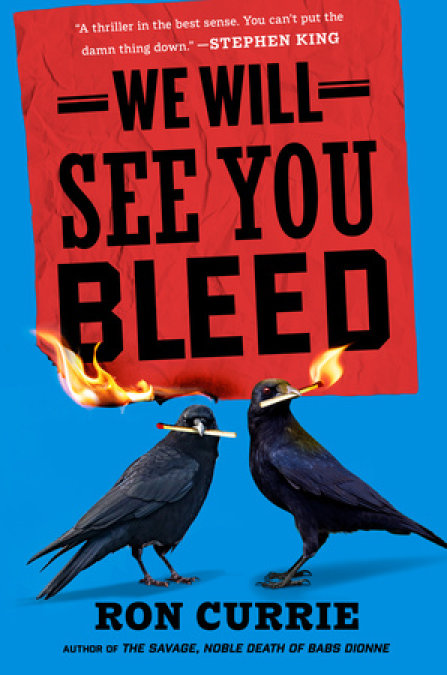
"We Will See You Bleed is a thriller in the best sense. You can’t put the damn thing down, and the story of these down-and-outs fighting the powers that be will stay with you a long time. Solid-gold guarantee." —Stephen King
It's late summer 1984, and Babs Dionne’s hometown of Waterville, Maine is on the verge of collapse. A strike at the paper mill has dragged on for a year, pitting neighbor against neighbor, leaving everyone broke and exhausted.
As head of the union local, Babs has presided over Little Canada’s decline. She's sworn off violence since killing a man when she was a teenager, and has stuck to this vow even as it's become clear that only violence can save their community. When Babs’ best friend Rita returns home after five years away, she is shocked by the state of things. And as the strike comes to a head, Rita notices something else: the men may be broken, but the women are furious, ready to do whatever necessary to take back Little Canada.
They just need Babs to be the fearless woman who emerged from the woods fifteen years ago, drenched in blood. They need Babs to face what she already knows: that the only way to fix things is to assume control. Completely. Mercilessly.
Poignant, unflinching, and brimming with sharp humor, We Will See You Bleed is a triumphant second installment in this electrifying crime thriller series by award-winning author Ron Currie.
Release date:
July 7, 2026
Publisher:
G.P. Putnam's Sons
Print pages:
368
* BingeBooks earns revenue from qualifying purchases as an Amazon Associate as well as from other retail partners.
CAUTION: This email originated from outside of Penguin Random House. Please be extra cautious when opening file attachments or clicking on links.
CHAPTER ONE
When the guy with the chain saw walked in, Babs's husband, Rheal Dionne, was seated alone at the Chez Paree Bar and Nightclub, three whiskeys deep and lost in a stir of thoughts. It was slow for a Thursday, or at least would have been considered slow for a Thursday before the strike; now it made sense that Rheal was the only person at the bar, given that it was two in the afternoon and most people in the neighborhood couldn't afford to eat, let alone drink. The jukebox was silent for want of a few quarters and the only other people in the place, besides Jeannie the bartender, were a couple in a booth against the far wall, whose conversation Rheal could make out over the hum of beer coolers behind the bar. So when he heard the squeak and clang of the door opening Rheal half turned toward the sound, on reflex, and spotted the guy with the Stihl as he crossed the threshold, headed straight toward him.
This was new. Rheal'd been shot at, stabbed, beaten with a baseball bat on two occasions. He'd been punched and kicked more times than he could count. He'd had his nose broken twice, lost five teeth, and once got his forearm snapped in two when Denny Albert took a swing at him with a pressure-treated two-by-four after hearing an erroneous report that Rheal had fucked his wife, Carrie. Rheal even had three pieces of steel shrapnel in his neck from a mortar round that'd had at least half his name on it fifteen years earlier. But on all the occasions somebody had tried to kill, maim, or simply beat the ever-loving shit out of Rheal, no one had ever come after him with a chain saw.
The novelty of it brightened his mood a bit. He rotated on his stool and watched, smiling and still holding his whiskey glass, as the man closed the distance between them and came to a stop five feet away.
"You Rheal Dionne?" the man asked.
"I am," Rheal said.
The man nodded and made a show of yanking the saw's starter cord several times-to no avail. He paused, looked down, fumbled with the choke, then started pulling again, glancing up at Rheal and appearing more than a little embarrassed.
"Take your time," Rheal said, lifting the whiskey to his lips. Over his shoulder, he could hear Jeannie on the phone out back, calling the police.
More adjustments to the choke, more yanking on the cord. The man was breathing hard now. Rheal imagined the skin on his fingers was starting to sting and blister.
"A friendly word of advice," Rheal said. "If you're going to attack someone with a chain saw, you may want to get it tuned up beforehand."
"Just-hold on a second," the man said. "It works fine."
"You gas it up?"
"Yes, I gassed it up. You think I'm an idiot?"
Rheal shrugged and finished his drink while the man continued to pull and curse. Finally the saw sputtered to life, hacking out a cloud of two-stroke smoke that billowed upward and spread across the ceiling like a black liquid. The motor was running, but barely; it chugged and hiccupped, threatening to stall.
"Hit the choke!" Rheal yelled over the racket. "You're going to flood it!"
"I know how to run a goddamn chain saw!" the man hollered, fumbling for the choke as the engine paused mid-chug, seemed for a second to quit, then turned over again and continued to cling to life. Behind the man, the couple in the booth got up and ran out; Rheal waved cheerfully to them as they went.
The man finally got his fat fingers around the choke knob and opened it up, and the saw's motor smoothed out and idled at a growl. The man took the saw by the handles and goosed the trigger a few times, trying to approximate a menacing glare. He said something to Rheal, unintelligible over the grind of the saw.
"I can't hear you!" Rheal said, cupping a hand behind one ear.
The man let the motor come back to idle and yelled, "What happened to the lady behind the bar?"
Rheal looked over his shoulder toward the door to the kitchen. "She probably ran outside, don't you think?"
"Well, go get her back in here," the man said.
Rheal gazed at the man for a moment, then shook his head. He reached back and pulled the bottle of Jameson from the rack and poured himself another drink. "Let's just walk through this, step by step," he said. "I assume you're here to cut me up, right?"
"That's right," the man said.
"That being the case . . . if you let me go outside, what makes you think I'm foolish enough to come back just so you can take that saw to me?"
The man didn't have a ready answer for this. He stood there mute, the chain saw still rattling in his hands.
"Let's try another line of inquiry," Rheal said, placing the bottle back in the rack. "Why is it so important that Jeannie be behind the bar to see you chop me up?"
"Because I've got a message someone needs to hear."
"Why not just tell it to me?"
"Because you're going to be dead."
"Oh, right," Rheal said. He took a long drink of whiskey and made a show of pondering, rubbing at the stubble on his chin. "Well, it's just the two of us in here, and you can't send me out to grab Jeannie, because no way I'm coming back," he said. "Seems like you've got yourself one heck of a dilemma."
"Shit," the man said. "I told them I should just use a gun. But no, they said, it's gotta be a chain saw, has to be scary and bloody and all that."
"Way I see it," Rheal said, "there are two possible solutions, and neither of them is perfect. One-and this is probably the better of the options-you could just write the message down. You know, for someone to find after I'm dead."
The man looked doubtful about this, and Rheal realized he must be illiterate.
"Or two," Rheal said, "and you're really not going to like this one-you could wait for the cops to show up, which I'm guessing they will within two minutes at this point, and give them the message."
"The cops?" the man said. "Who called the cops?"
"Jeannie," Rheal said, hooking a thumb over his shoulder. He finished his whiskey. "Tick-tock, friend. What's it gonna be?"
The man dropped the saw and turned to run the way he'd come in, but Rheal was quicker, he was always quicker, he was in fact a grand master when it came to life and the violence it visits upon us, having learned everything he needed to know and then some from his own father, and he leaped up and grabbed two fistfuls of the man's hair, hauled back hard enough to lift him clean off his feet, and slammed the back of his head into the bar.
The man went slack but Rheal held him upright, depositing him on a stool and leaning over to turn off the saw. He straightened up again and slapped the man's face a few times, lightly, to bring him around.
"What's the message?" Rheal asked.
"Huh?"
"Listen, you seem like a hapless shit caught up in something you don't understand," Rheal said. "I want to get you out of here before the cops show, but first I need to know who sent you."
The man finally focused his gaze on Rheal's face. "Harold Aucoin," he said.
"That was my first guess. And what message, pray tell, did Harold want you to give us?"
The man put a hand to the back of his head; it came away slick with blood. "That this town is his now, by order of both God and Clay Sutton."
"I see." Rheal brushed off the man's shoulders, clapped him on the arms. "Okay. You good? Can you walk out of here?"
"I think so."
"You give old Harold a message for me," Rheal said. "Tell him we've got enough problems without him trying to poison our neighborhood with drugs. And if he keeps sending people our way, we're going to start sending them back to Lewiston in body bags, regardless of what God or Clay Sutton has to say about it. Got all that?"
"No."
Rheal hauled the man to his feet. "Doesn't matter," he said. "Tell Harold I said to get fucked. Now scoot."
The man wobbled out the door, and Rheal turned to the bar and poured himself another couple fingers of Jameson. Two minutes later, Jeannie came back in with Captain Daryl Bates in tow.
"Did you kill him?" Bates asked.
"Kill who?" Rheal asked without turning around.
"The guy that saw belongs to."
"No idea what you're talking about, Daryl. I was cutting some dead branches off an elm in my backyard when I got thirsty."
"Uh-huh." Bates looked to Jeannie, who'd resumed her spot behind the bar. "That how you remember it?" he asked.
Jeannie shrugged. "If that's what Rheal says."
Bates slid between two stools and leaned against the bar top, facing Rheal. "I want to help you," he said, "but I can't if you won't talk to me."
"If and when I need help from a no-good Anglo cop," Rheal said, "you'll be the first call I make, Daryl."
Even a quick glance at the classics demonstrates that, throughout human history, going home after a long absence has always been at best a mixed bag. Odysseus came back from twenty years at war to find a bunch of guys trying to bed his wife; the Prodigal Son’s return, celebrated by his father, was received with considerably less joy by his older, more responsible brother. The very word home, for most of us, is freighted with ambivalence, and certainly that was the case for Rita Doyon as she came down the steps of a Greyhound bus and emerged into Little Canada, the place that had birthed and weaned her, for the first time in five years.
Rita had gotten word about hard times at home during the paper mill strike-that was, in fact, part of the reason she'd returned. But the squalor and decay she encountered as she walked south on Water Street and shifted her suitcase from hand to hand far outstripped what she had imagined. It looked like some kind of natural disaster had hit the place and no one could be bothered to clean up. Stores that had thrived her entire childhood were closed, display windows covered with plywood and For Lease signs pleading from their front entrances. Trash cluttered the sidewalks and gutters, drooped from power lines and tree branches. Most ominously: every third house had a sign in the front yard offering it for sale at a price one would expect to pay at a tax auction. It was more important to people, evidently, that they flee Little Canada as soon as possible than get anything resembling a fair price for their homes. And it seemed it was a struggle even to give them away.
As Rita walked and the scope of the damage wrought by the strike sank in block by block, she was surprised to find herself weeping. But there was little time for such things, because here now was a home stolidly not for sale, a home that, unlike the ones around it, had been kept up with great care and precision. This was the home that Rita's best friend, Babs, lived in, the home Rita herself had grown up in after Babs's parents had rescued her from her drunken, sadistic father. And inside that home, now, awaited a reckoning.
She climbed the front steps, set her suitcase on the porch landing with a thump, and wiped the tears from her cheeks. Not for the first time since getting on the bus at Forty-Second Street in Manhattan, she wondered if this had been a mistake. Things were far worse than she'd realized, and not only did there seem to be nothing Rita could do to help-whatever she'd imagined she could do was lost to the destitution on display-but now she had to face the prospect of Babs's ire at her having left in the first place. The two of them hadn't spoken since that day in 1979 when Rita had followed her ambitions south, and if she meant to be a part of this community again, she would first have to settle accounts with her best friend and adoptive sister.
Lacking the energy to walk all the way back to the bus stop, not to mention the money to pay the return fare to New York, Rita took a breath, fixed her posture, and knocked.
A few seconds later the door opened and there stood Babs, indelibly herself. The only difference five years had made being the length and cut of her hair-it was below her shoulders now, and aggressively feathered. Before she had a chance to catch herself, Babs's eyes went wide at the sight of her best friend, and in an instant Rita found herself enveloped in an embrace that lasted long enough for her to consider that this was not at all the reception she'd anticipated.
"Come on," she said finally. "It's not like I've risen from the dead."
Babs pulled back and looked her up and down. "No," she said, "and I can't tell you how glad I am that you're not dead. Because it means I can kill you."
That was more like it, Rita thought.
"Should I translate that as 'Great to see you, come on in'?"
"Has it been so long," Babs asked, "that you've forgotten my words never require translation?"
"An elephant's faithful one hundred percent," Rita said. She lifted her suitcase again. "I assume there's coffee on?"
Several minutes later the two sat together at Babs's kitchen table, cigarettes sending up smoke signals and mugs of black coffee steaming. Famished after more than a dozen hours on the bus, Rita worked over her second slice of Babs's tarte au sucre, alternating bites with drags on her cigarette.
"I saw you were in some plays," Babs said.
"Off-off-off-Broadway," Rita said. "Don't be too impressed. How'd you hear about that way up here?"
"You're my sister," Babs said. "I kept tabs. So why are you back?"
"Blunt as always."
"You chose to leave. Those of us who've been here all along have a right to ask why you returned."
Rita looked at Babs for a moment. "I knew there was trouble. I wanted to help."
Babs squinted. "How, exactly?"
"Not sure," Rita said. "I thought I had some idea, but it blew away on the ride up."
We hope you are enjoying the book so far. To continue reading...

 Please log in to recommend or discuss...
