
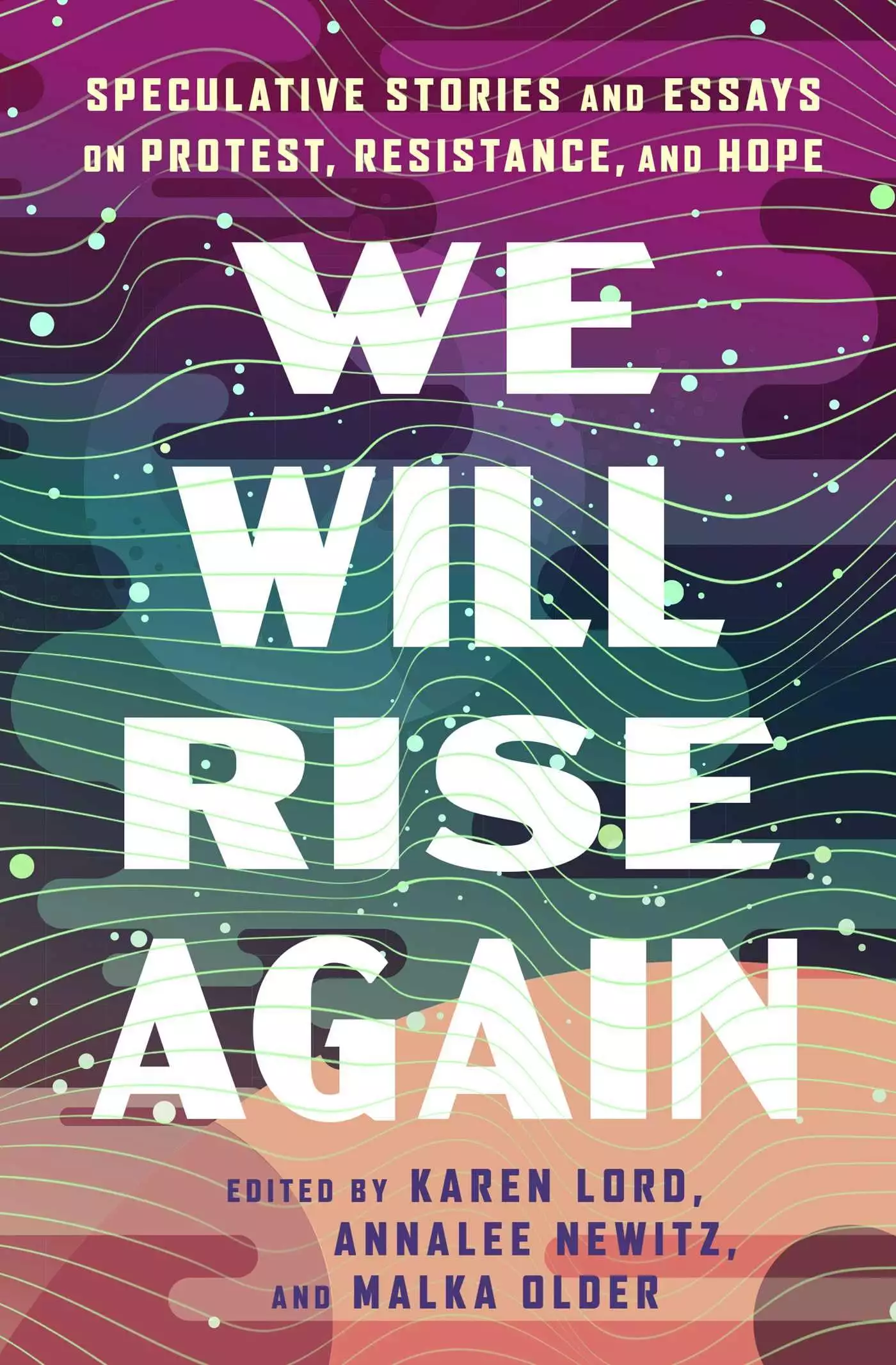
We Will Rise Again
- eBook
- Paperback
- Audiobook
- Book info
- Sample
- Media
- Author updates
- Lists
Synopsis
From genre luminaries, esteemed organizers, and exciting new voices in fiction, an anthology of stories, essays, and interviews that offer transformative visions of the future, fantastical alternate worlds, and inspiration for the social justice movements of tomorrow.
In this collection, editors Karen Lord, Annalee Newitz, and Malka Older champion realistic, progressive social change using the speculative stories of writers across the world. Exploring topics ranging from disability justice and environmental activism to community care and collective worldbuilding, these imaginative pieces from writers such as NK Jemisin, Charlie Jane Anders, Alejandro Heredia, Sam J. Miller, Nisi Shawl, and Sabrina Vourvoulias center solidarity, empathy, hope, joy, and creativity.
Each story is grounded within a broader sociopolitical framework using essays and interviews from movement leaders, including adrienne maree brown and Walidah Imarisha, charting the future history of protest, revolutions, and resistance with the same zeal for accuracy that speculative writers normally bring to science and technology. Using the vehicle of ambitious storytelling, We Will Rise Again offers effective tools for organizing, an unflinching interrogation of the status quo, and a blueprint for prefiguring a different world.
Release date: December 2, 2025
Publisher: S&S/Saga Press
Print pages: 448
* BingeBooks earns revenue from qualifying purchases as an Amazon Associate as well as from other retail partners.
Reader buzz
 Please log in to recommend or discuss...
Author updates
We Will Rise Again
Annalee Newitz
Other Wars ElsewhereR. B. LEMBERG
All the long hours Katinka spent on the bus from war-plagued Mavka back to Zlatow, legs tight to her chest and clutching her almost-empty backpack, she kept thinking about her home city. In her mind’s eye, it was gray-golden and warm, its cobblestoned streets reverberating with the weight of trolleybuses and people. Pigeons lived their lives on windowsills and under awnings, windows opened each morning to reveal the faces of children curious about the state of the pigeons, and the ever-cloudy early-autumn sky was undisturbed by aerial bombardment. In the evenings the great gas lanterns would be lit, lending the streets a festive air. Horse-chestnut trees towered by the old buildings, concealing the detritus of the day in gilt-edged shadows. For eight long hours, Katinka inhaled the thick air of the bus, and instead of the fear and sweat, she imagined the smell of Tanya’s primrose perfume at the Center, and hid a smile behind her hands. But once the bus crossed the border to Zlatow and rolled into the city proper, anxiety clotted like a furball in her gut. Something felt different here. Perhaps it was nerves, forgetting the city after weeks away on the medical run, or simply needing to eat.
She should have gone home. Home was Grandma’s apartment, just hers now these eight months after her passing. She did not want to be alone, and the big bus station was close enough to the Center. It was evening, and the city’s air was soft with the end of the workday, the promise of rest and company. With any luck, Tanya would be at the Center, and Mor, and the others, and she could report while she ate.
Turning onto Odesna Street toward the Center, Katinka rushed forward, then stopped under the big old sign—CALL TO ACTION. The soles of her shoes clicked to a halt. The spring-blue banner of Mavka was gone from the flag post by the door. Instead, two other flags hung from the pole, twisted around each other so tightly she could not separate out their colors. White and orange, and maybe a purple-silver. She blinked, wiping wetness from her cheek, then licking it off her hand. The wrongness, like salt, had crystallized in her mind. Three months ago, when she’d left Zlatow to go on the medical run, many businesses had displayed the symbols of Mavka in solidarity with the neighboring country under attack. Coffee shops and trolleybus stops had hung Mavkan banners, and little grandmotherly windows had sported a whorl of spring blue in between the lace of the curtains. What she noticed now was simply an absence.
Gulping down her incomprehension, Katinka unhooked the skeleton key from the leather cord around her neck and unlocked the old gray door. Behind it, the long vestibule was empty, but she heard the warmth of familiar voices from the floor above, and for a moment, she could breathe again.
Her friends were in the common room at the top of the stairs. A dozen or so people perched on old sofas, or sprawled on beanbag chairs and shaggy-looking orange pillows. On the floor underneath them, the faded forest-green rug with two miracle stags looked the same—stained and beautiful—reminding Katinka that this was home. The other activists were talking, always talking, quick and urgent and loud. Golob was pacing, his elbows jutting out like a stick figure’s, his curly hair flying every which way. Mor had their hands up in the air, their broad face intense with an aliveness that Katinka experienced as an expansion of brightness in her chest.
was tall and gorgeous in a long maroon day dress, healthy again by the looks of her. Relief and longing flooded Katinka’s mouth, and she could not find what to say. There was no need, because Tanya crossed the room in two easy strides and hugged Katinka to her chest.
“You’re here. Shhh. It’s all right.”
“I saw—I saw—”
She inhaled Tanya’s perfume, floral and homey with an undercurrent of pepper. I saw children get sick with daniga fever, and the ones that got our meds got better, but I did not have enough for everyone. In the hospital I befriended a very old woman, Riva—she had survived the old war, like my grandma had—and she told me—Riva said it was worse now in Mavka. Worse than the old war. She had seen her neighbor sitting dead and headless on a park bench for weeks after the Raigan Army bombed it. And I saw the magical birds, Tanya, the spring birds from our old picture books—they are real, the birds that drink from the holy wellspring and learn to speak in a human tongue. The birds were powder blue and small, and they sang to the wounded. Every night I wished you had come with me, and every night I was glad you got sick. Will you come back with me please, please, my heart will break if I need to do this alone again. Katinka pushed away from the haven of Tanya’s embrace.
“We need to go back with more medication,” she managed. “I’ll get a bit of sleep and I’ll be ready to leave again, maybe seven, eight hours.” She needed more—a week off, two weeks, glorious years on the seacoast with nothing to do, but that wasn’t on the agenda. Maybe she’d get a few extra days if the warehouse could not rush their order. “How much money did you manage to raise?”
Someone coughed, and Tanya stepped away from Katinka, looking apologetic. “Have you eaten? Of course not. I’ll fix you something.”
Mor pointed at the seat that Tanya had vacated, and Katinka sank down into the lumpy softness of the old mustard-colored sofa, still warm with Tanya’s presence. The others were looking at Katinka as if she were a small forest animal, easily spooked and pitiable, to be either trapped or shooed away. Then they began to speak, several people at once.
“Didn’t you hear, when you were over in Mavka? Two new wars—the Bariga government imprisoned three thousand student protesters… and then, a new disturbance in Khalem…”
Katinka shook her head. “I heard, a bit.” There was no way to get real news in Mavka. Raigan forces blocked most communications, both mundane and magical, and what resources remained were in use by the defenders’ army and the medics. “I was focused on my work at the hospital.”
“About that,” Mor said slowly, “I’m sorry to say, but we had to reallocate the resources.”
“What do you mean?” She was struggling to breathe. There had to be some mistake.
Mor adjusted the sleeves of their brown corduroy shirt. Their voice was apologetic but firm. “We raised money for the new causes.”
“But Mavka…” Katinka said. “The hospital—the children—”
Tanya returned to the common room and placed a white, chipped plate on Katinka’s knees. There was a sandwich on it, two pieces of rye bread with egg salad and a bit of greens. She would have welcomed this food just moments ago, but now the smell of the eggs made her stomach churn.
Tanya sat on the floor by the sofa, looking up at Katinka with something like tenderness.
Mor said, reasonably, “There are other wars now, new wars, and children need help there too—this is our work.”
Golob pushed some stray curls away from his face. “It is not a nice thing to say, maybe, but Mavka had its turn. It’s been, what, a year? We hoped it would be over by now, either way. Instead, the conflict has settled. It’s going to last and last no matter what we do.”
Katinka looked down at her plate. Words came, at least. “The conflict in Mavka has not settled. It’s not a conflict, it’s a war. Raiga attacked Mavka, remember? It’s still attacking. Raiga is very big and has a lot of resources, but Mavkans are
fighting, resisting.” It sounded, even to her, like a string of platitudes someone would write for pay. She did not know how to sound more convincing.
Mor said, “We have a chance to make a quick, decisive influence in Bariga. We needed to regroup. I’m sorry, Katinka. I really am.”
Under her friends’ gaze she felt like a child, and perhaps she still was in some ways—they were all at least a few years older than her, more experienced. She was usually happy to follow along, to do what needed to be done. But she could not regroup.
“I promised I would return quickly, with friends and more medical supplies,” Katinka said.
“You’ve been making all these runs,” Mor said. “We appreciate you.”
“But we voted,” said Golob.
Katinka swallowed, once again trying to figure out what to say. They had voted without her, when she was in Mavka. She wished she did not constantly feel on the verge of tears, or even crying—actually crying—big, salty blobs falling onto Tanya’s egg sandwich. Katinka gave the plate back, wondering if she was going to vomit, and how quickly she could manage to get up.
“Your vote would not have changed anything anyway,” Tanya said quietly, fingering the edge of the bread. “Everybody was in favor of reallocating. People only have so much to give. Mavka is a neighbor, which is why we managed to raise funds for so long, but it’s really not fair now that there is so much need elsewhere.”
Katinka wished she could get up and leave, but she did not have strength left. Her knees made a noise as they pressed against each other, two skinny sticks reminding her of a powder-blue bird rapping, rapping against the dirty glass of a hospital window, trying to get in as Katinka fed a spoonful of medicine to an unconscious, feverish child. Her friends kept talking, but she did not understand a thing. In a while—she wasn’t sure how much time passed—she managed to stumble to her feet.
“I need to get some sleep. Sorry, sorry…”
earlier, helping her down the stairs. She asked questions, but Katinka said she’d be fine. No, really, no need to come with. Reallocate your efforts, Tanya. The cloying smell of egg sandwich still clung to Tanya’s skin, overwhelming the primrose perfume—nauseating, alien. Katinka did not remember what she said to Tanya in the end, but now she was alone.
She wandered the eerily-lit streets of nighttime Zlatow, too weak and heartsick to figure out how to get home. Before Grandma died, she rarely cried, but now the tears came easily, as if the magical wellspring inside her kept overflowing, beyond all hope and pain.
Katinka crouched down on the cobblestone pavement. There was a large horse chestnut tree here, surrounded by a circle of wrought-iron grate. Separated from people by the delicate guard of dark iron, the tree was—imprisoned, protected?—in its own ring of earth. Katinka could not see it clearly without a source of light, but she felt the tree sigh in darkness, almost like a companion. Trees were rooted—even in those ancient, stone-hewn cities, the roots of the street maples and horse chestnuts reached underneath the pavement, tapped into the groundwaters, sank into the catacombs sealed empty since the old war. Trees could grow tall, but their roots were vaster, reaching below until they touched other roots, other trees, other times—until the whole of the land was roots, and there was no more earth.
Someone shook her shoulder, and she gasped. Was it an air-raid alarm? Soft light streamed down from a lantern held in a delicate hand, and a kind, round, wrinkled face bent over Katinka. Red embroidered ribbons hung from the old woman’s collar, brushing Katinka’s neck. This was no air alarm. She’d been half lying on a pavement, back wedged uncomfortably against the wrought-iron guard of the tree.
“You must be very tired.” The old woman’s voice above her was light as a spring bird’s. She spoke in Mavkan. The language startled Katinka, sinking her back into confusion. Perhaps she’d simply dreamt her return to the city, in and out of Tanya’s arms like a sigh.
“Where am I?” she asked. Katinka’s Mavkan was halting and unsure, but she could manage as much. Her head spun.
“This is the living city of Zlatow. I can help you.”
Katinka switched to the language of the city, which was her own. “I’m sorry. I am not a refugee. I don’t need—”
I don’t need help. I should be out there, helping.
The old woman contemplated her, and Katinka stared in return. The red ribbons were sewn not just into her collar but her sleeves, the trim of her vest, and all over her skirt. She wore her wispy, curly white hair up, pinned with what seemed to be a twig budding with leaves, fuzzy and out of place in an early autumn night.
The old woman spoke. “Get on, child. Up, up you go. Come have some tea with me.” She waved up at a building across the street, pointing at a window two stories above. Warm light streamed behind an old-fashioned starched lace curtain, but Katinka could not discern any blue whorls or any other political signs.
Everything about this was odd, but Katinka got up and linked arms with the old woman. It had been months since Grandma died, but the reassurance of the whisper-soft touch almost made her break down again. The old woman patted her hand. Her voice burbled like a brook. “I’m Baba Marta. In the spring you won’t see me—it’s good that we meet now. It’s hard sometimes to notice people out of my old eyes, but I spotted you right away, snoozing with your roots everywhere like a sapling in the wind.”
Katinka tried to figure out what that meant as Baba Marta led her across the street, toward the unlocked, narrow door of the apartment building. The lantern in her left hand shone, illuminating the robin’s-egg blue of the door, startling against Baba Marta’s red ribbons. Blue wasn’t a common paint color in Zlatow, where doors were customarily glossy black or gray. They passed through the narrow vestibule with its old black-and-white floor tiles and familiar smell of mice droppings, and slowly up the wooden
stairs to a landing with a single door. It was narrow but tall, and glossy black, with a brass knocker shaped like the face of an owl. Baba Marta knocked twice and immediately pushed through, pulling Katinka behind her into the apartment. The front door opened into a dim, long corridor. It was covered on both sides with built-in shelves studded with jeweled glass jars of preserves, whole apricots suspended in syrup, three different kinds of peppers, and yet more treasures—a veritable museum of grandmotherly things to walk through, but it lasted only a moment. The dark corridor opened into a brightly lit kitchen.
This, too, was small, with almost no room to maneuver; a table was wedged between the door and the stove, with four stools tightly hugging it. One was occupied by a pale, middle-aged woman with a drawn face. She was wrapped in a fuzzy gray shawl, and she was knitting, knitting, knitting, knitting the shawl itself, which sprawled off her shoulders and covered half the table. The woman’s deep-blue eyes stared at the small, curtained window. The other person was a giant. There was no other word for them. They were tall and wide and androgynous-looking, and they perched uncomfortably on a tallish stool; they wore a big sweater. The sweater was gray and unraveling little by little each time the knitting woman tugged at a thread.
When Katinka entered with Baba Marta, the giant person twisted their body toward the stove, plucked a robin’s-egg-blue teakettle from the fire, and poured a long stream of boiling water into a pair of teacups already on the table. They pushed a teacup toward Katinka. She all but collapsed onto a stool, wrapping her shaky hands around the miraculous cup, which somehow contained not water but lavender black tea, fragrant and generously sweetened with honey.
“What’s your trouble?” asked the giant, in a voice that rumbled and at the same time warmed.
“I…” Katinka could not find the words. “I…” She accidentally banged her teeth against the rim of the teacup and frowned.
were mistaken.” The old woman, too, pulled a cup of tea toward herself, adding yet more honey to it from a fish-shaped clay pot.
Clack-clack-clack, went the knitting needles of the pale woman in the shawl, who had not said anything yet.
Katinka sipped her tea, blinking at these people who looked like they’d just stepped out of a story she could have read as a child.
“Are you—are you a giant?” she asked in a small voice.
“Name’s Boro. ‘Giant’ is a slur where I’m from. Heard plenty of that growing up, so I’d thank you not to use it.”
“I’m sorry—”
The knitting woman tugged, and more gray thread unraveled from Boro’s sweater. She kept knitting, and the sweater’s gray thread was knit into the shawl, and—Katinka blinked, yes—instead of nothing, the absence of gray in Boro’s sweater was replaced by blue. She did not follow how exactly this happened, but the sweater’s left sleeve was almost entirely blue already, and a bit at the throat.
Boro frowned at her. “And you are?”
“I am Katinka.” She felt small, and young, unsure of her footing and whether or not she was truly awake.
“So?” Boro asked. “What’s your trouble?”
Katinka looked away, and into her teacup, where a piece of lemon wobbled on the surface.
“I have a group of friends that I’ve been working with since I was eighteen, over at the Call to Action Center. We’re activists, and…” Her voice broke. “When we heard that Raigans attacked Mavka, we mobilized. We hung flags and painted posters. We raised money, lots of money, five hundred gold—and when we heard that the Raigans released daniga poison into the Mavkans’ water supply, we used the money to buy medicine. Tanya and I were supposed to take it to Mavka together, but Tanya got sick. She was supposed to drive, but I managed to find a ride with some other volunteers. I stayed there for three months, in the end, to help at the hospital.”
Baba Marta took Katinka’s hand in hers and squeezed it. The old woman’s skin was warm and soft, and in some places rough like tree bark. Katinka swallowed down a lump of tears, and gulped some more tea. The lemon had overpowered all other flavors, bitter and sharp and alive. “I came back on a refugee bus, just this morning. We needed more medicine—” She hesitated, not wanting to complain about her friends, but she had to say this. “When I came back, I was told that Mavka was taking too much time, we had new causes now.”
“But you did not want new causes,” said Baba Marta.
It’s not that she did not want them, it felt so selfish not to want them. The powder-blue songbirds came from the wellspring itself, the holy source of all water in Mavka, hidden somewhere in a forest. The birds were magic. They knew the language of people and they sang until their little hearts gave out, but they could not do much. All they could do was to cheer up the people of Mavka, give them a bit of hope as they fought on and on, as enemies kept arriving. Daniga fever mostly affected children, and no bird alone could take away that pain. They needed medicine. And the new places, too, needed medicine, the whole world was going sour like a big pot of milk that nobody drank from but everybody cursed at, and Katinka had to care about all those other places too. She knew, she understood, but she’d promised to come back to Mavka, to the people she’d gotten to know: to Riva, who had survived the old war, to the sick children, to the songbirds.
Katinka stared at her fingers clutching the teacup. Said nothing.
Boro’s mouth twitched. “See, Katinka, we’re here for trouble of a particular kind. If someone’s in trouble of a particular kind, we take notice, and we do things. Is that what you’d call activism, I wonder.”
contact. “Your sweater’s barely blue and you’re already itching to go. Let me finish the work.”
“Kids these days,” said Baba Marta.
“I’m forty-three,” Boro countered, scratching their head.
“Ha-ha-ha-ha,” laughed Baba Marta, as if it were some great entertainment.
Katinka swallowed and spoke, with a bitterness that startled her, “Golob said—they all thought, I guess, that the Mavkans would lose heroically. And quickly. But they are holding on. Not winning, exactly, but not losing. The war has gone on and on, and I’m told it’s been too long.” Not very fashionable anymore. Old news. “So they raised money for other causes. There are other wars elsewhere.”
“In Mavka, you saw the blue spring birds, and now the land is calling you back,” Baba Marta said. It wasn’t a question. “There is a lot of magic in that land.”
The knitting woman spoke, staring straight ahead. “Just because the land is alive and helping does not mean that we are invincible. On the contrary.”
“I don’t see a problem beyond the money,” Boro said. “And that is easily solved. I give you money, you buy medicine, you go back to Mavka and help. End of story.” They thrust a hand somewhere underneath the table and pulled out a largish leather purse, then dropped it in front of Katinka. “Five hundred. All right? Now you have fundraised from me for your medicine. No more problem. Resolved.”
“The problem is heartache,” said Baba Marta, clanging a spoon against her emptied teacup.
“Nu, I hurt everywhere,” said Boro.
“I came all this way, you let me work,” grumbled the knitter.
When Katinka woke up, dawn was peeking through the canopy of the horse chestnut tree, coloring the edges of its splayed, hand-shaped leaves in a soft glow. Her whole body was stiff, half lying on cold cobblestones against the hard iron grate of the tree guard. Her right hand spasmed around the hard lump of the purse. The building across from her was morning gray, with no hint of robin’s-egg blue anywhere. In her mind she heard the clang, clang, clang of the knitter’s needles.
Even though she had slept on the street, Katinka felt a renewed sense of purpose, as if she could already hear the birds singing. She limped her way through the city, catching a trolleybus here and there until she reached the warehouse. She’d been there only once before, to pick up the order of medicine for Mavkan relief work, but Katinka remembered the address: 22 Ordowa Street. It was an old brick building with a front wall partially made of corrugated metal, which rolled up to reveal rows and rows of all kinds of supplies—bottles of medicine, hand grenades, spare wheels, stacks upon stacks of winter clothing. The tall and mustached man who came out to meet her looked familiar, but she could not remember his name. He remembered her, though.
“Katinka, right? New shipment?”
Her world narrowed down to this moment, her mission. She knew how to do this. “Same as the last one, please, ugh…”
“Yoto.” He grinned at her. “I remember you lot ordered three hundred units, is that all right again?”
“Sure.” She fiddled with the purse, then handed it over. Yoto untied the strings and began counting the money.
“There’s five hundred in there,” she said.
He continued counting the coins, and eventually said, “So you lot paid three hundred last time. Three hundred for three hundred units of medicine.”
“Five hundred,” Katinka said. “You must be misremembering. We fundraised and counted the money. Tanya placed the order, I collected it the next day, once you packed it.”
“Tall girl, pretty, wore a nice dress, smelled like
flowers,” Yoto said. “Three hundred.”
Katinka’s vision went black, like they wrote in books. She’d always thought that some kind of a flourish—a thing authors copied from each other without checking if it was real. But it was real enough. Her vision dimmed and a kind of roar filled her ears; the warehouse man grabbed her by the arm, quite roughly, but it steadied her; the world stopped wobbling after a while.
She chewed her lips. Focus. Focus. Songbirds—wellspring—medicine—sick children. Boro, one worn gray sleeve unraveling into blue. Perhaps in a dream.
She could do this. She would do this. “Five hundred will buy five hundred units?”
“Not anymore; ingredient prices are going up every day. But I’ll give you a special discount—four hundred units for four hundred and fifty, and fifty to rush; otherwise it’s a week’s wait.”
Katinka wordlessly nodded. Yoto bowed, then wrote out a receipt on a piece of brown paper. “Tonight at sunset, give or take an hour. I’ll help you load.”
Katinka weaved through the streets of Zlatow on shaky legs. Passersby elbowed her; many ignored her as if she was not even there, a few turned to her with concern on their faces, but Katinka kept walking. She stopped even looking forward, her gaze tracing the cracks on the sidewalk. A few dandelions fought through, toward the dim light. The smooth, glossy gray of the cobblestone streets was patched by the rattling shadows of trolleybuses. Bad sleep, the long travel, the meetings of the night and of this morning had blurred in a kind of a worn, spinning vinyl treading over and over a single word in a song. Tanya—Tanya—
The scratch of it wedged in her throat. How Tanya had always been there, warm and smelling of flowers, and how Katinka would fall asleep thinking about a time when she would be older and braver and say something; they’d go out for coffee. They’d go to the big city park where the swans circled and circled in the lake, and they
would throw small pieces of bread at every beautiful bird. They’d sit in Katinka’s apartment and make tea and lick the last of Grandma’s apricot jam from a single spoon.
“Watch where you go,” someone shouted, but Katinka was beyond that. Tears streamed down her cheeks, unbidden, unstoppable, as if the magical Mavkan wellspring itself were pouring out of her eyes. Tanya had embezzled money.
No, no, no, there had to be some other explanation.
Katinka did not remember how she stumbled to the door of the Center. It was the same door, gray and worn, and blinking tears from her eyes Katinka could almost see the gold painting underneath, the old gold of Zlatow, like a thin spider web painted over, still there, trying to emerge like cracks in the cobblestones. She blinked away tears, rubbed her eyes again. She needed sleep, and food; she was seeing things that weren’t there, did not exist. It did not matter.
In the darkness of the staircase, the smell of mouse droppings and musty plaster enveloped her in warmth—the grounding, familiar smell of the Center. She hadn’t even been home yet—she’d slept in the street or in some impossible dream; yet here she was, for the second time, at the Center. Unsteadily, Katinka placed her left hand on the dark wooden baluster and pulled herself up, up, toward the common room.
It was mostly empty—neither Golomb nor Mor nor Katinka’s other friends were around, just a few unfamiliar faces; but Tanya was there, half reclining on the mustard-colored sofa. She was wearing the same flowery dress, her long hair pinned up haphazardly. Her dark-brown eyes, alert and warm, searched Katinka’s. “Are you all right, love?”
Katinka’s heart did a thing. A cartwheel over an abyss.
She hesitated. “Can we talk somewhere?”
Tanya frowned but rose, and they stepped out onto the dark landing.
“It’s not the most private, but I don’t know what else to tell you, unless you want to go somewhere?” Tanya’s voice was wary now. At a different
time Katinka would say, “Yes, let’s go,” even though she was four years younger and afraid, always afraid of saying the wrong thing and hearing a no from Tanya when she had dreamt of a yes; but today she couldn’t. Katinka fixed her gaze on the black baluster post, where once there had been a rounded finial, worn from generations of hands; but someone or something had torn it off. Keeping her eyes on the exposed, lighter wood under the missing finial, Katinka said, “At the warehouse, they told me you only gave them three hundred.”
“I don’t know what you’re talking about,” Tanya muttered, her voice sullen.
“I think you know,” Katinka said, surprised at her own firmness. “We raised five hundred. What did you do with the other two hundred?”
Tanya exhaled. “As if you’d care.”
“I care!” Katinka felt anger flare in a hot wave in her chest. She wasn’t an angry person, but now this new feeling lent her vision an odd clarity; in the dark corners of the landing, spider webs flared a faint gold. “I care that you took money intended for others—for medication, Tanya, and there really wasn’t enough—and you took it away, and—”
“I was also sick!” Tanya shouted, her arms in the air, and columns of dust glinted around her like speckled jewels. “I got sick, I needed treatment, I needed surgery, I could not work, I could not pay rent. You’re always around, always hovering around me, where were you when I needed you?”
“I was in Mavka—”
Tanya interrupted. “I needed you before you left. I got sick before you left! Nobody cared, so yes, I took some money, I paid for treatment, I had my surgery. Yes, I got help then, but you know the funniest thing is—I lost the apartment anyway. I owed too much, I could not work, I’ve been sleeping at the Center for weeks—if you cared so much, where were you, before and after?”
“I did not know,” Katinka said quietly. “I was doing the same thing everybody else was doing, focusing on the war effort.” Back then, she had
been focusing also on whether or not she dared to ask Tanya out for coffee. “I’m sorry.”
“There’s always something going on somewhere, some war, some need.” Tanya’s voice was quick, angry. “What about me? Us? People right here who have nothing to eat, nowhere to go—perhaps you’ve never wanted for anything…”
“That’s enough.” The assertive, biting voice belonged to Mor. They were climbing up the stairs, breathing heavily; their short, broad-shouldered body shook with exertion. “Is it true, Tanya, that you took money from the shipment?”
Tanya stepped back toward the door of the Center, face turned away from Mor. She said nothing.
“You need to come with me,” Mor said, but they both ignored them.
“You should have asked me for help,” Katinka told Tanya, but she knew, deep down, that in her place she would never ask.
Tanya’s voice sounded suddenly leached of energy. “Maybe you should have asked me. When I told you I was sick, you should have asked me how I was doing.”
“You need to come with me,” Mor said again. “We’ll discuss all this at a meeting tonight. Katinka, you can come, too, for the discussion.”
She shook her head. Tanya followed Mor back into the common room. Katinka still stood there, and flecks of gold spun in her vision. Perhaps you’ve never wanted for anything.
She descended the stairs, her whole body wooden, beyond exhaustion and pain. Two hundred gold. That was missing. Missing from the shipment. Missing from the rescue effort. Missing from all the other wars, missing from the people who gave it.
You should have asked me how I was doing.
Outside, the air was as bright as Zlatow’s autumn days ever got, golden with a hint of winter’s desolation already creeping in. Katinka saw things now she did not notice before—gargoyles and stone rabbit spouts chiseled above ancient windows, redirecting the rain; golden webs stretched through the city’s air, sparkling from the
dual wires over the trolleybuses. She had not been to the apartment yet. She needed to check on it, to wash and get a change of clothing before she could figure out transport for her medicine run. She took a trolleybus home. Her neighborhood, close to the train station, always rattled and shook with the traffic. Grandma had loved it—she always wanted to go somewhere, she’d said; one day she would pack her valise and simply leave for the sea, where there would be pink umbrellas on the beach and cheerful people and no wars, ever, not even the old war, not even to remember.
Katinka unlocked the door to her apartment and entered the kitchen, cheery still with its old peach paint. It smelled like dust. Dust and medicine and memory. A few jam jars on the shelf, dwindled now almost to nothing after Grandma’s passing. A stool, like Baba Marta had. Another chair, with a back. In her mind, Katinka heard Tanya’s words, unspoken but clear, Your grandma left you the apartment, you were not even there, it was empty all this time—I had to sleep at the Center.
She washed and changed her clothing, then packed, frantically trying to figure out the problem of transport. It always had been someone else’s task. Mor had done it—they were good at figuring out solutions, and it seemed so easy for them—call that person, ask this person. Katinka did not know what to do. But when she stepped back into the kitchen, her problems resolved themselves into a visage of Boro, half sitting on the stool, half standing, their head slightly bowed to avoid colliding with the milk-glass globe of a kitchen light that hung down on a cord. Boro wore the same sweater; but instead of gray, the knit of it now looked steel-blue with deeper blue streaks here and there, as if winter’s sludge shifted two hues into the sky.
“Sorry,” said Boro. “I did not mean to intrude. I just wanted to say that I’m thinking of going back to Mavka. I was born there, you know. Haven’t been since I was a kid. So if you want, I can take you.”
Katinka chewed her lower lip, hesitating. Something about this seemed unfinished, unclear.
“I don’t have any tea,” she said at last. “Do you want some
jam?”
Boro perked up, their round face splitting into a grin. “What kind do you have?”
In truth she had not tasted it since Grandma passed, but now she put a jar of apricot preserves on the table, and two spoons. The jam was covered with a clean, embroidered handkerchief and tied with twine; when Katinka pulled it off, the taste of late summer, now past, seeped into her skin. Boro took the jar delicately in their big hands, and unsealed the lid with a pop. The jam smelled of apricots, intoxicating, like a cloud of orange-yellow memory released itself into the small space, sweet with a big, abrupt happiness. Their spoons clanged together as they reached at the same time for the jam; both sat back, just smiling at each other. As she licked the last of childhood summers from the spoon, Katinka kept thinking, There will never be another like this, and yet, I will have this forever.
Boro smacked their lips in happy appreciation. “Now, this is a flavor that will last.”
“I met an old woman in Mavka that I talked to; she survived the old war. Riva. She reminded me of my grandma.” Grandmothers everywhere were supposed to be alive and savoring their own homemade jam, not buried or crying in pain in the middle of war. “Why are you going back?”
“Knitter came over from Mavka with a refugee transport. She needed help, but she also reknit my sweater,” Boro said. “It’s still not very blue, but I feel less bitter. We can unbitter ourselves, you know, but it works better when we help each other.”
In the evening, the two of them locked the apartment and took Boro’s transport over to the warehouse. The transport was a mechanical wagon—more of a cart, with large cargo capacity and a single long leatherette bench at the front. It looked sturdy enough, Katinka thought. She wasn’t picky. Yoto helped the two of them load the crates of medicine, secured with long, thin strips of cargo belts. Boro took an embroidered red ribbon out of their pocket and tied it to one of the belts. “For luck,” they said, and a corner of
their mouth twitched. Katinka knew that it was Baba Marta’s handiwork. The ribbon hung limp from the belt, waiting for movement, or wind.
“Spring will come, you know,” said Boro. It wasn’t even winter yet. They hadn’t arrived yet. They hadn’t even left.
Katinka made up her mind. “I want to find Tanya before I go. If I can find her.”
Boro shrugged. “Sure. I can help you find her, with a bit of magic. The whole land is crisscrossed by it, like a spider web. You wish hard for something, strain your eyes to see the golden threads, and then you follow what you see. That’s the hardest part of this thing.”
Katinka was about to close her eyes, but then she shrugged. “Tanya’s probably still at the Center. They’ll have a meeting about the missing funds.”
When they drove the wagon to the Center, Tanya really was there, outside, slouching against the wall by the building’s gray door. An unlit cigarette dangled from her hand. Tanya’s face was impassive, closed like gray shutters against an onslaught of rain.
Boro slowed the wagon and Katinka got off. She ran forward, searching Tanya’s face for a trace of past warmth, inhaling the sweet scent of perfume and skin. This close, Tanya’s eyes were bloodshot, as if she’d been crying.
“Tanya…” Katinka trailed off, then tried again. “You said I hovered. Was it weird that I hovered?”
Tanya shrugged.
Katinka tried again. “I just wanted to be around you…”
“I know.”
“I thought we’d go out for coffee. To the park…” I wanted us to be together.
“I know.” Tanya’s voice was flat, as if she’d cried out her tears earlier, and now there was nothing left. The smell of primrose perfume hovered between them, and the yarn of bitterness spun in Katinka’s heart. Perhaps one day it could be remade into something the color of water; perhaps not.
seventeen.” We’ll talk when we get back, she wanted to say, Please don’t eat Grandma’s jam and You can eat the jam and I don’t trust you and I’m sorry I did not help you before. I’m sorry for us.
I cannot stay. I need to go.
Katinka stepped away, all the way back to the wagon, and climbed back into the passenger seat. Tanya looked after her, her hand in a fist around the key, saying nothing until the wagon turned the corner of Odesna Street, and away.
When the wagon drove out of the city and east, into the last golden rays of the sunset, Katinka turned to Boro. “I don’t know if we can always unbitter ourselves, even if others help.”
“We can’t always,” confirmed Boro.
“I do not know if I did the right thing. With any of this.” Other people—Tanya, her friends, the people fighting other wars—all who needed help. She did not know who she was anymore. Was she even an activist? Had she ever been? She had used magical money that appeared out of nowhere—a windfall, fundraised from Boro, then barely a dream. It hurt that Tanya simply took, but she, too, had used windfall money. How was one person’s need greater than any other’s? How was any one war more urgent than others?
Katinka did not know anything anymore. She did not know herself. Boro was a stranger who stepped out of a fairy tale—an activist of a particular kind. Yet they were also here, big and real and worried about going back to Mavka, and snug in their grayish-blue sweater, steering the wagon of medicine forward on the darkening road.
The city’s gold faded behind. On both sides of the road, elms and horse chestnuts rustled, their boughs pitch-black against the pale nighttime clouds. Katinka inhaled and let herself simply be in the dark. The wagon kept moving, toward the wellspring birds and the war, toward where people needed her.
ARTIST’S STATEMENT: R. B. LEMBERG
I am a Jewish Ukrainian writer and a current-generation immigrant to the United States. Since the full-scale invasion of Ukraine by the Russian Federation, I have been involved in efforts to support the Ukrainian struggle for independence. This story was inspired by my many conversations with volunteers—both in Ukraine and elsewhere—who support the war effort, aid refugees, and engage in literary work that responds to the war and asserts Ukraine’s right to self-determination.
In particular, I have deep appreciation for the work of Karolina Fedyk and other members of the Letjaha Collective, created by activists in Kraków, Poland, who organize transportation from the border, housing, and other help for refugees. (See https://www.instagram.com/letjaha_humanitarian_aid/.)
I was also inspired by the work of Ilya Knizhnik and other members of Ukraine TrustChain, a group of US-based volunteers who organize support for teams in Ukraine who deliver medicine, provide heat, repair homes, assist in evacuations, and support displaced people. (See https://www.ukrainetrustchain.org/about.)
The Letjaha Collective and the Ukraine TrustChain are two of many activist groups that continue to organize to assist those hardest hit by the Russian invasion. Special kudos to the many Ukrainian poets, prose writers, translators, academics, and other volunteers in the literary world who continue to spread the word and produce and disseminate wonderful, defiant, life-affirming works of art amid this ongoing war. Special thanks to Chytomo Magazine, which publishes journalistic coverage, literary news, book reviews, and poetry in both Ukrainian and English. Their work continues to be crucial and vital.
“Other Wars Elsewhere” is set in the Ships universe, a world in which migrant and refugee stories take central stage.
Many countries in the Ships universe are far removed from our world, but the country of Mavka is inspired by Ukraine. Mavka is a forest spirit in Ukrainian folklore and a figure I grew up with. In Ukrainian folklore, birds represent the souls of the dead.
The finished story ended up very different from what I set out to write. I had an outline, but the story fought me tooth and nail until I threw my outline away and let the story lead me where it needed to go. In the end, the work is not directly based on any particular experiences or conversations. It is its own thing, with one exception: the old woman, Riva, was directly inspired by elderly Jewish Ukrainian Holocaust survivors and their testimonies of the Russian invasion.
Communities and human lives are complicated. In the end of my story, Katinka is not sure if she’s still an activist. Yet she is engaged in the same activism as before. Her community is supporting new and necessary causes, but Katinka herself cannot change focus. This is not a moral judgment; it is life. She begins the story feeling that she is not able to continue her activism without the support of her community, but she finds different supports, and perhaps a different community. There are no perfect causes, no “perfect” people, and yet I believe that it is important to support people and causes. There are many ways to be an activist. Our human imperfections and failings are a source of heartbreak—but they are also a strength. As devastating wars and injustices continue to unfold worldwide, I hope that we will remember how important it is to unbitter ourselves, and each other. ...
We hope you are enjoying the book so far. To continue reading...
