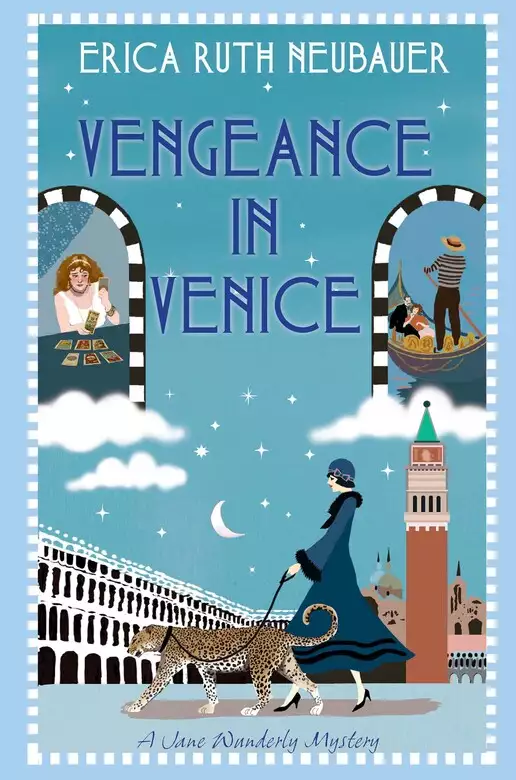
At long last, Jane and Redvers have arrived in Venice, the famed city of love, for their honeymoon. But behind a mask at a costume ball on the Grand Canal hides the gaze of a heartless killer…
Venice, 1927: As romantic as it is mysterious, the Floating City is a dream destination for the newlyweds, but they’ll soon discover the twisting canals hide more mystery than they expected. It begins when they are invited to an elaborate party at Clara Morton’s stunning palazzo on the Grand Canal. The affair is as eccentric as the hostess, who is dressed as Medusa, and features everything from snakes to her pet cheetah to tarot card readings.
The fete also features a fresh corpse—Clara’s ex-husband, found dead in the garden with marks around his neck. The hostess accuses the tarot card reader, who happens to be an acquaintance of Jane, claiming the woman foretold the death of someone close to her. Jane and Redvers come to the young woman’s aid as they learn she was far from the only partygoer with a motive. As the couple follows a labyrinthine trail of scandalous affairs, brazen blackmail, and people who are not who they say they are, they hope that Venice will disclose her secrets before they both end up in over their heads . . .
Release date:
March 31, 2026
Publisher:
Kensington Books
Print pages:
288
* BingeBooks earns revenue from qualifying purchases as an Amazon Associate as well as from other retail partners.
With a salt breeze ruffling my bobbed hair and a gondolier crooning in a language I didn’t understand as he piloted us toward a piazza where Redvers and I were about to have a quiet, romantic dinner, I was in heaven. I closed my eyes briefly, savoring the feeling.
“Is the singing too much?” Redvers whispered in my ear.
“No, I’m enjoying it,” I replied.
“Truly? Are you feeling quite well? Perhaps we should go back to the hotel so you can lie down.”
I gave him a little pinch on the leg, and he chuckled. I was relieved to hear the sound. After his near-death experience in India, my husband had been rather reserved. Instead of haring off on a new adventure, we’d spent the remaining spring and all of summer in a rented London flat recovering from the trip. Redvers had gone into an office every day and done some sort of desk work—pertaining to what, I had no idea. He didn’t talk about it, but after the first few weeks I did get the sense that he was bored. I busied myself with daily walks to discover new parts of London, and when that no longer held my interest, I started visiting the British Museum, wandering the halls and pestering the staff.
I was out of new things to discover there as well.
It had been a long summer. We hadn’t said as much out loud, but I suspected both of us were relieved to be out of London, even for a brief trip. Well, honeymoon, actually. We hadn’t taken a real honeymoon after our sudden wedding in Scotland, and we were making up for lost time now. My heart felt lighter than it had in some time. Perhaps when we returned to England, it would be time to pack our trunks and find a new adventure.
Our gondola came to a stop, and the boatman stopped his singing to announce that we had arrived. I’d rather been expecting one of the larger piazzas, but we seemed to be disembarking into nothing more than a tight alleyway, although I could see that the passage widened out slightly up ahead. Redvers paid the man, who tucked the money into his pocket, then indicated a small restaurant farther down the cobblestone alley. The sun had nearly disappeared behind the buildings, and the ancient passage looked deserted except for the brightly lit window our guide was pointing to. Redvers thanked him, and with a mutual shrug, we headed that way. We’d asked for a dining suggestion, and this was it.
As I was discovering about many things in Venice, from the outside the restaurant looked impossibly small, but once inside, we could see that the space was larger, if not taller—the ceiling was characteristically low, with thick wooden beams overhead. The restaurant was run by a local family, and the owner greeted us as though we were close relations when we stepped through the door. There were a handful of tables dotting the space, and we were ushered to one near the window and holding glasses of the house wine before we even knew what hit us. Redvers looked bemused, but I was utterly charmed and let the burly owner choose my dinner without reservation.
Redvers was more cautious, ordering a plate of linguine with scallops. He held his tongue until the owner bustled off. “You’re playing roulette with your dinner?” he asked. “You know they serve things—parts—that even I wouldn’t touch, don’t you?”
“That man clearly eats well,” I whispered quietly over the table. “I trust he knows what to feed me.” I paused. “Besides, you know I like to try the local cuisine, whatever that might entail.” Of course, even saying this, I was mentally crossing my fingers that my dinner wouldn’t entail a tongue or a liver. But Venice was known for its seafood, and I was hopeful that that was what I would get.
Redvers shook his head in mock horror. I acknowledged that I was taking a bit of a gamble, but I was also excited to see what was going to be brought to me. I was absolutely delighted with my choice when the proprietor set a plate with gorgeously cooked scallops on a bed of risotto in front of me. Redvers gave a grudging nod to the wisdom of my gamble and snuck a bite from my plate when he thought I wasn’t looking.
It was much later than we’d intended when we finally tore ourselves away from the trattoria, and the only reason we were allowed to leave was because we promised Pietro Sartori that we would return the following night. Stomachs full of wine and rich food and some panna cotta for dessert, not to mention the after-dinner limoncello, we waddled back into the alley.
I groaned and patted my stomach. “How will we get back to our hotel?”
Redvers had a hand on his own full stomach. “I think we should walk it off.”
I nodded. This was an excellent suggestion.
Venice was a magical city, floating on top of the very sea itself. There were no cars on the streets, since there were very few streets—only canals, winding between the stone houses built on top of a series of low-lying marshes and islands. The entire city felt precarious, not to mention nearly impossible to navigate in order to find our hotel—the gondola had taken so many twists and turns to get us to where we were, I didn’t have any faith we’d be able to find our way back.
But I trusted my husband. He had an unerring sense of direction, and while mine was good, his was better. Walking hand in hand, he led us over little bridges and through tiny winding alleyways until we were once more in front of our hotel.
“Lovely,” I said on a sigh. I’d enjoyed the walk, not only because I’d had the chance to work off some of the heavy meal but because I’d been able to take in more of the city. We’d only arrived that morning, and I wanted to soak up as much of Venice as I could before we returned to London the following week. Around nearly every corner it seemed there was yet another beautiful view, another enchanting surprise.
The hotel Redvers had chosen for us was itself romantic, designed and decorated in an oriental fashion, although the architectural flourishes very much reminded me of the Mena House hotel in Egypt, where we first met. The hotel was located in a fifteenth-century Venetian palazzo that had been converted into a hotel, overlooking the Canale della Sensa. It was a rather residential area otherwise, quiet and tucked back from the more bustling parts of the city, and an ideal spot to enjoy a honeymoon.
We were heading up the marble stairs to our room when the booming voice of a disgruntled vacationer echoed up to us from the lobby, where the front desk was located.
“This hotel is impossible to get to. It’s the third one we’ve stopped at this evening trying to get here. I don’t know why you don’t give better directions to patrons when they book a room with you.” The owner of the strident voice sniffed in a way that was all too familiar.
I stopped dead in my tracks on the landing between flights of stairs. “No,” I said quietly. Redvers turned and looked at me curiously. He clearly hadn’t been paying attention, or he would share my concern. “No, it can’t be.”
The voice continued, louder than before, if that were possible. “I have half a mind to try to book a room somewhere better, the Ritz perhaps, but it’s late and I’m exhausted, and I simply want to retire to my room.”
“There isn’t a Ritz in Venezia, madam.”
As though in a dream—or perhaps more accurately, a nightmare—I headed back down the stairs, turning at the bottom landing toward the lobby. The owner of the voice had continued her list of complaints, but I’d already tuned them out. I came around the corner and stopped in my tracks.
Sure enough, the owner of the voice was none other than Aunt Millie.
Redvers joined me, and I socked his arm. “Did you tell her where we were?” Millie hadn’t noticed us yet, and I was already considering whether we could escape upstairs before we were noticed.
He shook his head, clearly handling this news better than I was, the corners of his mouth tipping up slightly. I wasn’t sure if that was due to my distress at finding my aunt intruding on our honeymoon or just general amusement at the situation.
My aunt’s husband, Lord Hughes, caught sight of us and gave a little wave. I sighed—we’d been spotted. We returned his gesture and moved forward, my hopes for disappearing up the stairs, and possibly absconding from the city altogether, completely dashed.
“Jane, why didn’t you choose a larger hotel? One with better service?” Millie asked as soon as she turned her head and spotted us.
“Because this hotel is perfectly lovely, as are the staff.” I gave the desk clerk a sympathetic look and made a mental note to send Redvers down later with a generous tip for the young man’s trouble.
Or perhaps I should say, for Millie’s trouble.
Redvers gave my aunt a winning smile. “It’s much quieter here at night than at the hotels on the Grand Canal. Less boat traffic at night, not to mention the revelers.”
Millie narrowed her eyes at my husband but after a beat gave a stiff nod. She had a key in hand, and after a few more mutterings, she finally stepped away from the desk and the poor clerk behind it.
“How did you find us?” I asked, trying to keep my voice mild.
“Your aunts mentioned where you were traveling to.” Millie addressed this to Redvers, then turned her sharp eyes on me. “Marie and Carolyn, you remember them, Jane. They didn’t know what hotel you were staying at, however. I had to learn that information from your father.” Millie’s voice was as accusing as her glare, but Redvers’ pleasant demeanor never changed, not even when her glare was turned back to him at the mention of his father. I never understood how he managed it under her formidable mien.
I closed my eyes briefly. “Did they also mention that we are on our honeymoon?” I asked, doing my best to keep my voice level. This time I was the one who got a sympathetic look from Lord Hughes.
“Nonsense,” Millie said. “You’ve been gallivanting around the world since your wedding. Which you failed to invite us to, I might remind you.”
The wedding had been Redvers’ idea, and one I was beginning to believe we would never live down. Nearly seven months later, and we were still being scolded for having a quiet ceremony in Scotland instead of the big to-do that Millie had been planning for us.
Millie’s diatribe continued, but I had already tuned out. She finally stopped and huffed. “I’m tired, so we will retire. But I’ll come to your room in the morning to give you your costumes.”
I did a double take. “I’m sorry, what costumes? And what are they for?”
Millie huffed again, this time with exaggerated annoyance. “For the party we will all be attending tomorrow night. I swear, Jane, I sometimes wonder about your hearing. Or your memory. Before you know it, you’ll be just like your father.”
“Mmm,” I said, deciding to let that go by without comment. “Well, I suppose we will see you in the morning, then.”
Since it appeared we didn’t have any other choice.
True to her word, Aunt Millie was knocking on our door while we were still enjoying breakfast on our tiny patio overlooking the canal.
“At least you’re dressed,” Millie said to me when I opened the door. She had two hangers covered by garment bags draped over her arm. I was a little afraid to see what was inside them.
“Who is throwing this party we are attending?” I asked as she swept past me into the small sitting room. I had gone back and forth about whether to argue with my aunt about even attending said party, but in the end Redvers and I had decided it was best to simply give in, especially since she’d come prepared with costumes for the two of us. I would already be hearing about our wedding until I was in the grave—there was no sense in giving Millie something else to harangue us about.
Besides, we’d made a pact the night before to show up to the party for only an hour and then make our escape. With any luck there would be enough people in attendance that Millie wouldn’t notice our sudden absence.
“She’s an American heiress,” Millie replied. “Sole heir to the largest salt company in the United States, and possibly the world.”
I waited for a beat while Millie draped the costumes over the back of a chair, but no other information seemed to be forthcoming. “What’s her name? Why is she here?”
“I can’t believe you haven’t heard of her, Jane,” Millie scolded. “She’s Clara Ann Morton, heir to her family’s extensive fortune. Salt is a big business, you know.”
I didn’t know, but I kept that to myself. Redvers had stood up from his chair on the balcony and was now leaning casually in the doorway sipping his coffee. His dark eyes looked entirely amused.
“And why is she here?” I asked. “How do you know her?” My aunt was well-off, but she was far from the lofty status of heiress, even now that she’d married Lord Hughes, who was quite wealthy in his own right. I had no earthly idea how this salt baroness and my aunt might have met. It was even more incredible to me that the two had hit it off, since it seemed unlikely that Clara would have invited Millie and her entourage to a party if they hadn’t.
“I explained all this in my letter,” Millie said with no small amount of aggravation. “As well as explaining that I would be bringing the costumes.”
I hadn’t received such a letter. Helpless, I looked to Redvers, who suddenly looked rather sheepish. I raised an eyebrow and he gave a small shrug. With a sigh, I turned back to Millie.
“I guess I’m just forgetful these days.” There was no sense in blaming my husband. She would only find a way to turn it around on me anyhow.
She eyed me up and down. “You aren’t pregnant, are you? At your age, it would be quite a risk. I wouldn’t advise it, although it is a shame for your father’s sake.”
I needed to shut down this area of discussion. Fast. “No, I’m certainly not. Thank you for inquiring. What will we be going as this evening? I’m sure your own costume will be quite spectacular.”
Redvers was now covering his mouth with one hand, clearly trying not to laugh. It was sometimes maddening how much he was able to get away with—if I so much as giggled, Millie would catch me and demand to know what was so funny.
Millie huffed, but my distraction worked, since she pulled up one of the plastic bags to reveal a Renaissance dress in thick burgundy elaborately embroidered with silver thread. I made appropriately appreciative noises, and she showed us the other costume as well. “This one is for you, Redvers.”
Millie lifted the sheath to show us what appeared to be a naval captain’s outfit. I was quite curious about the type of party we would be attending, but it seemed that was all I was going to learn before we arrived, because Millie was suddenly ready to leave. “I must dash. James has a gondola waiting for me. Be ready at eight this evening. Eight sharp, Jane. I mean it.”
She was gone before I had the chance to argue with her that I was actually quite punctual as a habit.
“You’re a great deal of help,” I said to Redvers, although my tone was teasing. I pushed past him to the balcony where I resettled myself in my seat and took a long sip of coffee. Italians loved espresso, but Redvers had managed to wrangle a pot of American-style coffee for me, and I was going to enjoy it down to the very last drop, even though it had gone cold.
“I am, actually.” Redvers took his own seat, eyes dancing. “And what shall we do with ourselves today before eight this evening? Eight sharp.”
I threw a napkin at him, which was unfortunately caught in a salty breeze and danced past my husband and into the murky canal below us. I gazed down at it and sighed. “It looks as though I’ll have to keep projectiles to myself.”
Redvers chuckled. “Things really are working in my favor here in Venice.”
We could not have known that wouldn’t be the case for the rest of our trip.
After breakfast we spent a lovely morning wandering around Venice at a leisurely pace, taking in the popular sights and stopping now and again to pop into the various shops tucked around every corner. Our first stop was St. Mark’s Basilica or, as the Italians called it, Basilica San Marco. The large piazza that the basilica was located on was dominated by both the church itself and the former Doge’s Palace that stretched out in a long colonnade to the side and end of it. With similar buildings holding up the other side, the piazza felt like it was sitting inside a beautifully decorated rectangle with the basilica at the head of it. It was quite a large palazzo, considering how the city was essentially built on top of wooden logs, and I marveled at what must have gone into the construction of these hulking buildings. The front of the basilica was fascinating to me, decorated in various colors and shades of marble. It looked to be a hodgepodge of materials and carvings, and I enjoyed the overall effect, as well as the numerous onion domes on top. It meant that the building was a little unusual in addition to being stunning, as was the interior, which we meandered through, enjoying the intensely gilded gold ceilings.
“That’s quite a lot of gold,” I whispered to my husband, staring up at a religious mosaic nearly lost in the sea of shimmering gold.
“I cannot disagree,” Redvers said quietly.
Once finished inside, we went back out, and decided to climb the St. Mark’s Bell Tower, the Campanile di San Marco.
As we puffed up the numerous stairs leading to the top, my husband shared his bit of knowledge about the building. “It has been struck by lightning numerous times,” he said, pausing on a landing for a quick breath. “It was recently rebuilt in about 1910 or so, and is the tallest building in Venice.”
“I’m glad for that,” I managed to mutter. “I’m not going up another one.” We were nearly at the top, and I was rethinking my choice to climb the thing in the first place, but once we reached the final set of stairs, I was glad we’d made the effort. The city with its terracotta red roofs and serpentine waterways stretched out around us, the skyline dotted with other church towers. When I glanced down, the people looked like a colony of ants on the piazza below us, hustling about. From our lofty position, it was quite obvious just how large the Doge’s Palace below us was, with its row of columns stretching its arms wide across the façade. Turning my attention back to the horizon, I could see a few nearby islands dotting the landscape with buildings of their own, and the intermittent boat traffic cruising between them and Venice. Redvers and I stayed there for a while, enjoying the views of the city from every side of the tower before making our way back down, spilling back into the piazza and the bustle of the city, ready to move on to the next attraction.
Before I knew it, it was time to head back to our hotel. I was disappointed we didn’t have time to have another dinner at Pietro’s restaurant, but I acknowledged that Redvers was correct—if we went there for dinner, there was zero chance we would be back to our hotel in time to meet my aunt and Lord Hughes. Pietro’s enthusiasm for food was infectious, and dining at his place would require several hours. Hours we didn’t have tonight. Instead, we would have some light snacks sent up from the hotel kitchen while we got dressed in our respective costumes. But I mentally promised myself—and Pietro—that we would dine there the following night.
I slid into my Renaissance dress, holding the front of the costume to my chest while Redvers tightened the laces at my back, not so tightly that I couldn’t breathe, but enough that it would stay put. The dress fit well, and I had to admit that my aunt had done a good job choosing for us. Redvers looked wonderful in his black suit with the matching tricorn hat and cape—he cut quite the dashing figure.
Lord Hughes and Millie were resplendent in their costumes, similar to my own Renaissance-themed costumes. Millie bustled us to the pier outside our hotel where a gondolier was already waiting for us. He held a lantern so that we could see while stepping into the boat—it was already quite dark, the moon playing peekaboo with heavy clouds and a light fog rolling in from the sea.
I had no idea how this boatman was expected to navigate the canals with such little visibility. But he was obviously quite experienced, swinging his heavy wooden oar with ease through the dark water, expertly ushering our gondola through the maze of narrow canals until we reached the Grand Canal. Here we joined a wide sea of crafts like our own, the gondoliers in their black-and-white striped tops occasionally calling to one another in Italian. The Grand Canal seemed to serve as a kind of Main Street, the primary thoroughfare through the city where gondolas dodged both each other and the larger boats that served as taxis, ferrying people from one stop to the next.
We continued on toward the edge of the city, where even the Grand Canal traffic began to thin out. I was tempted to ask where we were going, but I would only be scolded for my lack of patience. And it turned out to be unnecessary, since we got in line with a handful of other gondolas waiting to pull up to a decrepit building, its white marble face nearly lost in a sea of vines and ivy. Instead of matching the towering height of the neighboring buildings, this was hunkered low on the water, perhaps only two stories, if that. A series of arched windows, peeking from beneath their ivy curtain, along with carved marble lions marching along the foundation were the defining points of interest for the place.
Redver. . .
We hope you are enjoying the book so far. To continue reading...

 Please log in to recommend or discuss...
