
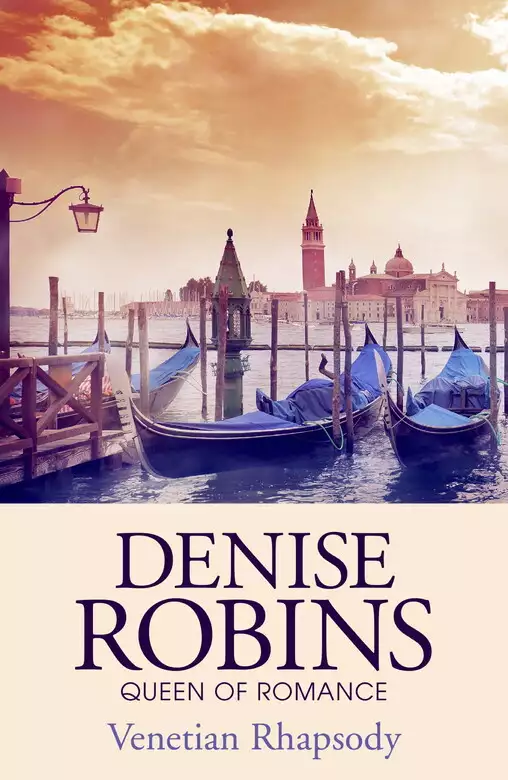
Venetian Rhapsody
- eBook
- Paperback
- Hardcover
- Book info
- Sample
- Media
- Author updates
- Lists
Synopsis
For Katherine, it was a fairy tale come true - being governess for the Marchesa's daughter in Venice, the most romantic city in the world. Even more thrilling, Katherine was falling in love with Renato, the Marchesa's son. Violante, the beautiful millionairess, wanted Renati tii - and she had a secret hold on him, for Renato's mother was gambling the family fortune away. If only Katherine could show him she had something more precious than wealth.
Release date: August 1, 1981
Publisher: Avon Books
Print pages: 400
* BingeBooks earns revenue from qualifying purchases as an Amazon Associate as well as from other retail partners.
Reader buzz
 Please log in to recommend or discuss...
Author updates
Venetian Rhapsody
Denise Robins
‘And this one is from the Ufficio Turismo—that means Official Tourist. It says: “Venice, a unique city of world-wide fame … of marble palaces, churches, Byzantine, Renaissance, lace-work of windows and colonnades … matchless and authentic marble and …”’
She was interrupted by an exclamation from her schoolboy brother:
‘Oh, golly!’ he said, and giggled.
But Katherine’s mother bit her lip and felt an absurd inclination to cry.
‘It does sound wonderful, doesn’t it, Kath? I’ve always longed to see Venice, but your father’—she gave a polite little cough and glanced at the grey-haired, mild-looking man who was half-buried behind the morning paper—‘never cared to go abroad. He said that England was good enough for him.’
Mr. Shaw had heard. His bespectacled eyes twinkled over the rim of the paper.
‘And I still think so, my dear. You can keep your Venice and all the glorious ruins. Take a look out of this window. Isn’t that good enough for you?’
‘Dear old British die-hard Daddy!’ laughed Katherine, but her cheeks remained pink with excitement as she sorted through the literature sent to her by the London Travel Agency. She knew that view from the window so well. It was a wonderful one. But Wonders can fade a little through habit and custom. She had lived here all her life. It was splendid enough. Towering cliffs, rocks glistening with wet, blue mussels, a long line of creamy Atlantic rollers breaking on the superb yellow sands. Dear little Mawgan Porth! Her father had worked in St. Columb as a doctor for many long years. He was still struggling, in his late fifties. And her mother, ten years younger, had worn herself out in the effort to bring up her children. There was Peter, aged fourteen, and David, twelve, and the youngest, barely ten, a girl named Veryan after the Cornish village in which her mother had been born.
Life in this little stucco red-roofed house on the cliffs had been a struggle for as long as Katherine could remember. Worse when Daddy had been in the R.A.M.C. during the war and Mummy had had to carry on alone. And for the last two years Mrs. Shaw had not been at all well, which worried Dr. Shaw and distressed Katherine. It was especially unfortunate because Katherine was not really domesticated. She was a scholar by nature. She had more of her father in her and was always to be found with her head buried in a book. She had also inherited from him those rather weak, but beautiful, grey eyes; needing glasses for close work. She had a particular passion for learning. As was to be expected, at school she had been what she herself called a ‘wash-out’ at games, but carried off all the prizes for history and English.
She had set her heart on a career. But now at twenty—she was still helping with the endless chores. Dr. Shaw was too busy and harassed to give much thought to Katherine’s personal ambitions. But the mother was not unaware of the many sacrifices her eldest girl had made; her unselfishness, her devotion to them all. She had lately become sharply aware that Katherine was undergoing a spiritual struggle—a longing to spread her wings and use that fine brain of hers which showed itself in all kinds of new ways. Sudden irritations with the younger children … fits of impatience … all the outward signs of an inner secret rebellion. But Constance Shaw had been rebelling too, in her quiet way. Determined that this quiet, clever, and thoroughly nice daughter of hers should not waste all her youth and gifts in Mawgan Porth. When she took pains with her appearance, who could be lovelier than their Katherine? Tall, like her father, with long straight legs and his fine-cut features, and her mother’s thick, burnt-gold hair with a deep wave in it. It was generally tied back severely with a ribbon to keep it out of her eyes. But she could look really wonderful when she tried. Veryan wasn’t going to be nearly as pretty. The boys were good-looking and, thank God, strong. Constance and Steven Shaw had a wonderful family.
Now, at last, Katherine’s big chance had come. Mrs. Shaw, as she heard the girl talking about Venice, rejoiced that she had never lost touch with her old school friend, Beatrice Crichton.
Constance and Beatrice had been at the same boarding-school. They had shared bedrooms, studies, pastimes, and struck up a friendship which was destined to last. Somewhat an incongruous one really, because Beatrice was the only child of wealthy parents, brought up by an ambitious mother to believe that the only thing that mattered was that she should make a brilliant marriage. The young Beatrice had been rather a haughty little girl, disliked by her companions. Constance, the antithesis; warm-hearted and cheerful, easy to get on with. And she had been quick to find there was a nice side to Beatrice, and befriended her. Long after Beatrice went abroad and made her ‘brilliant marriage’ she continued to write to her less-fortunate friend who had married a poor doctor.
Connie remained in Cornwall, Beatrice had become the Marchesa di Voccheroni, having netted one of the most illustrious titles in Italy. Whether or not she had found real happiness, Constance Shaw did not know. Beatrice had been too discontented by nature—ever seeking for more than she had. But she had sent her old friend, Connie, photographs of her magnificent Palazzo on the Grand Canal in Venice. And long letters describing the wonders of her handsome son, Renato, and her daughter, Bianca, who was Connie’s god-child.
Naturally as the years went by, correspondence grew less frequent between the old school friends. And during the war it stopped altogether. Then started again, in order to let Constance know that Beatrice and her family were reinstated in Venice, having spent the war years safe and sound in America.
After that came only spasmodic news. The latest news, a year ago, was that the old Marchese had died. Renato, the son and heir, who had been educated at Eton and Oxford, appeared to be leading the gay life of a typical wealthy Italian boy. Bianca was at a finishing school in Paris.
Then a wildly thrilling letter had come from Beatrice suggesting that Connie’s girl should go out to Venice and live with the family for awhile.
My Bianca’s English is so poor, Beatrice wrote. I want her taught properly. She is at an awkward age, seventeen. Too grown up for the school-room, yet not as old as I wish her to be when she takes her place in society here. As you may know we lead a very mondaine life and I am always enormously busy entertaining for Renato and his friends. He will, of course, make a brilliant marriage. But I want Bianca to have a companion and tutor for a year. If I remember right, your girl Katherine must be nearly of age. You’ve always said in all your letters that she is a good linguist and a nice clever girl. Send her to us, and I will of course pay all her expenses. Apart from her work here she will have a good time. She will relieve me of the tedious responsibility of amusing my teen-age Bianca and help to keep her out of mischief.
How Connie had smiled over that letter. Particularly the familiar words ‘brilliant marriage’. So like the old Beatrice. As ambitious for her son as her own parents had been for her.
At first Katherine had gone crazy with excitement over this letter, then shaken her head. She couldn’t go. She couldn’t leave Mummy and the family.
But this time Connie Shaw put down her foot. This was Katherine’s big chance. She was to take it. With what was perhaps the most superb gesture of her life, Constance proceeded to send a telegram accepting her old school friend’s offer.
And after that it didn’t take long to make Katherine agree. The girl was longing to go.
Winter still held Europe in the grip of ice and snow, but the Marchesa had said in her letter that Venice was quite lovely at this time of year. They had central heating in the palace—every modern comfort. As for clothes, the Marchesa could help Katherine in that respect. She must go to Venice as soon as she could. The Marchesa had a full social programme ahead of her and was longing to get Bianca settled. The real crux of the matter was the fact that Bianca had not been at all well lately. The poor child suffered from migraine and the doctor had advised that she should not return to her studies in Paris, but lead a less strenuous life in her own home.
Now all was settled. This was Saturday. On Monday Katherine was to fly to Milan; thence to Venice. In her imperious and not ungenerous fashion, Beatrice had already sent a cheque on her London bank to cover all the girl’s expenses. There had been a wild rush to the Newquay shops to get together a modest wardrobe for Katherine. She had nothing but ‘rags’ her mother had declared. She must not go out to the Voccheronis looking so shabby. This was where a little of the money that Dr. Shaw had put by for a rainy day should be drawn upon—for Katherine.
Katherine had sent for all these pamphlets from the tourist agency because she wanted to read all that she could get about the golden city of canals.
But now, suddenly, the keen scholar, and would-be traveller, was replaced by the affectionate young girl who just adored her parents and home.
‘Oh, darlings!’ she exclaimed, and her underlip quivered. ‘I’m going to send a wire and say I can’t go.’
Mrs. Shaw moved to her daughter’s side and put an arm around the slim, straight figure and smiled at the earnest, charming young face through the mist of her own tears.
‘Stop talking nonsense, darling, and slip upstairs and get on with your sorting and packing,’ she said.
Katherine flung her arms around her mother’s neck speechlessly, kissed her—and went.
AT TEN forty-five on the Monday morning, Katherine sat in the waiting-room at London Airport. Last night she had stayed with a cousin who had a flat in Kensington. The B.E.A. bus had brought her from the Terminus. There was a slight fog this November morning—enough to delay the take-off just a little. Over the tannoy it had just been announced that there would be no departures for another half an hour.
Katherine did not mind. And she had no nerves about flying, and fog. It was to be her first flight. She was inwardly seething with excitement. She listened enthralled as loud-speakers sonorously called each glamorous name:
‘Milan … Holland … Cairo. …’
It seemed a long cry now from Mawgan Porth.
Katherine looked unusually well-groomed in her new tweed suit, and the nicest, most expensive Jaegar overcoat she had ever had in her life. She had taken a little more care with her hair.
Two young men who were standing by the bookstall, lighting cigarettes, glanced in her direction. They had just driven up to the airport in an Aston Martin. It belonged to Richard Kerr-West, the elder of the two. He was saying:
‘She runs like a bird, doesn’t she, old boy? Sleekest thing I’ve had for years.’
‘Well, using the word “sleek”—what about those legs?’
Kerr-West looked at Katherine and shook his head.
‘Incurable, my dear Renato. I admit that she’s got beautiful legs. But the rest is not up to your standard.’
Thoughtfully, Renato di Voccheroni surveyed the young girl who seemed so engrossed in a book. She had no chic, of course, as compared with the exquisitely-dressed women of Italian society. The girl in the corner was English—a trifle bourgeois. But those legs were poems! Now, suddenly, as though a sixth sense told her that she was being criticized, Katherine raised her head.
‘Schoolmarm with glasses,’ whispered Richard. ‘You’re slipping, my lad.’
Katherine removed her glasses. Richard changed his mind, and Renato raised his brows. He was near enough to her to see the length of her eye-lashes and the extraordinary purity of her skin. The two men turned away.
‘Think again, buddy,’ said Renato lightly; ‘she’s “got something”.’ He spoke with a slight American drawl, and with no trace of an Italian accent.
‘I’ll hand it to you,’ said his friend, ‘and I see Venice on the label. You’re always lucky. Never without a companion. Is any girl safe with you?’
‘Mind you, I like them to be beautiful and responsive,’ laughed Renato.
‘And with a good bank balance,’ his friend reminded him. They laughed together.
Katherine listened to the laughter and looked at the backs of the two young men indifferently. They seemed to be sharing a good joke. The tall dark one with the bag was obviously the traveller being seen off by the one of shorter, sturdier build. He was extremely handsome, although not strictly Katherine’s type. If she had an ideal, she reflected, he would be essentially English, perhaps fair, and, of course, studious. As fond of books, of art, as herself.
The tall man looked anything but studious. And she didn’t much care for those brown suède shoes or that beautiful silk scarf—a little too beautiful, she decided. He also looked rather conceited, and had actually turned to glance back at her. Katherine primly lowered her gaze. But she was flattered, nevertheless.
Renato walked out to watch his friend drive off. He was devoted to old Dick. They had been at Oxford together. Dick had since become a barrister and was already working in London. Renato di Voccheroni had never known what it was to work, except to get his degree. But he had little ambition for a career. He was too fond of life as it could be lived by a rich young man—who, at the age of twenty-four, was head of an illustrious Venetian family.
He rode well to hounds. He was a skilled fencer. But his English blood frequently warred with the Italian strain in him.
Life so far for Renato had been merely a gay pursuit of pleasure. He was genuinely proud of his magnificent ancestral home. In Venice he had his own motor-boat. He owned a racing car. He could hunt and ride and shoot in Tuscany where they owned a delightful country house. He could come to England and behave like an Englishman when the fancy took him.
In spite of too much money and soft living he was fundamentally unspoiled. He had been exceedingly generous to Richard, whose people were unable to give him more than a meagre allowance. Now Richard had come into money—and was making it, but he could never forget Renato’s warm-hearted munificence. He really had an awfully nice side.
Richard was a bit worried at the moment because Renato’s English mother was as extravagant as her son, and the di Voccheroni fortune was dwindling rapidly. Renato had told Dick that it was essential that he should ‘marry money’. Richard himself, had every intention of marrying for love.
He knew that Renato was returning home to try and get himself into the frame of mind to propose marriage to one of the girls his mother had selected for him. The Contessa Violantè Chiago, the young and beautiful widow of one of the wealthiest industrialists in Italy, and an American girl, Hilary Drumann, were Renato’s latest girl-friends. But somehow Richard could not visualize him as the husband of a spoiled Roman beauty or as son-in-law of a corned-beef king.
Affectionately, Richard bade Renato good-bye and added with a mischievous twinkle:
‘Have a good flight—happy landings and all that, and I’ll lay ten to one you’ll be taking the little schoolmarm with the lovely legs out to dinner in Venice tonight.’
Renato laughed heartily and gripped his friend’s hand.
I accept the bet. You can pay me when you see me. Now I’ll see how quickly I can remove the horn-rimmed spectacles and bring a smile to the lovely lips. So long, old boy.’
Katherine looked up sharply from her book. She had heard her flight number being called over the tannoy.
Excitedly she sprang to her feet.
An attractive-looking air hostess piloted her to a window-seat. The rest of the seats filled up rapidly. Then, somewhat to her embarrassment, the tall young man wearing the expensive clothes, whom she had mentally labelled ‘film star’, dropped into the chair beside her.
The take-off thrilled Katherine so much that she took no further interest in him. She saw roof-tops below her at one moment, blank space the next. Then up, up, up, rocking through the clouds.
A pleasant voice from beside her said:
‘Well, that’s that. I’m always thankful once we’re airborne, aren’t you?’
Katherine turned now to her companion. At close quarters she saw that he had fine eyes, as grey as her own, and superb teeth that seemed very white in the tanned face. He looked as though he must have found some sunshine this winter.
He smiled at her with such a disarming friendliness that she had to smile back.
‘It’s my first flight,’ she said.
How amusing, thought Renato di Voccheroni. His shoulders touched hers. There wasn’t much room between these chairs. His gaze, so critical of feminine charm, could find no fault with her flawless skin.
Renato constituted himself her instructor—told her that she could now unfasten her safety-belt and offered her a cigarette which she refused. So she didn’t even smoke, he smiled to himself. And she asked for coffee when he suggested a stronger drink.
‘What, no vices?’
‘Oh yes, if I could afford it, I think travelling would be a vice with me. It’s so exciting.’
Renato, who had done too much of it, envied her.
Katherine did not really know how to stand up to all the charm that Renato so deliberately put over. During the three hours of that flight he seemed to take complete charge of her, whether she wanted it or not.
‘We must meet,’ said Renato gaily; ‘you must give me your address and, perhaps, allow me to show you Venice. I know it well enough. It is my home.’
This surprised her. What was an Englishman doing living in Venice?
She took off her glasses and regarded him a trifle severely. She decided that he wanted snubbing—he was much too self-confident. She was quite certain that he expected her to drop like a ripe plum into his lap and say: ‘Oh, how thrilling—I’d love you to show me Venice.’
But she said nothing. She would much rather visit all the places of interest in Venice alone, she decided, with her little handbook of information to help her.
Eventually Renato Voccheroni lapsed into silence. He was being forced, incredible though it seemed, to realize that he was getting nowhere with this grey-eyed, funny little thing in her awful suit. (What a laugh for Dick!) It was certainly not a walkover. He was a long way yet from taking her out to dinner.
She had returned to that book of hers. Renato had the most primitive desire to remove her glasses and kiss her on that beautifully-moulded, disapproving young mouth; he was positively intrigued. Why, she wouldn’t even give him her name.
He made one or two further attempts to engage her attention and failed, so buried himself moodily in a magazine. Just before they landed, he tried another line. Perhaps her violent interest in the countryside would conquer her. He heard her indrawn breath of delight when they first came down, broke through the clouds and she could discern the mighty city of Milan unfolding itself beneath her.
‘Oh, I believe I can see the cathedral!’ she exclaimed. He saw the colour sweep her face and throat and he thought:
‘This girl’s got something. I’d like to see her blush because of me. The cathedral, indeed! No girl with legs like her should go haywire at the sight of a cathedral—and scowl at me. It isn’t natural.’
He began to tell her about Milan. But she was still not taking much notice of him when they landed. She rejected his offer to drive her to Venice. She was going on by plane as arranged, she said.
Renato found himself reduced to an humiliating attempt to interest her in his car, since she made no response to him. He pointed to the big, powerful, yellow Alfa-Romeo beside which a green-liveried chauffeur with smart black gaiters stood waiting.
‘Won’t that tempt you? Do come along with me. I can show you the countryside.’
‘It’s terribly nice of you but I shall keep to my schedule, thanks,’ she said, and then gave quite a pleasant smile because she thought she was being rather too unfriendly. He had really been very nice to her and well … he was a heart-throb to look at!
Renato said: ‘Oh, well, as you wish. I’d like awfully to see you again, though. What about that address you promised me?’
‘Did I?’ Now her lips trembled into a smile and Renato Voccheroni, who had been ‘the great lover’ ever since he left Oxford, found himself absurdly elated because the ice had momentarily thawed.
‘Come on—tell!’ he pleaded.
She thought there could be no harm in letting him know her address. After all, he lived in Venice.
‘I am going to the Palazzo Voccheroni,’ she said.
Renato was staring at her incredulously.
‘The Palazzo di Voccheroni?’ he repeated. ‘But why … what for …?’ he broke off stupidly.
‘Why not?’ asked Katherine indignantly.
‘It happe. . .
We hope you are enjoying the book so far. To continue reading...
