1
CLARA
March 31
The thermostat is fucking with me. For months, the display has insisted that the conference room is a pleasant sixty-eight even though it feels more like the steam room in a Russian banya. I’ve only been in here ten minutes and sweat is already soaking my shirt. Today’s guest (beneficiary? panderer?) is an old friend of Teddy’s, a blond guy named Conrad Gaffney, and as he sets up his presentation, my brother leans over to ask me quietly whether I remembered to call down to facilities management about the furnace.
“Yes, of course I did,” I hiss. “I told you. They’re holding a grudge.”
“They’re not holding a grudge,” Teddy whispers back.
“They are. They’re trying to sweat us out. Like bedbugs.” At his skeptical look, I add, “You have to call down. They’ll listen to you.”
“They’ll listen to you, too. If you speak with authority.”
I want to roll my eyes, but that would be unprofessional, so I grit my teeth and flip to a new page of my legal pad. When Teddy told me he wanted me to take over as director of the Wieland Fund for Community Investment, I told him he was making a mistake. I can’t even keep a houseplant alive without our gardener’s help. It isn’t my fault Teddy decided to embarrass himself on the national stage with a run for a Senate seat and no longer has time for philanthropy. It maybe is my fault that a few weeks into this role, I accidentally started a feud with the facilities manager of the Brenner Science Center, where WFCI leases office space. Now here we are, five months later, hearing pitches in what has essentially become a sauna with whiteboards and task chairs.
At the front of the room, Conrad pulls up a deck so plain that at first I think he’s accidentally opened a PowerPoint template instead of his intended slideshow. He claps his hands once, like Gather ’round, even though it’s only Teddy and me in the room and we’re already seated. I roll my chair a few inches away from Teddy’s and assume a virtuous expression.
I’ve met Conrad before. His parents used to be summer people, and he was one of those interchangeable sailing-lessons kids who were always stumbling around the docks in orange life vests. Most summer kids vanished from our lives as soon as they aged out of family vacations, but Conrad and Teddy eventually ended up in the same class at Harvard, even roomed together a couple years. I think that’s why Teddy felt obligated to invite him to pitch WFCI, even though Conrad’s work experience is limited to a few failed crypto start-ups with names like Jaggr and PeskBall. He hasn’t grown up to be interesting. He has a firm handshake and a pseudo-hipster undercut. His hobbies are probably rock climbing and grilling meat. I’ve dated a thousand men like him, back when I still dated men.
Not that personal mediocrity automatically disqualifies him from receiving a grant. But if Teddy actually thought the project was a contender, he would have told me to bring in Allan, the chief scientific officer, and the rest of the team. He wouldn’t have scheduled this meeting on a weekend afternoon, right before the annual opening of Cicero’s Fish House. Teddy invited Conrad to pitch as a favor, and I’m pretending to have organized it, also as a favor. So the world goes round.
I do my best to pay attention. Conrad’s pitch is, essentially: National parks, digitized. He’s an avid rock climber (nailed it) and studied business and computer science at Harvard (I was wondering when he’d drop the H-bomb), and the combination of those interests led him to create an immersive virtual reality platform that people can use in their own homes to have the 3D experience of communing with nature. All they need is his company’s unique projector string and access to their library of simulations, and they can visit Yosemite while the pasta’s boiling on the stove. Because marveling at the Half Dome is everyone’s top priority when dinner’s running late.
“Can we see it in action?” Teddy asks.
“I’m not really set up to do that today,” Conrad says. None of these people ever say what they really mean, but I’m fluent in bullshit. He means the technology isn’t ready. “But soon.”
“Soon” in bullshit means maybe in, like, a decade. If we double their funding.
Conrad shows us an unimpressive prototype, a spool of cord that looks like cheap Christmas lights, and I doodle a fern leaf in the margins of my page. The loops make it look more like handwriting from afar. Teddy looks at me askance and I turn the leaf’s stem into the words patent pending.
When the presentation finally limps to an end and I shake Conrad’s hand goodbye, his grip is looser, his shoulders tighter. Somehow he’s sensed that it’s a wash.
“It’s a really neat project,” I say, trying to soften the awkwardness. “And it’s nice to meet you. I mean, see you again. It’s been a while.”
He returns the smile, slightly strained. He wants to get out of here as much as I do. “Nice to see you, too.”
As Teddy walks him to the elevator, I collapse back into the nearest chair. It’s hot as fuck. I peel my shirt away from where it’s stuck to my front and try to use it to fan myself, to no avail.
The screen has flipped back to its usual screensaver, a colorful topographic map of the island, a repeating WFCI logo in the background. I could draw the silhouette of this island in my sleep. It’s shaped almost like a circle, except that the sound runs right through the center, coming up from the south and going more than halfway across before ending abruptly, as if someone was sawing through flesh and stopped when their blade hit bone. So instead of a circle, the island is more like a hoofprint, a balsam leaf, its edges fringed with coves and inlets. Every Locust Harbor boutique sells a million souvenirs printed with that outline. Sweatshirts, dog tags, lampshades, throw pillows. The silhouette is cartoonish, cute, inviting.
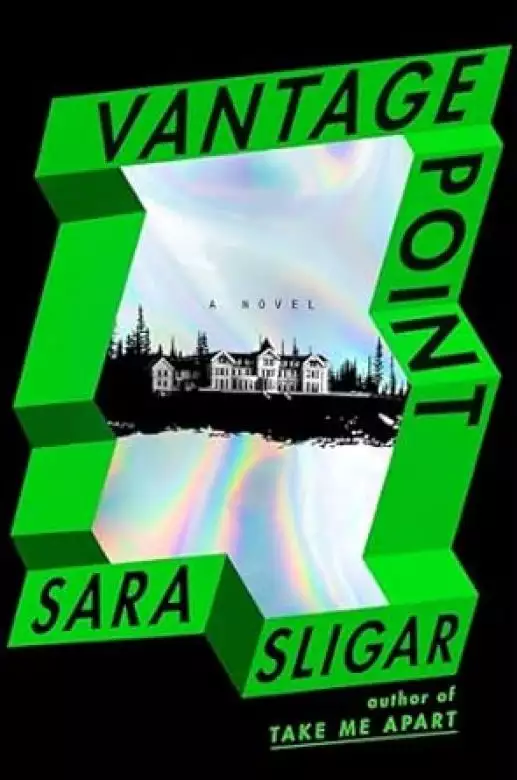
And misleading. Millions of years ago, glaciers formed this island, slowly scraping away at the granite, pressing down until it gave way. They left wreckage in their wake, gulches and cliffs, shorn rocks, mountains that jut from the sea. This place is the work of slow violence, and the topographic map shows those battles. Red claw marks where the mountains were dragged southward by melting ice. Marigold hills, yellow valleys. And at the southern end of the sound, where land and sea meet in noncommittal green, and the ground parts like a curtain onto open ocean, you can see the telltale protrusion of Vantage Point—our home.
Teddy comes back in and takes the seat next to me, a casual sprawl.
“Well?” I ask. “Do you think we should give him the grant?”
“What do you think? You’re the director now.”
“Ha.” But he waits for an answer. “I don’t know,” I hedge. “It doesn’t seem far enough along. And even if the technology was perfect, and he could actually create the feeling of visiting a place from inside the home, would that be good for the island? People wouldn’t come here anymore. And everyone would be out of a job.”
Teddy pretends to give me a noogie. “See? You’re good at this.”
“What, poking holes in people’s dreams?”
“Taking care of WFCI.”
I pull back and smooth down my hair. “I’m only here until you let me start a foundation for the study of British punk rock.”
Inside, I’m preening. It’s nice to joke around with Teddy again—we haven’t gotten a lot of one-on-one time the past couple months. It’s even nicer to know he thinks I can run WFCI; I’m helping him. He trusts me. I’ve been working a long time on that.
“Should I wait a few days to let Conrad know?” I ask. “So he thinks we debated it more?”
“No, I’ll tell him in person.”
“I don’t mind telling him, if you want to preserve your friendship or whatever.”
“Don’t worry. I’m going to say it was your idea anyway.”
“Ha, ha.”
Teddy messes with my hair again as he stands. “I’m going to grab my jacket out of my office—”
“My office.”
“Your office,” he corrects himself. “Then Cicero’s? I’m starving.”
2CLARA
March 31
Forget groundhogs, equinoxes, religious holidays. On our island, spring starts the day Cicero’s Fish House plugs in their deep fryer. By the time Teddy and I get there, the deck is packed. Half the draft beer list is already crossed out. Every available surface overflows with empty pitchers and crumpled napkins. Empty fish crates litter the side yard like hunks of marble.
Jess has claimed our usual table, but we’ve barely hugged hello before Teddy’s swarmed by a group of middle-aged men. Ernie Gluck wants to report Millie Powell for illegal clamming. Teddy tells him that’s a task for the island police. Max Lisle wants to ask when the town council will repaint the crosswalks in Locust Harbor. Teddy reminds him that he stepped down as mayor last month, so Max needs to talk to Dale Simonson. Joe Michaud, who owns the hardware store in Chaumont, wants Teddy to hire him to install security cameras around Vantage Point.
“As protection,” Joe explains.
“From what? I feel safe on this island. I feel secure.” Teddy grins. “Unless you know something I don’t.”
“Faded crosswalks are a safety threat,” Max says.
“So are clam poachers,” Ernie says.
“I don’t think cameras would help with either of those,” I point out.
Joe peers down the length of the table. “What do you think, Jess? How do you feel about some cameras around your place?”
Wedged up against the railing, she nods thoughtfully. “Your system definitely sounds top-of-the-line.” Jess is good at finding answers that satisfy everyone.
Sure enough, Joe raises his hands in triumph, even though she’s committed to nothing. “There you go, Teddy. Happy wife, happy life.”
Teddy shakes his head. Before he has to reply, a frazzled server arrives at the end of our table, struggling under the weight of an overloaded tray of food and beer.
“Here we go!” she announces, out of breath. My stomach goes tight. I didn’t even notice Teddy placing the order.
“Okay, that’s our cue.” Joe slaps the table and gets up. As he shepherds Max and Ernie away, he points a finger at Teddy. “But think about it, yeah?”
“Absolutely,” Teddy promises.
By the time the men have squeezed their way back into the crowd, the tray is wobbling in the server’s hands. When she tries to shift the weight to her left arm to distribute the food, beer sloshes at the pitcher’s lip. Teddy leaps up and takes the whole tray from her, moving it gallantly out of reach, so all she can do is stand there and wring her hands as he passes the baskets down to us. Cheeseburgers, lobster rolls, fries. Way too much food for three people.
“Thanks, Mr. Wieland,” she says, her tone a mixture of gratitude and embarrassment.
I recognize her now: Lisa Cicero, the owner’s daughter. Last time I saw her, she was in braces. Now the braces are off, and her hair is striped with box highlights. Under her jacket, she’s knotted her T-shirt at the waist to reveal a slice of stomach spotty with cold.
Jess gives her a warm smile. “Lisa, how are you? How’s school?”
Lisa wipes her forehead with the back of her arm. “Oh, it’s good. I mean, I’m taking this semester off. There was, um, an administrative issue? But I’m going back in the fall.”
“I bet your parents are glad you’re here to help out.”
“Yeah,” she says with wan enthusiasm. “Well, I’m looking forward to the May Day party.”
“Us too. We can’t wait,” Jess says.
The fries pass under my nose, golden-white, wilted with fat.
To Teddy, Lisa adds, “I’m excited about the primary, too. I registered just so I could vote for you.”
“Really? I’m honored.” He sets down the last basket with a flourish and hands back the empty tray, adding a wink for good measure. “Thanks for helping us out.”
She blushes and clutches the dull black circle to her stomach like a shield. “Sure. Let me know if you need anything else?”
When she’s scurried out of earshot, I lean over the table and whisper, “She looks so different! Last time I saw her, she was, like, twelve. Now she’s in college?”
“Was in college,” Teddy corrects. He removes a hamburger’s top bun and arranges the onion with military precision. “Sounds like she got suspended.”
“What are you talking about?” Jess asks.
“She said there was an ‘administrative issue.’”
“I think she meant a problem with the tuition.”
“She’d have said that.”
“Uh, no,” Jess says, “I don’t think she would have told the Wielands she couldn’t afford a semester of college.”
He shrugs. “If you say so.” As he lifts the burger to his mouth, he nods at me, then at the food baskets. “Want anything?” Trying to sound casual; failing.
“Maybe in a second,” I say in an equally pleasant voice.
“You need to eat something.”
My lips tighten. “I will.”
Jess tries to redirect us. “I don’t think security cameras are a bad idea,” she announces. “They could at least show us how the raccoons keep opening the latch on the trash can.”
Copyright © 2025 by Sara Sligar
We hope you are enjoying the book so far. To continue reading...
Copyright © 2026 All Rights Reserved

 Please log in to recommend or discuss...

